
 The Holiday Collection

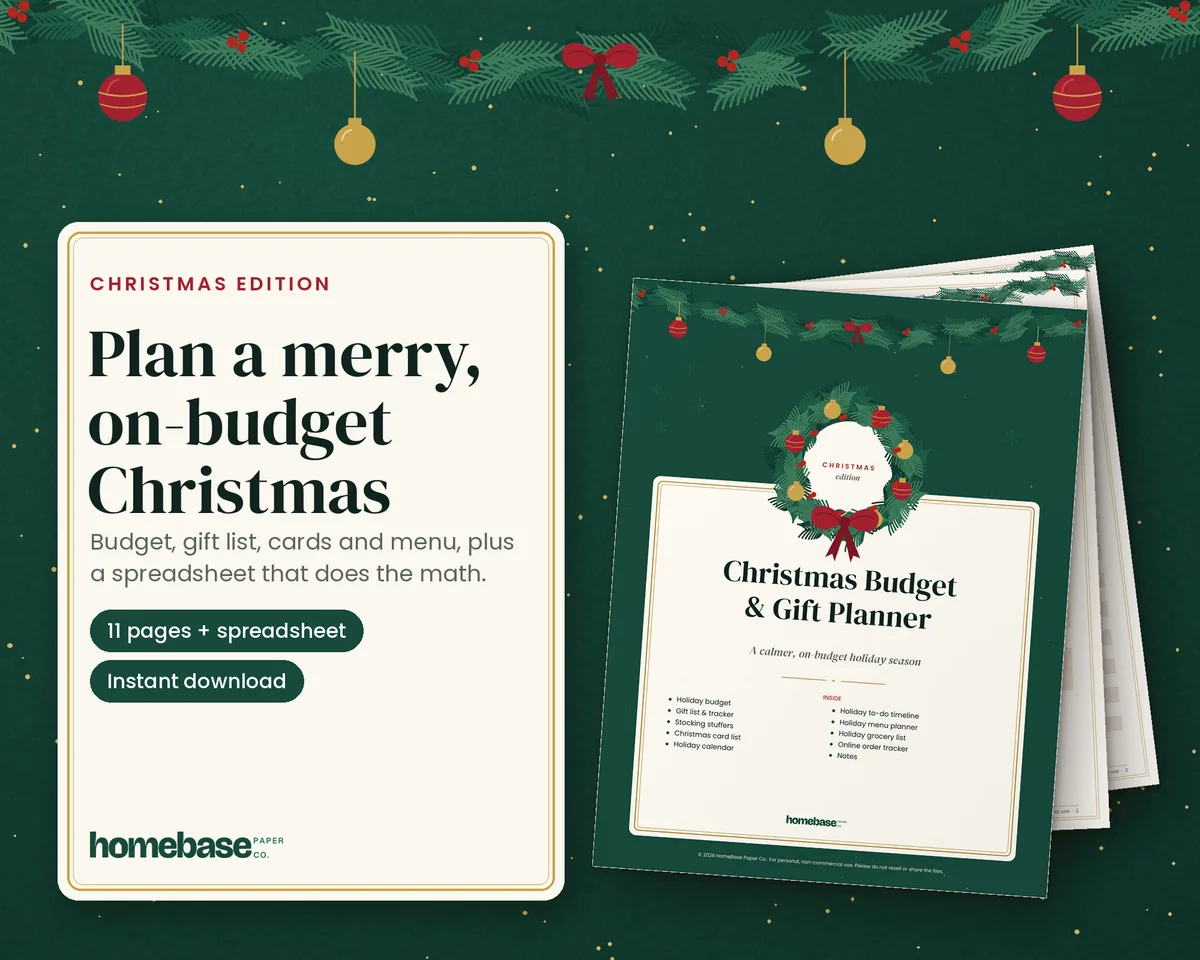
The short answer: to figure out how much to spend on Christmas, start with what your household can actually afford: holiday-season take-home pay minus must-pay expenses equals what's left. Keep a cushion, and the rest is your limit.
- A: holiday-season take-home pay (Nov–Dec), plus B: money already saved
- C: must-pay bills and essentials for those two months
- Your limit: what's left (A + B − C) minus the cushion you want to keep
- Budget from your lowest recent month, not your best one
- Free tool: the Christmas budget calculator does this math from your pay and bills, then splits the total into gifts, food and travel
- Next step: Plan it with the Christmas Budget & Gift Planner ($4.99).
Most Christmas budget advice starts with the gifts: how much per kid, how much per teacher, how much for the in-laws. That's useful, but it skips the most important question. How much can your household actually afford to spend this year?
Once you have a number, our Christmas budget planner printable and spreadsheet sets a budget per person, logs each purchase and shows what's left.
I've learned that a holiday number only works when it comes from your real paycheck. A number you borrowed from a friend, a TV segment or last year's credit card statement won't do the job. This guide walks you through setting a Christmas budget by income, step by step, with worksheets you can fill in tonight.
One quick note before we start: every dollar figure in this post is a made-up example to show the math. Your numbers are the only ones that matter.
Why set your Christmas budget by income?
When you build a holiday budget from the gift list up, the total tends to grow every time you remember another person. When you build it from your income down, you start with a ceiling and fit the list under it. The fitting part is a lot easier on your stress level, and on January.
An income-based budget also keeps things fair to future you. Your rent, car note, utilities and groceries don't take December off. Setting your limit from take-home pay makes sure those bills get covered first and Christmas gets what's truly left.
Find your total here first, then divide it up: the split by relationship further down shows how much to spend on Christmas gifts for each person, and our guide on how much to spend on Christmas per child goes deeper for kids.
Step 1: add up your take-home pay for the holiday season
Use take-home pay, the amount that actually lands in your account after taxes and deductions. Gross salary isn't money you can spend, so leave it out of this.
For most families, the holiday season runs from early November through the end of December. Count every paycheck you expect in that window.
What to include
- Regular paychecks for every working adult in the house
- Side income you can reasonably count on (be conservative)
- Child support or other regular deposits you receive
What to leave out (for now)
- A holiday bonus that hasn't been confirmed in writing
- Overtime you're hoping for but haven't been scheduled for
- Tax refunds, which won't arrive until next year
Example: A family expects four paychecks between November 1 and December 31, each $1,600 after deductions. Their holiday-season take-home pay is $6,400.
If your income changes from month to month, skip ahead to the section on irregular income below. There's a slightly different approach that protects you.
Step 2: subtract what has to be paid no matter what
Next, list every bill and expense due during the same window. Be honest here. This is where most holiday budgets go sideways.
- Rent or mortgage
- Utilities (heating costs can climb in winter, so look at last year's bills if you have them; here are ways to lower your heating bill)
- Car payment, insurance, gas
- Phone and internet
- Groceries and household basics
- Childcare, school costs and activity fees
- Minimum debt payments
- Any regular savings you don't want to pause
A bill tracker spreadsheet or monthly budget worksheet makes this part quick, especially if you already track due dates.
Example (continued): That same family adds up $5,700 in bills and essentials for November and December.
Step 3: find what's actually left
Here's the simple math:
Holiday-season take-home pay − must-pay expenses = what's left
Example (continued): $6,400 − $5,700 = $700 left over.
That leftover amount is the most you could put toward the holidays without borrowing. It is not automatically your budget. Most families want to keep a cushion for surprises, like a car repair or a sick day without pay.
Step 4: choose a method to set your limit
There's no official rule for what share of income should go to Christmas. Anyone who tells you there's one right percentage is guessing. Instead, pick the method below that fits your household.
Method 1: the leftover-with-a-cushion method
Take what's left from Step 3 and hold back part of it as a cushion. Whatever remains is your holiday limit.
Example: The family above decides to keep $200 as a buffer. Their holiday limit is $500.
This is the best method for tight months, because it never asks you to spend money that isn't there.
Method 2: the sinking fund method
If you've been setting money aside all year, or you're starting now for next year, your Christmas budget is simply whatever is in that fund. You spend the fund and nothing more.
Example: A family saved $40 a month for ten months. Their holiday limit is $400, plus anything extra they can add from Step 3 without touching their cushion.
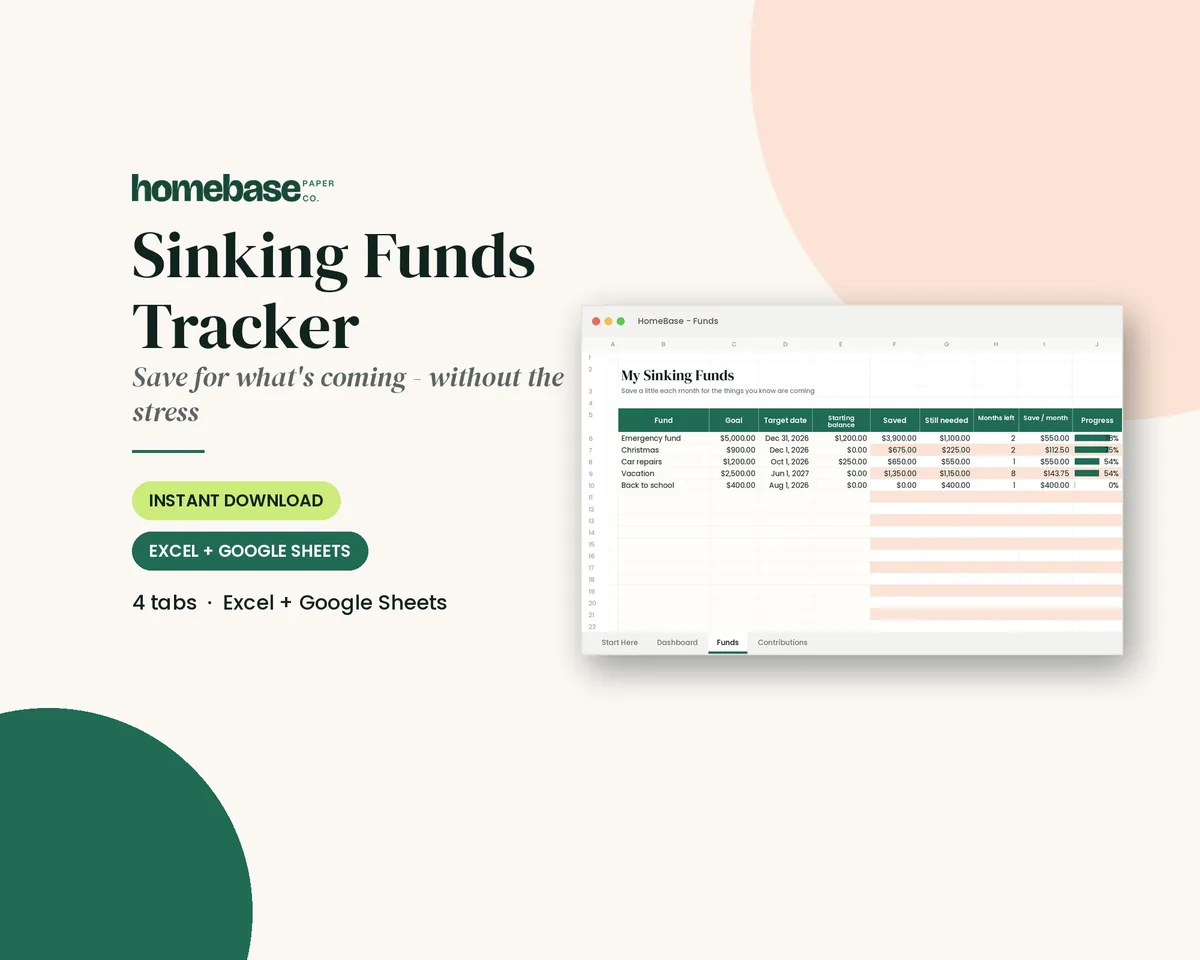
Our guides on sinking funds and saving money for Christmas walk through this in detail. The Sinking Funds Tracker Spreadsheet does the math for you as you go.
Method 3: the "one paycheck slice" method
Some families like to cap Christmas at a portion of a single paycheck or a single month's leftover money, so it never touches more than one pay period. This works well for households paid every week or every two weeks.
Example: A parent paid every two weeks decides Christmas can use $150 from each of the four November and December paychecks, for a total limit of $600, but only after bills for that pay period are covered.
If you budget by paycheck, our paycheck budget planner guide and the Paycheck Budget Spreadsheet are built for exactly this.
Christmas budget worksheet by income
Copy this into a notebook or the Free Holiday Budget Kit and fill in your own numbers.
| Line | Your number |
|---|---|
| A. Holiday-season take-home pay (Nov–Dec) | |
| B. Money already saved for Christmas | |
| C. Must-pay bills and essentials (Nov–Dec) | |
| D. What's left (A + B − C) | |
| E. Cushion you want to keep | |
| F. Your Christmas limit (D − E) |
If line D is zero or negative, that's not a failure. It's important information, and it means this year's plan should focus on low-cost and no-cost ideas. More on that below.
The same income can produce three different Christmas limits
An income percentage cannot show rent, dependents, medical bills or the money you have already saved. These illustrative two-month budgets use the same take-home income to show why the leftover calculation matters. They are not recommendations for what any income group should spend.
| November–December total | Household A | Household B | Household C |
|---|---|---|---|
| Take-home pay | $6,400 | $6,400 | $6,400 |
| Christmas savings already set aside | $0 | $300 | $0 |
| Bills, essentials and planned savings | $5,700 | $6,200 | $6,500 |
| Remaining before cushion | $700 | $500 | −$100 |
| Cushion protected | $200 | $200 | No spare cash |
| Maximum holiday allocation in this example | $500 | $300 | $0 |
Household B adds its existing Christmas fund only once. If that fund is already included in a bank balance used elsewhere in the calculation, do not add it again. Household C has a $100 gap before gifts; a percentage-based allowance would make that gap larger. Its next step is to reconcile essential costs and income before promising purchases.
Check the dates, not only the total
A season-wide surplus can hide a short week. Put every payday and bill due date on a calendar, then buy only from the money left after the bills due before the next payday. A December paycheck cannot pay for a November order unless the purchase is already covered by savings.
For example, a $500 holiday limit might be funded as $100 available now, $150 after the next paycheck and $250 in December. Those amounts total $500, but only the first $100 is ready today. Allocate the essential purchases to each funded period, and move an optional purchase later if a bill changes.
The CFPB's bill calendar is part of its Your Money, Your Goals toolkit for matching income and bills by date. Our guide to organizing bills can help you put the same information beside your holiday list. For other household budgeting methods, use the budgeting methods guide.
How to adjust for your income situation
Two families with the same paycheck can have very different Christmas budgets. Here's how to think about a few common situations.
If money is tight this year
Start with Method 1 and protect your cushion. Then lean on the gifts and traditions that cost little or nothing. Our guide to Christmas on a tight budget is full of ideas, and it's okay to talk with family about scaling back or skipping gifts. A smaller Christmas that's paid for usually feels better in January than a bigger one on a card.
If your income is steady but your bills are high
A good salary doesn't always mean a big holiday budget, especially with childcare, a mortgage or debt payments. Go by what's left in Step 3, not by what your income "should" allow.
If your income is irregular
Gig work, commission, tips, seasonal hours and self-employment all make holiday planning harder (our guide on how to budget with irregular income goes deeper). Two tips:
- Budget from your lowest recent month, not your best one. If a good month comes, the extra can go to savings or paying down anything you charged. If you work for yourself, a simple expense tracker for your business shows what you actually earned.
- Spend in order of importance. Buy the must-have gifts first, after a paycheck clears, and leave the nice-to-haves until you know what December really looks like.
If you're a single-income household
With one paycheck, a cushion matters even more, because there's no second income to absorb a surprise. Consider a slightly bigger buffer in Step 4 and a shorter gift list. For more on this topic, see our Christmas on a budget hub.
If you're expecting a holiday bonus
Wait until it's in your account before you spend it. Once it arrives, decide ahead of time how much goes to Christmas and how much goes to savings, debt or next year's sinking fund.
Dividing your total into categories
Once you have your limit, split it so gifts don't swallow everything. Common holiday categories include:
- Gifts for kids and immediate family
- Gifts for extended family and friends
- Teacher, coach and service-provider thank-yous (our holiday tipping guide can help)
- Holiday meals and baking
- Decorations
- Cards and postage
- Travel
- Activities and outings
How much to spend on Christmas gifts for each person
Once you know the gift line, split it by relationship. These shares are a starting point, not a rule:
| Who | Share of gift budget | Notes |
|---|---|---|
| Partner | 20 to 30% | Agree the number together |
| Children | 35 to 45% | Equal count matters as much as equal dollars |
| Parents and in-laws | 10 to 15% | Match both sides |
| Siblings and their families | 5 to 10% | Name draws help |
| Friends, coworkers, teachers | 5 to 10% | Small and consistent |
| Stockings | 5 to 10% | Often forgotten |
Three examples:
- $400 gift budget: partner $100, two kids $80 each, parents $50 split between both sides, siblings through a $20 name draw, friends and teachers $30 in total, stockings $40.
- $800 gift budget: partner $200, two kids $160 each, parents $50 per couple, siblings $60, friends and work $70, stockings $50.
- $1,500 gift budget: partner $300, three kids $180 each, parents $100 per couple, siblings $120, friends and work $140, stockings $200.
For kids, the number of gifts and fairness between siblings usually matter more than price; our guide on how much to spend on Christmas per child goes deeper. With a partner, agree a number together in November, since mismatched spending causes more hurt feelings than a small budget ever does.
Want the worksheet done for you? The free Christmas budget calculator runs the "what's left after bills" method from your own pay, with a cushion, and gives a limit per person. The holiday budget split calculator is a quick way to try different splits. Our full holiday budget guide covers each category in more depth.
When it's time to shop, the Christmas Budget & Gift Planner gives you per-person budgets, a purchase log and an online order tracker, so you can see at a glance whether you're still under your limit.
Watch out for borrowed Christmas money
The biggest risk to an income-based budget is spending money you haven't earned yet. Two common ways that happens:
- Credit cards. If you can't pay the full balance when the statement arrives, interest adds to the cost of every gift. The Consumer Financial Protection Bureau has a plain-language guide to how credit cards work.
- Buy now, pay later. These plans split a purchase into payments, and they can be easy to stack up during the holidays. The CFPB explains what a buy now, pay later loan is and what to check before you use one. Another option is layaway for Christmas, where the store holds the item while you pay it off.
If you do end up carrying a holiday balance, our holiday debt payoff guide can help you make a plan.
Make next year easier starting in January
The best time to set next year's Christmas budget is right after this one. Take your final holiday total, divide it by the number of months until next December, and set up that monthly transfer to a sinking fund. When the next season rolls around, Method 2 does all the work.
Our Ultimate Budget Bundle and Annual Budget Spreadsheet help you plan for Christmas as a regular yearly expense instead of a December surprise.
If you'd rather have a bank automate it, a Christmas club account moves a fixed amount into a separate savings account on a schedule and pays it out before the holidays.
Your next step
Grab your last two pay stubs and your bills list, and fill in the worksheet above. It takes about as long as a cup of coffee, and it gives you a number you can trust. Then download the Free Holiday Budget Kit or pick up the Christmas Budget & Gift Planner to keep your season on track, one paycheck at a time.
See also: teach kids to budget for gifts, holiday travel budget and unwanted gifts and gift cards.
For the national picture, see our holiday spending breakdown of how much Americans plan to spend on Christmas in 2026. Prefer apparel with the same energy? See our Christmas Budget? Never Heard of Her tee.

The Holiday Collection
Give every person a limit and watch what's left
The Christmas Budget & Gift Planner adds up every list for you: a budget for each person, a log of each purchase and the amount left to spend, plus printable gift, card, menu and to-do pages.
- Spreadsheet for Excel and Google Sheets
- 11 printable pages, US Letter + A4
- Instant download, 14-day fix-or-refund promise
Planning the whole season? See the holiday sets from $7, with early prices through Cyber Monday
Make it easier
Tools for this
Printables
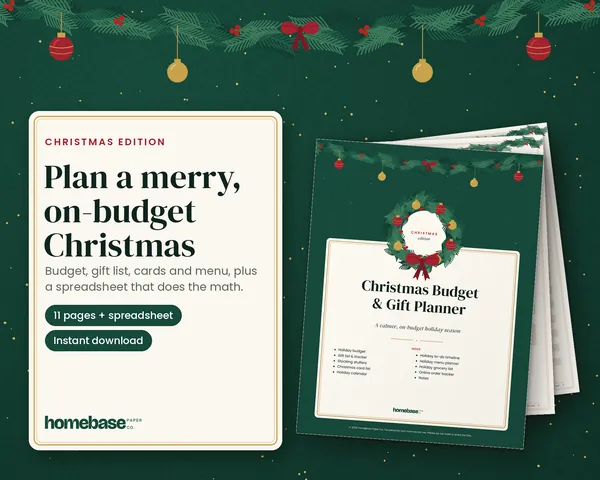
Christmas Budget & Gift Planner
Set a budget for every person, log each purchase, and watch what's left - plus printable gift, card, menu and to-do pages.

Spreadsheets
Sinking Funds Tracker
It does the math: how much to set aside each month to hit every goal on time.

Spreadsheets
Paycheck Budget Spreadsheet
Enter your bills once. The sheet tells you which paycheck pays each one, all year.
Frequently asked questions
What percentage of my income should I spend on Christmas? There isn't an official percentage, and a number that works for one family can hurt another. A more reliable way is to subtract your must-pay bills from your take-home pay for November and December, keep a cushion, and use what remains as your limit.
Should I use my gross or net income for my Christmas budget? Use your net income, also called take-home pay. That's the money you can actually spend after taxes, insurance and other deductions come out.
What if I have nothing left over after bills? Then this year's budget is your savings fund (if you have one) plus low-cost and no-cost ideas. Focus on traditions, homemade gifts and honest conversations with family. Starting a small monthly sinking fund in January can give you a real budget next year.
How do I set a Christmas budget with irregular income? Base your budget on your lowest recent month, not your best. Buy the most important gifts first, after paychecks clear, and wait on extras until you know how December's income turned out.
Is it okay to use a credit card for Christmas? It can be, if you already have the cash and you'll pay the full statement balance on time. If you'd need to carry a balance, the interest raises the real cost of everything you buy. The CFPB's credit card resources explain how that works.
How do I split my Christmas budget once I have a total? Divide it into categories such as gifts, food, decorations, cards, travel and thank-you gifts. Then set per-person amounts inside the gift category. The Free Holiday Budget Kit includes a budget page and a gift list with limits to make this easy.
How much should I spend on Christmas? Only what's left after this season's bills and savings come out of your take-home pay. Add up the paychecks before Christmas, subtract the must-pay bills and savings, then set your limit from what remains.
Can two households with the same income have different Christmas budgets? Two households with the same income can have different Christmas budgets because their essential bills, dependents, savings and existing holiday funds differ. Calculate the money available after those commitments instead of assigning a universal percentage of income. If the result is negative, there is no spare cash for gifts in that calculation.
More from HomeBase
You may also like
 Thanksgiving Edition
Printables
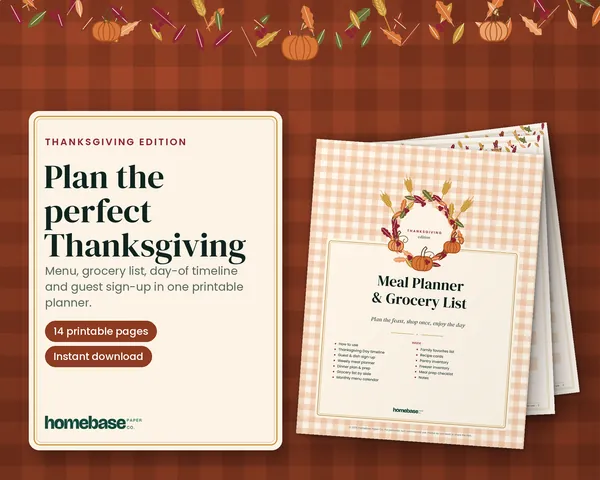
Meal Planner & Grocery List: Thanksgiving Edition
Plan the perfect Thanksgiving: our meal planner in a warm harvest design, with a Thanksgiving Day timeline, a guest & dish sign-up, an aisle-sorted grocery list and pantry and freezer trackers.
 Starter pick
Printables
100 Envelope Savings Challenge
Classic, half and 52-week challenges to print, plus a spreadsheet that tracks every envelope and tells you how much to save each week.
 Save 38%
Bundles
Holiday Season Bundle
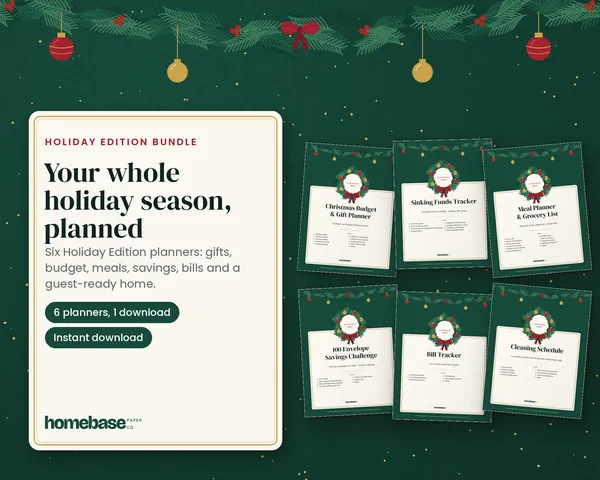
Plan Christmas, save for it all year, and host without the January money hangover.

Printables
Budget Planner Printable
Twelve undated pages you can print every month: budget, bills, spending, savings and debt.
 Club
Monthly club
Money Club
Anyone who wants a clear plan for the month's bills, holiday spending and savings.
Free printable
Get the free Holiday Budget Starter Kit
A one-page holiday budget, a gift list with a spending limit for every person, and a 6-week countdown so December stays calm and paid for. You'll also get our weekly HomeBase email with simple holiday planning, budgeting and hosting tips.

Sources
- Your Money, Your Goals toolkit (Consumer Financial Protection Bureau) consumerfinance.gov
- How credit cards work consumerfinance.gov
- What a buy now, pay later loan is consumerfinance.gov