
 The Holiday Collection

The short answer: there's no correct national number for how much to spend on Christmas per child. Start from the cash your household can spend this season, take out everything that isn't a kid's gift, hold back a small buffer and divide the rest fairly between the children.
- Take out first: food, travel, other people's gifts and the small per-child extras
- Buffer: hold back about 10%, then divide the rest evenly
- Inside each share: stockings get about 18%; split the rest between want, need, wear and read
- Pick one fairness rule (equal dollars, equal count or equal mix) and write it down before you shop
- Free tool: the Christmas spending per kid calculator splits your total per child, stocking share included
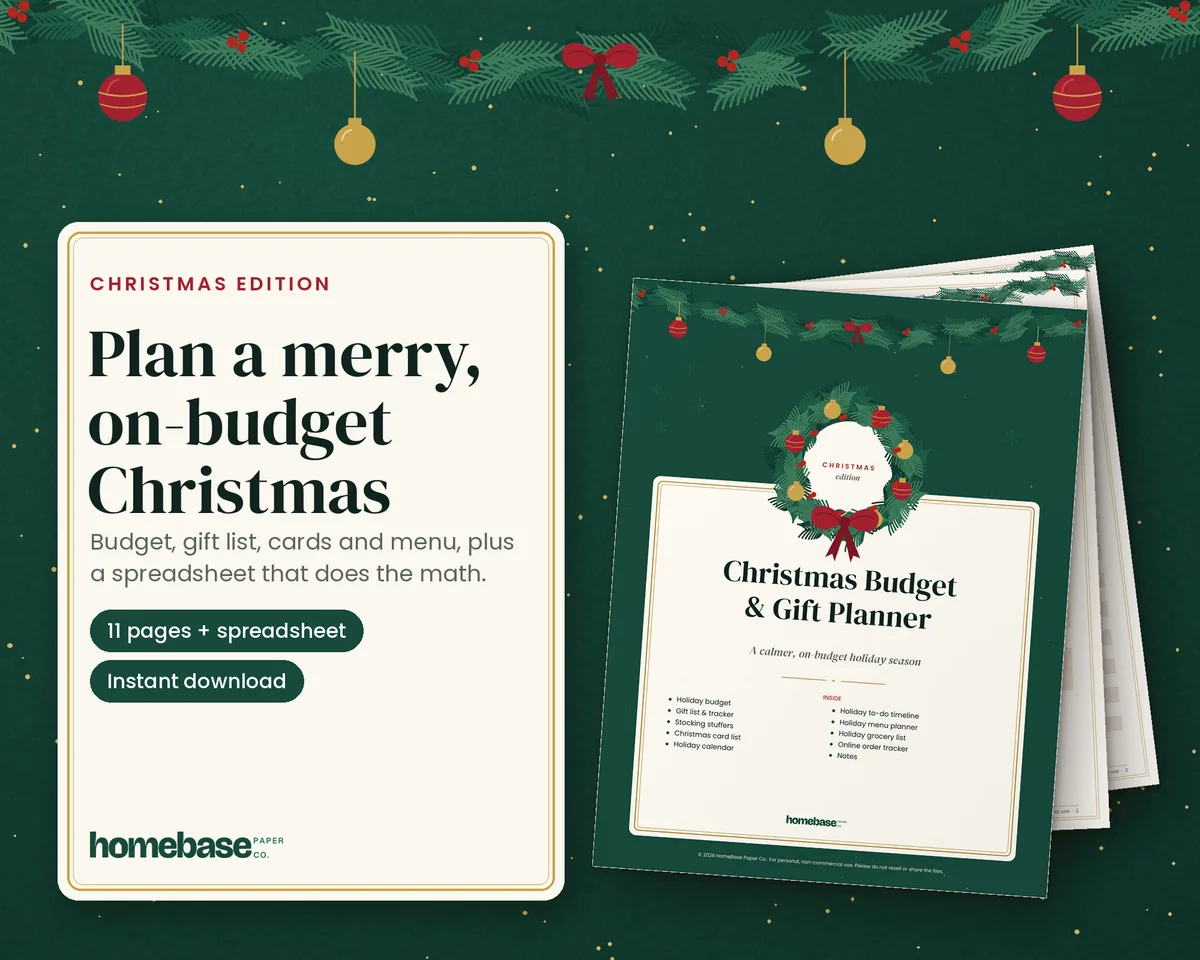
- Next step: Plan it with the Christmas Budget & Gift Planner ($4.99).
There's no correct national number for how much to spend on Christmas per child. The right amount is the cash your household can spend this season, minus everything that isn't a kid's gift, minus a small buffer, divided fairly between the children. Start from your total and work down to each child. Don't start from the wish lists and add up.
Use one number per child, a clear fairness rule for different ages and a payday plan before deciding on individual gifts. The examples below show how stockings and the four-gift rule can fit inside that number.
Key takeaways
- Set the season total first, then take out food, travel, other people's gifts and the small per-child extras.
- Hold back about 10% as a buffer, then divide the rest evenly.
- Inside each child's share, give stockings about 18% and split the rest between want, need, wear and read.
- Pick one fairness rule (equal dollars, equal count or equal mix) and write it down before you shop.
- Divide what you still need by the paydays left before your shopping cut-off.
Want the math done for you? The free Christmas spending per kid calculator runs this whole formula in about a minute. To track it as you shop, the Christmas Budget & Gift Planner ($4.99) gives every child a budget line and a running total.
How much to spend on Christmas per child: why averages don't help
Surveys publish an "average" holiday budget every year, but an average mixes households with very different incomes, family sizes and debts. It says nothing about what your own account can cover.
The National Retail Federation's 2026 holiday consumer survey, released October 20, focuses on how people plan to shop rather than headlining a per-person spending figure. Here's what it found:
- 56% of holiday shoppers say the state of the economy will affect their holiday spending plans.
- Among them, 43% plan to shop for sales more often, 31% will comparison shop online more often and 29% will use coupons more often.
- 43% of shoppers planned to start browsing and buying before November. Half of those early starters said they were doing it to spread out their budgets.
- 64% say they're likely to wait until Thanksgiving weekend to do most of their shopping.
So the useful question isn't "what does everyone else spend?" It's "what can we spend, and how do we split it fairly?"
Step 1: Set the season total in cash
Your season total is the money that will actually be available for Christmas:
- Anything already saved in a holiday or Christmas sinking fund
- What your November and December paychecks can spare after rent, utilities, groceries, debt payments and other regular bills
- Extra income you've already received, such as a bonus. Count it only once it's in your account.
Leave credit cards and buy now, pay later out of this number. If you don't have a total yet, the free Christmas budget calculator suggests one from your take-home pay and bills, and our guide to a Christmas budget by income walks through the reasoning.
Step 2: Take out everything that isn't a gift for the kids
Kids' gifts share the same money with everything else. Subtract these before you divide anything:
| Cost | What it usually includes |
|---|---|
| Food and hosting | Christmas dinner, baking, party dishes, extra groceries over the school break |
| Other people's gifts | Partner, grandparents, teachers, coaches, coworkers, exchanges |
| Travel and outings | Gas, flights, a night away, tickets to see the lights |
| Decorations and cards | Christmas tree costs, lights, wrapping paper, tape, postage |
Affiliate links: we may earn a small commission. As an Amazon Associate we earn from qualifying purchases. Details.
For the wrapping supplies line, check whether you already have tape and somewhere to keep the rolls. Scotch Magic Tape with a desktop dispenser and a Whitmor gift wrap storage organizer are optional supplies; count either purchase inside that line rather than the child's gift allowance.
The per-child extras most budgets miss
These costs scale with the number of kids, so they're easy to underestimate. Decide whether each one comes out of the kids' pool or the "other" money, and write it down either way:
- Batteries for toys that need them
- A gift from each child to their siblings or grandparents
- Class gift exchanges and holiday party contributions
- New pajamas or outfits for photos or a Christmas Eve box
- Gifts "from Santa" if that's part of your tradition (budget them as part of each child's share so they don't become a second Christmas)
What's left after Step 2 is your kids' gift pool.
Step 3: Hold back a buffer, then divide the pool evenly
Set aside about 10% of the pool before you split it. Prices change, a gift sells out, or a name gets added late, and the buffer absorbs it instead of your grocery money. Anything left over can start next year's fund.
Divide the rest evenly by the number of children. That's each child's share. (If you choose the equal-count or equal-mix rule below, this is still your average to check against.)
How to split each child's share: stocking plus the four-gift rule
A single per-child number is helpful, but it's easy for one big gift to swallow the whole share. Splitting the share into slots before you shop keeps the morning balanced. These are the same starting points our free calculator uses:
- Stocking: about 18% of the share. Take it out first so stocking stuffers don't quietly become extra spending.
- The rest goes to four gifts:
- Want: 40%. The thing at the top of their list.
- Need: 25%. Something practical they'd need anyway, like boots or a backpack.
- Wear: 20%. Clothes, pajamas or accessories.
- Read: 15%. A book, comic or magazine subscription.
A worked example
A family has a kids' gift pool of $600 for three children.
- Buffer (10%): $60, which leaves $540
- Each child's share: $540 ÷ 3 = $180
| Slot | Share of the $180 | Amount |
|---|---|---|
| Stocking | 18% | $32 |
| Want | 40% of the remaining $148 | $59 |
| Need | 25% of the remaining $148 | $37 |
| Wear | 20% of the remaining $148 | $30 |
| Read | 15% of the remaining $148 | $22 |
| Total | $180 |
Amounts are rounded. The percentages are a starting point: if a child needs nothing, move that money into want, and if you skip stockings, spread the $32 across the four gifts.
What $50, $100 or $200 per child could look like
These are sample spending caps, not survey averages or store-price quotes. Choose the total you can fund, then fit the gifts inside it. The four-gift split is optional; a child who wants one larger gift does not need four extra packages.
| Per-child cap | Stocking cap | Want | Need | Wear | Read | Total |
|---|---|---|---|---|---|---|
| $50 | $5 | $20 | $10 | $10 | $5 | $50 |
| $100 | $10 | $40 | $20 | $20 | $10 | $100 |
| $200 | $20 | $80 | $40 | $40 | $20 | $200 |
The stocking amounts here deliberately use 10%, rather than the calculator's 18% starting point, to show how a household can change the mix without changing the limit. Include sales tax, shipping and batteries within each slot. If a $20 want gift costs $23 delivered, its budget cost is $23; reduce another slot by $3 before buying.
For a $50 cap, the read gift could be a secondhand book and the want gift could be supplies for a favorite activity. Those are ideas to price locally, not promises that particular products cost the amounts shown. Borrowing books or writing an activity coupon can leave more of the cap for the gift the child values most.
Stop shopping when the share is spent
Keep three numbers for each child: limit, committed spending and amount left. Committed spending includes orders that have not arrived. Don't count a refund as available until it comes back, and don't put a returned gift on the "still need" list twice.
For example, with a $100 cap and $72 already ordered, only $28 remains. A new $35 idea needs either a cheaper substitute or a confirmed return; it does not create a $107 cap. Put new wish-list ideas on next year's list after the budget is used.
Use the Christmas shopping timeline to assign purchases to actual paydays. If you want to compare the planning formats before buying, the holiday planner collection keeps the HomeBase options together.
Keeping it fair when kids are different ages
Equal dollars don't always feel equal. A teenager's one gadget can cost more than a preschooler's entire pile, and the preschooler will mostly notice how many boxes there are. Choose one of these rules and use it for all the kids this year:
| Fairness rule | How it works | Works best when | Watch out for |
|---|---|---|---|
| Equal dollars | Every child gets the same share | Older kids compare, or you want the simplest tracking | Younger kids may get more boxes, which older kids notice |
| Equal count | Every child opens the same number of gifts | Kids are close in age | Costs drift apart, so track each child separately |
| Equal mix | Everyone gets want, need, wear, read and a stocking | Ages are far apart | It's easy to overspend on the want gift for the oldest |
Under any rule, keep each child on a separate list with their limit written at the top. That's how you notice in early December that one child has three gifts wrapped and another has none.
When one child's big wish costs more than their share
Say the oldest child in our example is a teen who really wants a $150 item, and their share is $180. You have three honest options:
- Make it the whole Christmas. Put most of the share into the want gift and keep the stocking small. Some older kids would rather have one thing they chose than several they didn't.
- Make it a family contribution. Count part of a grandparent's or other relative's gift toward it, if they offer.
- Look again. A previous model, an open-box item or a gently used one can bring the price inside the share.
If you buy secondhand for a younger child, check the item against the Consumer Product Safety Commission's recall list before you pay. The list updates weekly, and it regularly includes children's products. On October 22, 2026, for example, it listed light-up toys and costumes recalled because children could easily get to their button-cell batteries.
Talking about the number with older kids
You don't have to share your whole budget, but a simple frame like "We have $180 for your Christmas this year. What matters most to you?" turns a teen's wish list into a set of choices. Younger kids don't need numbers.
If you'd like a structure for those talks, the CFPB's Money as You Grow resource for parents and caregivers groups money activities by age, from young children to teens. Our guide to teaching kids to budget for Christmas gifts turns the same idea into an age-by-age gift project.
Coordinating with grandparents, relatives and a second household
Your pool only covers what you buy. Relatives can double the pile, so a little coordination helps:
- Send one short list per child. Include three to five ideas with rough prices, plus a note about what's already covered.
- Offer a bigger shared idea. One gift from several relatives, an outing, or a contribution toward the child's want gift can feel more meaningful than more toys.
- If kids split time between two homes, share the big-gift plan with the other household early so nobody buys the same thing twice. Each home sticks to its own budget.
A simple note works: "Thank you for thinking of the kids. Here are a few ideas for each of them. We've already got the bike covered, so anything on this list would be perfect."
If you've agreed to scale back gifts across the family this year, see how to tell family no gifts for kind ways to say it.
Turn the plan into a payday schedule
Once you know each child's share, check how much of it you still need to save. Pick a shopping cut-off date, such as December 18, then divide what's left by the paydays between now and then.
For an illustrative schedule with eight weekly or four biweekly paydays remaining:
| What you still need | Weekly pay (about 8 paydays) | Every two weeks (about 4 paydays) |
|---|---|---|
| $200 | $25 per payday | $50 per payday |
| $400 | $50 per payday | $100 per payday |
| $600 | $75 per payday | $150 per payday |
Count your own paydays on a calendar. The exact number depends on your pay schedule. Buy the want gifts first, as soon as the money is there, since popular items can sell out. Leave stocking items and the read gift for the last paychecks, because they're easy to find later.
For online orders, check each retailer's and carrier's holiday shipping deadlines, and set your cut-off a few days before them.
A note on buy now, pay later
Installments can look like they fit the plan. The Consumer Financial Protection Bureau explains that a buy now, pay later loan usually splits a purchase into four or fewer payments, and that most charge late fees for missed payments. Several plans with payments due in January can squeeze the month after Christmas. If you use one, make sure each installment is already covered by money you'll have on its due date. If you'd rather pay in installments without borrowing, Christmas layaway holds a gift while you pay it off before you take it home. For more on this topic, see our budget Christmas planning.
When the per-child number is small
A small number is still a plan, and it's a better one than a big number on a credit card. If the math leaves $40 or $50 per child, a few changes stretch it:
- Use the equal-mix rule with small slots. A $15 want, a $10 need, a $10 wear, a $5 read and a small stocking still add up to a full morning.
- Wrap the practical things. Pajamas, a toothbrush and school supplies you'd buy anyway feel like gifts on Christmas morning.
- Give one family gift. A board game or a day out can count toward everyone's share.
- Add experiences. A homemade gift coupon for a movie night, a baking afternoon or a sleepover with a friend costs little.
- Include a card. A short handwritten note to each child can make a simple gift feel personal.
Our guide to Christmas on a tight budget has more low-cost ideas, and our list of stocking stuffers has small, low-cost fillers that fit a stocking share.
Track every purchase as you go
Write things down as you buy them. Six weeks of "just one more thing" is how a $180 share becomes $260. Keep one list per child: the limit, what you've bought and what's left.
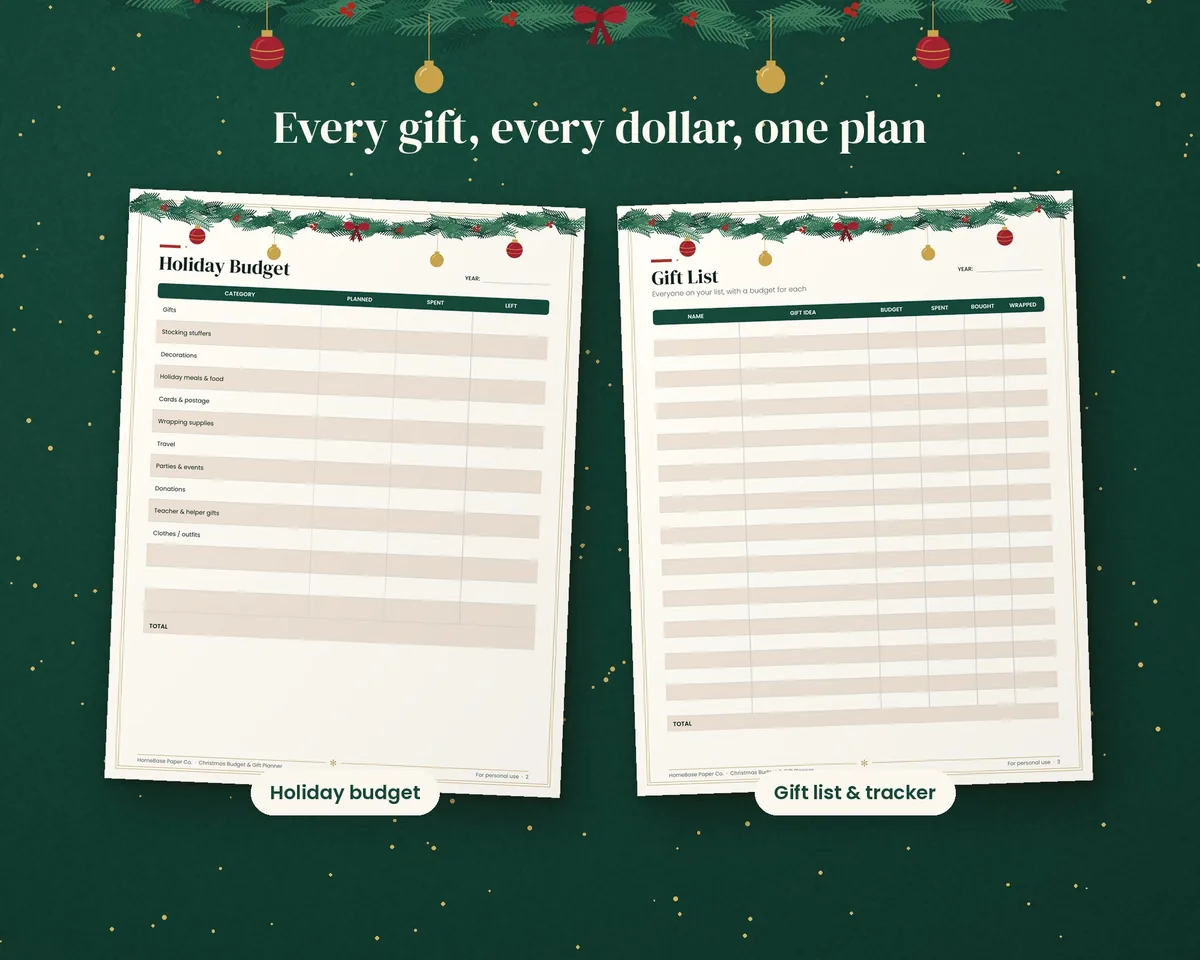
The Christmas Budget & Gift Planner ($4.99) has a holiday budget page, a gift list with a budget for each person, a stocking stuffers page and an online order tracker, plus a spreadsheet for Excel and Google Sheets that adds up each child's total for you. If you're hosting Thanksgiving too, the Holiday Quick-Start Pack ($7) pairs it with the Thanksgiving Edition meal planner.
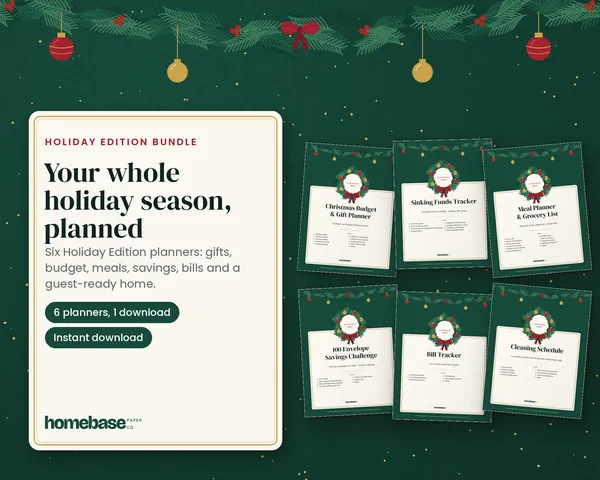
Planning the whole season? The Holiday Season Bundle ($15.99) includes the planner plus a Sinking Funds Tracker, Meal Planner & Grocery List, 100 Envelope Savings Challenge, Bill Tracker Printable and Cleaning Schedule.
Not ready to buy? The free Holiday Budget Starter Kit includes a one-page budget, a gift list with per-person limits and a six-week countdown.
Start next year's fund in January
When December is over, add up what you actually spent on each child and compare it with the share you planned. That's next year's starting point. Divide the total by 11 and save that amount each month from January, and next year's kids' gift pool is already waiting by December.
The Sinking Funds Tracker ($4.99) shows the monthly amount you need for each goal and tracks your progress. Our sinking funds guide explains the method step by step. For the full season plan, see how to make a holiday budget.
Planning for a newborn? See baby's first Christmas on a budget. Shopping for new parents? Our gifts for new parents list has useful picks, including a baby feeding log.
This guide is general education, not financial advice. Your situation is yours.
Deciding on a number of presents too? Here is how to choose how many Christmas gifts per child makes sense for your family.
For the bigger picture, see our cost of raising a child guide, which puts the USDA estimate at about $317,300 in today's dollars.

The Holiday Collection
Give every person a limit and watch what's left
The Christmas Budget & Gift Planner adds up every list for you: a budget for each person, a log of each purchase and the amount left to spend, plus printable gift, card, menu and to-do pages.
- Spreadsheet for Excel and Google Sheets
- 11 printable pages, US Letter + A4
- Instant download, 14-day fix-or-refund promise
Planning the whole season? See the holiday sets from $7, with early prices through Cyber Monday
Make it easier
Tools for this
Printables
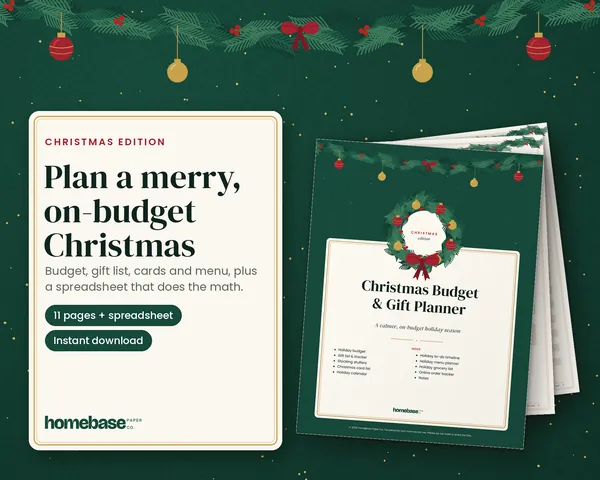
Christmas Budget & Gift Planner
Set a budget for every person, log each purchase, and watch what's left - plus printable gift, card, menu and to-do pages.
 Save 38%
Bundles
Holiday Season Bundle
Plan Christmas, save for it all year, and host without the January money hangover.

Spreadsheets
Sinking Funds Tracker
It does the math: how much to set aside each month to hit every goal on time.
Frequently asked questions
How much should I spend on Christmas per child? Hold back about 10% of your season budget as a buffer and divide what's left, after food, travel, other people's gifts and the small extras, evenly between the kids. There is no correct national number, so start with the cash your household can spend on the whole season. That per-child number fits your budget in a way an average never can.
Is it okay to spend different amounts on each child? Yes, as long as you choose the rule on purpose and keep it consistent. Some families match dollars, some match the number of gifts, and some give every child the same mix of gifts (want, need, wear, read and a stocking) even when the costs differ. Decide before you shop, and write the rule at the top of your gift list.
What is the four-gift rule for Christmas? The four-gift rule gives each child one gift they want, one they need, one to wear and one to read, and many parents add a stocking on top. It keeps the number of gifts reasonable and makes a per-child budget easy to follow: once you know each child's share, take out about 18% for the stocking and split the rest across the four slots, usually with the biggest part going to the want gift.
How much should a Christmas stocking cost? A useful starting point is 15% to 20% of each child's amount, taken out of their share rather than added on top. On a $180 share, that's about $27 to $36. If your family doesn't do stockings, put that money back into the gifts.
Should older kids get more expensive gifts? No, a bigger budget isn't required, even though their wish lists usually cost more. Under an equal-dollar rule, an older child can put most of their share into one item they really want, while a younger child gets more boxes for the same amount. Talking with an older child about the number often works better than guessing.
How do I stop relatives from overspending on my kids? Send one short list per child with a few ideas, rough prices and a note about what's already covered. Suggesting one shared gift, an outing or a contribution toward a bigger item gives generous relatives a way to give without doubling the pile.
Is buy now, pay later a good way to pay for Christmas gifts? Only if every installment is already covered by money you'll have on the due dates. The CFPB explains that BNPL loans usually split a purchase into four or fewer payments and that most charge late fees for missed payments. Several of them due in January can squeeze the month after Christmas.
Does the per-child Christmas budget include stockings and Santa gifts? A per-child Christmas budget should include stockings, Santa gifts and any shipping, tax or batteries for those gifts. Count those costs within the child’s share rather than treating them as a second allowance. Separate food, travel and adult gifts before calculating that share.
Is $50 enough for Christmas gifts per child? A $50 per-child Christmas budget can be a complete spending cap when that is what your household can afford. One sample split is $5 for a stocking, $20 for a want, $10 each for need and wear, and $5 for reading, including purchase extras. Those amounts are planning choices, not guaranteed product prices; fewer gifts or free activities can fit the same cap.
More from HomeBase
You may also like
 Thanksgiving Edition
Printables
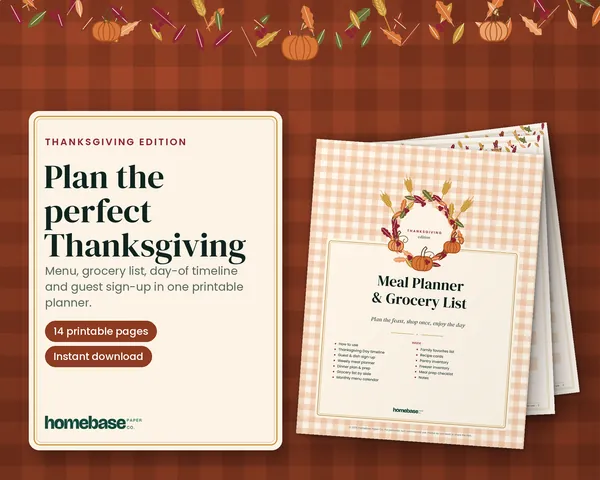
Meal Planner & Grocery List: Thanksgiving Edition
Plan the perfect Thanksgiving: our meal planner in a warm harvest design, with a Thanksgiving Day timeline, a guest & dish sign-up, an aisle-sorted grocery list and pantry and freezer trackers.
 Starter pick
Printables
100 Envelope Savings Challenge
Classic, half and 52-week challenges to print, plus a spreadsheet that tracks every envelope and tells you how much to save each week.

Printables
Budget Planner Printable
Twelve undated pages you can print every month: budget, bills, spending, savings and debt.
Printables
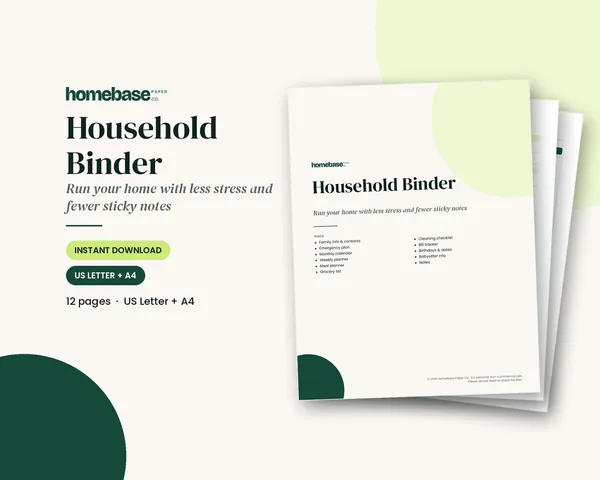
Household Binder
Family info, emergency plan, calendars, meals, groceries, cleaning, bills and sitter notes.
 Club
Monthly club
Money Club
Anyone who wants a clear plan for the month's bills, holiday spending and savings.
Free printable
Get the free Holiday Budget Starter Kit
A one-page holiday budget, a gift list with a spending limit for every person, and a 6-week countdown so December stays calm and paid for. You'll also get our weekly HomeBase email with simple holiday planning, budgeting and hosting tips.

Sources
- Money as You Grow (Consumer Financial Protection Bureau) consumerfinance.gov
- 2026 holiday consumer survey nrf.com
- Recall list cpsc.gov
- Buy now, pay later loan consumerfinance.gov