

The short answer: goal setting is deciding exactly what you want to achieve, by when, and what you'll do each week to get there. Choose one to three goals, make each specific and measurable with a deadline, and check progress on the same day every month.
- Break it down: year, quarter, month, this week
- If-then plan: for the moments you usually slip
- Monthly check-in: 15 minutes, same day each month
- Why goals fail: they're vague, there are too many, there's no first step or nobody checks
- Next step: Plan it with the Budget Planner Printable ($5.99).
Goal setting is the process of deciding exactly what you want to achieve, by when, and what you'll do each week to get there. The short version: choose one to three goals, make each one specific and measurable with a deadline, break it into monthly milestones and a first step you can take this week, write an "if-then" plan for the moments you usually slip, and check your progress on the same day every month.
That last part is where most goals are won or lost. Decades of research on goal setting point to the same few ingredients: a clear target, real commitment, regular feedback and a plan for when and where you'll act. This guide walks through each one, with examples for money, health, home, family and career, and free pages to help you keep going past February.
| Goal setting at a glance | |
|---|---|
| How many goals | 1 to 3 at a time per season |
| Best format | Specific, measurable, with a date (SMART) |
| Break it down | Year → quarter → month → this week |
| Daily tool | An "if-then" plan for the moment you act |
| Check-in | Same day each month, 15 minutes |
| Hardest part | Weeks 3 to 8, when motivation fades |
What is goal setting?
Goal setting means turning a wish ("I want to get in shape", "I need to save more") into a target you can measure and a plan you can follow. A goal has three parts: the result (what will be different), the measure (how you'll know you got there) and the deadline (when). Everything else, from vision boards to planners, is a tool for keeping those three parts in front of you.
Psychologists Edwin Locke and Gary Latham spent about 35 years studying how goals affect what people actually do. In their widely cited 2002 review in American Psychologist, they found that specific, challenging goals led to better performance than vague "do your best" goals, as long as people were committed to the goal and got feedback on their progress (Locke & Latham, 2002). Goals work, they explained, because they direct attention, increase effort, extend persistence and push people to look for better strategies.
In everyday terms: "save money" doesn't change your behavior. "Save $1,200 for a car repair fund by June 30 by moving $50 every payday" does.
Why goal setting matters (and why most goals fail)
Most goals don't fail because people are lazy. They fail for predictable reasons:
- They're vague. "Get organized" has no finish line, so you never feel progress.
- There are too many. Ten resolutions split your time, money and willpower ten ways.
- There's no first step. A big goal with no next action stays a wish.
- Nobody checks. Without feedback you can't tell whether you're on track until it's too late.
- Life gets in the way. A sick week or a surprise bill knocks the plan off course, and there's no plan B.
Each step below fixes one of those problems.
How to set goals in 7 steps
Step 1: Review where you are now
Before picking a goal, take 20 minutes to look back. What went well in the last year? What drained your time or money? Which goals from last year did you finish, and which quietly disappeared? Write three short lists: keep doing, stop doing and start doing. Your best goals usually come from the "start" and "stop" columns.
If money is part of the picture, pull your last three months of bank statements too. It's easier to set a savings goal when you know what you actually spend.
Step 2: Choose your life areas and pick one to three goals
Look at the main areas of your life and pick the ones that matter most right now:
- Money: emergency fund, debt payoff, a holiday fund, a budget you stick to
- Health: movement, sleep, cooking at home, a medical checkup you keep putting off
- Home: decluttering, a cleaning routine, a room project
- Family and relationships: weekly family dinner, date nights, calling a parent
- Career and learning: a certification, a raise, a new skill
- Personal: a hobby, reading, a trip, volunteering
Then choose one to three goals total for the next season. Every goal competes for the same hours, dollars and energy, so a short list gets more done than a long one. You can always add a new goal when one is done.
Step 3: Make each goal SMART
The SMART method is the most popular goal setting framework for a reason: it forces the clarity that Locke and Latham's research says matters most. A SMART goal is:
| Letter | Means | Question to ask | Example |
|---|---|---|---|
| S | Specific | What exactly will be different? | Build an emergency fund |
| M | Measurable | How will I know? | $1,000 in a separate savings account |
| A | Achievable | Can I do it with the time and money I have? | $42 per paycheck fits the budget |
| R | Relevant | Why does this matter to me now? | A car repair wiped out savings last year |
| T | Time-bound | By when? | By June 30 |
Put together: "Save $1,000 in a separate emergency fund by June 30 by moving $42 from each paycheck."
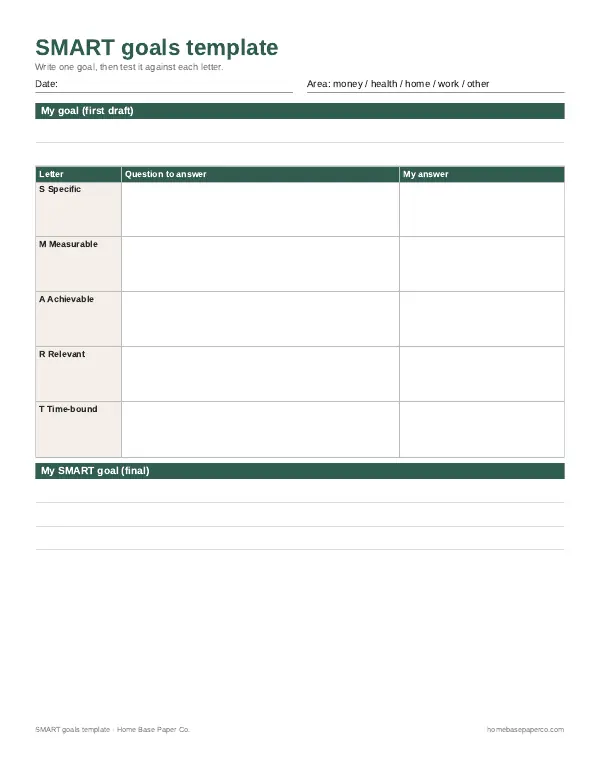
The Consumer Financial Protection Bureau's Your Money, Your Goals toolkit uses the same idea for money goals, pairing each goal with the specific steps and amounts needed to reach it (CFPB toolkit). Our free SMART goals template walks you through the five questions on one page.
Step 4: Break the goal into milestones
A one-year goal feels far away. Oregon State University's Academic Success Center recommends breaking a goal into smaller tasks, because finishing even small steps gives you a motivating sense of progress, and anticipating the obstacles you're likely to hit (Goal Setting 101). Break yours down until the next piece fits inside a week:
- Year goal: pay off a $3,600 credit card by December.
- Quarter milestones: $900 paid off by March, June, September and December.
- Monthly target: $300 a month.
- This week: call the card company about a lower rate and set up a $150 automatic payment on both paydays.
Milestones give you the regular feedback that keeps motivation alive. Hitting the March number is proof the plan works, and missing it is early enough to adjust. If you like working in shorter cycles, our guide to monthly goals shows how to pick and review one focus each month. For a project with overlapping steps, a gantt chart template puts every milestone on one timeline.
Step 5: Write an "if-then" plan
This is the step most goal setting guides skip, and it may be the most useful. Psychologist Peter Gollwitzer called them implementation intentions: plans in the form "If situation X happens, then I will do Y" (Gollwitzer, 1999). A later meta-analysis of 94 studies by Gollwitzer and Paschal Sheeran found that people who made these if-then plans were noticeably more likely to reach their goals than people who only set the goal (Gollwitzer & Sheeran, 2006).
The reason is simple: the plan decides for you ahead of time, so you don't have to rely on willpower in the moment. Examples:
- If it's Sunday after lunch, then I'll write next week's meal plan and grocery list.
- If I get paid, then I'll move $42 to savings before I pay anything else.
- If I'm tempted to order takeout on a weeknight, then I'll make the 15-minute backup meal on the fridge list.
- If I miss a workout, then I'll do a 10-minute walk that evening instead of skipping the day. For eating goals, a calorie tracker shows the daily pattern.
Write one or two if-then plans for each goal, especially for the moment you're most likely to slip. Oregon State's guide also points to the WOOP method (wish, outcome, obstacle, plan), which builds the same idea in: name the obstacle first, then plan your response.
Step 6: Put the goal where you'll see it
Out of sight really is out of mind. Write your goals on the first page of your planner, on a sticky note on the bathroom mirror, or on a vision board by the door. Add the deadline and the monthly number. If you use a phone calendar, schedule your monthly check-in as a recurring event.
Step 7: Track progress and review monthly
Pick one day each month, such as the first Sunday, and spend 15 minutes answering four questions:
- What did I finish this month?
- Am I on track for the next milestone?
- What got in the way?
- What's my first step for next month?
Progress you can see, such as a filled-in habit tracker, a debt balance going down or a savings bar going up, is the feedback that Locke and Latham found makes goals work. If you're behind, change the plan, not the goal: move the deadline, lower the monthly amount or remove an obstacle.
Types of goals
Knowing what kind of goal you're setting helps you plan it the right way.
- Outcome goals are the result you want: "lose 15 pounds", "pay off the car". They're motivating but not fully in your control.
- Process goals are the actions you'll repeat: "walk 30 minutes, five days a week", "cook dinner at home four nights a week". They're fully in your control, and they're what you actually do each day.
- Performance goals measure against your own past: "run a mile two minutes faster than in March".
- Short-term goals take days to a few months; long-term goals take a year or more. Long-term goals need short-term milestones, or they get pushed aside.
The best plans pair one outcome goal with one or two process goals. The outcome tells you where you're going; the process goal tells you what to do on a Tuesday.
For bigger, once-in-a-lifetime goals, our bucket list ideas include 80 ideas with rough costs and a plan to save for them.
Goal setting examples by life area
Use these as starting points. Change the numbers and dates to fit your life. For more on this topic, see our productivity planning hub.
Money goals
- Save $1,000 for emergencies by June 30 by moving $42 per paycheck.
- Pay off a $2,400 store card in 12 months with $200 monthly payments.
- Save $600 for Christmas by December 1 with $50 a month from January.
- Track every expense for 30 days, then write a budget for next month.
- Spend no more than $600 a month on groceries for three months.
For a full money-goals walkthrough, see how to set financial goals and our free savings goal tracker.
Health goals
- Walk 7,000 steps a day, five days a week, for eight weeks.
- Cook dinner at home four nights a week with a weekly meal plan.
- Be in bed by 10:30 p.m. on weeknights for a month.
- Schedule the annual checkup and dentist visit by March 31.
Home goals
- Declutter one drawer, shelf or closet every weekend until spring.
- Follow a 20-minute daily cleaning routine for 30 days.
- Finish the guest room makeover for under $300 by May.
Family goals
- Eat dinner together at the table four nights a week.
- Plan one free family outing every month.
- Set up a weekly chore chart so each child helps for 15 minutes a day.
Career and learning goals
- Finish an online certificate course by August with two study sessions a week.
- Ask for a raise at the annual review with a one-page list of results.
- Read one book a month, 20 minutes a night.
Personal goals
- Take a phone-free evening once a week.
- Learn 10 songs on the guitar by the end of the year.
- Volunteer one Saturday a month.
Goal setting for the new year
January is the most popular time to set goals, and a fresh calendar can help. To make New Year's goals stick:
- Start your review in December, so you're ready on January 1 instead of deciding on New Year's Eve.
- Pick a theme word for the year if it helps, then attach one to three SMART goals to it.
- Plan the first 12 weeks in detail and the rest of the year in quarters.
- Expect a dip in February. Schedule your first monthly review for the last Sunday in January, before motivation fades.
Our list of New Year's resolutions has 60 ideas you can turn into SMART goals, and the 2027 planner guide helps you choose the format to track them in.
Goal setting for kids and families
Kids can set goals too, and practicing early makes it a habit. Keep goals short (one to four weeks), concrete and visible: "read 15 minutes every night this week", "save $20 for a new book", "make my bed every school day". A sticker chart or tracker on the fridge gives young kids the feedback they need. Let older kids choose their own goals, then help them find the first step. A family goal, such as saving for a day trip, teaches budgeting and teamwork at the same time.
Goal setting at work
At work, goals are often set with a manager, and many teams use OKRs (objectives and key results) or annual performance goals. The same rules apply: be specific, agree on how progress will be measured, and set check-in dates. If your manager gives you a goal that feels vague, ask: "What would a great result look like by the end of the quarter, and how will we measure it?" That one question turns a vague goal into a SMART one.
Tools that make goal setting easier
You don't need fancy tools, but the right page in front of you helps:
- A planner or notebook with your goals on the first page and monthly check-ins on the calendar.
- A habit tracker for process goals you repeat daily.
- A vision board if pictures motivate you more than lists.
- A budget for any goal that costs money.
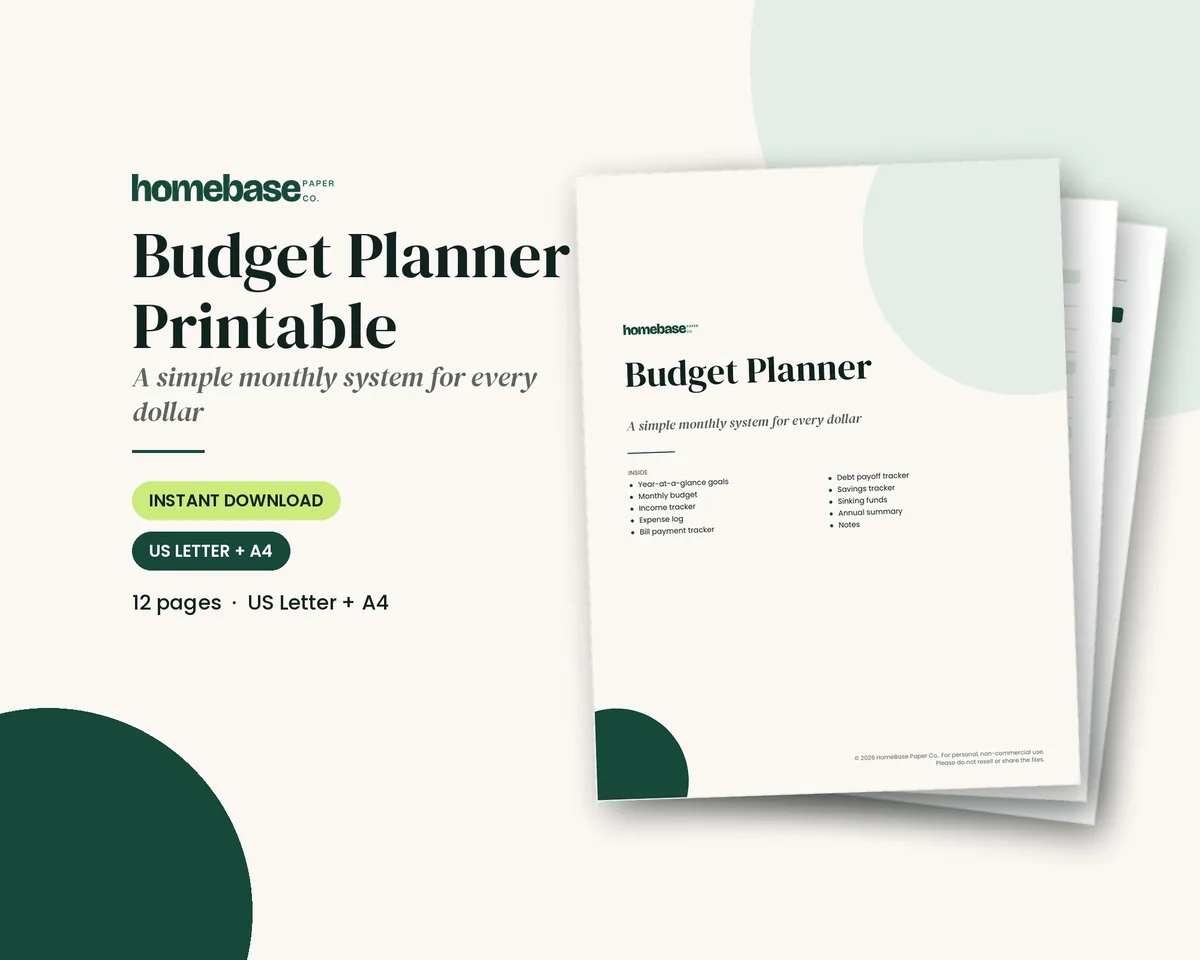
Money is behind more goals than people expect: the trip, the debt payoff, the home project, even the gym membership. The Budget Planner Printable ($5.99) opens with a Money goals for the year page and then gives you monthly budget, savings tracker, debt payoff and sinking funds pages, so your goals sit right next to the numbers that fund them. If you'd rather work in a spreadsheet, the Sinking Funds Tracker ($4.99, Excel and Google Sheets) turns up to 20 goals into a monthly savings amount with progress bars that fill as you save.
Common goal setting mistakes
- Setting goals only in January. Any Monday, birthday or new month works.
- Copying someone else's goals. A goal you don't care about won't survive a busy week.
- Making every goal huge. Challenging is good; impossible is discouraging. Aim for a goal that feels like a stretch but doable.
- Only setting outcome goals. Add a process goal so you know what to do today.
- Quitting after one bad week. Missing once is normal. Missing twice is the start of a new habit, so get back on track at the next chance.
- Never celebrating. Mark each milestone with something small and free so the progress feels real.
A one-page goal setting worksheet
Copy this into your planner or notebook for each goal:
- My goal (SMART): ________________________________
- Why it matters to me: ________________________________
- Deadline: ____________ Measure of success: ____________
- Milestones: Month 1 ______ Month 3 ______ Month 6 ______
- Process goal (what I'll do each week): ________________
- If-then plan: If ____________, then I will ____________.
- What could get in the way, and my plan B: ________________
- Cost (if any) and monthly amount to save: ________________
- Monthly check-in day: ________________
- How I'll celebrate: ________________
Keep going after the first month
Goal setting isn't a one-day event. It's a short loop you repeat: set the goal, take the first step, check in, adjust. The people who reach their goals aren't the ones with the most motivation in January. They're the ones who keep the goal in sight, plan for the bad days and look at their progress every month.
Pick one goal today. Write it in SMART form, add an if-then plan and put your first check-in on the calendar. If you want more help getting your days in order, our guides to being more productive and building a morning routine pair well with your goals, and our planner ideas show creative ways to track them.
Need ideas for this year? Our list of short term goals has 80 examples, from money to health to work.
Make it easier
Tools for this

Printables
Budget Planner Printable
Twelve undated pages you can print every month: budget, bills, spending, savings and debt.

Spreadsheets
Sinking Funds Tracker
It does the math: how much to set aside each month to hit every goal on time.

Spreadsheets
Annual Budget Spreadsheet
See exactly where your money goes every month - without complicated software.
Frequently asked questions
What is goal setting? Goal setting is the process of deciding what you want to achieve, how you'll measure it and when you want it done, and then planning the steps to get there. A good goal has a clear result, a way to measure progress and a deadline. Research by psychologists Edwin Locke and Gary Latham found that specific, challenging goals lead to better results than vague 'do your best' intentions.
What are the 5 steps of goal setting? A simple five-step version is: review where you are, choose one to three goals, make each one SMART (specific, measurable, achievable, relevant and time-bound), break it into monthly milestones with a first step for this week, and check your progress on the same day every month. Adding an 'if-then' plan for the moments you usually slip makes the plan much sturdier.
What is a SMART goal? A SMART goal is specific, measurable, achievable, relevant and time-bound. Instead of 'save more money', a SMART goal says 'save $1,000 in a separate emergency fund by June 30 by moving $42 from each paycheck'. Our free SMART goals template walks you through the five questions on one page so every goal ends up with a number and a date.
How many goals should I set at once? One to three goals at a time is plenty for most people. Every goal competes for the same time, money and energy, so a long list usually means none of them get done. Start with the goal that matters most this season, and when you finish one, add the next.
What are some examples of personal goals? Good personal goals include saving $1,000 for emergencies by June, walking 30 minutes five days a week, cooking dinner at home four nights a week, decluttering one closet a weekend, reading one book a month or finishing an online course by August. Each example has a number and a time frame, which is what turns a wish into a goal you can track.
What is the difference between short-term and long-term goals? Short-term goals take days to a few months, like paying off a small bill or following a cleaning routine for 30 days. Long-term goals take a year or more, like paying off a car or saving a house down payment. Long-term goals work best when you break them into short-term milestones, so you get regular proof that you're on track.
What is an if-then plan for goals? An if-then plan, which researchers call an implementation intention, links a situation to an action: 'If it's Sunday after lunch, then I'll write next week's meal plan.' Psychologist Peter Gollwitzer showed that deciding the when and where ahead of time helps people follow through, and a 2006 meta-analysis of 94 studies found people who made these plans reached their goals more often.
How do I set money goals? The Budget Planner Printable ($5.99) opens with a Money goals for the year page, then gives you monthly budget, savings, debt payoff and sinking funds pages so each money goal sits next to the numbers that fund it. Start by giving every money goal a price and a deadline, divide the price by the months left, and add that monthly amount to your budget as if it were a bill.
How do I track progress toward a savings goal? The Sinking Funds Tracker ($4.99, Excel and Google Sheets) tracks up to 20 savings goals, works out the monthly amount each one needs by its target date and fills a progress bar as you log deposits. Whatever tool you use, check it on the same day each month and adjust the amount if you've fallen behind.
Why do most people fail to reach their goals? The most common reasons are goals that are too vague, too many goals at once, no first step, no regular check-in and no plan for setbacks. Each has a simple fix: make the goal SMART, limit yourself to one to three, write this week's first step, schedule a monthly review and decide in advance what you'll do when a bad week happens.
When is the best time to set goals? Any time you're ready is a good time. January is popular because the calendar and the budget both reset, but a birthday, a new month, the start of a school year or simply a Monday work just as well. If you're planning New Year's goals, start your review in mid-December so you're ready on January 1.
How often should I review my goals? Review your goals once a month and do a bigger check every quarter. The monthly check takes about 15 minutes: what did I finish, am I on track for the next milestone, what got in the way and what's my next step? Each quarter, retire finished goals, adjust deadlines that no longer fit and decide whether to add a new one.
What should I do if I fall behind on a goal? Change the plan, not the goal. Move the deadline, lower the weekly amount or remove whatever got in the way, then take the next small step right away. Missing one week is normal. What matters is getting back on track at the next chance instead of waiting for a fresh start next January.
How can kids learn goal setting? Give kids short, concrete goals they can see, such as reading 15 minutes a night for a week or saving $20 for a book. A sticker chart or tracker on the fridge shows progress every day. Let older kids choose their own goals and help them find the first step, and try a family goal like saving for a day trip together.
Do vision boards help with goal setting? A vision board can help as a daily reminder, especially if pictures motivate you more than lists. It works best when each picture is tied to a real SMART goal with a deadline and a first step written underneath. Our guide on how to make a vision board shows how to price each goal so the board turns into a plan.
Is there a goal setting template I can use? The one-page goal setting worksheet on this page works as a free goal setting template: copy its eight lines, from the SMART goal to the monthly savings amount, into your planner for each goal. For a template focused on SMART goals, see our SMART goals template.
More from HomeBase
You may also like

Spreadsheets
Bill Tracker Spreadsheet
Bills due in 3 days or less light up red, so nothing slips through.

Spreadsheets
Paycheck Budget Spreadsheet
Enter your bills once. The sheet tells you which paycheck pays each one, all year.

Spreadsheets
Zero-Based Budget Spreadsheet
The 'Left to budget' counter turns green when every dollar has a job.

Spreadsheets
Debt Payoff Planner
Pick snowball or avalanche, add any extra payment, and get your debt-free month instantly.
 Club
Monthly club
Money Club
Anyone who wants a clear plan for the month's bills, holiday spending and savings.
Free printable
Turn a vague goal into a plan you'll follow
A SMART worksheet, an action plan and a goal tracker. You'll also get our weekly HomeBase email with simple planning and home organization tips.
Sources
- Building a Practically Useful Theory of Goal Setting and Task Motivation (Locke & Latham, American Psychologist, 2002) doi.org
- Implementation Intentions: Strong Effects of Simple Plans (Gollwitzer, American Psychologist, 1999) doi.org
- Implementation Intentions and Goal Achievement: A Meta-analysis of Effects and Processes (Gollwitzer & Sheeran, 2006) doi.org
- Goal Setting 101 (Oregon State University Academic Success Center) success.oregonstate.edu
- Your Money, Your Goals toolkit (Consumer Financial Protection Bureau) consumerfinance.gov