

The short answer: a savings tracker shows, for each goal, the target amount, the date you need it by, how much to put aside each month and how much you've saved so far.
- Formula: (target − already saved) ÷ months left
- Name each goal and put a real number and date on it
- Example: five goals for $620 a month
- Printable chart, spreadsheet or both
- Next step: Plan it with the Sinking Funds Tracker ($4.99).
Our picks for savings tracker

Spreadsheets
Sinking Funds Tracker
It does the math: how much to set aside each month to hit every goal on time.
 Starter pick
Printables
100 Envelope Savings Challenge
Classic, half and 52-week challenges to print, plus a spreadsheet that tracks every envelope and tells you how much to save each week.

Printables
Budget Planner Printable
Twelve undated pages you can print every month: budget, bills, spending, savings and debt.
 Save 57%
Bundles
Ultimate Budget Bundle
All 6 spreadsheets + both printable planners - for less than half the price of buying them separately.
A savings goal tracker shows, for each thing you're saving for, the target amount, the date you need it by, how much to put aside each month and how much you've saved so far. Seeing the gap shrink is what keeps people saving. You can keep a savings tracker on a printable chart, in a spreadsheet that does the math, or both.
To do the math for you, our Sinking Funds Tracker shows how much to set aside each month to hit every goal on time.
Here's how to set goals that work, the simple formula behind every tracker, and an example with five goals running at once. If you're still deciding what to save for, start with our guide to setting financial goals. To make a goal feel like a game, try a savings challenge.
The formula behind every savings goal
Monthly amount = (target − already saved) ÷ months left
New to saving? Our guide on what is a savings account covers how interest works, current national rates and savings vs. checking.
If you want $1,200 for a family trip in 10 months and you've saved $200, you need ($1,200 − $200) ÷ 10 = $100 a month. A good tracker recalculates this as you go, so a missed month shows up as a slightly higher amount, not a failed goal.
How to set goals you'll actually reach
Goals work best on top of a plan; here's how to make a budget if you don't have one yet.
To turn a wish into a clear plan, fill in our free SMART goals template before you add the goal to your tracker.
- Name each goal specifically. "Summer trip to the lake" works better than "vacation".
- Put a real number on it. Research the cost rather than guessing.
- Pick a date. Without one, there's no monthly amount.
- Rank them. If money is tight (see how to budget on a low income), the emergency fund and near-term needs come first.
- Automate the deposits for the day after payday.
An example with five goals
| Goal | Target | Date | Saved so far | Monthly |
|---|---|---|---|---|
| Emergency fund | $3,000 | 12 months | $600 | $200 |
| Christmas | $1,100 | 11 months | $0 | $100 |
| Car tires | $800 | 8 months | $160 | $80 |
| Family trip | $1,500 | 10 months | $300 | $120 |
| New laptop | $900 | 6 months | $180 | $120 |
| Total | $620 |
If $620 a month is more than the budget allows, push a date back or lower a target. The tracker makes that trade-off a calm decision instead of a guilty one.
How much to save each week for one goal
For a single $1,000 goal with nothing saved yet, the weekly amount depends only on the deadline.
| Time to the goal | Weekly amount | Monthly amount |
|---|---|---|
| 12 weeks | $83.33 | About $361 |
| 26 weeks | $38.46 | About $167 |
| 52 weeks | $19.23 | About $83 |
In a spreadsheet, put the target in B2 and the amount saved so far in C2. Then =B2-C2 gives what is left and =C2/B2 formatted as a percentage gives the progress bar number.
Which goal gets funded first?
When money is tight, rank your goals and fund them one at a time. A goal with a hard date, such as holiday gifts or a car registration, goes first; flexible goals like a trip go later. When the first goal reaches its target, the next one on the list starts receiving the same monthly amount. Track each goal's own balance so one account never hides which goal is behind.
One account or several?
You can keep separate savings accounts for each goal, or one savings account with the split recorded in a tracker. Many banks let you create named "buckets" inside one account, which combines both. What matters is that the tracker tells you how much of the balance belongs to each goal, so you don't spend the tire money on the trip.
If you are choosing where to open that account, see what is a high-yield savings account, with a rate comparison and FDIC insurance basics.
FDIC insurance covers deposits up to at least $250,000 per bank.
Printable or spreadsheet tracker?
A printable chart is satisfying to color in and works well on the fridge, especially for one or two goals or for kids saving toward something. A spreadsheet handles many goals at once, recalculates monthly amounts and keeps a deposit and withdrawal history.
If you'd rather track on your phone, see the best budgeting apps; several of them include a savings goals feature.
The wedding planner bundle combines the checklist, budget and guest list.
Prefer an app? Our comparison of Rocket Money vs. Monarch covers cost and features.
Trackers we make
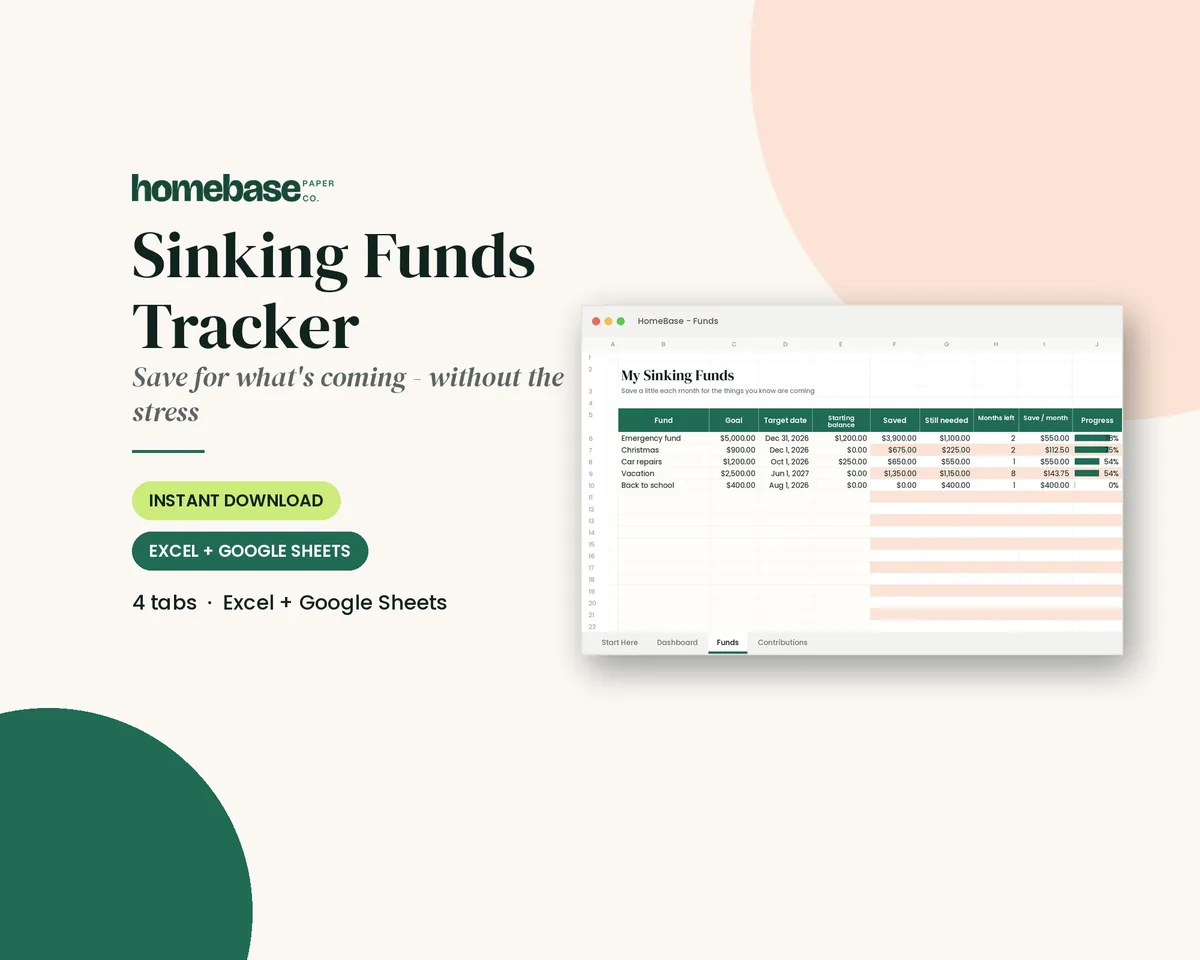
The Sinking Funds Tracker ($4.99) is a savings goal tracker for up to 20 goals. Enter a target and date and it works out the monthly amount, shows progress bars, keeps a deposit and withdrawal log and has a savings dashboard with a chart. It includes an emergency fund goal ready to use and works in Excel and Google Sheets.
Prefer a challenge? The 100 Envelope Savings Challenge ($3.99) has the classic 100 envelope chart, a half version, a 52-week challenge and a custom savings tracker you can set to any goal, plus a spreadsheet version. The Budget Planner Printable ($5.99) also includes savings and sinking funds pages inside a full monthly budget. All three are in the Ultimate Budget Bundle ($19.99). For a year-end goal, check the weeks left in the year and save that fraction each week.
Common savings goals to track
Saving for a down payment? Our guide on how to save for a house shows how to set the target, pick an account and build the monthly amount into your budget.
Saving for a trip? Once the money is set aside, plan the days with our free travel itinerary template, which includes a trip budget and a packing checklist.
- Emergency fund (often the first goal)
- Christmas and birthdays
- Car repairs, tires and registration
- Vacation or a family trip
- Home repairs and appliance replacement
- Back-to-school
- Medical and dental costs
- A down payment
- Wedding or a big celebration (see our wedding planning checklist and budget tracker and what to do after getting engaged; a wedding guest list template helps too, since the guest count drives most of the cost)
- A new phone or laptop
Start with an emergency fund. The CFPB's guide describes it as cash set aside for unplanned expenses.
Savings goals for kids
Children understand saving best when they can see it. Give them a simple printable chart for one goal, such as a toy or a day out, and let them color a box for every dollar. Matching their savings, for example 50 cents for every dollar they save, is a simple way to teach how money grows. If they earn money from chores, a chore chart and allowance tracker records each payday and the amount saved. Older kids can graduate to a spreadsheet tab of their own.
The CFPB's Money as You Grow has savings activities by age.
Keeping momentum
For the rest of the plan, our family budgeting guide lists every guide in order.
For more ideas on staying on track, see our guide to savings motivation, including budget motivation tips.
A picture helps, too. Our guide on how to make a vision board shows how to put each goal's price, deadline and monthly amount on the board.
- Check progress every payday, when you log the deposit.
- Celebrate milestones at 25%, 50% and 75%.
- Use windfalls. Tax refunds, bonuses and gift money can finish a goal early.
- Don't raid one goal for another without writing it down and planning the catch-up.
For more on saving for irregular costs, read our sinking funds guide, and see 100 envelope challenge vs. 52-week challenge if you want a challenge format.
For long-term goals, the investment calculator projects what a starting amount plus monthly deposits could be worth after a number of years.
Save ahead for the big stuff
It does the math: how much to set aside each month to hit every goal on time.
$4.99 · Instant download. Print at home or fill it in on screen. Or browse the full Budget & Money collection.
Frequently asked questions
What is a savings goal tracker? It's a chart or spreadsheet that lists each savings goal with its target, deadline, monthly amount and progress. A savings goal tracker turns a vague wish into a monthly number and shows how close you are, which helps you keep going.
How do I calculate how much to save each month? Subtract what you've already saved from the target, then divide by the months left. For $1,200 in 10 months with $200 saved, that's $100 a month. A spreadsheet tracker recalculates this automatically after each deposit.
Should I keep each savings goal in a separate account? You can, but it isn't required. One savings account works if a tracker records how much belongs to each goal. Many banks also offer named savings buckets inside one account, which keeps goals separate without extra accounts.
Is there a printable savings goal tracker? Yes, there is a printable savings goal tracker from HomeBase. Our 100 Envelope Savings Challenge includes a custom savings tracker you can set to any goal, and the Budget Planner Printable has savings and sinking funds pages. For many goals at once, the Sinking Funds Tracker spreadsheet handles up to 20.
Free printable
Get organized for the new year: get the free 2027 planner
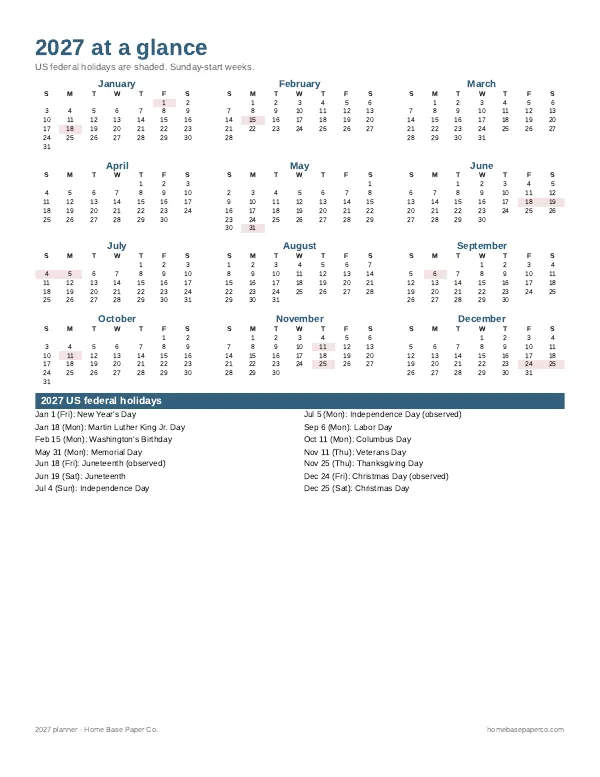
A 16-page printable 2027 planner with a year-at-a-glance page and monthly calendars with US holidays marked. You'll also get our weekly HomeBase email with simple planning and home organization tips.
Sources
- FDIC insurance fdic.gov
- Guide consumerfinance.gov
- Money as You Grow consumerfinance.gov