

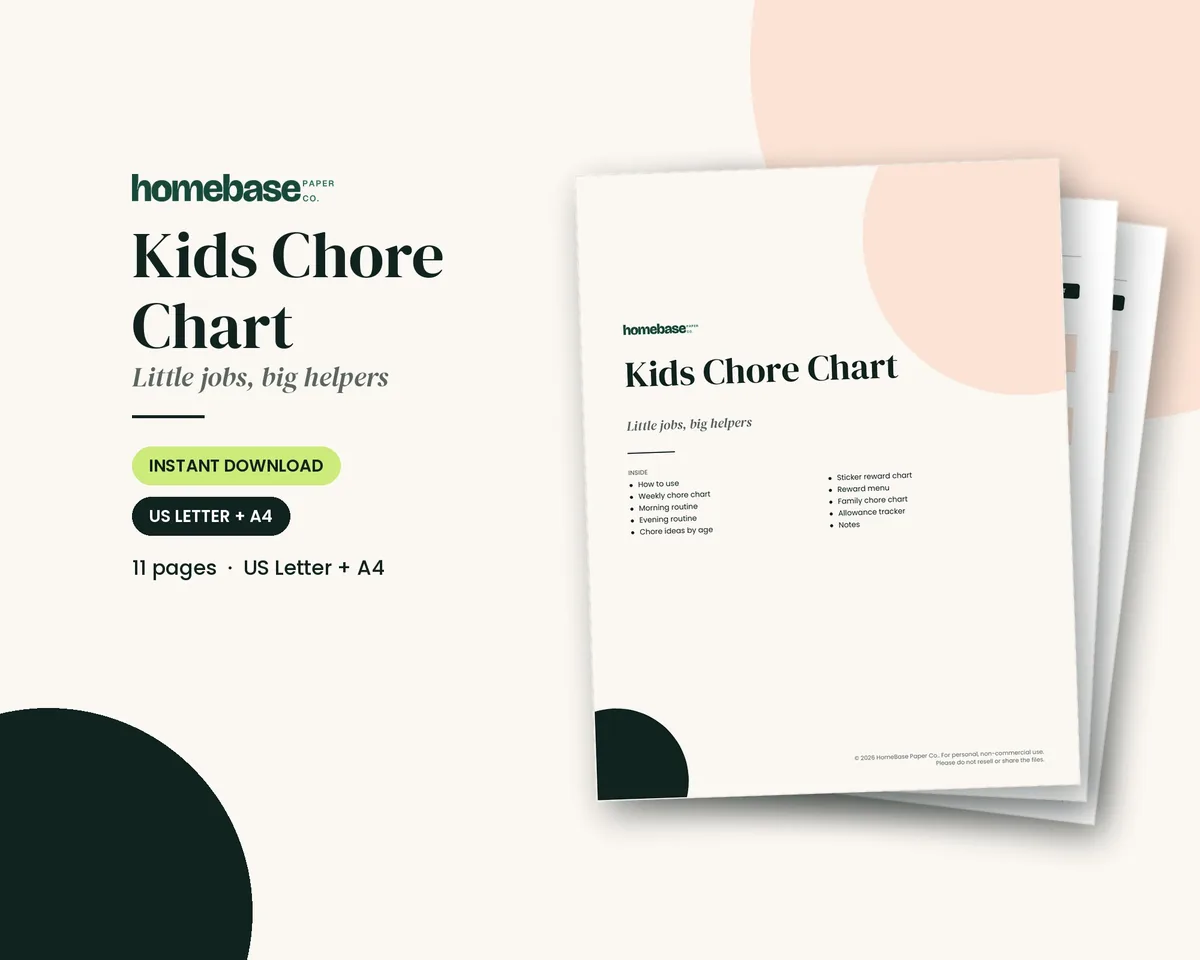
The short answer: A chore chart and allowance tracker puts two things on paper: the jobs your kids do each week and the money they earn, save, spend and give. Kids check off chores as they go, and on payday you count the checks, pay what was earned and write it down. Without that record, allowance often turns into a weekly argument about who did what.
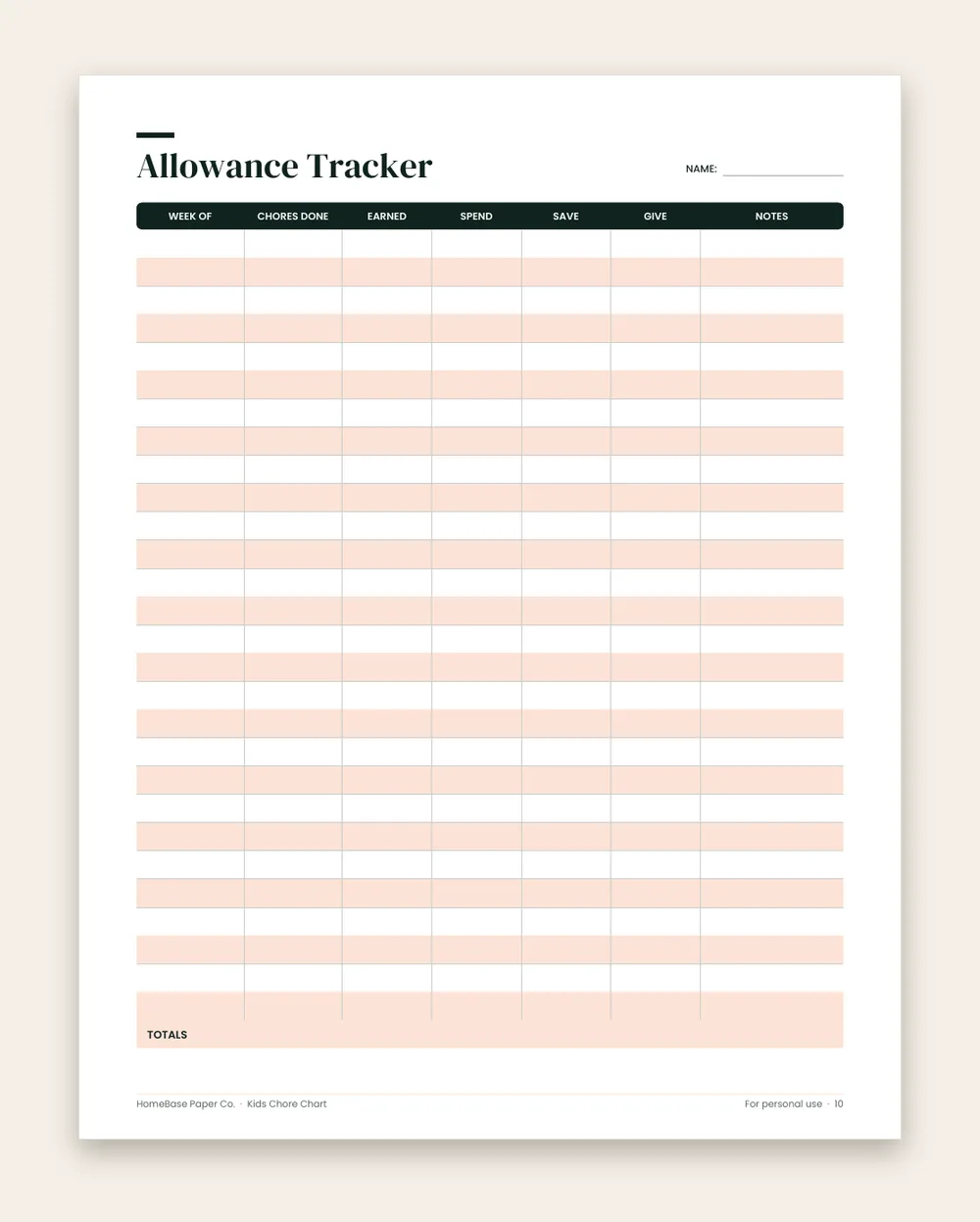
Below you'll find how to decide which chores earn money, how much to pay by age, a weekly payday routine that takes about five minutes, and how to use the save, spend and give columns. The Kids Chore Chart printable includes a Weekly Chore Chart and an Allowance Tracker page, so the whole system fits in one set of printables.
What's included in the Kids Chore Chart
- How to use these charts
- Weekly Chore Chart
- Morning Routine
- Evening Routine
- Chore Ideas by Age
- Sticker Reward Chart
- Reward Menu
- Family Chore Chart
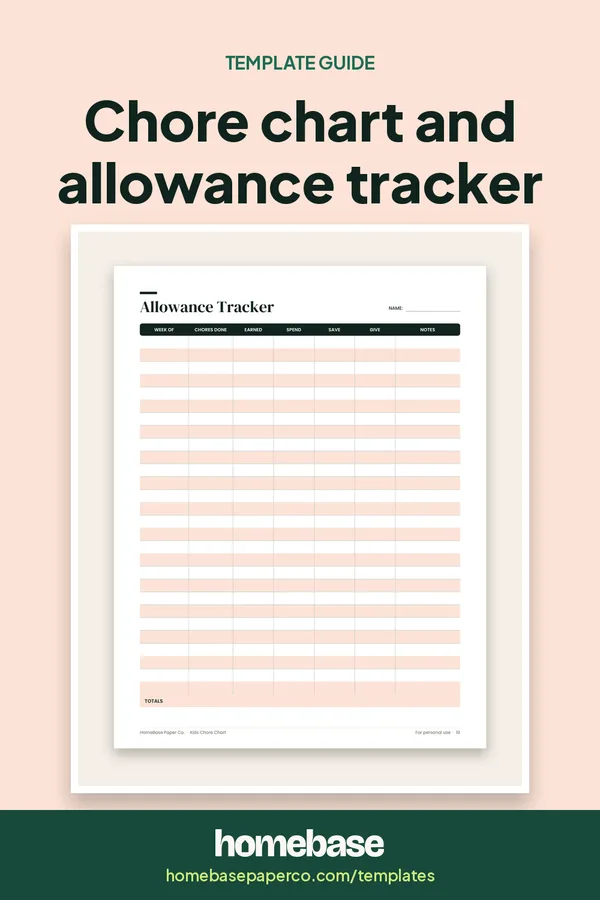
- Allowance Tracker
- Notes
Printable PDF, $3.49. Instant download; nothing is shipped. See every page on the product page.
Who it's for
- Parents of kids ages 5 to 12 who want chores and pocket money in one simple system.
- Families tired of nagging, who'd rather let a chart and a weekly payday do the reminding.
- Parents teaching saving and giving, not just spending, with a running record kids can read.
- Households with more than one child, where every kid needs their own fair, visible record.
- Grandparents and caregivers who help with chores and want to follow the same rules as home.
How to set up a chore chart and allowance tracker
- Split chores into two lists. Write everyday family jobs (make your bed, clear your plate) that everyone does for free, and paid extra jobs (wash the car, weed the garden) that earn money.
- Set the weekly amount. Pick an amount you can afford every single week. Many families start with about half the child's age in dollars and adjust from there.
- Put the chores on the chart. Fill in the Weekly Chore Chart with each child's jobs and the days they're due, and post it where everyone sees it.
- Check off chores daily. Kids mark each chore when it's done. A quick evening check takes two minutes and avoids end-of-week surprises.
- Hold a weekly payday. Pick one day, like Sunday. Count the checkmarks, pay what was earned and write it in the Allowance Tracker.
- Split the money. Have your child divide the pay into save, spend and give, and record each amount in its own column.
- Review once a month. Look at the tracker together, celebrate savings progress and update chores as your child gets older.
Why put chores and allowance on one chart
Chore charts and allowance work better together for a few simple reasons:
- Kids can see the connection. Checkmarks during the week turn into dollars on payday, and that link is easy to understand on paper.
- No more memory contests. "I did the dishes Tuesday!" is settled by the chart, not by who argues longer.
- It builds a money record. After a few months, the tracker shows how much your child has earned and saved, which is a lesson by itself.
- It's fair across siblings. Each child has their own row of jobs and their own tracker page.
The CFPB's Money as You Grow program for parents notes that kids build money skills, habits and attitudes as they grow, and it suggests age-based activities for each stage. A weekly payday is one of the easiest of those activities to keep up at home.
Paid chores vs. everyday family jobs
Most families find a two-list system works best. It keeps kids helping at home for free while giving them a real way to earn.
| List | What goes on it | Paid? | Examples |
|---|---|---|---|
| Everyday family jobs | Things everyone does because they live here | No | Make bed, clear plate, put away laundry, feed the pet |
| Paid extra jobs | Bigger or optional jobs beyond the basics | Yes | Wash the car, rake leaves, weed a flower bed, clean the garage |
| Bonus jobs | One-time projects you offer when they come up | Yes, set per job | Help paint a fence, sort old toys for donation |
Write both lists on the Weekly Chore Chart so nobody is confused about which jobs earn money.
How much allowance to pay by age
There's no official amount. These are common starting points that many families use and then adjust to their own budget. Choose a number you can pay every week without fail, because a missed payday teaches the wrong lesson.
| Age | Common weekly range | Example chores (EXAMPLE only) |
|---|---|---|
| 5 to 6 | $2 to $3 | Match socks, water plants, wipe the table |
| 7 to 8 | $3 to $5 | Empty small trash cans, fold towels, sweep the porch |
| 9 to 10 | $4 to $7 | Vacuum a room, unload the dishwasher, rake leaves |
| 11 to 12 | $5 to $10 | Mow with supervision, wash the car, clean a bathroom |
| 13 and up | $10 and up | Cook a simple dinner, bigger yard work, babysit siblings |
Two simple formulas people use are half the child's age in dollars per week and $1 per year of age per week. Either is fine as a starting point. For chore ideas matched to each age, see our chore chart by age guide.
Setting up the weekly payday
Payday is what makes the system stick. Keep it short, on the same day, and with the tracker on the table.
- Count the week's checkmarks on the Weekly Chore Chart together.
- Pay the amount earned in cash for younger kids, so they can hold and count it.
- Write it in the Allowance Tracker: the week, chores done and amount earned.
- Split it into save, spend and give, and record each amount.
- Reset the chart for the next week and talk about any chore changes. For more on this topic, see our chores & allowance guides.
If your family already holds a family budget meeting, payday can be the first five minutes of it.
Using the save, spend and give columns
The Allowance Tracker has separate spend, save and give columns. Splitting every payday teaches kids that money has more than one job.
| Split style | Save | Spend | Give | Good for |
|---|---|---|---|---|
| Starter | 50% | 40% | 10% | Ages 5 to 8, with a short saving goal |
| Balanced | 40% | 50% | 10% | Ages 9 to 12 |
| Teen choice | Their choice, with at least 20% saved | Their choice | Their choice | Teens learning to plan |
Help your child write a saving goal with a price in the Notes column, like a book or a game. Each payday, add up the saved amount and show how close they are. For older kids, our savings goal tracker gives the goal its own page.
A sample week (EXAMPLE only)
Here's how one week might look for a 9-year-old earning a base of $4 plus paid extras:
| Chore | Paid? | Done | Earned |
|---|---|---|---|
| Make bed, clear plate, feed the dog | No (family jobs) | All week | $0 |
| Unload the dishwasher (4 times) | Yes, base allowance | 4 of 4 | $4.00 |
| Rake the front yard | Yes, extra | Done | $3.00 |
| Wash the car | Yes, extra | Skipped | $0 |
| Total | $7.00 |
On the Allowance Tracker that week: earned $7.00, saved $3.00, spent $3.30 and gave $0.70.
Common problems and simple fixes
- Chores get skipped all week. Check the chart each evening for two minutes instead of only on payday.
- Kids rush and do a poor job. Agree on what "done" looks like for each chore and write it on the chart.
- Siblings compare pay. Explain that pay follows age and chore difficulty, and keep each tracker personal.
- You forget payday. Set a phone reminder and keep small bills in an envelope for allowance.
- Kids lose interest. Refresh the paid extras every couple of months, and let kids suggest new jobs.
For young kids who aren't ready for money yet, start with a sticker chart printable and move to an allowance tracker later. For more ideas on talking about money with your children, see our guide to teaching kids about money. The CFPB's youth financial education resources also have free activities for different ages.
Ready to use
A chore chart with the allowance tracker already built in
 Starter pick
Printables
Kids Chore Chart
Weekly chore chart, morning and evening routines, chore ideas by age, a sticker reward chart and an allowance tracker.
 Save 33%
Bundles
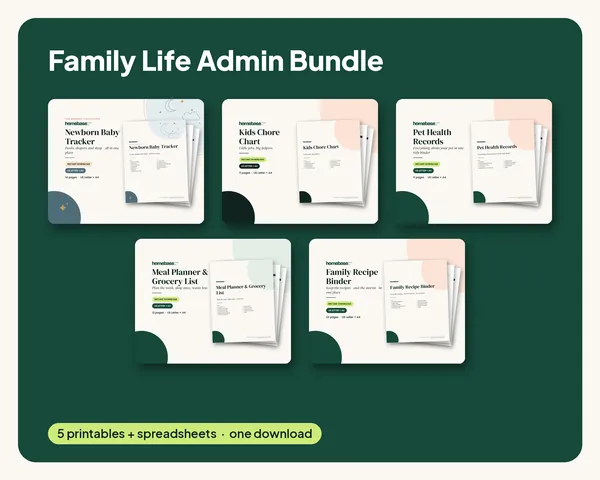
Family Life Admin Bundle
Baby logs, chore charts, pet records, meal plans and family recipes in one tidy set.
Frequently asked questions
What is a chore chart and allowance tracker? It's a chore chart that also records money. Kids check off chores during the week, and on payday you write down what they earned, then how much they saved, spent and gave. It turns chores and pocket money into one simple system kids can see.
Should kids be paid for chores? Families decide differently, and both approaches can work. Many parents use a hybrid: everyday family jobs, like making the bed and clearing the table, are expected for free, and extra jobs, like washing the car, earn money. That keeps kids helping at home while still letting them earn.
How much allowance should a child get? There's no single right amount. A common starting point is about half the child's age in dollars per week, so a 6-year-old might get $3 and a 10-year-old $5. Some families use $1 per year of age. Pick an amount your budget can cover every week without fail.
At what age should kids start getting an allowance? Many families start around ages 5 or 6, when kids can count money and understand that saving means waiting. Younger kids can start with a sticker chart and small rewards, then move to an allowance when they're ready.
What chores can kids do to earn money? Good paid extras include washing the car, raking leaves, weeding, cleaning out the garage, washing windows, helping with a big pantry clean-out and pet jobs beyond the daily basics. Our chore chart by age guide has more ideas matched to each age.
What happens if my child doesn't finish their chores? Keep it simple: unfinished paid chores mean no pay for that job. Avoid fines or taking back money already earned, which makes the tracker feel like punishment. Everyday family jobs still need doing, and that's handled like any other house rule.
Should allowance be split into save, spend and give? Yes, splitting allowance into save, spend and give is a helpful habit for kids. Splitting each payday into save, spend and give teaches kids that money has more than one job. Many families start with a simple split such as half to spend, a third to save and the rest to give, then let older kids choose.
When is the best day for allowance payday? Choose one day you can stick to, often Sunday or Friday. Paying on the same day every week builds trust and makes the tracker easy to keep up.
How do I track allowance for more than one child? Give each child their own Allowance Tracker page and their own chore list matched to their age. A shared Family Chore Chart can show household jobs, while each child's money record stays private and personal.
Should I pay allowance in cash or digitally? Cash is best for young kids because they can see and count it. Older kids and teens can move to a kids' debit card or savings account, and keep writing amounts in the tracker so they still see the totals.
How can kids use allowance to learn saving? Help your child pick a saving goal with a price, like a toy or a game, and write it in the notes. Each payday, add the saved amount and show how close they are. Seeing the total grow is the lesson.
Is this chore chart and allowance tracker free? The Allowance Tracker comes in the Kids Chore Chart printable, which also includes a Weekly Chore Chart, morning and evening routines, Chore Ideas by Age, a Sticker Reward Chart, a Reward Menu and a Family Chore Chart. You can print it as often as you need for your own family.
What size does the tracker print? The printable comes in US Letter and A4. Print one tracker page per child, or slip it into a sheet protector and use a dry-erase marker.
How long should we use a chore chart? As long as it's working. Most families update chores every few months as kids get older, and teens often move from a printed chart to a simple list or app while keeping a money record.
Free printable
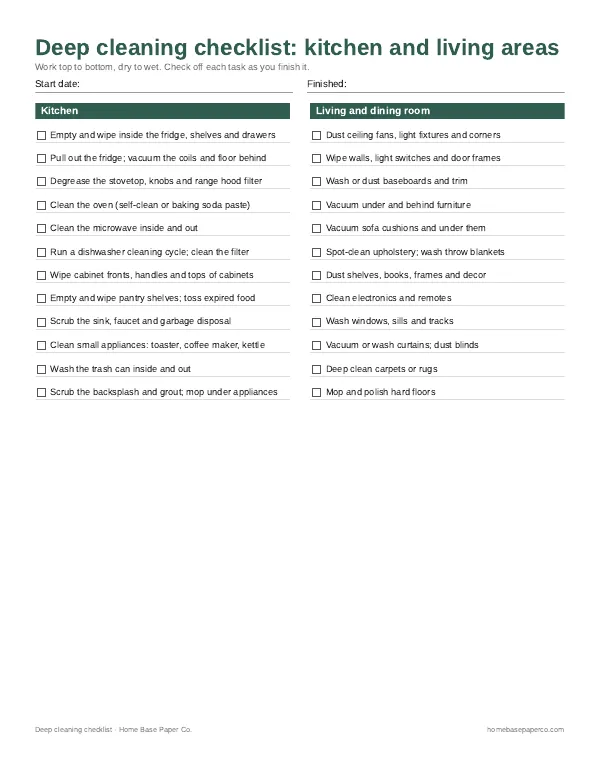
Clean the whole house in order: get the free deep cleaning checklist
A printable room-by-room deep cleaning checklist that tells you what to do first, so nothing gets cleaned twice. You'll also get our weekly HomeBase email with simple cleaning routines and chore ideas the whole family can help with.
Sources
- Money as You Grow consumerfinance.gov
- Youth financial education resources consumerfinance.gov