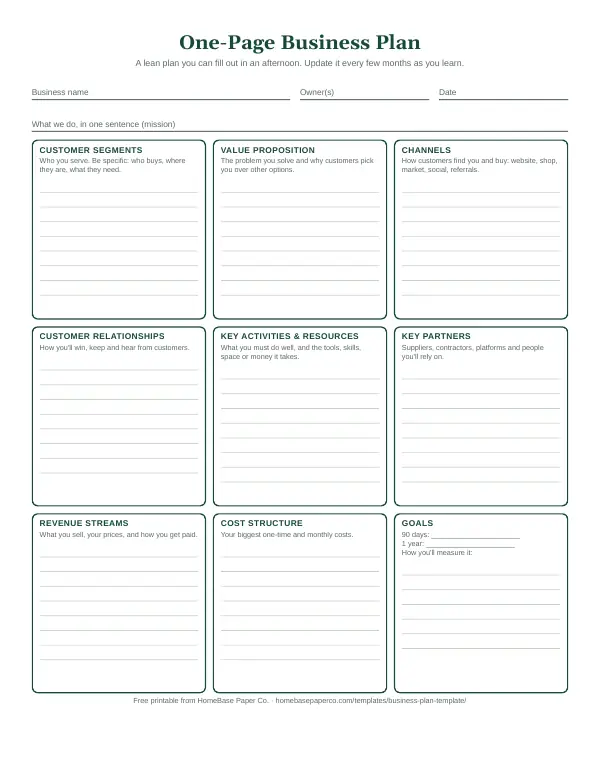
The short answer: A business plan template is a fill-in outline that walks you through the parts of a plan: what you sell, who buys it, how you'll reach them, who runs the business and how the numbers work. Our free printable business plan template gives you a one-page lean plan, a two-page worksheet that follows the traditional sections lenders expect, and a startup cost and 12-month forecast page.
It's made for first-time owners, side hustlers, makers, freelancers and anyone who wants a simple business plan on paper before they open a document or spreadsheet.
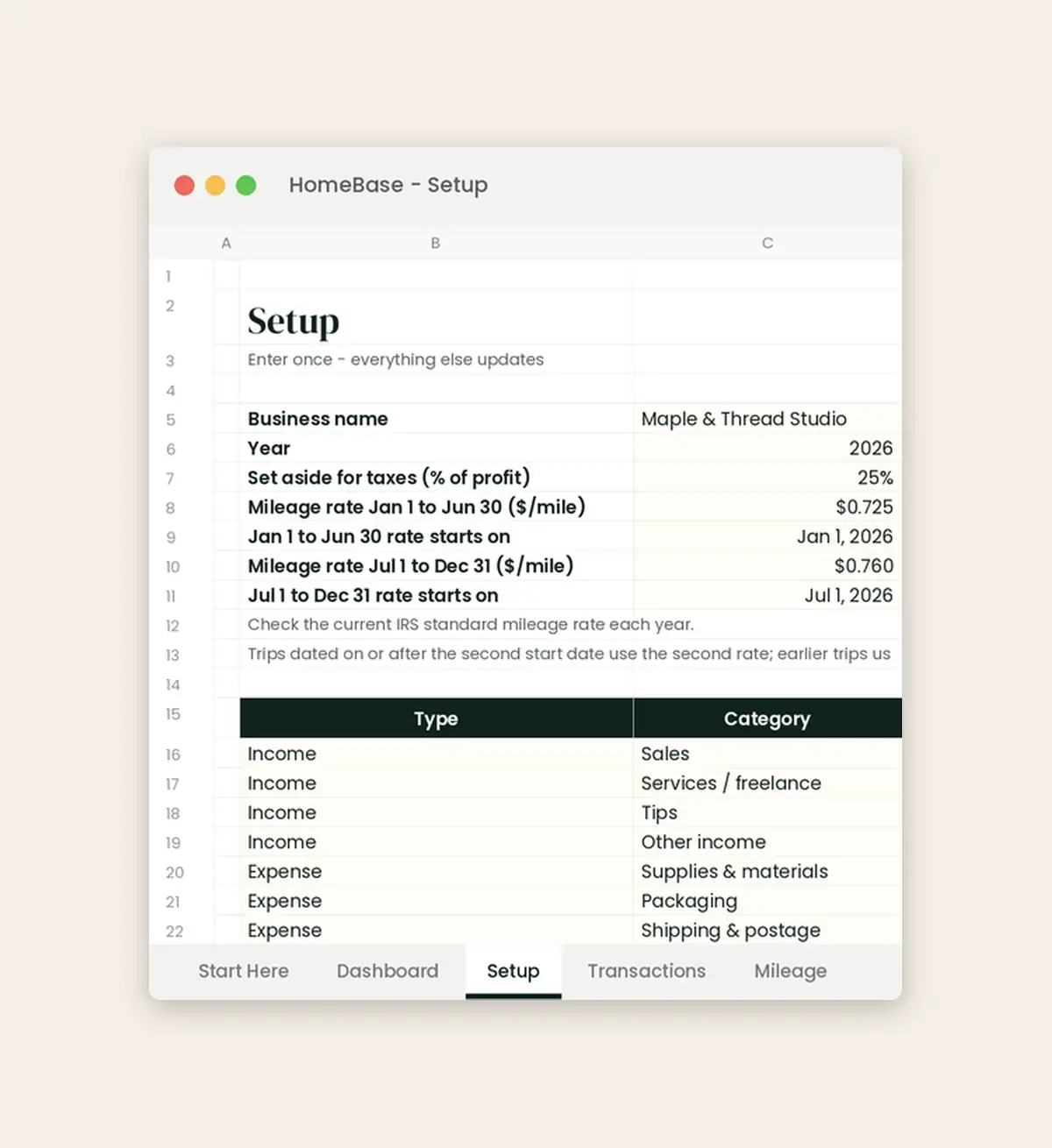
What's included in the Business Income & Expense Tracker
- Start Here guide
- Income & expense log with category dropdown
- Income / expense type fills in automatically
- Monthly profit & loss
- Mileage log with deduction estimate
- Tax set-aside estimate each month
- Year & month totals by category
- Dashboard + chart
Spreadsheet (Excel + Google Sheets), $7.99. Instant download; nothing is shipped. See every page on the product page.
Who it's for
- First-time owners turning an idea into a plan before they spend money.
- Side hustlers and makers who want a simple one-page plan.
- Freelancers and service businesses setting prices, goals and a monthly budget.
- Anyone applying for a small loan who needs an outline of the traditional sections.
- Students and teachers working on a business class project.
How to fill out a business plan template, step by step
- Write the mission. Say what you do and for whom in one sentence.
- Name your customer segments. Be specific about who buys, where they are and what they need.
- Write your value proposition. Describe the problem you solve and why customers would pick you.
- Research the market and competitors. List three competitors, their prices and how you'll be different.
- Choose your channels. Write where customers will find you and how they'll buy.
- Price your products or services. Fill in price, cost to make or deliver, and profit per sale.
- Add up startup and monthly costs. Use page 4 and get real quotes where you can.
- Forecast the first 12 months. Estimate monthly sales, subtract costs and track cash on hand.
- Set goals and write the executive summary last. Sum up the plan in a short paragraph once the rest is done.
Why write a business plan at all
A business plan turns an idea into decisions. Writing it forces you to name your customer, set a price, count your costs and decide how you'll find buyers. The U.S. Small Business Administration says a good plan guides you through each stage of starting and managing your business and works as a roadmap for how to structure, run and grow it. The same plan can help you get funding or bring on a partner, because it shows them you've thought it through.
You don't need dozens of pages to get those benefits. Most owners use a plan to:
- Test the idea. If the numbers on page 4 don't work, it's cheaper to learn that on paper.
- Set goals. A 90-day goal and a one-year goal give you something to measure.
- Ask for money. A lender or investor will want a clear funding request and projections.
- Stay focused. When a new opportunity shows up, you can check it against the plan.
What's on the free printable business plan template
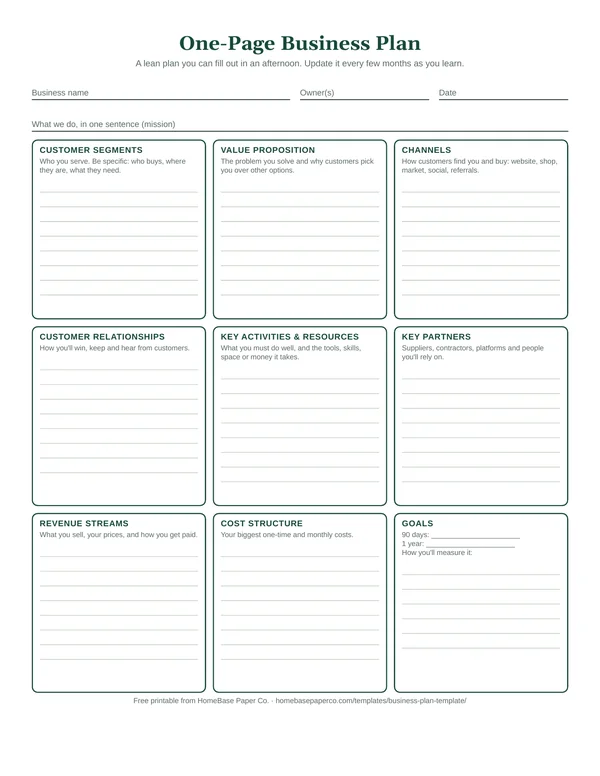
The PDF has four US Letter pages. Use page 1 on its own for a quick lean plan, or fill out all four for a fuller plan.
| Page | Section | What you fill in |
|---|---|---|
| 1. One-page business plan | Header | Business name, owners, date and a one-sentence mission |
| 1. One-page business plan | Nine lean boxes | Customer segments, value proposition, channels, customer relationships, key activities and resources, key partners, revenue streams, cost structure and goals |
| 2. Worksheet, part 1 | Sections 1 to 4 | Executive summary, company description, market analysis with a competitor table, and organization and management with a team table |
| 3. Worksheet, part 2 | Sections 5 to 8 | Products or services with price and profit per sale, marketing and sales, funding request, and a three-year financial summary |
| 4. Startup costs and forecast | Three tables | One-time and monthly startup costs, a 12-month sales and expense forecast, and a break-even check |
Lean or traditional: which business plan format to use
The SBA describes two common formats. A traditional plan uses a standard structure, goes into detail in each section and can run dozens of pages. A lean startup plan summarizes only the key points and can take as little as an hour, usually on one page.
| Format | Length | Best for | Pages to use |
|---|---|---|---|
| Lean (one-page) plan | One page | Side hustles, simple businesses, testing an idea, plans you change often | Page 1, plus page 4 for the numbers |
| Traditional plan | Several pages or more | Bank loans, investors, partners, businesses with staff or a location | Pages 2 to 4 as your outline, then a typed version |
| Both | One page plus a worksheet | Most new small businesses | Start with page 1, then expand into pages 2 to 4 |
If you're not sure, start lean. You can always expand a one-page plan into a traditional one when a lender asks.
How to fill out a business plan template, step by step
- Write the mission in one sentence. Say what you do and for whom, like "custom pet portraits for dog owners in Austin."
- Name your customer segments. Be specific about who buys, where they are and what they need.
- Write your value proposition. Describe the problem you solve and why customers would pick you.
- Research the market and competitors. List three competitors, their prices and what you'll do differently.
- Choose your channels. Write where customers will find you and how they'll buy, from a website to a craft fair.
- Price your products or services. Fill in the price, the cost to make or deliver each one and the profit per sale.
- Add up your startup and monthly costs. Use page 4 and get real quotes where you can.
- Forecast the first 12 months. Estimate sales month by month and subtract costs to see cash on hand.
- Set goals and write the executive summary last. Once everything else is done, sum it up in a short paragraph.
A worked business plan example
These figures are an EXAMPLE only, made up to show how the numbers connect. They aren't real costs, prices or a forecast for any business.
| Plan section | EXAMPLE: a home bakery selling custom cookies |
|---|---|
| Mission | Custom decorated cookies for birthdays, showers and small events in one town |
| Customer segments | Parents planning parties and people hosting showers, within 15 miles |
| Value proposition | Made-to-order designs with a 7-day turnaround and local pickup |
| Channels | Instagram, a simple order form and two local markets a month |
| Revenue | One dozen custom cookies at $42 (EXAMPLE) |
| Cost per dozen | $14 ingredients and packaging (EXAMPLE) |
| Profit per sale | $28 per dozen (EXAMPLE) |
| Monthly fixed costs | $280 for license, insurance, software and market fees (EXAMPLE) |
| Break-even | $280 ÷ $28 = 10 dozen per month |
What this EXAMPLE shows: the baker needs about 10 orders a month just to cover fixed costs, so the goal for the first 90 days is 15 orders a month. If the forecast on page 4 shows fewer than that, she can raise prices, cut a cost or add a channel before she spends money on equipment.
The traditional business plan sections, explained
Pages 2 and 3 follow the sections the SBA lists for a traditional plan. You don't have to use every one, and you can change the order to fit your business.
- Executive summary: what the company is, why it will succeed, your mission, what you sell, who runs it and where. Write it last.
- Company description: the problem you solve, who you serve and the strengths that set you apart.
- Market analysis: your industry, your target market, your competitors and what they do well.
- Organization and management: your legal structure, such as sole proprietor, LLC, partnership or corporation, and who's responsible for what.
- Products or services: what you sell, how it helps customers, and what each sale earns.
- Marketing and sales: how you'll attract and keep customers and how a sale actually happens.
- Funding request: how much you need, debt or equity, the terms you want and what the money pays for.
- Financial projections: forecasts of sales, costs and cash, monthly for the first year.
How to estimate startup costs and your first-year numbers
The numbers are the part most people skip, and the part lenders and partners look at closely. The SBA suggests you calculate your startup costs so you know how much money you need to launch. Page 4 splits them in two:
- One-time costs: equipment, starting inventory, licenses and permits, a website and logo, and deposits.
- Monthly costs: rent or space, supplies, software, marketing and insurance.
Then forecast 12 months of sales. Be conservative in the first few months, since many new businesses start slowly. Subtract cost of sales and expenses to get net profit, and track cash on hand so you can see the lowest point before sales catch up. The break-even box divides monthly fixed costs by profit per sale to tell you how many sales you need each month.
Common business plan mistakes
- Describing everyone as your customer. A specific customer is easier to find and sell to.
- Guessing costs instead of getting quotes. Call suppliers and check real prices before you trust the forecast.
- Forecasting big sales from month one. Plan for a slow start and build up.
- Skipping the competitors. Every business has some, even if it's people doing it themselves.
- Writing it once and never looking again. Review the plan every few months and update the numbers.
- Making it longer than it needs to be. A clear one-page plan beats a 40-page plan no one reads.
When a spreadsheet makes more sense
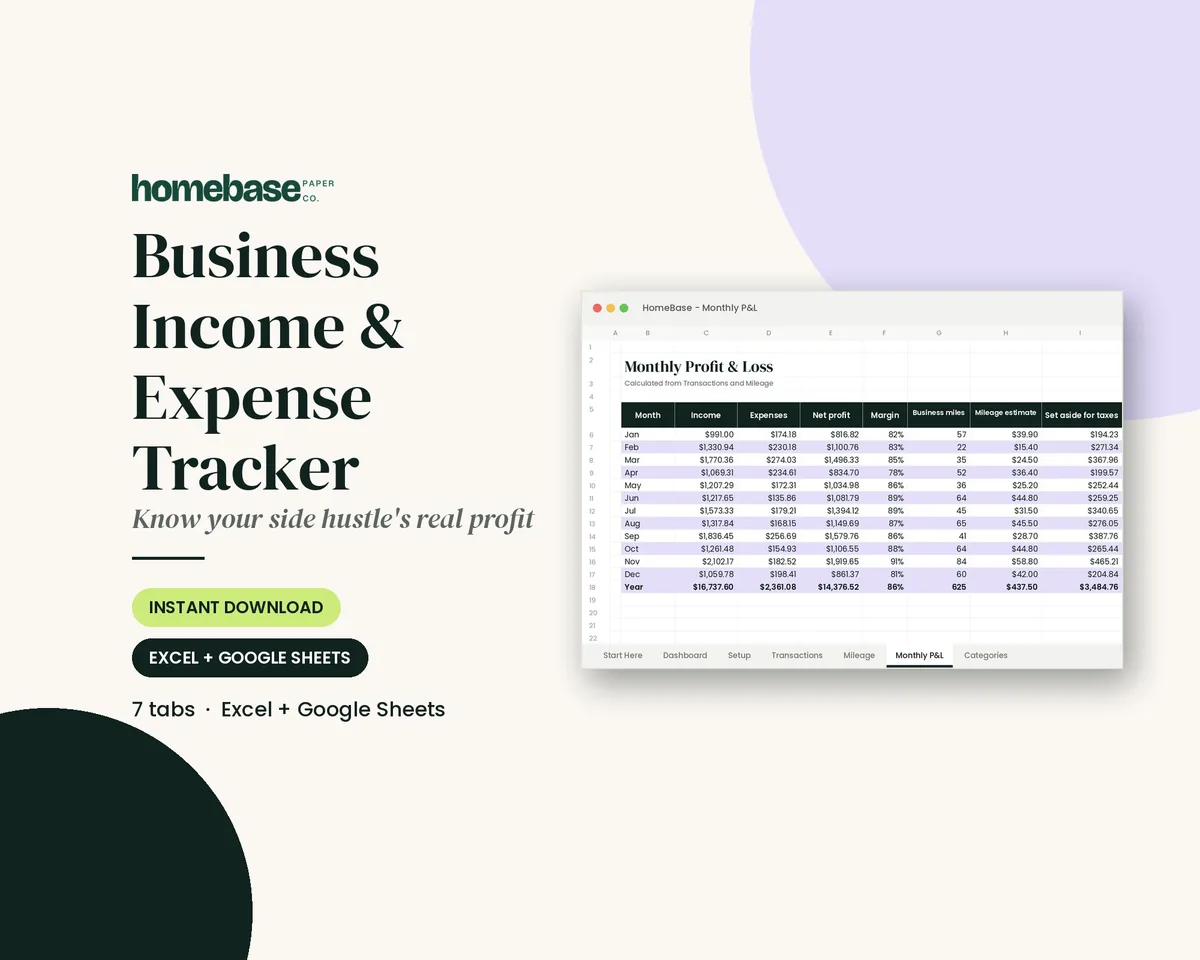
A paper plan is the right place to think. Once the business is running, you'll want your real numbers to add themselves up so you can compare them with the plan. The Business Income & Expense Tracker ($7.99) works in Excel and Google Sheets. Log each sale and expense, and it shows monthly profit and category totals you can hold up against your forecast. If you also manage the household budget that funds the business, the Ultimate Budget Bundle ($19.99) covers budgeting, bills and savings in one set.
For the next steps, plan the monthly numbers with our business budget template, bill your first customers with the free invoice template, and keep every purchase on record with our small business expense tracker guide.
Ready to use
When you want your real numbers to add themselves up
Spreadsheets
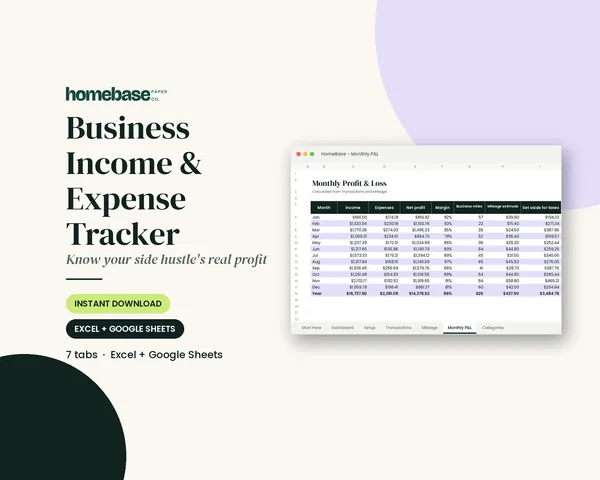
Business Income & Expense Tracker
Log sales, expenses and business miles - see your monthly profit, category totals for tax time and how much to set aside.
 Save 57%
Bundles
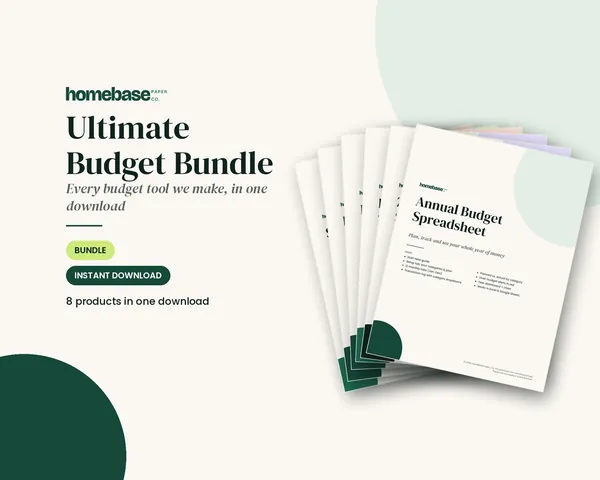
Ultimate Budget Bundle
All 6 spreadsheets + both printable planners - for less than half the price of buying them separately.
Frequently asked questions
What is a business plan template? A business plan template is a ready-made outline you fill in to plan a business. It prompts you for your mission, customers, products, pricing, competitors, marketing, team, costs and sales forecast, so you don't have to start from a blank page or guess which sections a lender or partner expects to see.
Is this business plan template free? Yes, this business plan template is free. Enter your email and we will send the four-page PDF to print. Page 1 is a one-page lean plan, pages 2 and 3 are a traditional plan worksheet, and page 4 covers startup costs, a 12-month forecast and a break-even check, all on US Letter paper.
What should a simple business plan include? A simple business plan should include a one-sentence mission, who your customers are, the problem you solve, what you sell and at what price, how customers will find and buy from you, your main costs, how you'll make money and a few measurable goals. Page 1 of the template fits all of that on one sheet.
What are the main sections of a traditional business plan? The SBA lists the common sections of a traditional plan as the executive summary, company description, market analysis, organization and management, service or product line, marketing and sales, funding request and financial projections. You can use the sections that fit your business and skip or combine the rest.
What is a one-page business plan? A one-page business plan, also called a lean plan, sums up only the most important parts of a business on a single sheet: customers, value proposition, channels, relationships, key activities, partners, revenue, costs and goals. It's quick to write and easy to update, which suits side hustles and new ideas you're still testing.
How long should a business plan be? A business plan should be as long as its reader needs. A lean plan can be one page and take about an hour. A traditional plan for a bank loan or investor is longer and more detailed, and can run dozens of pages. Many owners start with one page and expand it later.
Do I need a business plan for a small business or side hustle? You don't legally need a business plan for most small businesses or side hustles, but writing even a one-page plan helps. It makes you set a price, count your costs and decide how to find customers before you spend money, and it gives you goals you can check against real results.
What should I write in the executive summary? In the executive summary, briefly say what your company is and why it will succeed. Include your mission, what you sell, who runs the business and where it's based. If you're asking for money, add the amount and a short look at your financial outlook. Write it last, after the other sections.
How do I estimate startup costs for a business plan? List one-time costs like equipment, starting inventory, licenses, a website and deposits, then monthly costs like rent, supplies, software, marketing and insurance. Get real quotes where you can rather than guessing. Page 4 of the template has a table for both columns and a total for each.
How do I make a sales forecast for a new business? Estimate how many sales you expect each month for the first year and multiply by your price. Start conservatively, because many new businesses grow slowly at first. Subtract cost of sales and expenses to get monthly profit, and track cash on hand so you can see the lowest point before sales catch up.
How do I calculate break-even in a business plan? Divide your monthly fixed costs by the profit you make on each sale. For example, if fixed costs are $280 a month and each sale earns $28 after its direct costs, you need 10 sales a month to break even. The break-even box on page 4 does this calculation.
Is there a business plan template for Word, Excel or Google Sheets? Our free business plan template is a printable PDF you fill in by hand. If you'd rather track the real numbers in a spreadsheet once you open, the HomeBase Business Income & Expense Tracker works in Excel and Google Sheets and totals income, expenses and profit by month and category.
What business structure should I put in my plan? Put the legal structure you have or plan to form, such as a sole proprietorship, partnership, limited liability company or corporation. Each one affects taxes, paperwork and personal liability differently, so read the SBA's guide to choosing a business structure and ask a qualified professional if you're not sure.
How often should I update my business plan? Review your business plan every few months and whenever something big changes, like a new product, a price change, a new location or a funding request. Compare your real sales and costs with the forecast, adjust your goals, and keep the old version so you can see how the business has changed.
Can a business plan help me get a loan? A clear business plan can help when you apply for a loan, because lenders and investors want to see how the business will make money and repay them. For financing, include a funding request with the amount, terms and use of funds, plus financial projections that match the request.
Free printable
Write a lean business plan in an afternoon
A one-page plan plus a fuller version to grow into. You'll also get our weekly HomeBase email with simple small business paperwork and money tips.