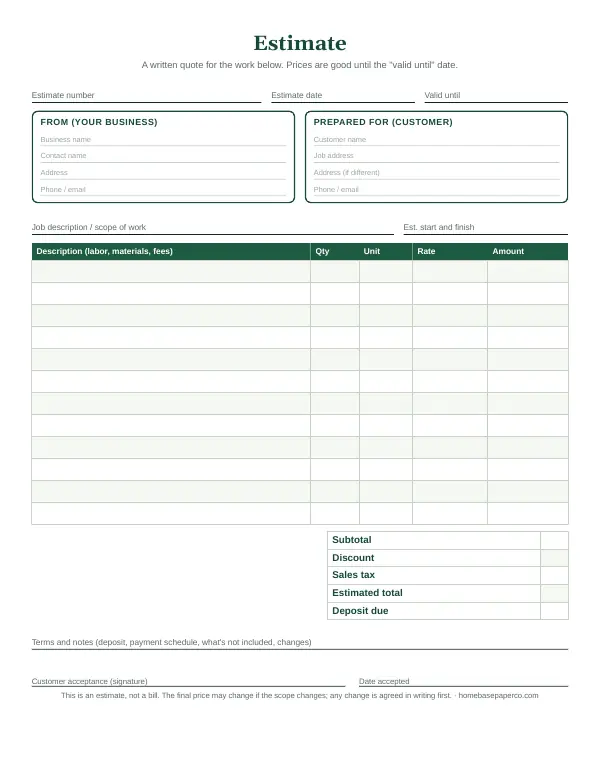
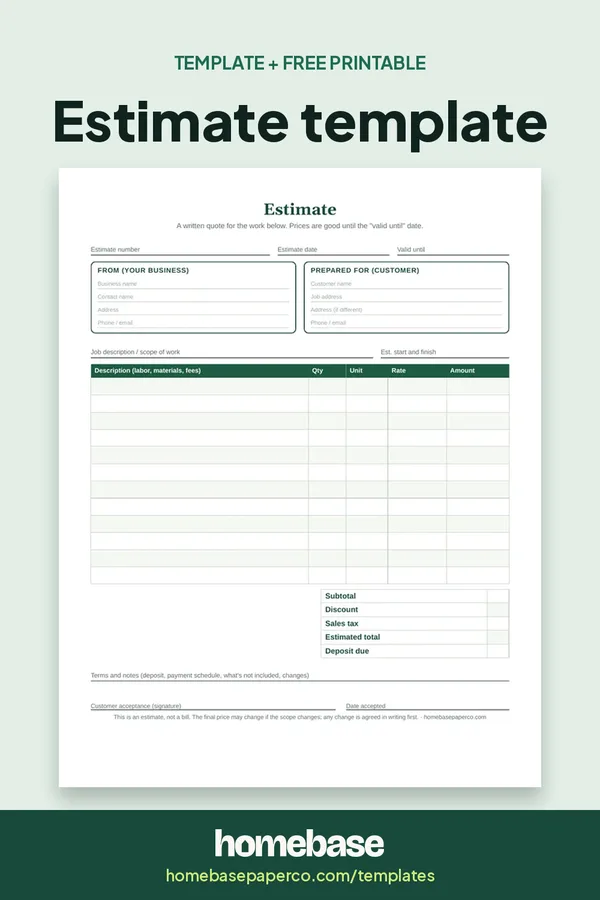
The short answer: An estimate template is a ready-made form you fill out to tell a customer what a job will likely cost before you start: the work, the materials, the labor, the price and how long the quote is good for. Our free printable estimate template gives you a one-page estimate with 12 line items, a totals box with discount, tax and deposit, and a customer acceptance line, plus an estimate log on page two.
It's made for contractors, cleaners, handymen, landscapers, photographers, bakers, makers and anyone who quotes a price before doing the work.
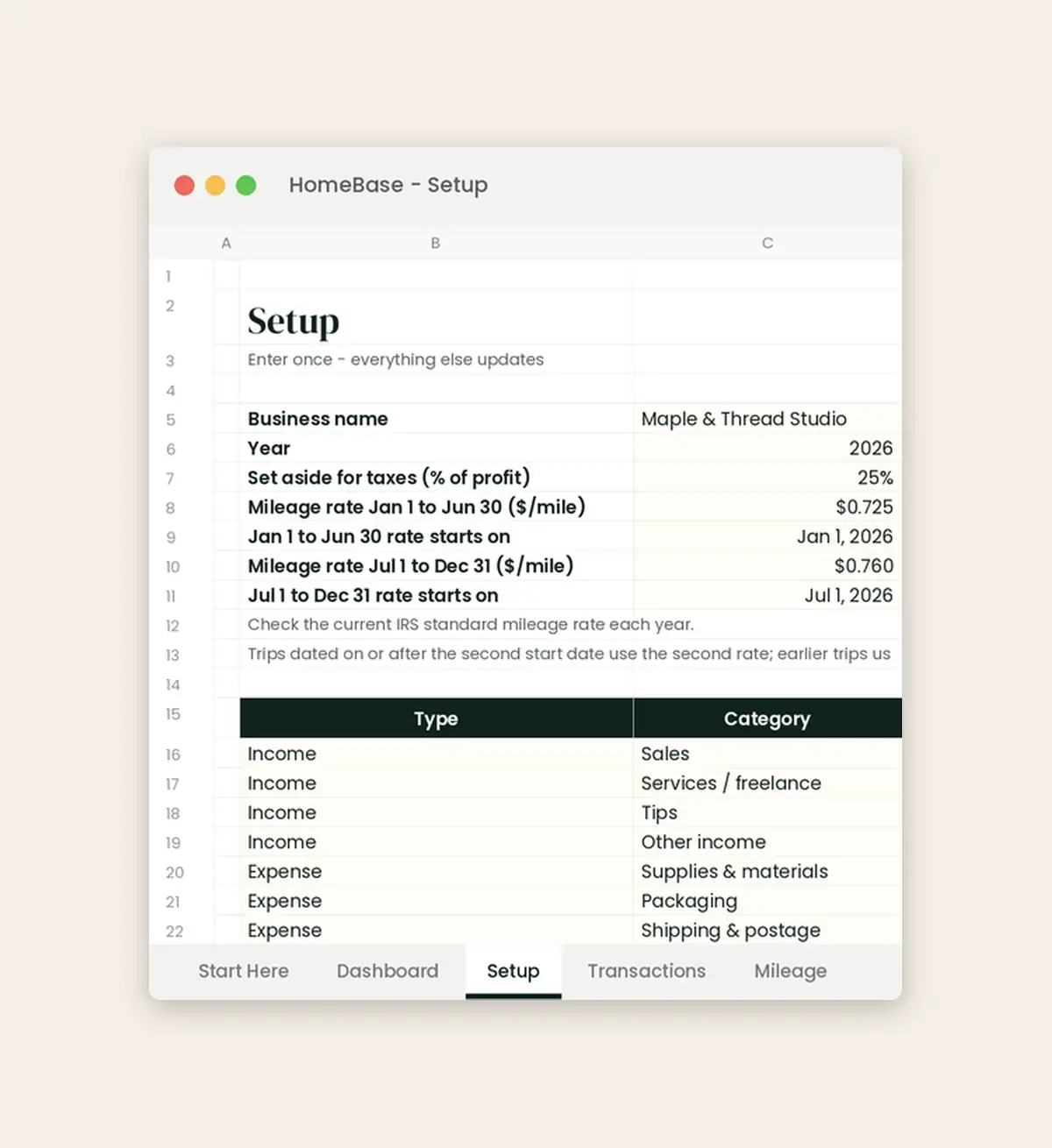
What's included in the Business Income & Expense Tracker
- Start Here guide
- Income & expense log with category dropdown
- Income / expense type fills in automatically
- Monthly profit & loss
- Mileage log with deduction estimate
- Tax set-aside estimate each month
- Year & month totals by category
- Dashboard + chart
Spreadsheet (Excel + Google Sheets), $7.99. Instant download; nothing is shipped. See every page on the product page.
Who it's for
- Contractors, painters and handymen quoting repair and remodel jobs.
- Cleaners and landscapers pricing recurring or one-time visits.
- Photographers, bakers and event pros quoting packages before a booking.
- Makers and custom-order shops pricing commissions before buying materials.
- Side hustlers who want to look professional without paying for software.
How to write an estimate, step by step
- Number the estimate. Use a sequence like E-2026-001 and never reuse a number.
- Date it and set a valid-until date. Thirty days is common, since material prices change.
- Fill in both boxes. Your business details on the left, the customer's name and job address on the right.
- Describe the scope of work. Write what you'll do in plain words, including what's not included.
- Itemize labor and materials. One line each, with a quantity, unit and rate.
- Add it up. Subtotal, discount, sales tax if it applies, estimated total and deposit.
- Write the terms, send it and log it. Add payment and change terms, ask the customer to sign, and record it on page 2.
Why use a written estimate
A written estimate sets expectations before any work begins. The customer sees exactly what's included, what it costs and what isn't covered. You get a clear record of what you promised. When the job is done, the invoice should match the estimate, or explain any change the customer already approved.
Written estimates also keep your records clean. The IRS notes that business transactions create supporting documents such as sales slips, invoices and receipts, and that you should keep them because they back up the income and expenses on your tax return. An estimate, the signed acceptance and the final invoice together tell the whole story of a job.
Small businesses use estimates to:
- Win the job. A clear, professional quote builds trust faster than a number sent by text.
- Avoid scope creep. Anything not listed on the estimate is extra and needs a new approval.
- Collect a deposit. The deposit line makes it easy to ask for money up front for materials.
- Price consistently. Your past estimates show what you charged for similar jobs.
What's on the free printable estimate template
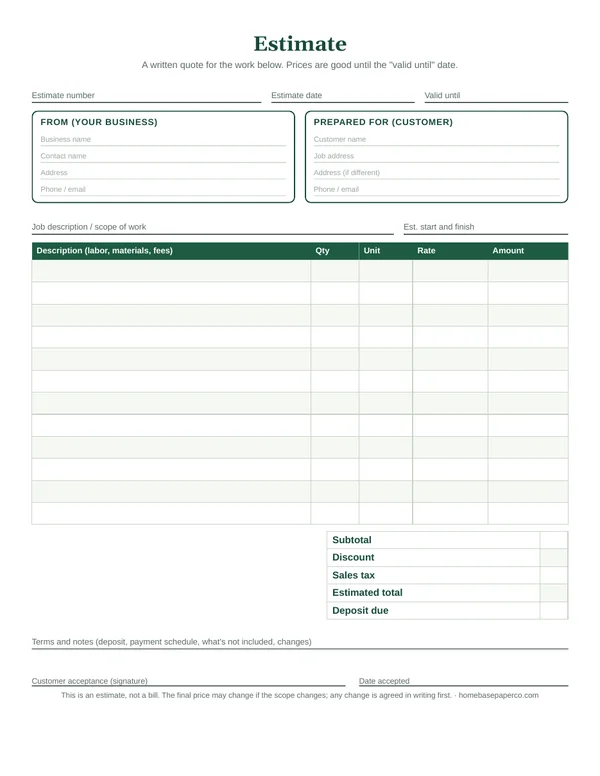
The PDF has two US Letter pages. Print page 1 for each job and page 2 to keep every quote in one place.
| Page | Section | What you fill in |
|---|---|---|
| 1. Estimate | Header | Estimate number, estimate date and valid-until date |
| 1. Estimate | From and prepared-for boxes | Your business details, the customer's name, job address and contact |
| 1. Estimate | Scope of work | A short job description and the estimated start and finish |
| 1. Estimate | 12 line items | Description (labor, materials, fees), quantity, unit, rate and amount |
| 1. Estimate | Totals | Subtotal, discount, sales tax, estimated total and deposit due |
| 1. Estimate | Terms and acceptance | Payment terms, exclusions, change rules, customer signature and date |
| 2. Estimate log | 22 rows | Estimate number, date, customer, job, amount, valid until, follow-up, accepted and invoice number |
How to write an estimate, step by step
- Number the estimate. Use a simple sequence like E-2026-001, and never reuse a number.
- Date it and set a valid-until date. Thirty days is common. Material prices change, so a quote shouldn't stay open forever.
- Fill in both boxes. Your business name and contact go on the left, and the customer's name and job address go on the right.
- Describe the scope of work. Write what you'll do in plain words, like "paint two bedrooms, walls and trim, two coats."
- Itemize labor and materials. Put each piece on its own line with a quantity, a unit (hours, square feet, each) and a rate.
- Add it up. Total the lines, subtract any discount, add sales tax if it applies, and note the deposit.
- Write the terms. Say when payment is due, what isn't included and how changes are handled.
- Send it and log it. Give the customer a copy, ask them to sign if they accept, and add the estimate to page 2.
A worked estimate example
These figures are an EXAMPLE only, made up to show how the totals work. They aren't real rates or a quote.
| Description | Qty | Unit | Rate | Amount |
|---|---|---|---|---|
| Labor: prep and paint two bedrooms (EXAMPLE) | 14 | hours | $45.00 | $630.00 |
| Interior paint, eggshell | 4 | gallon | $38.00 | $152.00 |
| Primer for patched areas | 1 | gallon | $27.00 | $27.00 |
| Tape, plastic and patching supplies | 1 | job | $35.00 | $35.00 |
| Subtotal | $844.00 | |||
| Discount (returning customer) | -$40.00 | |||
| Estimated total | $804.00 | |||
| Deposit due (25%) | $201.00 |
What this EXAMPLE shows: a painter quotes estimate E-2026-031, valid for 30 days. The customer signs, pays the $201 deposit for materials, and the painter writes "accepted" in the log. When the job is done, the invoice shows $804.00 minus the $201 deposit, so $603 is due. Sales tax is left off here because whether it applies to labor or materials depends on your state.
Estimate vs. quote vs. bid vs. invoice
People use these words loosely, but they usually mean different things.
| Document | Who sends it | When | Is the price fixed? |
|---|---|---|---|
| Estimate | The seller | Before the work | No. It's a best guess and can change if the job changes |
| Quote | The seller | Before the work | Usually yes, for the listed scope and time |
| Bid | The seller | Before the work, often in competition | Usually fixed, for a project put out to bid |
| Invoice | The seller | After the work or at billing | Yes. It's what the customer owes |
When the job is approved and done, bill it with our free invoice template, and give a receipt when you're paid. If you're the one buying supplies for the job, a purchase order puts your order in writing.
The estimate log: from sent to signed
Page 2 keeps every quote on one sheet, so you can see what's still open. Each row moves through a few checkpoints:
- Sent: the date and amount of the estimate.
- Valid until: when the price expires.
- Followed up: the date you checked in with the customer.
- Accepted: yes or no, and why if they said no.
- Invoice #: the invoice number once the job is billed.
Look at the log once a week. Open estimates near their valid-until date get a friendly follow-up. Over a few months, the log also shows your win rate and which kinds of jobs say yes most often.
How to price an estimate so it covers your costs
A good estimate covers more than materials. Before you set a rate, list:
- Direct costs: materials, supplies, rentals and any subcontractors.
- Your time: hours on site plus travel, setup and cleanup.
- Overhead: a share of insurance, software, vehicle costs and tools. For more on this topic, see our printable business templates.
- Profit: the amount left after costs, so the business can grow.
- A cushion: a small contingency for surprises, stated in your terms.
Cash timing matters, too. The SBA explains that businesses often use either the accrual or cash method to record transactions, and either way a deposit on accepted estimates helps you pay for materials before the customer's final payment arrives. Ask a tax professional which method fits your business.
Common estimate mistakes
- Leaving out the valid-until date, so a customer expects last year's price.
- Lumping everything into one line. Itemized estimates are easier to trust and to adjust.
- Vague scope. "Fix the deck" invites arguments. "Replace 6 deck boards and re-stain" doesn't.
- No change rule. Write that any extra work is approved in writing first, with its own price.
- Forgetting the deposit. Ask for one on large or custom jobs, especially when you buy materials.
- Not following up. Many estimates are lost simply because no one checked back.
When a spreadsheet makes more sense
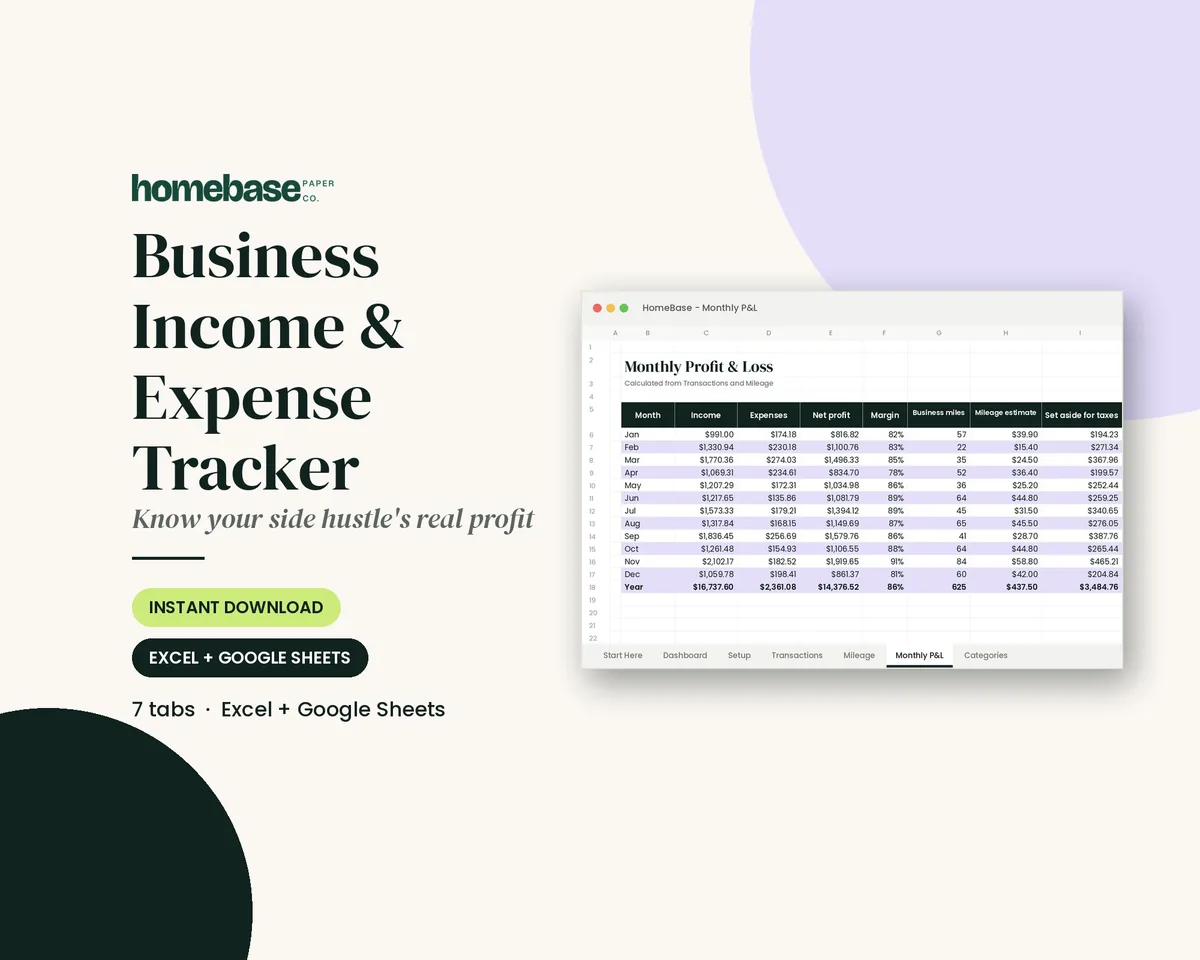
Paper estimates work well when you quote a few jobs a month. When you want to see what each job actually earned, a spreadsheet does the math for you. The Business Income & Expense Tracker ($7.99) works in Excel and Google Sheets. Log each deposit and final payment as income and each material purchase as an expense, and it shows monthly profit and category totals for tax time. If customers or suppliers pay on a schedule, the Bill Tracker Spreadsheet ($4.99) keeps due dates in view.
For planning the whole business month, see our business budget template and our small business expense tracker guide.
Ready to use
When you want every job's profit to add itself up
Spreadsheets
Business Income & Expense Tracker
Log sales, expenses and business miles - see your monthly profit, category totals for tax time and how much to set aside.
Spreadsheets
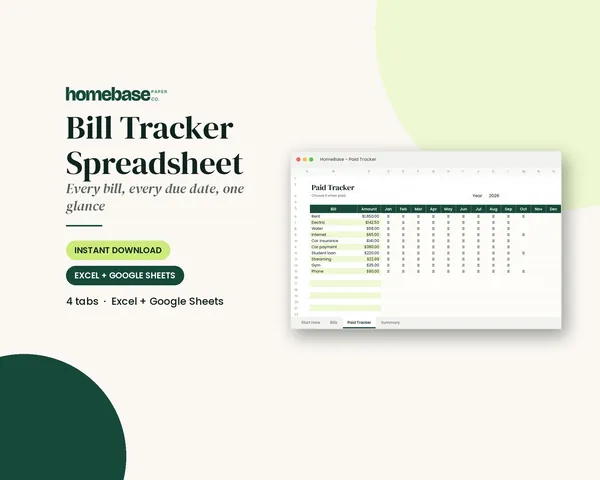
Bill Tracker Spreadsheet
Bills due in 3 days or less light up red, so nothing slips through.
 Save 57%
Bundles
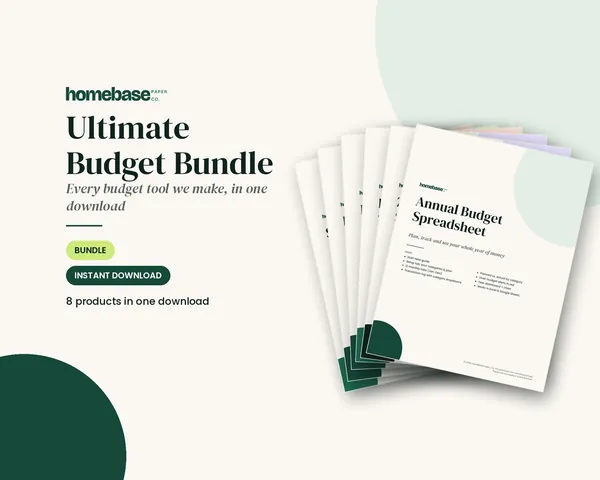
Ultimate Budget Bundle
All 6 spreadsheets + both printable planners - for less than half the price of buying them separately.
Frequently asked questions
What is an estimate template? An estimate template is a ready-made form a business fills out to tell a customer what a job will likely cost before the work starts. It lists the estimate number and date, a valid-until date, your details and the customer's, the scope of work, each line of labor and materials, the total, any deposit and a place for the customer to accept.
Is this estimate template free? Yes, this estimate template is free. Enter your email and we will send the PDF to print. Page 1 is a job estimate form with 12 line items, totals, terms and a customer acceptance line, and page 2 is a 22-row estimate log, both on US Letter paper.
What should an estimate include? An estimate should include an estimate number, the date, a valid-until date, your business name and contact, the customer's name and job address, a clear scope of work, itemized labor and materials with quantity and rate, a subtotal, any discount or sales tax, the estimated total, the deposit, payment terms, what isn't included and a signature line.
What is the difference between an estimate and a quote? An estimate is a best guess at the price, and it can change if the job turns out to be bigger or different. A quote is usually a fixed price for a defined scope, often good for a set number of days. Whatever you call it, write down what's included and how changes are handled.
What is the difference between an estimate and an invoice? An estimate comes before the work and tells the customer what the job will likely cost. An invoice comes after the work, or at billing time, and tells the customer what they owe and when it's due. The invoice should match the accepted estimate plus any approved changes.
Is an estimate legally binding? An estimate is generally a good-faith projection, not a promise of an exact final price, but a signed estimate with clear terms can become part of an agreement. Rules vary by state and by trade, and some states have specific rules for home improvement or auto repair estimates, so check local rules or ask a qualified professional for large jobs.
How long should an estimate be valid? Many small businesses make estimates valid for 15 to 30 days, and some use 60 or 90 days for larger projects. A shorter window protects you when material prices change. Write the valid-until date on every estimate so the customer knows when the price expires.
How do I write an estimate for a job? Number and date the estimate, set a valid-until date, fill in your details and the customer's, describe the scope of work in plain words, list each piece of labor and material with a quantity and rate, total it, add discount, tax and deposit lines, write your terms, and ask the customer to sign if they accept.
Should I charge for an estimate? Many small businesses give simple estimates for free because it helps win the job. Some charge a fee for complex estimates that need a site visit, measurements or design work, and credit the fee toward the job if the customer goes ahead. Say up front whether there's a fee.
Should I ask for a deposit on an estimate? Asking for a deposit is common for large, custom or material-heavy jobs, because it covers your up-front costs and confirms the customer is committed. Write the deposit amount and when it's due on the estimate. Some states limit deposits for certain trades, so check local rules.
How do I number estimates? Number estimates in order and never reuse a number. A simple system is a letter plus the year and a sequence, like E-2026-001, E-2026-002. When an estimate turns into a job, write the invoice number next to it in the log so the two documents stay linked.
Can I use this estimate template for cleaning, landscaping or photography? Yes, this estimate template works for cleaning, landscaping, photography and other services. The line items work for any service: hours of labor, square feet, visits, sessions, materials or flat fees. Cleaners, landscapers, handymen, painters, photographers, bakers, event planners and makers all use the same structure of scope, line items, total and terms.
What should I put in the terms section of an estimate? Put the deposit amount and due date, when the balance is due, accepted payment methods, what the estimate doesn't include, how changes are approved and priced, and how long the estimate is valid. Clear terms prevent most disagreements before they start.
Do I add sales tax to an estimate? Add sales tax to an estimate only if it applies to what you're selling. Whether labor, materials or both are taxable depends on your state and your type of work, so check your state's rules or ask a tax professional, and keep the same treatment on the final invoice.
Is there an estimate template for Excel or Google Sheets? Our free estimate template is a printable PDF. If you want to track what each job earns in a spreadsheet, the HomeBase Business Income & Expense Tracker works in Excel and Google Sheets and totals deposits, payments and material costs by month and category.
How do I follow up on an estimate? Follow up a few days after you send the estimate and again shortly before it expires. Keep it friendly and short: ask if they have questions and offer to adjust the scope. Note each follow-up date in the estimate log so you know which quotes are still open.
Free printable
Send clear job estimates that get approved
A printable estimate form and an estimate log. You'll also get our weekly HomeBase email with simple small business paperwork and money tips.