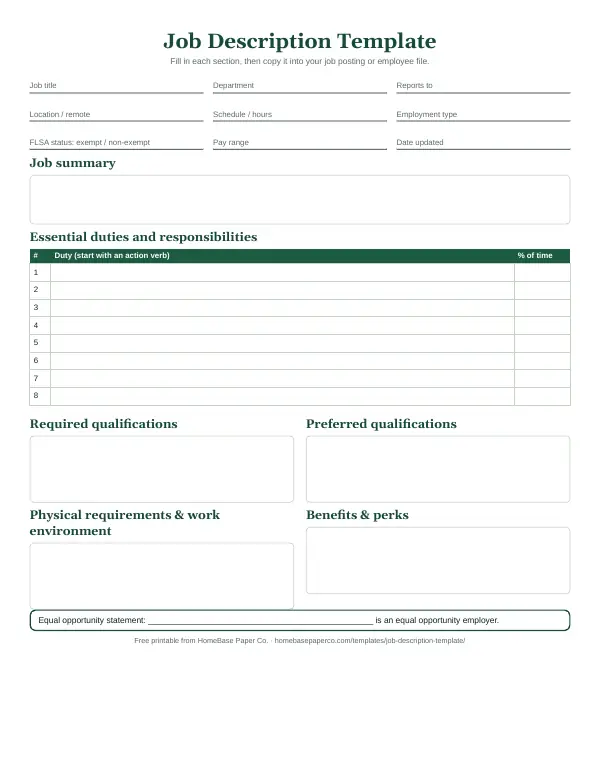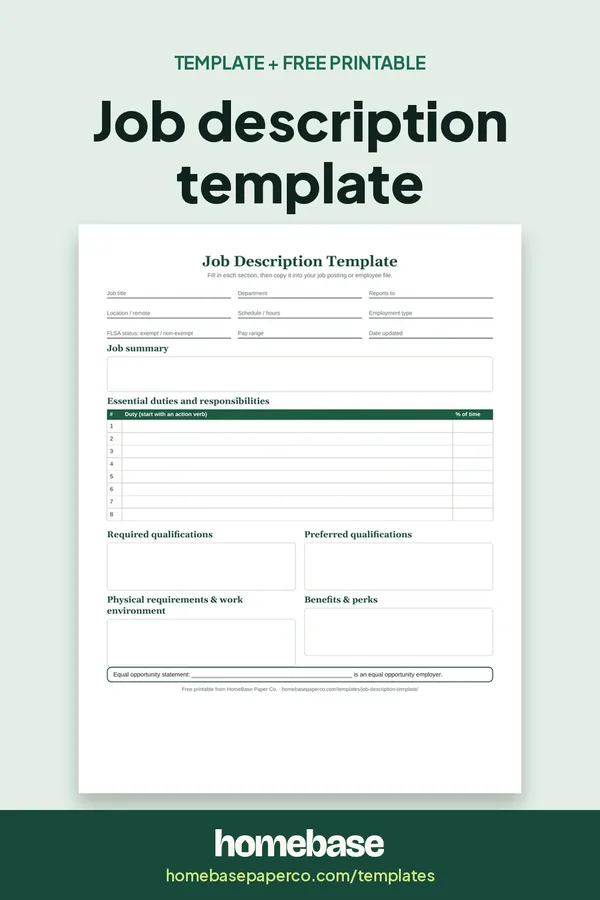
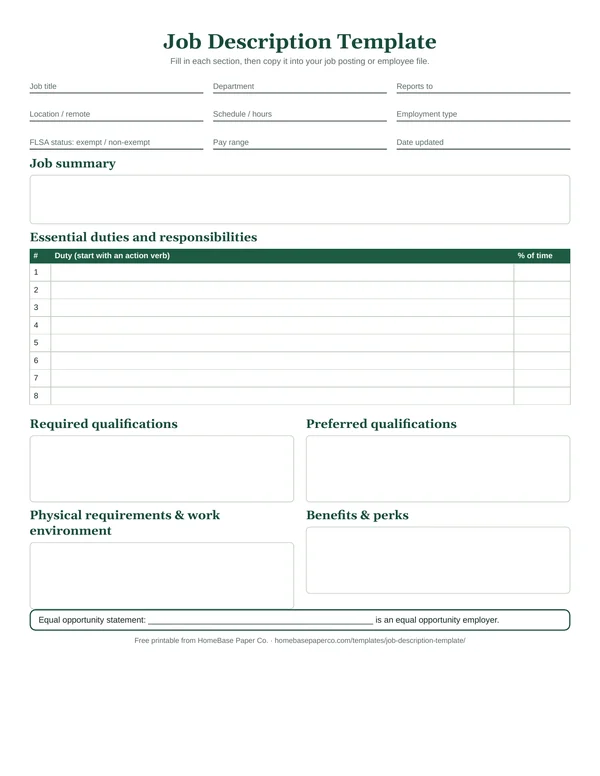
The short answer: A job description template helps you explain a role clearly before you hire: what the person will do, what skills they need, how they'll be paid and who they'll report to. Our free printable job description template is built for small businesses, with labeled sections for the job title, FLSA status, pay range, essential duties, qualifications, physical demands, benefits and an equal opportunity line.
A second page is a hiring worksheet that helps you think the role through before you write a word.
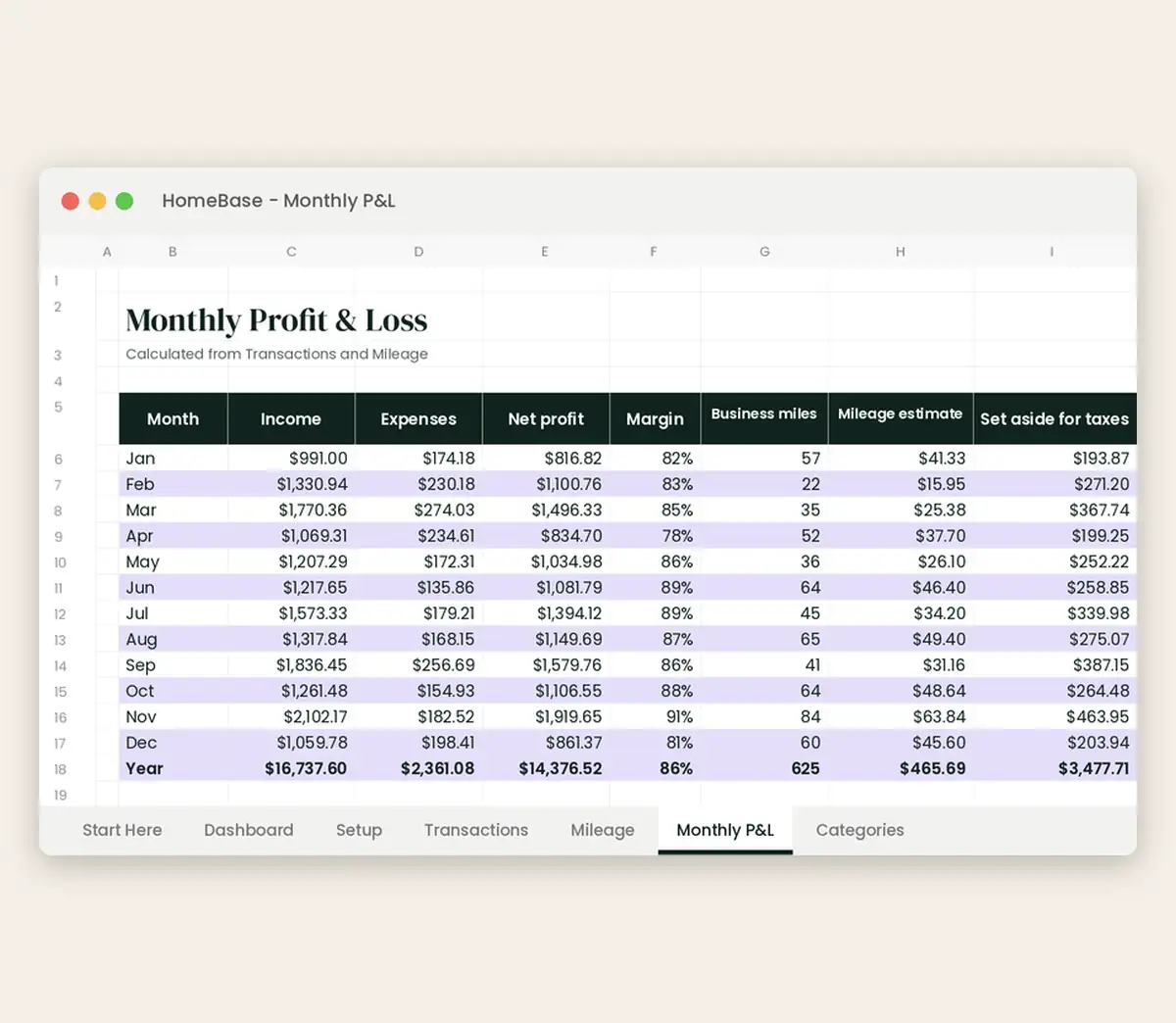
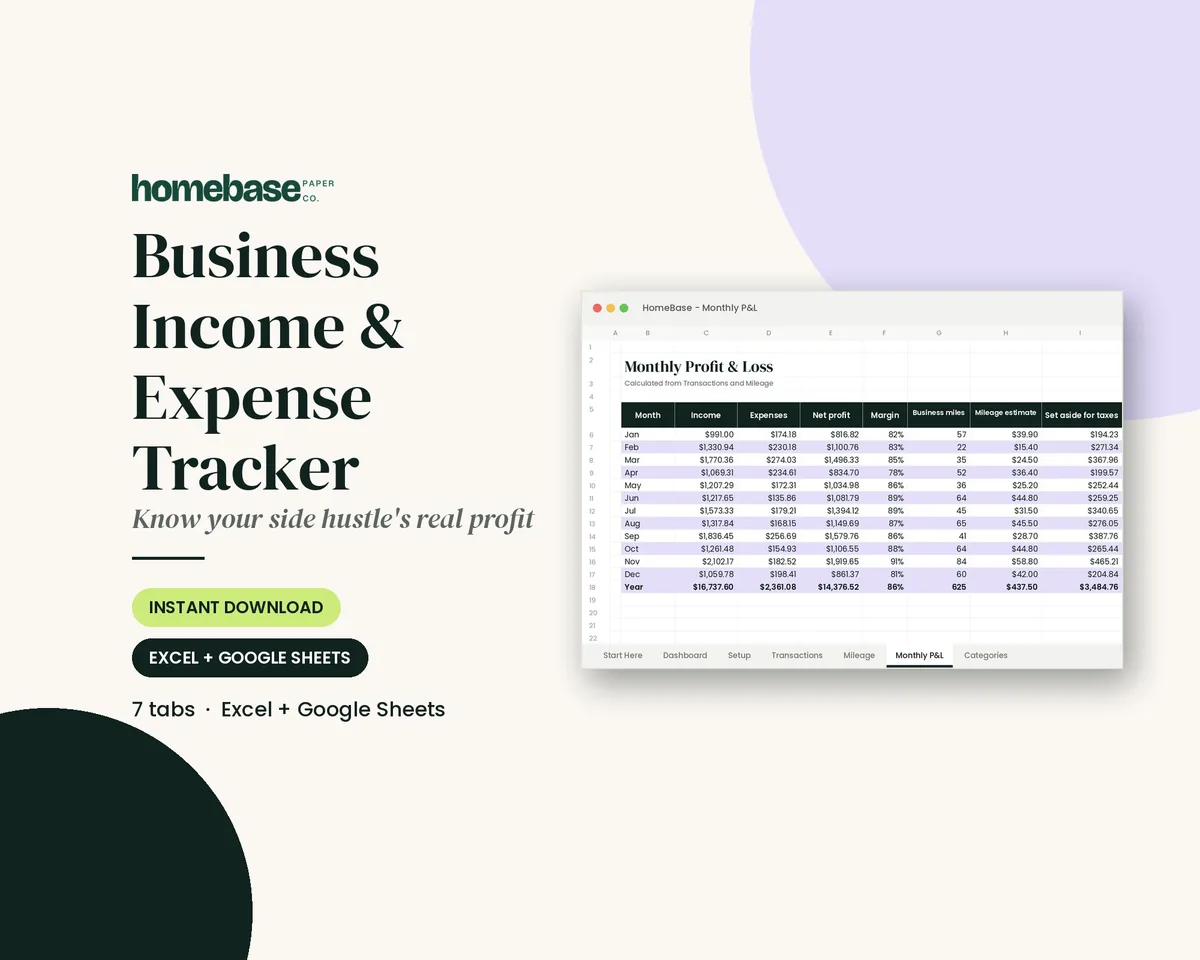
What's included in the Business Income & Expense Tracker
- Start Here guide
- Income & expense log with category dropdown
- Income / expense type fills in automatically
- Monthly profit & loss
- Mileage log with deduction estimate
- Tax set-aside estimate each month
- Year & month totals by category
- Dashboard + chart
Spreadsheet (Excel + Google Sheets), $7.99. Instant download; nothing is shipped. See every page on the product page.
Who it's for
- Small business owners hiring their first employee.
- Shop and studio owners adding part-time help for the holidays.
- Managers updating an old or missing job description.
- Nonprofits and community groups writing volunteer or staff roles.
- Families hiring a nanny, caregiver or household helper.
How to write a job description with the free template
- Answer the worksheet questions. Use page 2 to decide why you're hiring, what success looks like and what you can afford.
- Fill in the basics. Add the job title, department, manager, location, schedule, FLSA status and pay range.
- Write a short summary. Describe the purpose of the role in two or three sentences.
- List essential duties. Write five to eight duties with an action verb and the share of time for each.
- Add qualifications and conditions. List required and preferred skills, physical demands and work environment.
- Review and publish. Add benefits and the equal opportunity line, check state pay range rules, then post.
What's in the free job description template
| Page | What's included |
|---|---|
| 1. Job description template | Title, department, reports to, location, schedule, FLSA status and pay range; job summary; essential duties table with share of time; required and preferred qualifications; physical demands and work environment; benefits; EEO statement |
| 2. Job description worksheet | Seven questions on why you're hiring, what success looks like at 90 days, must-have skills, budget and schedule |
The sections of a strong job description
| Section | What to write | Example |
|---|---|---|
| Job title | A clear, common title people search for | "Retail Sales Associate (Part-Time)" |
| Basics | Reports to, location, schedule | "Reports to store owner; Sat–Sun, 16–20 hrs/week" |
| FLSA status and pay | Exempt or non-exempt, pay range | "Non-exempt, $16–$18 per hour" |
| Summary | Two or three sentences on the role's purpose | "Helps customers find gifts and keeps the shop running smoothly." |
| Essential duties | Five to eight duties with share of time | "Ring up sales and process returns, 40%" |
| Qualifications | Required vs. preferred | "Required: weekend availability. Preferred: retail experience." |
| Physical demands | What the job physically requires | "Stand for up to 4 hours; lift up to 25 lbs." |
How to write a job description, step by step
- Start with the worksheet. Write down why you're hiring and what a great first 90 days would look like.
- Pick a clear title. Use the words a job seeker would type, not an internal nickname.
- Decide FLSA status. Under federal law, non-exempt workers earn overtime at time and a half after 40 hours in a workweek. The Department of Labor's overtime pay guidance explains the salary and duties tests for exempt jobs.
- List essential duties. Begin each with an action verb and add the share of time.
- Separate required from preferred. Long "required" lists scare off good applicants.
- Add physical demands honestly. Describe what the job actually requires.
- Set the pay range and check the law. Several states, including Colorado, California, Washington and New York, require many employers to include pay ranges in postings.
Essential functions and the ADA
The essential duties section matters for more than clarity. The EEOC's guidance on reasonable accommodation under the ADA explains that employers look at whether a person can perform a job's essential functions with or without a reasonable accommodation, and a written job description prepared before you advertise can help show what those functions are. Focus on the outcome ("move stock from deliveries to shelves") rather than one way of doing it.
Borrow plain-language duties
Not sure how to describe a role you've never hired for? The Bureau of Labor Statistics' Occupational Outlook Handbook explains what workers do in hundreds of occupations, plus typical pay and training. Use it as a starting point, then rewrite the duties so they fit your business.
Make sure the budget works first
A new hire is one of the biggest costs a small business takes on. Before you post the job, look at your monthly profit and decide what you can comfortably pay, including payroll taxes.
The Business Income & Expense Tracker ($7.99) logs sales, expenses and business miles and shows your monthly profit and how much to set aside for taxes. To plan the year ahead, the Annual Budget Spreadsheet ($6.99) shows where your money goes every month. This page is general information, not legal advice; check your state's employment rules before you hire.
Ready to use
Know what you can afford before you hire
Spreadsheets
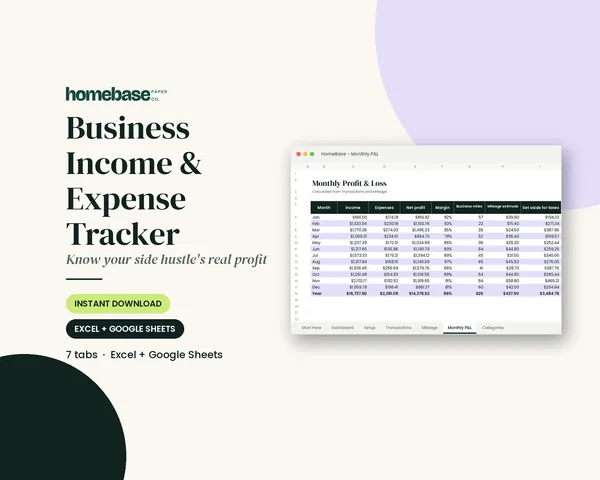
Business Income & Expense Tracker
Log sales, expenses and business miles - see your monthly profit, category totals for tax time and how much to set aside.
Spreadsheets
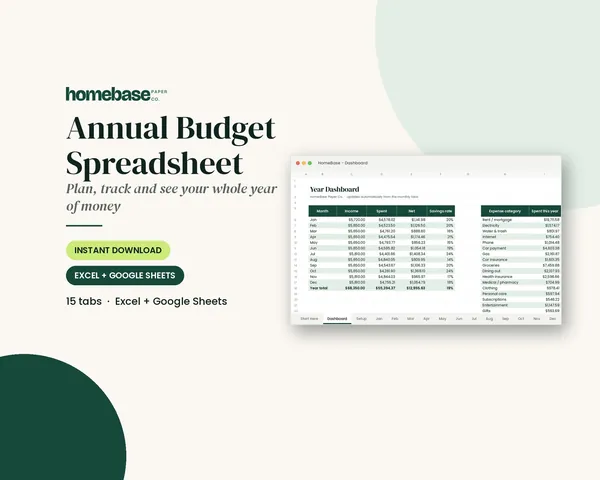
Annual Budget Spreadsheet
See exactly where your money goes every month - without complicated software.
Frequently asked questions
What should a job description template include? A complete job description template includes the job title, department, who the role reports to, location and schedule, FLSA status (exempt or non-exempt), pay range, a short job summary, the essential duties with a rough share of time for each, required and preferred qualifications, physical demands and work environment, benefits, and an equal opportunity statement. Our free printable has a labeled section for each one.
What is the difference between a job description and a job posting? A job description is an internal document that explains what the role does, who it reports to and what it takes to succeed. A job posting is the shorter, friendlier ad you publish to attract applicants. Most small businesses write the job description first, then pull the summary, top duties, qualifications and pay range into the posting.
Should I list the job as exempt or non-exempt? Under the federal Fair Labor Standards Act, non-exempt employees must be paid at least minimum wage and overtime at one and a half times their regular rate for hours over 40 in a workweek. To be exempt, a job generally has to meet both a salary test and a duties test. The Department of Labor's overtime pages explain the rules, and state laws may be stricter.
What are essential functions in a job description? Essential functions are the fundamental duties of a job, the reasons the position exists, as opposed to marginal tasks that are occasionally done. Under the Americans with Disabilities Act, employers consider whether an applicant can perform the essential functions with or without a reasonable accommodation, and a written job description prepared before advertising the job can be evidence of what those functions are.
Do I have to include a pay range in a job description? It depends on where you hire. A growing number of states and cities, including Colorado, California, Washington and New York, require many employers to include a good-faith pay range in job postings. Even where it isn't required, listing a pay range saves time for you and applicants. Check your state and local rules before you post.
How long should a job description be? Aim for one to two pages. That's long enough to explain the role, list five to eight essential duties and the must-have qualifications, and short enough that people will read it. If you find yourself listing twenty duties, group them into a few bigger responsibilities and keep the rare tasks under 'other duties as assigned.'
How do I write job duties that are clear? Start each duty with an action verb, say what the result is, and add how often it happens or what share of time it takes. 'Answer customer calls and emails within one business day, about 30% of the time' is much clearer than 'customer service.' Use the duties table on the free job description template to list each one with its percentage.
Can I find example duties for a role I've never hired for? Yes, the Bureau of Labor Statistics' Occupational Outlook Handbook describes what workers do in hundreds of occupations, along with typical education, pay and job outlook. It's a helpful place to borrow plain-language duty descriptions and check that your pay range is realistic, then adjust the details to fit your business.
Free printable
Write a clear job description in one sitting
Title, summary, duties with % of time, qualifications and pay range. You'll also get our weekly HomeBase email with simple small business paperwork and money tips.