

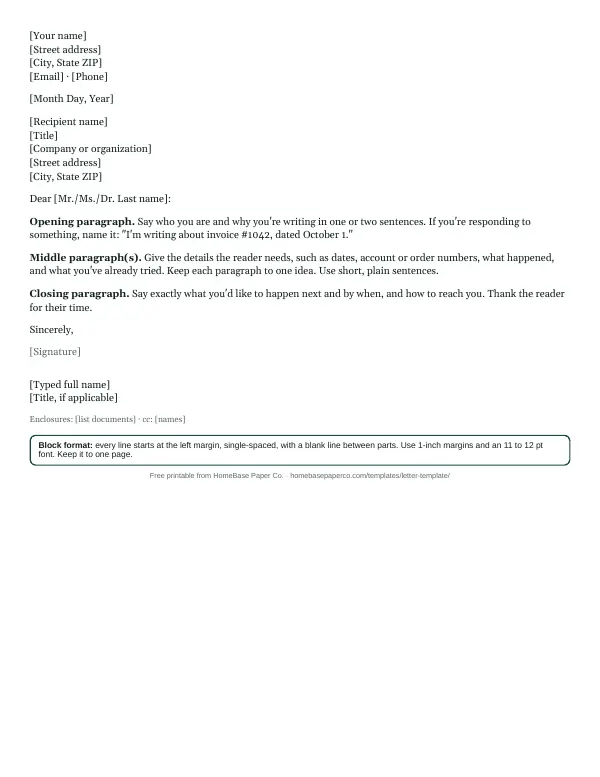
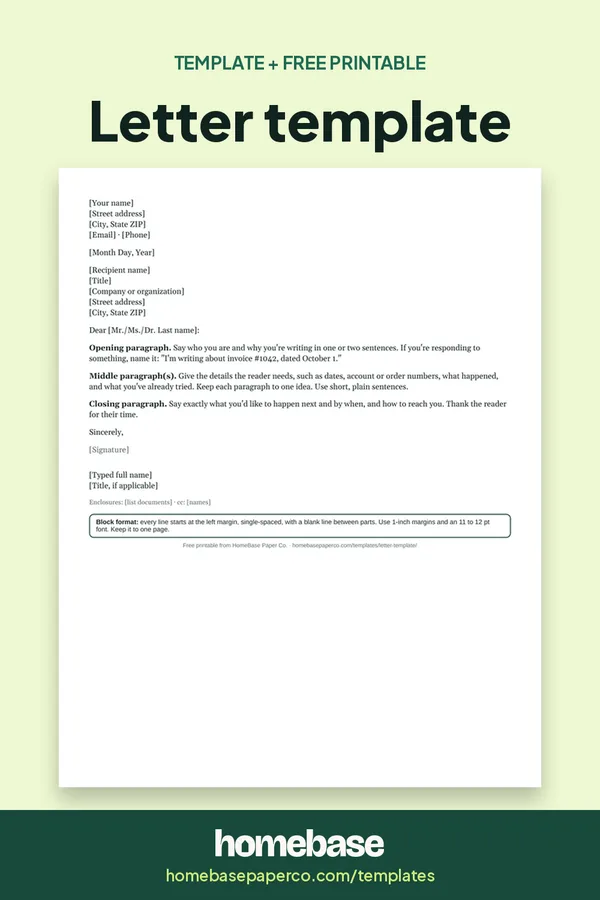
The short answer: A letter template gives you the right layout for a letter, so you can focus on what to say instead of where the date goes. Our free printable letter template has two pages: a block-format formal letter with every part labeled, and a friendly letter page with writing lines, a warm closing, a quick checklist and an envelope addressing guide.
It's made for anyone writing to a company, landlord, school or agency, students learning letter format, job seekers, and families writing holiday letters and thank-you notes this season.
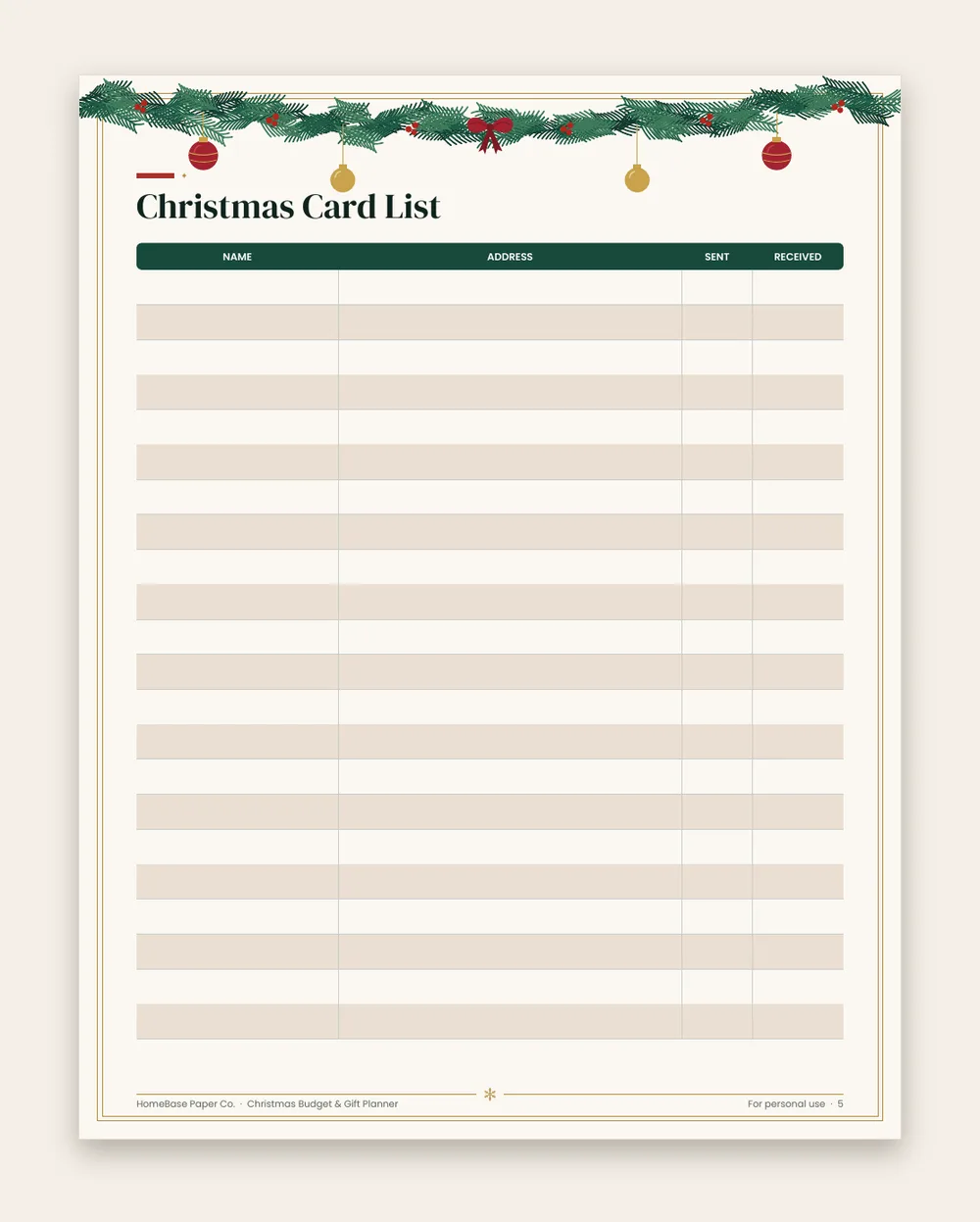
What's included in the Christmas Budget & Gift Planner
- Holiday Budget
- Gift List
- Stocking Stuffers
- Christmas Card List
- Holiday Calendar
- Holiday To-Do Timeline
- Holiday Menu
- Holiday Grocery List
- Online Order Tracker
- Notes
- Christmas budget & gift tracker spreadsheet (Excel / Google Sheets)
Printable PDF + spreadsheet, $4.99. Instant download; nothing is shipped. See every page on the product page.
Who it's for
- Anyone writing a formal letter to a company, landlord, school or agency.
- Students learning the parts of a formal and friendly letter.
- Families writing holiday letters and thank-you notes.
- Job seekers who need a clean business letter layout.
- Grandparents and pen pals who still love real mail.
How to write a letter with the template
- Choose the page. Use page 1 for a formal or business letter and page 2 for a friendly letter.
- Add the addresses and date. For a formal letter, write your address, the date and the recipient's address.
- Write the greeting. Use Dear and the person's name, with a colon for formal letters and a comma for friendly ones.
- Write the body. State your purpose first, give the details next, and end with what you'd like to happen.
- Close and sign. Add a closing, your signature and, for a formal letter, your typed name.
- Proofread. Check names, dates, numbers and spelling, and read it aloud once.
- Address the envelope. Follow the envelope guide on page 2 and add enough postage.
The parts of a formal letter
Purdue's Online Writing Lab explains that most business letters use block format, with every line flush left, single spacing and a blank line between parts. Here's the order.
| Part | What to write | Example |
|---|---|---|
| Your address | Your street, city, state, ZIP, plus email and phone | 12 Elm St., Denver, CO 80203 |
| Date | Month, day and year, written out | November 3, 2026 |
| Recipient's address | Name, title, company and address | Ms. Ana Lopez, Customer Care Manager |
| Greeting | Dear, title, last name, colon | Dear Ms. Lopez: |
| Body | Three to five short paragraphs | Purpose, details, request |
| Closing | One or two words, comma | Sincerely, |
| Signature and name | Handwritten signature, then typed name | Jordan Smith |
| Enclosures or cc | Optional notes for attachments or copies | Enclosures: receipt |
What's on the free letter template printable
| Page | What's included |
|---|---|
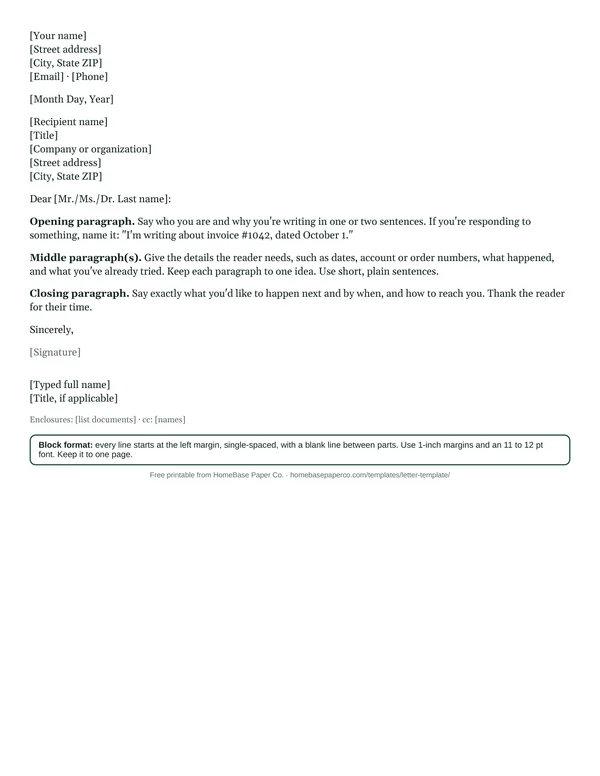
| 1. Formal letter template | A block-format letter with labeled placeholders for both addresses, date, greeting, opening, middle and closing paragraphs, signature and enclosures, plus formatting tips |
| 2. Friendly letter and envelope | A friendly letter page with a greeting, date, writing lines, closing and signature, a friendly letter checklist, and an envelope addressing guide |
How to write a formal letter, step by step
- Know your goal. Write one sentence that says what you want the reader to do.
- Find the right person. A name and title get faster answers than "To whom it may concern."
- Open with your purpose. Say who you are and why you're writing in the first two sentences.
- Give the details. Include dates, account numbers, order numbers and what you've already tried.
- Ask clearly. End with the specific action you want and a reasonable deadline.
- Keep it to one page. Attach documents instead of retelling them.
- Proofread and keep a copy. Save a copy and note the date you sent it.
Friendly letters, holiday letters and thank-you notes
A friendly letter is more relaxed: the date, a greeting like "Dear Grandma," with a comma, a few paragraphs of news and a warm closing. It's the format for holiday letters, thank-you notes after Thanksgiving dinner or holiday gifts, letters to deployed family members and notes tucked into care packages. Mention something specific, like a gift, a memory or a plan, and ask a question so they'll write back. For a family update letter, our Christmas letter template guide has more ideas.
How to address an envelope
The U.S. Postal Service's guide to sending letters and cards covers postage and sizes. For the address itself:
- Put the recipient's address in the center, your return address in the top left and the stamp in the top right.
- Print clearly, ideally in capital letters without punctuation.
- Put the city, two-letter state and ZIP code on the last line, and use ZIP+4 when you know it.
- Square cards and lumpy envelopes may need extra postage.
During the holidays, mail early. Cards to military addresses and overseas take extra time.
Keep track of holiday cards and letters
The Christmas Budget & Gift Planner ($4.99) includes a Christmas card list with name, address, sent and received columns, plus gift lists, a holiday budget and a to-do timeline. For the rest of the year, the Household Binder ($6.99) keeps important contacts and household papers in one place.
Ready to use
Keep track of holiday cards, letters and addresses
Printables
Christmas Budget & Gift Planner
Set a budget for every person, log each purchase, and watch what's left - plus printable gift, card, menu and to-do pages.

Printables
Household Binder
Family info, emergency plan, calendars, meals, groceries, cleaning, bills and sitter notes.
Frequently asked questions
What is the standard format for a formal letter? The most common format for a formal letter in the U.S. is block format. Every line starts at the left margin, the text is single-spaced, and there's a blank line between each part. The parts, in order, are your address, the date, the recipient's name and address, the greeting, the body paragraphs, the closing, your signature and your typed name.
What is the difference between a formal and a friendly letter? A formal letter is written to a business, organization or someone you don't know well, so it includes both addresses, uses a greeting like Dear Ms. Lopez with a colon, and keeps a professional tone. A friendly letter goes to family or friends, usually has only the date, uses a comma after the greeting, and sounds like you talking.
How do I start a formal letter? Start a formal letter with Dear, followed by the person's title and last name and a colon, such as Dear Dr. Patel:. If you don't know the person's name, try to find it on the company's website, or use the job title, like Dear Hiring Manager:. In the first paragraph, say who you are and why you're writing.
How should I sign off a letter? For a formal letter, Sincerely, Respectfully or Best regards are safe choices, followed by a comma, about four blank lines for your handwritten signature, and your typed full name. For a friendly letter, use something warmer, like With love, Warmly, Hugs or Talk soon. Capitalize only the first word of the closing in either case.
How do I address an envelope correctly? Write the recipient's name and address in the center of the envelope, your return address in the top left corner, and put the stamp in the top right. The U.S. Postal Service recommends printing addresses in capital letters without punctuation, with the city, two-letter state abbreviation and ZIP code on the last line. Use the ZIP+4 code when you know it.
How long should a formal letter be? A formal letter should usually fit on one page, which is about three to five short paragraphs or 250 to 400 words. Say what you need in the first paragraph, give the details in the middle, and end with the action you're asking for. If you need to include more detail, attach documents and list them as enclosures.
What font and margins should I use for a letter? Use a clean, readable font like Times New Roman, Georgia, Arial or Calibri at 11 or 12 points, with 1-inch margins on all sides. Keep everything single-spaced with a blank line between paragraphs and sections. Print on plain white paper for formal letters. For friendly letters, handwriting or a favorite stationery adds a personal touch.
Can I use this letter template for a holiday letter or thank-you note? Yes, page 2 of the free letter template is a friendly letter page with writing lines, a closing and a short checklist, which works well for holiday letters, thank-you notes, letters to grandparents or pen pals, and notes in care packages. For a family newsletter-style holiday letter, see our Christmas letter template guide too.
Free printable
Write a clear formal or friendly letter
Fill-in letter layouts with guidance for each paragraph. You'll also get our weekly HomeBase email with simple planning and home organization tips.
Sources
- Basic business letters (Purdue Online Writing Lab) owl.purdue.edu
- Send letters and cards (USPS) usps.com