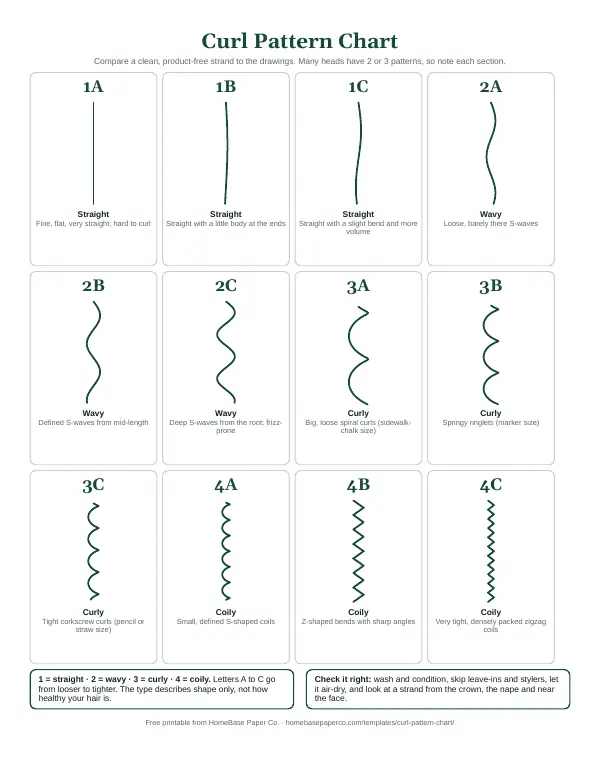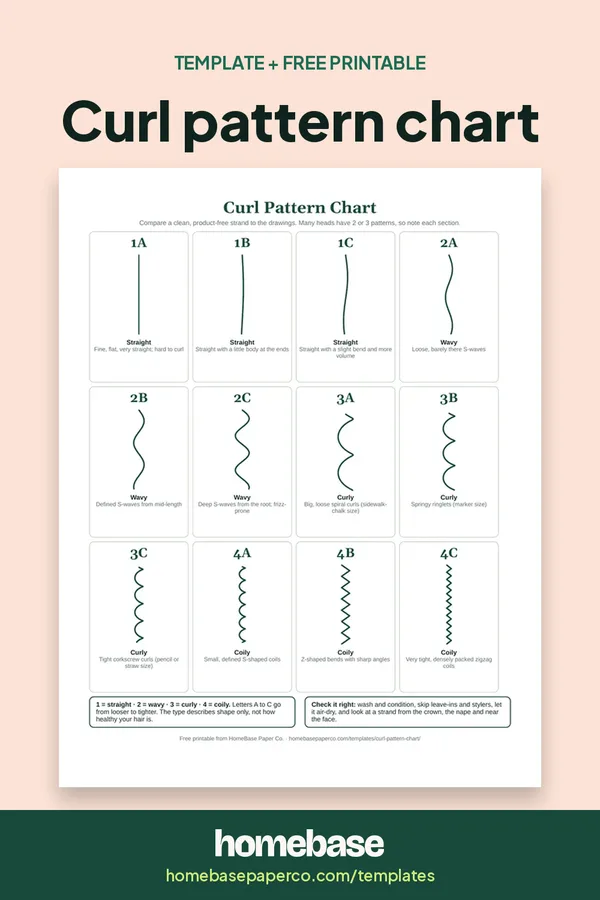
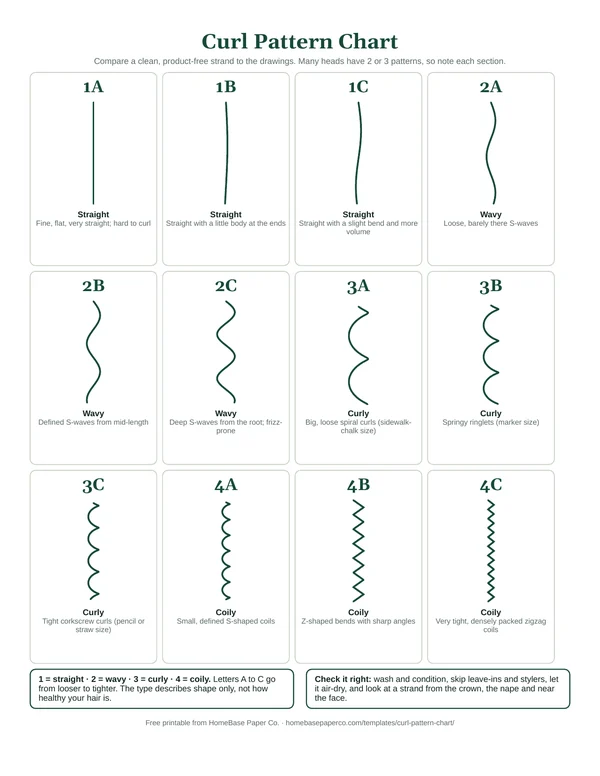
The short answer: A curl pattern chart sorts hair into four types and twelve subtypes, from 1A pin-straight to 4C tightly coiled, so you can put a name to your texture and find the right care for it. Our free printable curl pattern chart draws a strand for every type from 1A to 4C with a short description, and a second page gives you a hair profile and wash day log to track what works.
It's useful for anyone learning their curls, parents caring for a child's curly hair, and people transitioning from relaxed or heat-styled hair.
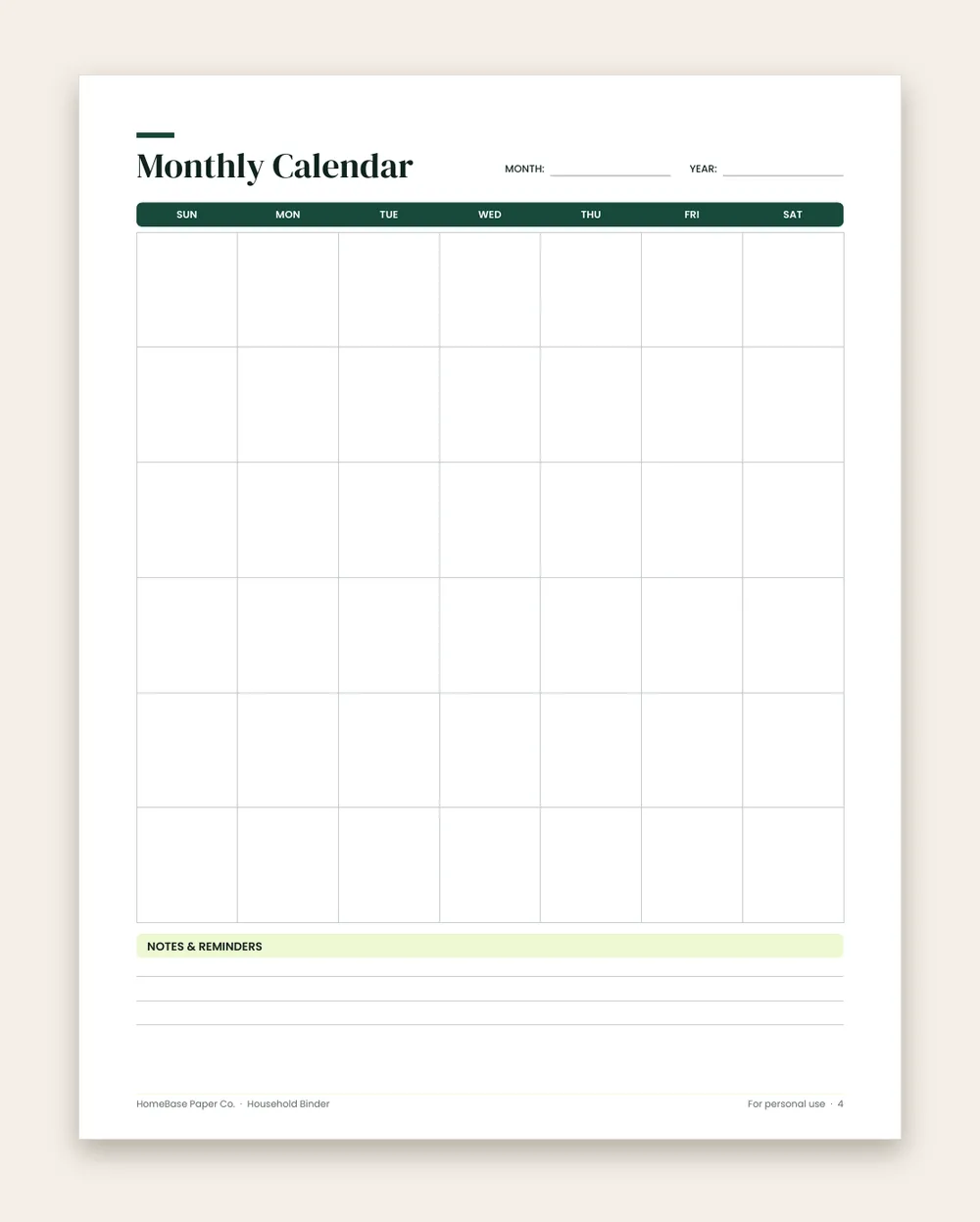
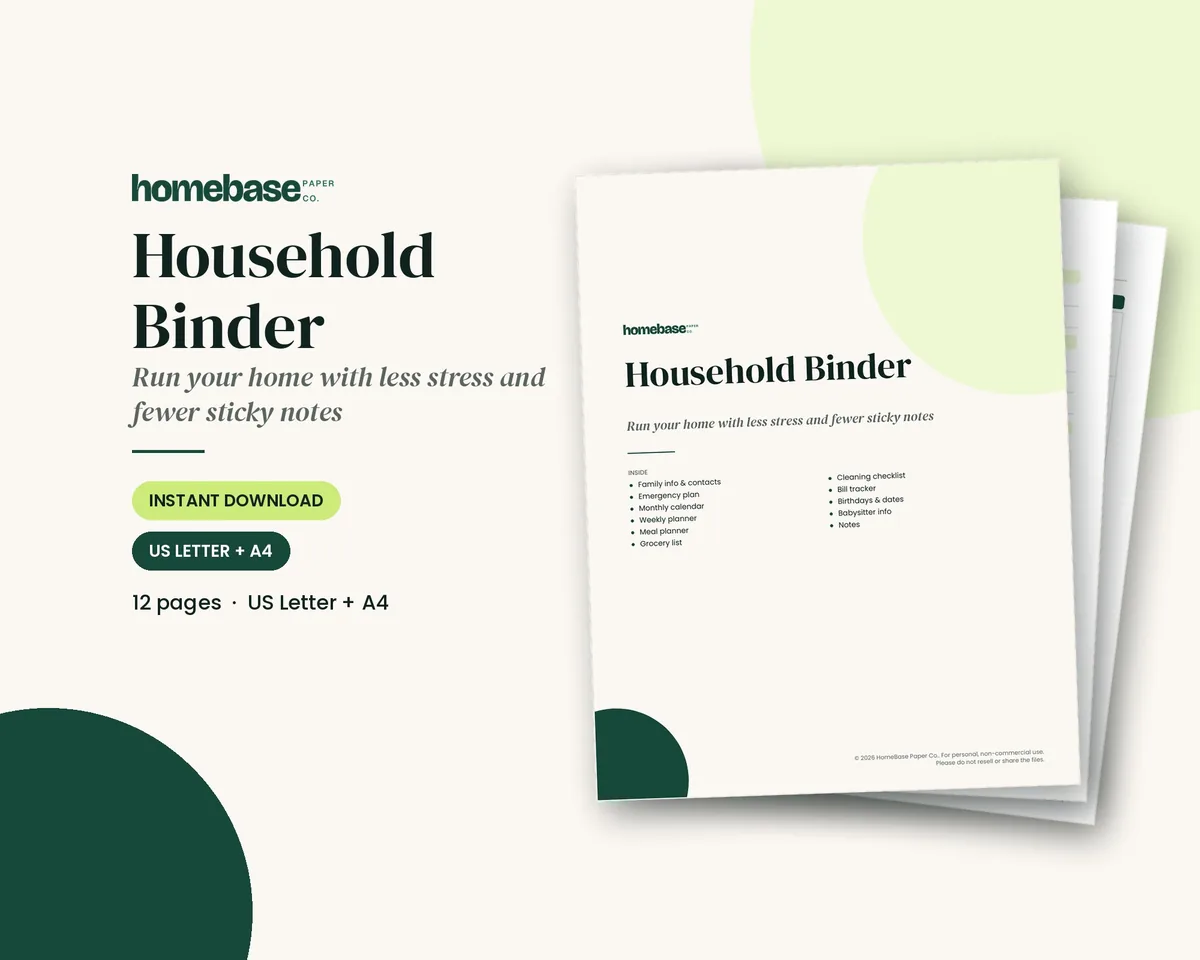
What's included in the Household Binder
- Family information
- Emergency plan
- Monthly Calendar
- Weekly Planner
- Meal Planner
- Grocery List
- Weekly Cleaning
- Bill Tracker
- Birthdays & Important Dates
- Babysitter & sitter info
- Notes
Printable PDF, $6.99. Instant download; nothing is shipped. See every page on the product page.
Who it's for
- Anyone new to curly hair care who wants to learn their type.
- Parents learning to care for a child's curly or coily hair.
- People transitioning from relaxed or heat-styled hair.
- Stylists and braiders who want a quick visual for clients.
- Families planning wash days for several heads of hair.
How to use the curl pattern chart
- Print both pages. Print the PDF on US Letter paper. Page 1 is the curl pattern chart and page 2 is the hair profile and wash day log.
- Start with clean hair. Wash and condition, skip styling products and let your hair air-dry.
- Check several areas. Look at strands from your crown, nape and front hairline.
- Match to the chart. Compare each strand to the 1A to 4C drawings and note the closest match.
- Fill in your hair profile. Record your pattern, porosity, thickness and the products you use.
- Log each wash day. Write the date, products, method and results so you can repeat what works.
The curl pattern chart at a glance
| Type | Subtypes | What it looks like |
|---|---|---|
| 1: Straight | 1A, 1B, 1C | Lies flat from root to tip; 1B and 1C have a slight bend or more body |
| 2: Wavy | 2A, 2B, 2C | Loose S-shaped waves; 2C waves start near the root and can frizz |
| 3: Curly | 3A, 3B, 3C | Defined loops, from sidewalk-chalk curls (3A) to pencil-width corkscrews (3C) |
| 4: Coily | 4A, 4B, 4C | Tight coils and zigzags with lots of shrinkage; 4C is the tightest |
What's on the free curl pattern chart printable
| Page | What's included |
|---|---|
| 1. Curl pattern chart | A drawn strand and description for all 12 types, 1A to 4C, plus tips for checking your pattern |
| 2. Hair profile and wash day log | Curl patterns, porosity, thickness and density, goals, products that work and products to skip, and a log for wash, conditioner, styler, results and next time |
How to find your curl pattern, step by step
- Wash and condition. Use your usual gentle shampoo and conditioner.
- Skip the products. No leave-in, gel or cream, so you see your natural pattern.
- Let it air-dry. Heat and diffusing can change the shape of the curl.
- Check three areas. The crown, the nape and the front hairline often differ.
- Match each strand. Compare to the chart and write the closest type for each area.
- Note porosity and thickness. These often matter as much as the pattern.
Beyond curl type: porosity, thickness and density
Two people with 3B curls can need very different routines. Porosity is how easily hair takes in and holds moisture. Low-porosity hair can feel like products sit on top, while high-porosity hair soaks up water and dries fast. Thickness is the width of a single strand, fine, medium or coarse. Density is how many strands you have. Write all three on the hair profile page so your notes stay useful.
Caring for your curls safely
Curly and coily hair is often drier and more fragile than straight hair, so gentle habits help: detangle with conditioner and your fingers or a wide-tooth comb, avoid very tight styles that pull at the scalp, and limit high heat. The FDA reminds consumers to follow the directions on hair products, especially chemical relaxers, straighteners and dyes, and to stop using a product that irritates the scalp. If you notice sudden shedding, bald spots or a painful scalp, MedlinePlus explains that hair problems can have medical causes worth checking with a doctor.
Plan wash days for the whole family
Wash day can take an hour or more for curly hair, and even longer when you're doing a child's hair too. Putting wash days, deep conditioning, trims and salon appointments on a calendar keeps the routine from sneaking up on you.
The Household Binder ($6.99) includes family calendars, meal plans, cleaning schedules and sitter notes, so wash days fit around everything else. For kids who are learning to care for their own hair, the Kids Chore Chart ($3.49) has morning and evening routine pages and a sticker reward chart.
Ready to use
Plan wash days and family routines

Printables
Household Binder
Family info, emergency plan, calendars, meals, groceries, cleaning, bills and sitter notes.
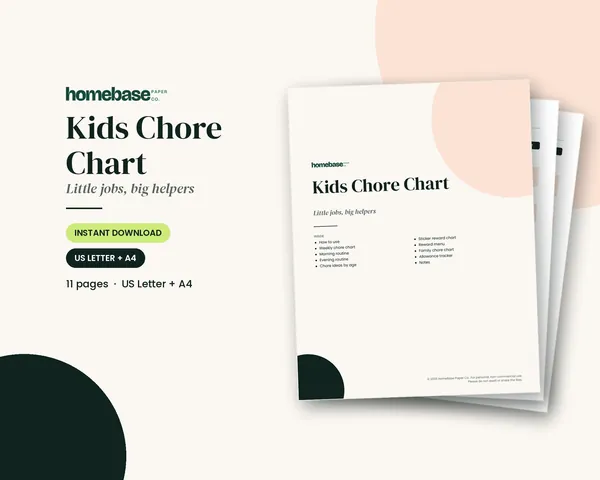 Starter pick
Printables
Kids Chore Chart
Weekly chore chart, morning and evening routines, chore ideas by age, a sticker reward chart and an allowance tracker.
Frequently asked questions
How do I read a curl pattern chart? A curl pattern chart groups hair into four types: 1 is straight, 2 is wavy, 3 is curly and 4 is coily. Each type has subtypes from A to C, where A is the loosest pattern and C is the tightest. Compare a clean, product-free strand of your hair to the drawings and pick the one that matches the shape most closely.
How do I find my curl pattern? Wash your hair with a gentle shampoo and conditioner, skip leave-in products and styling, and let it air-dry. Then look at a few strands from the crown, the nape and near your face, since those areas often differ. Match each strand to the curl pattern chart and write the results on the hair profile page of our free printable.
Can you have more than one curl pattern? Yes, and most people do. It's common to have looser waves near the face and tighter curls at the nape or crown, or a mix like 3A and 3B across the head. Heat damage, color and hormones can also change how your hair curls over time. That's why the printable has space to note the pattern in each area of your head.
What is the difference between 3A, 3B and 3C curls? 3A curls are large, loose loops about the width of sidewalk chalk. 3B curls are springy ringlets about the size of a marker. 3C curls are tight corkscrews about the width of a pencil or straw, and they often have more volume and shrinkage. All three are type 3, which means the hair forms a defined curl rather than a wave or a zigzag.
What is 4C hair? 4C hair is the tightest pattern on the curl pattern chart. Strands form very small, dense zigzags or coils that may not look defined without styling, and the hair can shrink up to most of its stretched length when dry. 4C hair is often fragile and tends to feel dry, so many people focus on gentle detangling, moisture and protective styles.
Does curl pattern tell me which products to use? Curl pattern is a helpful starting point, but it isn't the whole story. Porosity, or how easily hair absorbs moisture, along with strand thickness and density often matter just as much. Try one new product at a time, follow the label directions, and use the wash day log to note what worked so you can repeat it.
Who created the curl pattern chart? The popular 1A to 4C hair typing system is generally credited to celebrity stylist Andre Walker, who introduced a numbered hair type system in the 1990s. Stylists and the natural hair community later added the A, B and C subtypes that most charts use today. It's a descriptive tool, not a medical one, and there's no single official version.
When should I see a doctor about my hair? See a doctor or dermatologist if you notice sudden shedding, bald patches, breakage that won't stop, or an itchy, scaly or painful scalp. Hair changes can be linked to stress, illness, medicines, hormones or styling that pulls too tightly. A professional can find the cause, which a curl pattern chart can't do.
Free printable
Find your curl pattern from 1A to 4C
A printable hair type chart with drawings and descriptions. You'll also get our weekly HomeBase email with simple routines for kids, school days and family life.