

The short answer: to set financial goals, turn each wish into a monthly number. "Save more" doesn't change anything; "$1,200 for Christmas by December 1, at $100 a month" does.
- Give each goal a price and a date, then rank them
- Common order: starter emergency fund, employer retirement match, high-interest debt, known upcoming costs
- Example: a $1,000 starter emergency fund in 6 months is $167 a month
- Track progress every month
- Next step: Plan it with the Sinking Funds Tracker ($4.99).
Learning how to set financial goals is mostly about turning a wish into a monthly number. "Save more" and "get out of debt" don't change anything on their own. "$1,200 for Christmas by December 1, at $100 a month" does. Below is a simple five-step plan, a worked example you can copy, and the order most families use when there's more to do than money to do it with.
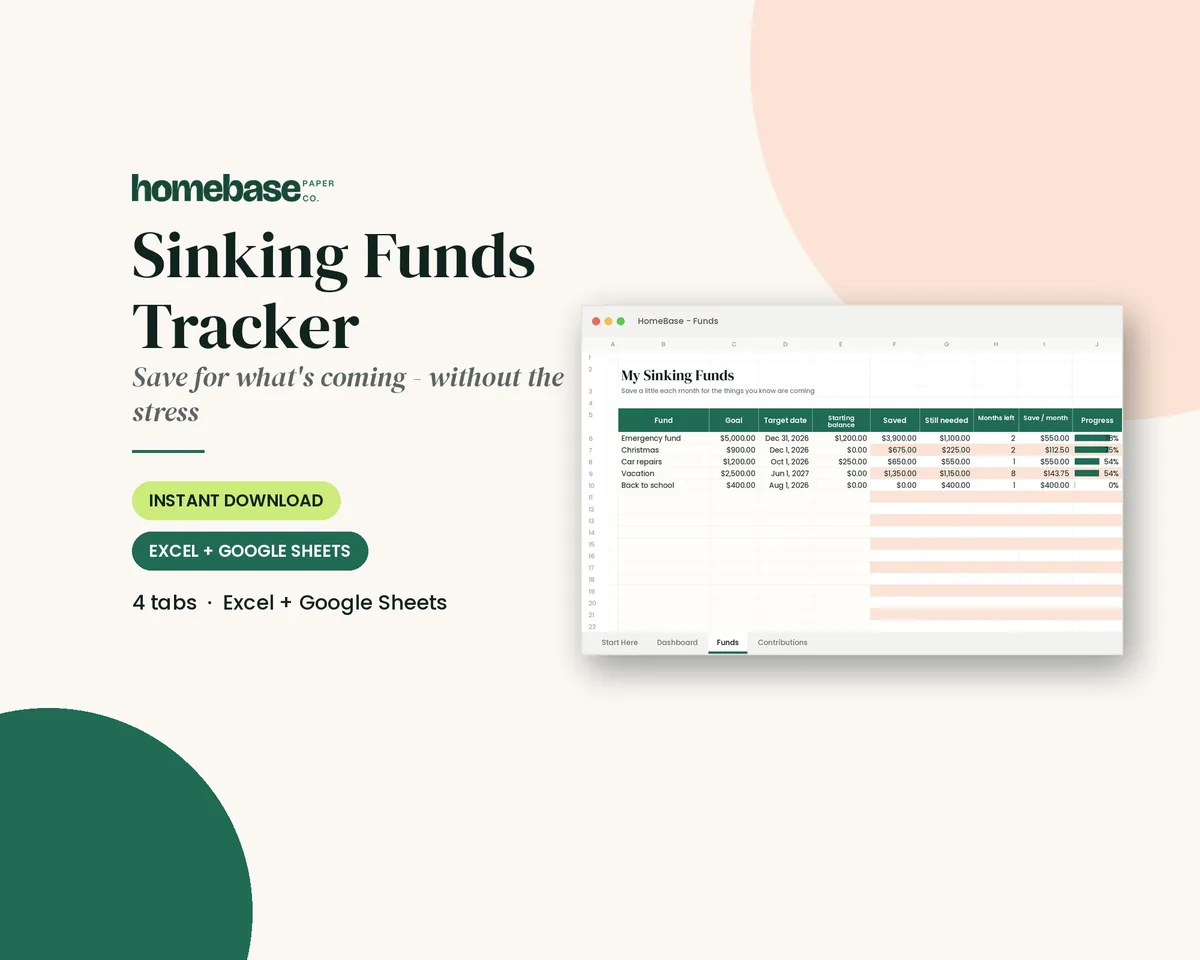
Our Sinking Funds Tracker does the monthly math in step 4 for you: enter up to 20 goals with a target and a date, and it shows how much to set aside each month, with progress bars.
Why financial goals matter
A budget tells your money where to go this month. Goals tell it where to go this year. Without them, extra money tends to disappear into small spending, and big costs like holidays, car repairs and annual bills land on a credit card. Money goals are one piece of the picture; our guide to setting goals shows how to plan health, home and career goals the same way.
Goals also make saving feel less like a sacrifice, because every transfer has a reason. The Consumer Financial Protection Bureau built its Your Money, Your Goals materials around the same idea: tools that help people set goals and work through money challenges, starting from what matters to them.
Step 1: Write down everything you want
Set a timer for ten minutes and list everything, without judging. Include the boring ones:
If you think in pictures, learn how to make a vision board and price each goal into a monthly amount.
- A starter emergency fund
- Paying off a credit card or car loan
- Christmas and birthdays (an annual gift budget)
- Car repairs and new tires
- A family trip (start with a vacation budget)
- Home repairs or a new appliance
- A down payment
- Retirement
If you share money with a partner, do this separately, then compare lists. The overlaps are your first goals.
If one of your long-term goals is extra income, our guide to passive income ideas explains what each option really takes upfront. Some goals are experiences rather than numbers; our bucket list ideas include money goals like paying cash for a trip.
Step 2: Give each goal a price and a date
A goal without a number can't be planned. Look up real costs: last year's holiday spending, a tire quote, flight prices. Then pick a realistic date.
To write each goal out in full, use our free SMART goals template: a worksheet, an action plan and a goal tracker.
For a debt goal, our free debt payoff calculator gives you a realistic debt-free date to write down.
| Goal | Type | Amount | Date | Monthly amount |
|---|---|---|---|---|
| Starter emergency fund | Short-term | $1,000 | 6 months | $167 |
| Christmas 2027 | Short-term | $1,200 | 12 months | $100 |
| Pay off credit card | Medium-term | $3,600 | 24 months | $150 + interest |
| New car fund | Medium-term | $6,000 | 36 months | $167 |
| Raise retirement savings | Long-term | +2% of pay | Ongoing | Varies |
The last column is the one that matters. Divide the amount by the months left and you have a goal you can put in a budget.
Step 3: Rank your goals
You probably can't fund everything at once. Most families use this order:
Not sure which goal comes first? The financial order of operations gives a simple ranking, from an emergency fund to retirement.
- Starter emergency fund. The Federal Reserve's household survey found that 63% of adults would cover a $400 emergency with cash or its equivalent. A cushion protects every other goal.
- Employer retirement match. Free money first.
- High-interest debt. Use the debt snowball method or the avalanche to pick the order.
- Known upcoming costs. Holidays, car repairs and annual bills, saved in sinking funds.
- Bigger long-term goals. A full emergency fund, a home, more retirement savings.
Pick one short-term, one medium-term and one long-term goal to work on now. Park the rest on a "next" list. To work on them in short sprints, try a 12 week plan for January through March.
Step 4: Build the monthly amounts into your budget
Add each goal as a line in your budget, the same as a bill. Then automate it: a recurring transfer the day after payday, as in a pay yourself first budget.
If the total doesn't fit, adjust before you start:
- Push a deadline back a few months.
- Shrink the target.
- Pause a goal until another one is finished.
For retirement goals, increases of one or two percentage points at a time are easier to absorb. For 2026 the IRS raised the 401(k) contribution limit to $24,500, so there's room to grow gradually. If you'd like help building a retirement plan, our guide to choosing a financial advisor covers fees and fiduciary duty.
Step 5: Track progress every month
Once a month, update each goal's balance. A visible tracker keeps you going in the dull middle months, when the goal feels far away.
- The Sinking Funds Tracker ($4.99) gives each goal its own progress bar, so you can watch five goals fill at once.
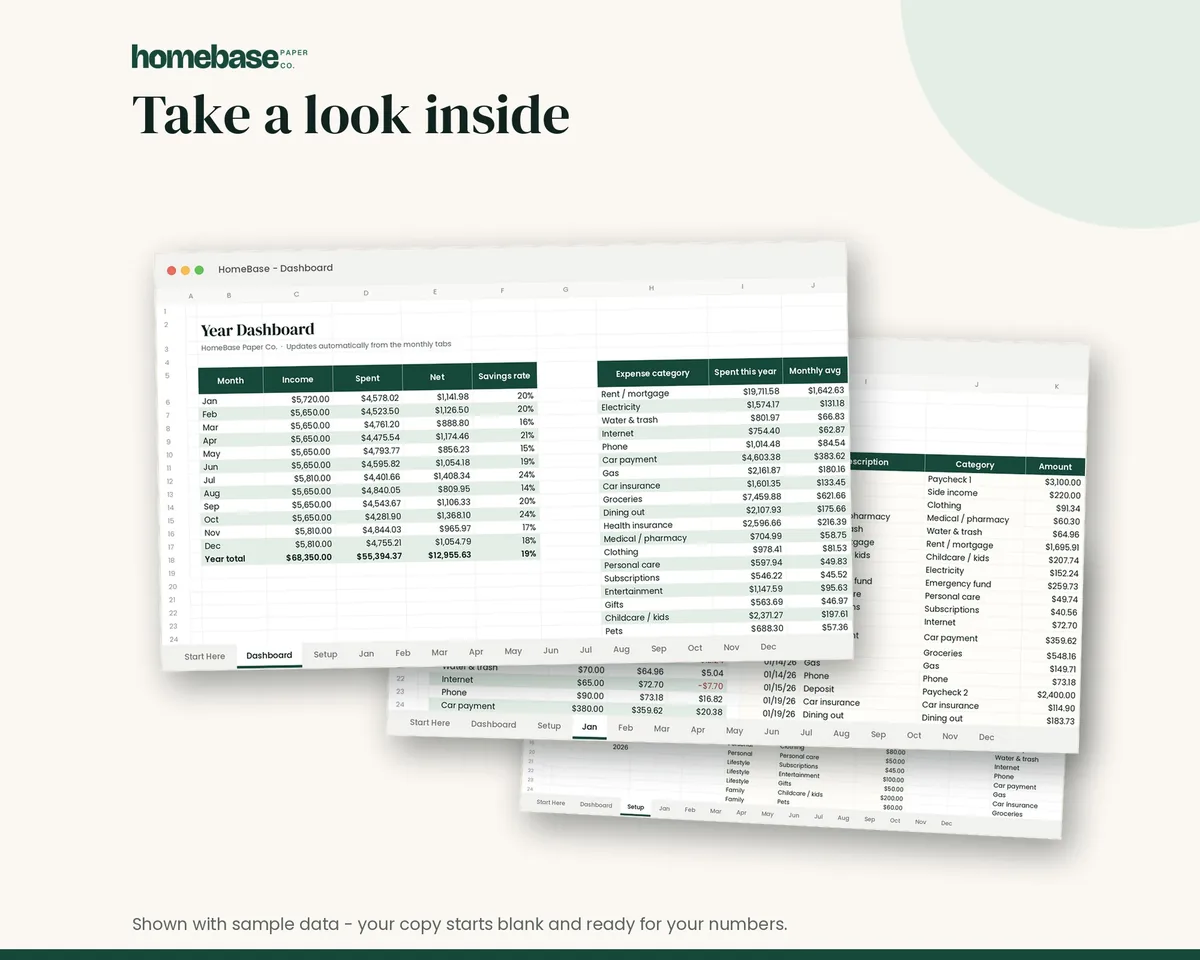
- The Annual Budget Spreadsheet ($6.99) shows the year at a glance, which is where long-term goals live.
- The Debt Payoff Planner Spreadsheet ($6.99) shows a payoff date for each debt and how extra payments move it.
Our savings goal tracker guide has more ways to chart progress, including printable coloring charts kids can help fill in.
Short, medium and long-term goals at a glance
Buying a home is a common medium-term goal; our guide on how to save for a house turns it into a monthly savings amount and a timeline.
| Time frame | Typical length | Examples | Where the money lives |
|---|---|---|---|
| Short-term | Under 1 year | Holiday fund, starter emergency fund, tires | Savings account or sinking fund |
| Medium-term | 1 to 5 years | Car fund, debt payoff, down payment | High-yield savings or extra debt payments |
| Long-term | 5 years or more | Retirement, college, paid-off home | Retirement accounts and long-term savings |
Working on one goal from each row keeps short wins coming while the big goals grow quietly in the background.
Common goal-setting mistakes
- Too many goals at once. Five goals at $20 each feel like nothing. Three at $100 each feel like progress.
- No date. "Someday" goals stay someday.
- Ignoring irregular costs. If Christmas isn't a goal, it becomes debt.
- Never celebrating. Mark the milestones: a family dinner at 50%, a small treat at 100%.
- Never revisiting. Life changes. A yearly reset, often alongside your new year budget, keeps goals current.
A one-page goal plan you can copy
Write this on one page and keep it where you'll see it:
- My three goals right now: short, medium and long term.
- Amount and date for each.
- Monthly amount for each.
- The day each transfer happens.
- Where I track progress.
- My next goal when one is finished.
Setting financial goals takes one evening. Reaching them takes a monthly number, an automatic transfer and a tracker you actually look at. For a year-end check on each goal, use the end-of-year financial checklist; more help is in our budgeting guides.
Goals work best as part of a bigger plan. Our step-by-step guide to financial planning shows how they fit together.
For quick wins you can reach within a year, see our list of short term financial goals with example targets.
Make it easier
Tools for this

Spreadsheets
Sinking Funds Tracker
It does the math: how much to set aside each month to hit every goal on time.

Spreadsheets
Annual Budget Spreadsheet
See exactly where your money goes every month - without complicated software.

Spreadsheets
Debt Payoff Planner
Pick snowball or avalanche, add any extra payment, and get your debt-free month instantly.
Frequently asked questions
How do you set financial goals? To set financial goals, write down what you want, give each goal a dollar amount and a deadline, rank the goals, and divide each amount by the months left to get a monthly number. Then build those monthly amounts into your budget and track them every month.
What are examples of financial goals? Examples of financial goals include a $1,000 starter emergency fund, paying off a credit card, saving for Christmas, a car repair fund, a down payment, a family vacation and increasing retirement contributions. Good financial goals are specific enough that you know exactly when you've reached them.
What are short-term, medium-term and long-term financial goals? Short-term financial goals take under a year, like a holiday fund. Medium-term goals take one to five years, like a car or paying off debt, and long-term goals take five years or more, like retirement or a home. Most families work on one of each at a time.
How many financial goals should I have at once? Most families do best with three financial goals at once: one short-term, one medium-term and one long-term. More than that spreads the money so thin that nothing feels like progress, which is usually when people give up.
What should my first financial goal be? For most households the first financial goal should be a small emergency fund, often $500 to $1,000. It protects every other goal, because a surprise expense gets paid from savings instead of a credit card.
What makes a financial goal SMART? A SMART financial goal is specific, measurable, achievable, relevant and time-bound. Saving $1,200 for Christmas by December 1 at $100 a month is a SMART goal; saving more money this year is not.
How do I stay motivated to reach my financial goals? Stay motivated on financial goals by tracking progress visually, celebrating milestones and automating the monthly amount. A tracker with a progress bar or a coloring chart makes small wins visible, which matters most in the middle months.
Should I save or pay off debt first? Most people build a small emergency fund first, then focus on high-interest debt, then return to bigger savings goals. That order keeps a surprise bill from adding new debt while you're paying the old debt down.
How often should I review my financial goals? Review your financial goals monthly for progress and fully once or twice a year. A monthly check catches problems early, and a yearly reset, often in January, lets you retire finished goals and add new ones.
What if I can't afford all my financial goals? If you can't afford all your financial goals, push back a deadline or shrink the target instead of quitting. Moving a vacation from June to September can cut the monthly amount by a third and keep the goal alive.
More from HomeBase
You may also like

Printables
Budget Planner Printable
Twelve undated pages you can print every month: budget, bills, spending, savings and debt.

Spreadsheets
Bill Tracker Spreadsheet
Bills due in 3 days or less light up red, so nothing slips through.

Spreadsheets
Paycheck Budget Spreadsheet
Enter your bills once. The sheet tells you which paycheck pays each one, all year.

Spreadsheets
Zero-Based Budget Spreadsheet
The 'Left to budget' counter turns green when every dollar has a job.
 Club
Monthly club
Money Club
Anyone who wants a clear plan for the month's bills, holiday spending and savings.
Free printable
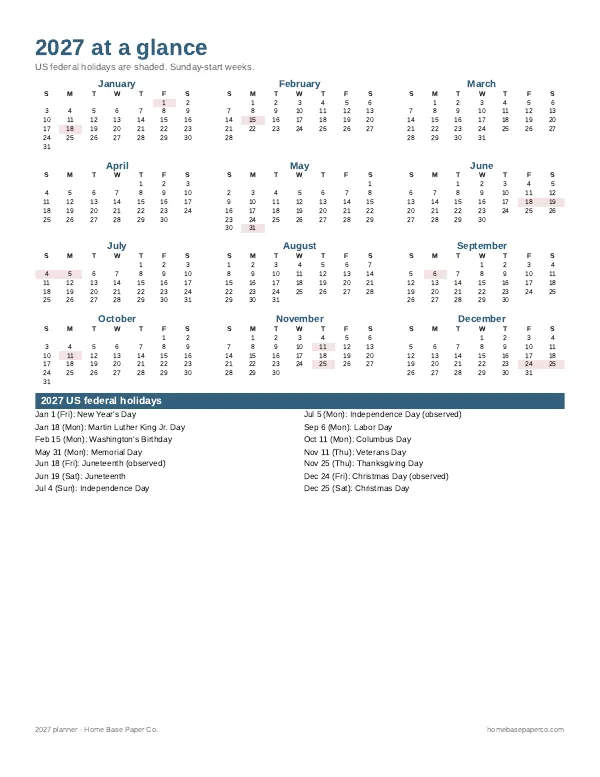
Get organized for the new year: get the free 2027 planner
A 16-page printable 2027 planner with a year-at-a-glance page and monthly calendars with US holidays marked. You'll also get our weekly HomeBase email with simple planning and home organization tips.
Sources
- Your Money, Your Goals toolkit (CFPB) consumerfinance.gov
- Economic Well-Being of U.S. Households in 2025 (Federal Reserve) federalreserve.gov
- 401(k) limit increases to $24,500 for 2026, IRA limit increases to $7,500 (IRS) irs.gov