

The short answer: disability insurance replaces part of your income if an illness or injury keeps you from working, so you can keep paying the rent or mortgage and other bills.
- Short-term: waiting period of about 0 to 14 days, and benefits usually last 3 to 6 months
- Long-term: waiting period often 90 days, and benefits can last several years or until age 65 or 67
- Where to get it: employers, a few state programs or an individual policy
- Compare: the definition of disability, benefit amount and benefit period
- Next step: Plan it with the Family Peace of Mind Bundle ($17.99).
Disability insurance protects your most valuable financial asset: your ability to earn a paycheck. If an illness or injury keeps you from working for months or years, disability insurance replaces part of your income so you can keep paying the mortgage or rent, groceries and other bills. This guide explains how disability insurance works, the difference between short-term and long-term coverage, how it compares with Social Security disability benefits, what it costs, and how to decide how much you need.
This page is general education, not insurance, legal or financial advice. Coverage rules vary by state and by policy, so always read your own policy documents. If you could not work for a while, someone else may need to find your accounts and bills fast. The Family Peace of Mind Bundle and the If Something Happens to Me Binder help you write it all down in one place.
How disability insurance works
You pay a premium, and if you become disabled as defined by the policy, the insurer pays you a monthly benefit after a waiting period, called the elimination period. Investopedia explains that benefits usually replace a portion of your income rather than the full amount. That is intentional: it keeps an incentive to return to work, and benefits from a policy you paid for with after-tax dollars are generally not taxed.
Most disabilities are not caused by dramatic accidents. Back problems, cancer, heart disease and pregnancy complications are among the common reasons people miss work for long periods, which is why disability coverage matters even if you have a desk job.
Short-term vs. long-term disability insurance
| Feature | Short-term disability | Long-term disability |
|---|---|---|
| Typical waiting period | About 0 to 14 days | Often 90 days |
| How long benefits last | Usually 3 to 6 months, sometimes up to a year | Several years, or until age 65 or 67 |
| Typical benefit | A portion of your income, set by the policy | A portion of your income, set by the policy |
| Where people get it | Employers, a few state programs | Employers or an individual policy |
| Main job | Bridge a short recovery | Protect long-term income |
A handful of states, including California, New Jersey, New York, Rhode Island and Hawaii, run or require short-term disability programs for many workers, so check what your state offers before you buy extra short-term coverage.
Disability insurance vs. Social Security disability
Social Security Disability Insurance (SSDI) is a federal program for workers who have paid into Social Security. The Social Security Administration explains that you generally must be unable to do substantial work because of a medical condition expected to last at least one year or result in death. In 2026, earning more than $1,690 a month, or $2,830 if you are blind, is generally considered substantial gainful activity, according to the SSA's SGA page; those amounts rise to $1,770 and $2,950 in 2027. There is also a five-month waiting period before benefits start, and approval can take months. For how SSDI fits with retirement and survivor benefits, see Social Security explained.
Because of those strict rules, SSDI is best thought of as a safety net, not a full income replacement. Private and employer disability insurance often has a broader definition of disability and starts paying sooner.
How much disability insurance do you need?
Start with your monthly take-home pay and your essential expenses: housing, utilities, food, insurance, transportation, minimum debt payments and child care. Then subtract any group coverage from work and any other income your household could rely on. The gap is roughly how much monthly benefit you need. Your budget is the best source for these numbers.
Your emergency fund also matters. A larger emergency fund lets you choose a longer waiting period, such as 90 or 180 days, which lowers the premium.
Key policy features to compare
- Definition of disability. Own-occupation coverage pays if you cannot do your specific job; any-occupation coverage pays only if you cannot do any reasonable job.
- Benefit amount. Usually a percentage of income, with a monthly cap.
- Elimination period. How long you wait before benefits start.
- Benefit period. How long benefits last, such as five years or to age 65.
- Partial or residual benefits. Pays part of the benefit if you can work part time.
- Cost-of-living adjustment. Raises benefits over time with inflation.
- Non-cancelable or guaranteed renewable. Protects you from cancellation or certain price increases.
- Future increase option. Lets you buy more coverage as your income grows without new medical exams.
Employer coverage vs. an individual policy
Group disability insurance through work is often cheap or free, and it is a great starting point. But it usually ends if you leave the job, it may cap benefits at a modest amount, and if your employer pays the premium, the benefits are typically taxable. An individual policy stays with you when you change jobs and can be customized, but it costs more and requires medical underwriting. Many people combine a group policy with a smaller individual policy to fill the gap.
Disability insurance in your family plan
Disability insurance pairs naturally with term life insurance: life insurance protects your family if you die, while disability insurance protects your family if you live but cannot work. Review both when you have a baby, buy a home or take on a big debt. Our financial planning guide shows where insurance fits, and our estate planning checklist lists the documents your family would need in an emergency.
Later in life, the bigger risk may be needing help with daily care. Our guide to long term care insurance explains how that coverage works.
The bottom line
Disability insurance replaces part of your income if illness or injury stops you from working. Check what your employer and state already provide, understand the limits of Social Security disability, and fill the gap with a policy that has a solid definition of disability, a waiting period your savings can cover and benefits that last long enough to protect your family.
Make it easier
Tools for this
 Save 37%
Bundles
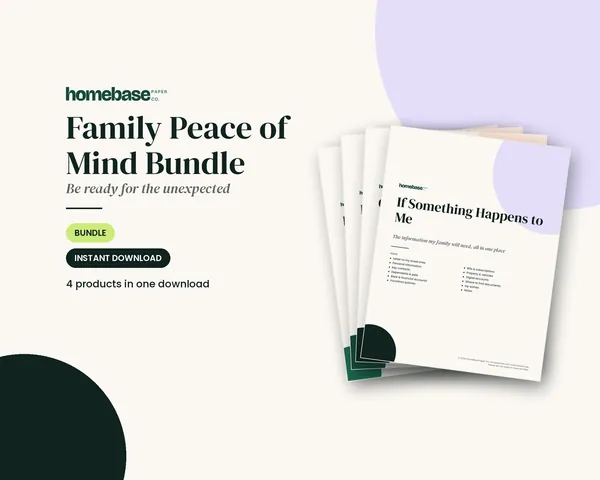
Family Peace of Mind Bundle
The If Something Happens to Me binder, Caregiver Organizer, Pet Health Records and Password Log together.
Printables
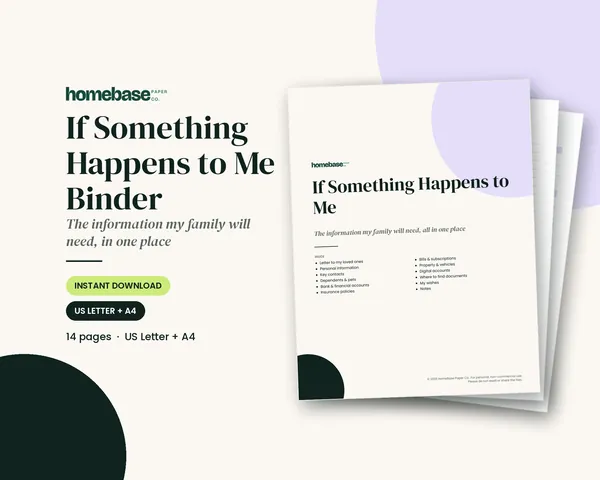
If Something Happens to Me Binder
Accounts, insurance, bills, contacts, documents and your wishes - so your family isn't left guessing.
Frequently asked questions
What is disability insurance? Disability insurance replaces part of your income if an illness or injury keeps you from working. Short-term disability usually pays for a few weeks or months, while long-term disability can pay for years or until retirement age. Benefits are often around 60% of your earnings, which helps you keep paying for housing, food and other bills while you recover.
Do I need disability insurance if I have Social Security? Social Security disability benefits have strict rules. You generally must be unable to do substantial work because of a condition expected to last at least a year or result in death, and there is a waiting period before benefits begin. Many people also find the monthly benefit is lower than they expect, so private or employer disability insurance can fill a large gap.
How much does disability insurance cost? Individual long-term disability insurance often costs a small percentage of your yearly income, but the price depends on your age, health, job, the benefit amount, the waiting period and how the policy defines disability. Group coverage through an employer is usually cheaper, and some employers pay the full premium as a benefit.
What is the difference between own-occupation and any-occupation coverage? An own-occupation policy pays if you cannot perform the main duties of your specific job, even if you could work in another field. An any-occupation policy pays only if you cannot work in any job that fits your education and experience. Own-occupation coverage is stronger and more expensive, and it matters most for specialized professions.
Free printable
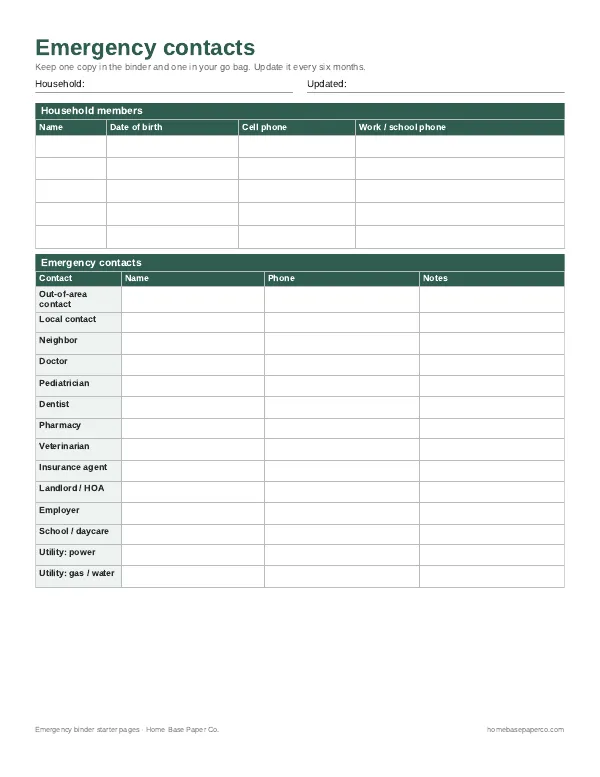
Have the important stuff in one place: get the free emergency binder pages
Printable starter pages for household members, emergency contacts, medical notes and where key documents live. You'll also get our weekly HomeBase email with simple ways to keep family records and important papers in order.
Sources
- SSA: How to qualify for disability benefits ssa.gov
- SSA: Substantial gainful activity ssa.gov
- Investopedia: Disability insurance investopedia.com