

The short answer: a Roth IRA is a retirement account you fund with money you've already paid tax on. Follow the rules and every dollar you take out in retirement, growth included, is free of federal income tax.
- 2026 limit: $7,500, or $8,600 at age 50+
- Single phase-out: $153,000 to $168,000
- Married filing jointly: $242,000 to $252,000
- Deadline for 2026: the tax filing deadline in April 2027
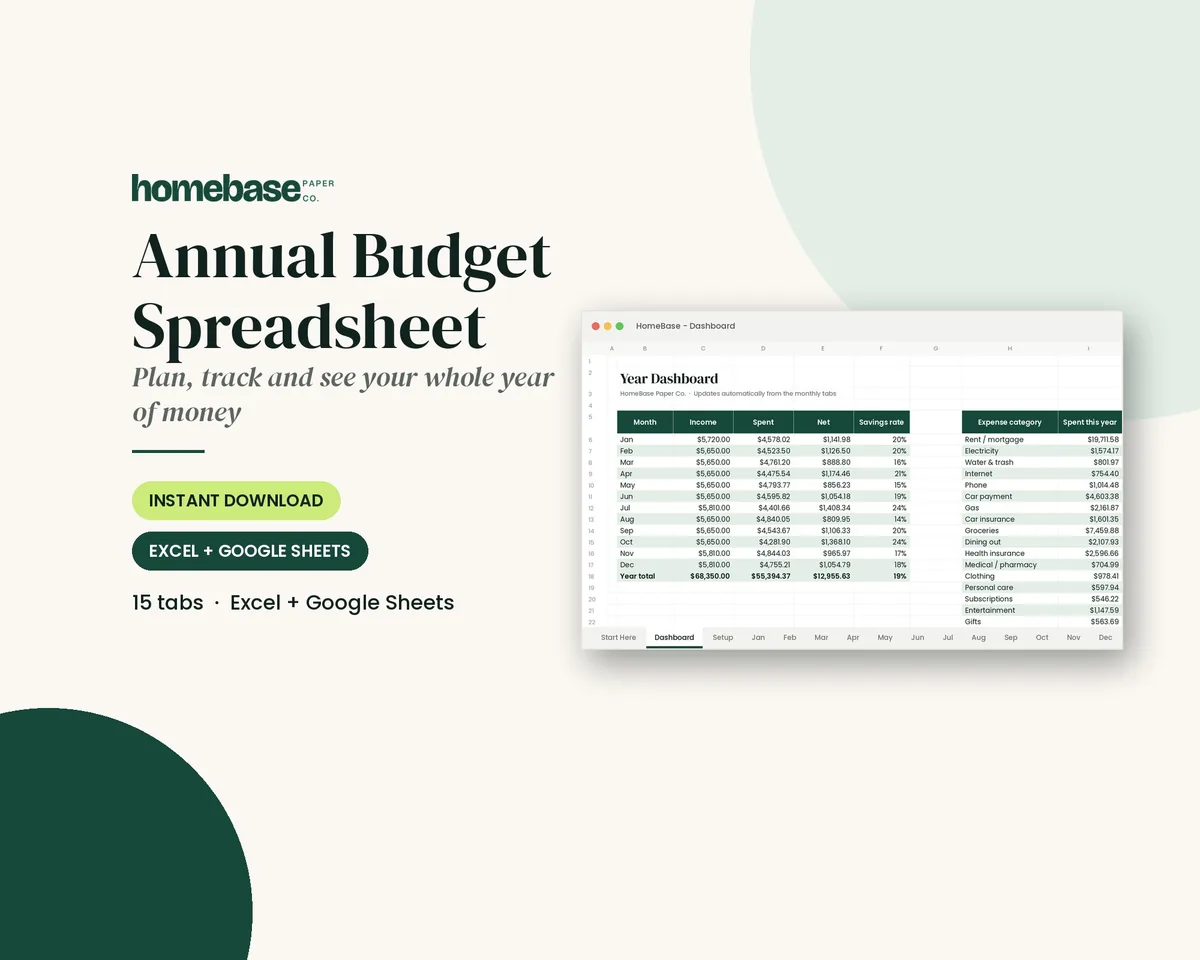
- Next step: Plan it with the Annual Budget Spreadsheet ($6.99).
A Roth IRA is one of the simplest and most powerful ways to save for retirement. You put in money you have already paid tax on, invest it, and if you follow the rules, every dollar you take out in retirement, including decades of growth, comes out free of federal income tax. This guide explains what a Roth IRA is, the 2026 contribution and income limits, how withdrawals work, and the steps to open one and start investing, even if you can only spare a small amount each month.
This page is general education, not financial, legal or tax advice. The hardest part of a Roth IRA is finding money to put in it. The Annual Budget Spreadsheet helps you plan a yearly contribution, and the Ultimate Budget Bundle helps you free up cash month by month.
What is a Roth IRA?
A Roth IRA is an individual retirement arrangement, an account you open yourself rather than through an employer. The IRS explains the key difference from a traditional IRA: contributions to a Roth are not tax-deductible, but qualified distributions are tax-free. In plain terms, you pay tax on the money today and never pay federal income tax on it again, as long as you follow the withdrawal rules.
The SEC's Investor.gov notes that a Roth IRA is a type of account, not an investment by itself. Once you put money in, you choose what to invest it in, such as index funds, target-date funds, individual stocks or bonds. The account is the tax-sheltered wrapper; the investments are what actually grow. Many beginners pick a low-cost fund that tracks the S&P 500; our explainer on what the S&P 500 is covers how it works and what it costs.
2026 Roth IRA contribution and income limits
| Rule | 2026 amount |
|---|---|
| Contribution limit, under age 50 | $7,500 |
| Catch-up contribution, age 50+ | $1,100 extra ($8,600 total) |
| Phase-out range, single filers | $153,000 to $168,000 |
| Phase-out range, married filing jointly | $242,000 to $252,000 |
| Contribution deadline for 2026 | Tax filing deadline in April 2027 |
These figures come from the IRS 2026 limit announcement. The $7,500 limit is shared across all your IRAs, so if you put $3,000 in a traditional IRA, you can put up to $4,500 in a Roth. You also need earned income at least equal to what you contribute. If your income falls inside the phase-out range, your allowed contribution shrinks, and above the top of the range you cannot contribute directly.
How Roth IRA withdrawals work
Roth IRA withdrawal rules sound complicated, but they boil down to two buckets. Your contributions, the money you put in, can come out at any time for any reason without federal tax or penalty. Your earnings, the growth on that money, are tax-free only when the withdrawal is qualified, which generally means you are at least 59 and a half and the account has been open for at least five years.
If you pull out earnings early, you may owe income tax plus a 10% penalty, though there are exceptions, such as up to $10,000 toward a first home. Another perk: the original owner of a Roth IRA does not have to take required minimum distributions, so the money can keep growing for as long as you like.
Roth IRA vs. traditional IRA
| Roth IRA | Traditional IRA | |
|---|---|---|
| Tax break | Tax-free withdrawals later | Possible deduction now |
| Withdrawals in retirement | Tax-free if qualified | Taxed as income |
| Income limit to contribute | Yes | No (deduction may be limited) |
| Required minimum distributions | None for original owner | Yes, starting in your 70s |
A Roth usually wins if you expect to be in the same or a higher tax bracket later, which is common for younger savers early in their careers. A traditional IRA can win if you are in a high bracket now and expect a lower one in retirement. If you are not sure, splitting contributions between the two is a reasonable way to hedge. Compare the current federal income tax brackets before you choose. Before splitting retirement savings between accounts, check the current 401(k) contribution limits.
How to open a Roth IRA, step by step
- Confirm you have earned income and check that your income is under the phase-out limit.
- Pick a provider, such as a major brokerage or robo-advisor, and compare fees and fund choices.
- Open the account online, which usually takes about 15 minutes.
- Link your bank account and make your first contribution.
- Choose investments, such as a low-cost target-date or broad index fund.
- Set up an automatic monthly contribution, such as $625 a month to max out $7,500. For more on this topic, see our retirement planning hub.
- Check once a year that you have not gone over the limit.
How much a Roth IRA can grow
Because growth inside a Roth is never taxed when withdrawn correctly, time is your biggest advantage. As a rough illustration, contributing $7,500 a year for 30 years with an average 7% annual return could grow to roughly $700,000, and all of it could come out tax-free in retirement. Returns are never guaranteed and will vary year to year, but the math shows why starting early matters. Our rule of 72 guide and the compound interest calculator let you test your own numbers.
Where a Roth IRA fits in your plan
Most people should take care of a few basics first. Build at least a small emergency fund so you are not tempted to pull money out early; our guide on how to build an emergency fund explains how. If your employer offers a 401(k) match, contribute enough to get the full match, then consider a Roth IRA. Pay off high-interest credit card debt along the way. Our guides on how to save for retirement and how to start investing walk through the order in more detail.
The bottom line
A Roth IRA lets you pay tax now and enjoy tax-free growth and withdrawals later. For 2026 you can contribute up to $7,500, or $8,600 at 50 and older, if your income is under the limits. Open an account, pick a simple diversified fund, automate a monthly amount and let time do the heavy lifting.
Getting help managing your IRA? Check how much a financial advisor costs first, since a yearly fee comes out of the same tax-free growth.
Make it easier
Tools for this

Spreadsheets
Annual Budget Spreadsheet
See exactly where your money goes every month - without complicated software.
 Save 57%
Bundles
Ultimate Budget Bundle
All 6 spreadsheets + both printable planners - for less than half the price of buying them separately.
Frequently asked questions
What is a Roth IRA and how does it work? A Roth IRA is an individual retirement account you fund with money you have already paid income tax on. Your investments grow inside the account, and qualified withdrawals in retirement, generally after age 59 and a half once the account has been open at least five years, come out free of federal income tax, including all of the growth.
How much can I put in a Roth IRA in 2026? For 2026, the IRS limit for total IRA contributions is $7,500, or $8,600 if you are 50 or older thanks to the $1,100 catch-up contribution. That limit is shared between traditional and Roth IRAs, and your ability to contribute to a Roth phases out at higher incomes, starting at $153,000 for single filers.
Can I take money out of a Roth IRA early? You can withdraw the amount you contributed to a Roth IRA at any time without federal tax or penalty, because you already paid tax on it. Earnings are different: taking out growth before age 59 and a half, or before the account is five years old, may trigger income tax and a 10% penalty unless an exception applies.
Is a Roth IRA or a traditional IRA better? A Roth IRA is often better if you expect to be in the same or a higher tax bracket in retirement, because you pay tax now and withdraw tax-free later. A traditional IRA can be better if you expect a lower bracket later and want a tax deduction today. Many people use both to spread out future tax risk.
What should I invest in inside a Roth IRA? A Roth IRA is just the account; you still choose the investments inside it. Many beginners use a low-cost target-date fund or a broad stock and bond index fund, which spread money across many companies. Leaving contributions in cash means missing out on most of the long-term, tax-free growth that makes a Roth valuable.
More from HomeBase
You may also like

Printables
Budget Planner Printable
Twelve undated pages you can print every month: budget, bills, spending, savings and debt.

Spreadsheets
Bill Tracker Spreadsheet
Bills due in 3 days or less light up red, so nothing slips through.

Spreadsheets
Sinking Funds Tracker
It does the math: how much to set aside each month to hit every goal on time.

Spreadsheets
Paycheck Budget Spreadsheet
Enter your bills once. The sheet tells you which paycheck pays each one, all year.
 Club
Monthly club
Money Club
Anyone who wants a clear plan for the month's bills, holiday spending and savings.
Free printable
Give every dollar a job: get the free monthly budget template
A printable zero-based monthly budget: income, bills, everyday spending and savings on one page, with a planned vs. actual column. You'll also get our weekly HomeBase email with simple budgeting and bill-paying tips.

Sources
- IRS: 2026 401(k) and IRA limits irs.gov
- IRS: Roth IRAs irs.gov
- Investor.gov: Roth IRA investor.gov