

The short answer: how much does a financial advisor cost? Most charge a yearly percentage of the money they manage, typically 0.25%, 1% or 2%, or $250, $1,000 or $2,000 for every $100,000.
- Flat fee: for example, $500 a year for an annual review
- One-time plan: for example, $2,000 for a financial plan
- Subscription: $3, $5 or $10 a month at some robo-advisers
- True cost: the advisor's fee plus fund expenses and account fees
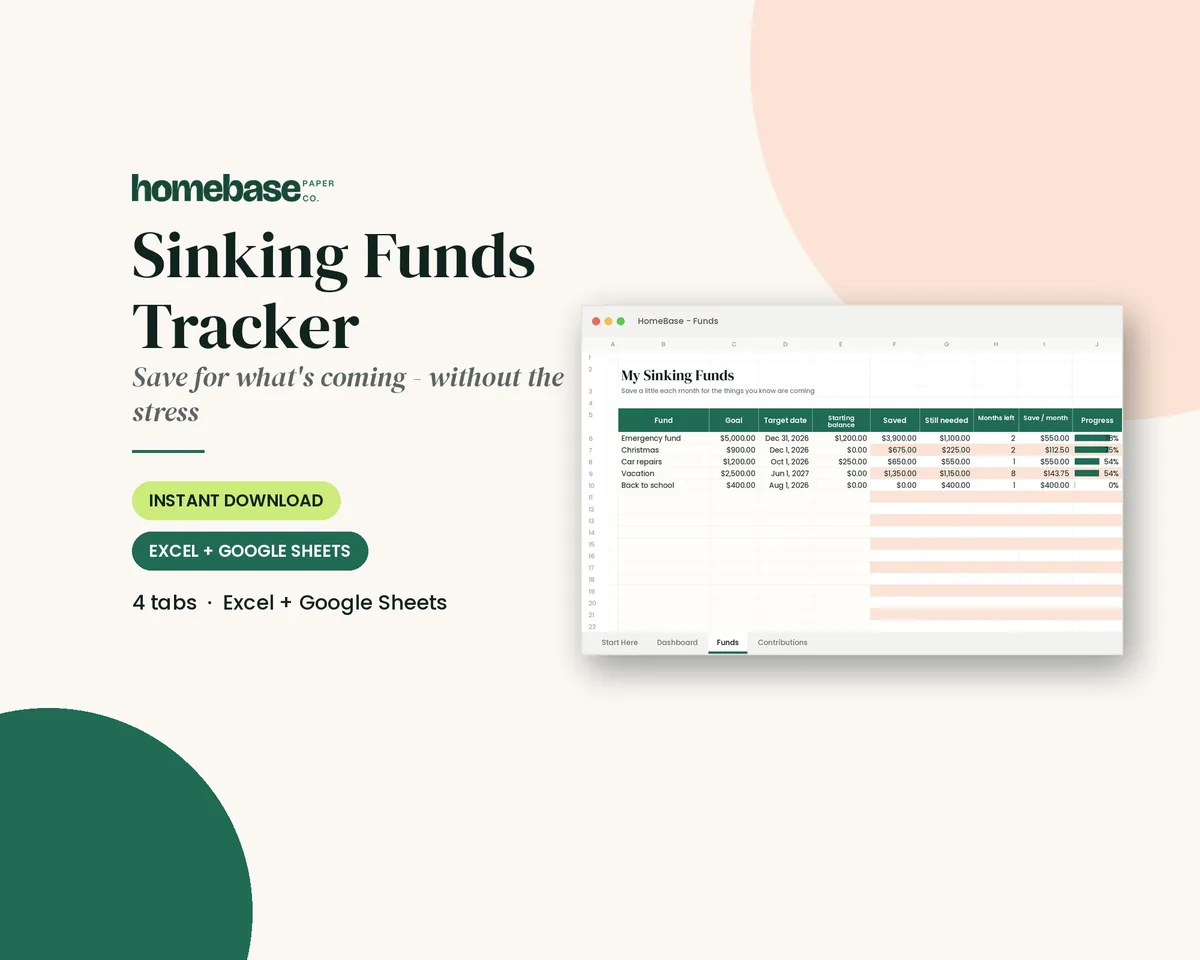
- Next step: Plan it with the Sinking Funds Tracker ($4.99).
How much does a financial advisor cost? Most advisers who manage your investments charge a yearly percentage of the money they manage. The SEC says those rates are typically stated as figures such as 0.25%, 1% or 2% a year, which works out to $250, $1,000 or $2,000 for every $100,000. Other advisors charge a flat yearly fee, a one-time fee for a written plan, an hourly rate, a monthly subscription or commissions on products they sell. Your true cost is the advisor's fee plus fund expenses and account fees, so always ask for the total in dollars.
Below you'll find every fee model in one table, what common percentages cost at real balances, how a fee grows over 10 to 30 years, a break-even formula for flat-fee vs. AUM, and a simple way to budget for advice. If you're still deciding who to hire, our guide on how to choose a financial advisor covers registration checks, fiduciary duty and interview questions. This page is all about the price tag.
Growing up the oldest of three in Detroit, I was the one who kept track of things for everybody, and I learned that a cost you can see in dollars is a cost you can actually decide on. A percentage hides the number. So that's how we'll look at every fee here. If you want those numbers in one place, the Sinking Funds Tracker ($4.99) helps you save ahead for a one-time planning fee, and the Annual Budget Spreadsheet ($6.99) shows what advice costs next to everything else you spend in a year.
Financial advisor fees at a glance
Here are the main ways advisors get paid. The examples come from SEC investor education materials, not from a survey of today's prices, so treat them as illustrations and ask each advisor for their own number.
| Fee model | How you pay | Example of what it looks like | Often a fit for |
|---|---|---|---|
| Assets under management (AUM) | A yearly percentage of your account, usually billed quarterly | 0.25%, 1% or 2% a year (SEC examples) | Ongoing investment management |
| Flat annual fee or retainer | A set dollar amount each year | $500 a year for an annual portfolio review (SEC example) | Ongoing planning with a known price |
| One-time plan (project fee) | A single fee for a written plan | $2,000 for a financial plan (SEC example) | A plan you carry out yourself |
| Hourly | Pay only for time used | Rate varies; ask for an estimate in hours | One question or a second opinion |
| Subscription | A set monthly fee | $3, $5 or $10 a month at some robo-advisers (SEC example) | Small automated accounts |
| Commission | Built into a product you buy or sell | $12 per trade, sales loads, markups (SEC examples) | Buying a specific product |
| Wrap fee | One fee that bundles advice and trading costs | Usually a percentage of assets | People who want one predictable bill |
The flat-fee, project-fee and commission examples come from the SEC's bulletin of top tips for selecting a financial professional. The percentages and subscription examples come from Investor.gov's bulletin on subscription-based advisory fees, which also says an asset-based fee is the most common way investment advisers charge.
How each fee model works
Percentage of assets (AUM). The adviser takes a slice of your balance each year, commonly billed at the end of each quarter. Because it's a percentage, the dollar amount rises as your account grows and falls when markets drop. Many firms use tiers, such as a higher rate on the first chunk of money and a lower rate above it. Many also set an account minimum or a minimum yearly fee.
Flat annual fee or retainer. You pay a set price for ongoing planning, and sometimes investment management, no matter how big your accounts are. Ask exactly what's included, such as tax-season check-ins, insurance reviews or help with a workplace retirement plan.
One-time plan. You pay once for a written plan, then follow it on your own. Follow-up questions usually cost extra, so ask how a second meeting is billed.
Hourly. You buy time for a specific question, like a rollover, a Social Security timing decision or a review of your current investments. Ask for a written estimate of the hours before you start.
Subscription. A small monthly charge looks cheap, but the SEC points out it can be a big percentage of a small account. Its example: a $3 monthly fee on a $500 balance adds up to $36 a year, which is more than 7% of the account.
Commission. You don't write a check, but you still pay. Commissions, sales loads on some mutual funds and annuities, and markups on bonds come out of your money or are built into the product's price.
Wrap fee. One fee covers advice and trading. Investor.gov's relationship summary page notes some people prefer a wrap fee program for the certainty of a single fee covering advisory services and commissions.
What a percentage fee costs in dollars
This is the table I wish every advisor handed out. The math is simply balance × rate.
| Account balance | 0.25% a year | 0.5% a year | 1% a year | 1.5% a year |
|---|---|---|---|---|
| $50,000 | $125 | $250 | $500 | $750 |
| $100,000 | $250 | $500 | $1,000 | $1,500 |
| $250,000 | $625 | $1,250 | $2,500 | $3,750 |
| $500,000 | $1,250 | $2,500 | $5,000 | $7,500 |
| $1,000,000 | $2,500 | $5,000 | $10,000 | $15,000 |
Divide any number by 12 for a monthly figure. A 1% fee on $250,000 is about $208 a month, which is a real line in a family budget even when it comes out of the investment account instead of your checking account.
How much a financial advisor costs over time
A percentage fee doesn't just cost you this year's dollars. It also takes away the growth those dollars would have earned. Here's a simple illustration: $100,000 invested once, earning a hypothetical 5% a year before fees, with the fee subtracted from the return each year. It isn't a prediction, and it leaves out fund expenses, taxes and new deposits.
| Yearly fee | After 10 years | After 20 years | After 30 years |
|---|---|---|---|
| 0.25% | $159,052 | $252,977 | $402,366 |
| 0.5% | $155,297 | $241,171 | $374,532 |
| 1% | $148,024 | $219,112 | $324,340 |
| 1.5% | $141,060 | $198,979 | $280,679 |
Over 30 years in this example, the gap between 0.25% and 1% is about $78,000. Between 0.25% and 1.5%, it's about $122,000. That doesn't mean the cheapest option always wins, because good advice can prevent expensive mistakes. It does mean you should know what you're buying with the difference.
How to calculate what your advisor really costs
Use these steps for your current advisor or any quote you're comparing.
- Find the advisory fee. It's in your advisory contract, the firm's Form CRS and its Form ADV Part 2 brochure. Investor.gov's bulletin on opening an investment advisory account suggests reading the contract to see how fees are calculated and how to cancel.
- Apply the tiers, if any. Say a firm charges 1% on the first $250,000 and 0.75% above that (a made-up schedule for this example). On $400,000, that's $2,500 + $1,125 = $3,625 a year.
- Add fund expenses. Look up each fund's expense ratio and weight it by how much you hold. If your $400,000 portfolio averages 0.20%, that's another $800 a year.
- Add account and transaction fees. Include custody, platform, trading and any annual account fees from the fee schedule.
- Total it in dollars. In this example: $3,625 + $800 = $4,425 a year, or about $369 a month, which is about 1.1% of the balance.
- Look ahead. At the same rates, the dollar fee grows as the account grows, so recheck it every year on your statement.
Flat-fee vs. AUM vs. hourly: which costs less for you?
Here's a quick break-even formula. Divide the flat fee by the percentage rate to find the balance where the two cost the same.
- A $3,000 flat fee equals a 1% AUM fee at $300,000 ($3,000 ÷ 0.01).
- A $5,000 flat fee equals a 1% fee at $500,000.
- Below the break-even balance, the percentage fee costs less in dollars. Above it, the flat fee does.
That formula only works when the services are the same. Use this table to match the model to what you need.
| Your situation | Model that often costs less | Why |
|---|---|---|
| One big question (rollover, pension choice, home purchase) | Hourly or one-time plan | You pay once, with no ongoing fee |
| You want a plan but will invest on your own | One-time plan or flat annual fee | You aren't paying for portfolio management you don't use |
| Large balance, want ongoing management | Flat fee, or negotiate a lower AUM tier | Percentage fees grow with the balance |
| Smaller balance, want ongoing management | Low AUM fee or robo-adviser | A big flat fee could be a high share of a small account |
| Buy-and-hold investor who rarely trades | Watch commission accounts closely | Investor.gov notes transaction fees may suit you if you trade rarely |
Investor.gov says an asset-based fee may cost more than a transaction-based fee, but you may prefer it if you want ongoing advice or want someone to make investment decisions for you. Cost and service always travel together.
Is a 1% financial advisor fee worth it?
A 1% fee can be worth it if you're getting real planning along with investment management, and if that help changes your decisions. It's harder to justify if all you get is a portfolio you could hold yourself in a few low-cost funds.
Ask yourself these questions before paying 1% or more:
- What will I get each year besides investment management? Tax planning, retirement income planning, insurance and estate reviews?
- How often will we meet, and who do I talk to?
- Would a one-time plan or an hourly review give me most of the value for less?
- Is the rate tiered or negotiable at my balance? Investor.gov notes that your services and fees depend on the contract you negotiate.
How to compare advisor quotes side by side
Put every quote on the same balance and the same line items. This keeps a lower headline rate from hiding extra costs.
| Compare this | Advisor A | Advisor B | Advisor C |
|---|---|---|---|
| Fee model and rate | |||
| Minimum fee or account size | |||
| Advisory fee in dollars on my balance | |||
| Estimated fund expenses in dollars | |||
| Other account fees in dollars | |||
| Total yearly cost in dollars | |||
| Services included | |||
| How the fee is paid (deducted or invoiced) | |||
| Fees to leave or transfer |
For everything beyond price, like checking registration and asking about conflicts of interest, use the questions and scorecard in how to choose a financial advisor.
How to budget for financial advice
Advice is easier to afford when it's planned like any other bill. Here's how I'd set it up.
- For a one-time plan or hourly review: decide the amount, then save toward it monthly. A $2,000 plan saved over 10 months is $200 a month.
- For a flat annual fee: divide by 12 and treat it as a monthly bill, even if you pay once a year.
- For an AUM fee taken from your account: you won't see it in checking, so write the yearly dollar amount in your annual budget anyway. That keeps the cost visible when you decide whether it's still worth it.
- Review it every January. Check last year's statements for the total you actually paid.

The Sinking Funds Tracker ($4.99) works in Excel and Google Sheets. Add a "financial plan" fund with a goal and target date, and it shows what to set aside each month and how close you are. The Annual Budget Spreadsheet ($6.99) gives you a 12-month view of income, spending and savings, so a yearly advice fee sits right next to everything else. It's also the snapshot most planners ask for at a first meeting, which can help an hourly meeting go further.
Want the whole set? The Ultimate Budget Bundle ($19.99) includes six budget spreadsheets plus the Budget Planner and Bill Tracker printables. Browse every option in Spreadsheets. Prefer to start free? The Holiday Budget Starter Kit is 3 US Letter pages, emailed to you after you join our list.
When you may not need to pay for a financial advisor
You may not need paid advice yet if you're still building an emergency fund, paying off high-interest debt or getting your monthly budget to balance. A step-by-step financial order of operations can handle that stage for free. Many workplace retirement plans also include planning tools or sessions, so check what you already have before you pay.
If you'd like to invest on your own first, how to start investing walks through the basics. Then, when a bigger decision comes up, a one-time plan or a few hours of advice can be a low-cost way to get a second set of eyes.
Not sure which kind of professional you need? Our financial planner vs. financial advisor guide explains how the roles, pay and fiduciary duty differ.
Make it easier
Tools for this
Spreadsheets
Sinking Funds Tracker
It does the math: how much to set aside each month to hit every goal on time.

Spreadsheets
Annual Budget Spreadsheet
See exactly where your money goes every month - without complicated software.
 Save 57%
Bundles
Ultimate Budget Bundle
All 6 spreadsheets + both printable planners - for less than half the price of buying them separately.
Frequently asked questions
How much does a financial advisor cost? How much a financial advisor costs depends on the fee model: SEC examples include 0.25%, 1% or 2% of assets a year, a $500 flat fee for an annual review or $2,000 for a written plan. On a $100,000 account, a 1% fee is $1,000 a year. Add fund expenses and account fees to get your true total.
How much does a financial advisor cost per year? A financial advisor charging a percentage costs balance times rate each year, so 1% on $250,000 is $2,500 and 0.5% is $1,250. Flat-fee advisors charge a set yearly price instead. Your statement or the firm's Form CRS shows what you actually pay.
What percentage do most financial advisors charge? Most investment advisers charge an asset-based fee, and the SEC gives 0.25%, 1% and 2% a year as typical examples of how those rates are stated. Many firms lower the rate as your balance grows through tiers. Always convert the percentage into dollars on your own balance.
How much does a financial advisor charge per hour? Hourly rates vary by advisor and location, so ask each one for their rate and a written estimate of the hours your question needs. Hourly advice is often the cheapest choice for a single decision, like a rollover or a review of your current investments, because there's no ongoing fee.
How much does a one-time financial plan cost? A one-time financial plan is a single project fee, and the SEC uses $2,000 for a financial plan as an example. Prices vary, so ask what the plan includes and how follow-up questions are billed. The Sinking Funds Tracker can help you save for it month by month.
Is a 1% financial advisor fee worth it? A 1% fee is worth it when you get ongoing planning that changes your decisions, not just a portfolio you could hold yourself. On $500,000 it's $5,000 a year, and over decades it can reduce growth by tens of thousands of dollars, so compare it against flat-fee and hourly options first.
How much does a 1% fee cost over time? Over time, a 1% fee costs more than the yearly bill because it also removes future growth. In a simple illustration of $100,000 earning 5% a year before fees, 30 years at 1% ends near $324,000, versus about $402,000 at 0.25%. Real results will differ.
Is a flat-fee financial advisor cheaper than a percentage fee? A flat-fee advisor is cheaper than a percentage fee once your balance passes the break-even point, which is the flat fee divided by the rate. A $3,000 flat fee equals a 1% fee at $300,000. Below that balance, the percentage fee costs less in dollars.
How are financial advisor fees paid? Financial advisor fees are often deducted straight from your investment account, commonly at the end of each quarter for asset-based fees. Flat and hourly fees are usually invoiced. Deducted fees are easy to overlook, so write the yearly dollar total into your Annual Budget Spreadsheet.
Are financial advisor fees tax deductible? For most individuals, financial advisor fees aren't currently deductible on a federal return. IRS Publication 529 lists investment fees and expenses among the miscellaneous itemized deductions you can no longer claim, apart from certain employee categories. Ask a tax professional about your situation.
Can you negotiate financial advisor fees? Yes, you can often negotiate financial advisor fees, because Investor.gov notes your services and fees depend on the contract you negotiate. Ask about lower tiers at higher balances, a lower minimum, or switching to a flat or project fee if you only need planning.
How much does a robo-advisor cost compared with a human advisor? A robo-advisor usually costs less than a human advisor, with either a low percentage or a small subscription, such as the $3, $5 or $10 a month in the SEC's examples. On a tiny balance, though, a flat monthly fee can be a high percentage, so do the math.
What is a wrap fee? A wrap fee is one fee, usually a percentage of assets, that bundles advisory services with trading costs. Investor.gov says some people prefer it for the certainty of a single fee. Compare it against paying advice and commissions separately, especially if you rarely trade.
How do I find out what my financial advisor charges? To find out what your financial advisor charges, read the firm's Form CRS, its Form ADV Part 2 brochure and your advisory contract, then check your statements for fees deducted. Add fund expense ratios on top. Ask for one yearly total in dollars in writing.
How do I budget for a financial advisor? To budget for a financial advisor, turn the fee into a monthly amount: divide a flat fee by 12, or save toward a one-time plan in the Sinking Funds Tracker ($4.99). Track deducted AUM fees in your annual budget so you always see the real cost.
Free printable
Give every dollar a job: get the free monthly budget template
A printable zero-based monthly budget: income, bills, everyday spending and savings on one page, with a planned vs. actual column. You'll also get our weekly HomeBase email with simple budgeting and bill-paying tips.

Sources
- Subscription-based Advisory Fees: Investor Bulletin (Investor.gov, SEC) investor.gov
- Investor Bulletin: Top Tips for Selecting a Financial Professional (SEC) sec.gov
- Investor Bulletin: Opening an Investment Advisory Account (Investor.gov, SEC) investor.gov
- Form CRS Relationship Summary (Investor.gov, SEC) investor.gov