

The short answer: the usual rule of thumb is about one year's salary saved for retirement by 30, plus an emergency fund covering three to six months of expenses.
- Most people under 35 have much less
- Median net worth: $33,000
- Start with a $1,000 starter emergency fund and your full employer match
- Raise your savings rate 1% every three months
- Next step: Plan it with the Debt Payoff Planner ($6.99).
How much money should I have saved by 30? It's a common question, and the usual rule of thumb is about one year's salary saved for retirement, plus an emergency fund covering three to six months of expenses. If that sounds out of reach, you're far from alone. The latest Federal Reserve data shows most people under 35 have much less. Here's what young adults really have, what the benchmarks mean and a step-by-step plan to catch up from wherever you are.
The benchmarks at a glance
| Goal | Target by 30 | Example on $55,000 salary and $3,000/month essentials |
|---|---|---|
| Retirement savings | About 1× your salary | About $55,000 |
| Emergency fund | 3–6 months of essential expenses | $9,000 to $18,000 |
| High-interest debt | $0 | Credit cards paid in full each month |
These are guidelines, not grades. Someone who started saving at 22 with an employer match can hit them. Someone who spent their 20s paying off student loans or getting through school may be just starting. Both are normal.
What people under 35 actually have
The Federal Reserve's Survey of Consumer Finances, released in October 2026 with data for 2025, is the best source on what families own and owe. For families headed by someone under 35, it found:
- Median net worth: $33,000. That's down 23% from $42,700 in 2022, after adjusting for inflation. Half of young families have more, half have less.
- Mean net worth: $135,400. The average is much higher than the median because a small number of families have a lot.
- Mean retirement savings among those with an IRA or workplace plan: $48,400. About half of the youngest families have these accounts.
For context, the median net worth of all families was $215,900, and the median balance in checking, savings and similar accounts was $8,200. For the same survey's numbers across every age group, see average savings by age.
Cash cushions are thin for young adults too. The Fed's survey data on unexpected expenses shows that in 2025, 45% of adults aged 18 to 29 and 57% of those aged 30 to 44 would cover a $400 emergency with cash or its equivalent.
So if you have $10,000 saved at 30, you're ahead of many people your age. If you have $50,000, you're above the median net worth for under-35 families. If you have nothing, you're not alone, and the plan below is for you. For a faster push, here's how to save $10k in a year.
Where your savings put you at 30
Using the Federal Reserve numbers above, here is a quick way to read your own total (cash plus retirement accounts):
| What you have saved at 30 | How to read it |
|---|---|
| Under $1,000 | Start with a $1,000 starter fund, then your employer match. You are in good company: many young adults could not cover a $400 surprise with cash. |
| About $10,000 | A solid start. Aim to grow the cash part toward three months of essentials. |
| About $33,000 | Right at the median net worth for families under 35. Check that retirement savings are growing next to cash. |
| $50,000 or more | Above the median for under-35 families. Compare the retirement part with one year of your salary. |
Not sure how big the cash part should be? Our guide to building an emergency fund walks through the target, and the savings goal tracker helps you watch it grow.
Why the one-year-salary rule exists
Retirement rules of thumb work backward from what you'll likely need. If you save about 15% of pay from your early 20s and earn reasonable returns, you'd have roughly one year's salary by 30, and much more later as compound growth takes over. The rule isn't magic; it's a checkpoint that tells you whether you're on a pace to retire comfortably.
How much to save from here
Here's what monthly saving can grow to by age 60 if you start at 30, assuming a 5% annual return compounded monthly. Returns vary, so treat these as illustrations.
| Saved each month from 30 | Value at 40 | Value at 50 | Value at 60 |
|---|---|---|---|
| $100 | $15,528 | $41,103 | $83,226 |
| $250 | $38,821 | $102,758 | $208,065 |
| $500 | $77,641 | $205,517 | $416,129 |
The earlier you start, the more the growth does for you. Every year you wait means you need to save more each month to reach the same result.
Targets by salary
Here's what the benchmarks look like at different incomes. Essential expenses vary a lot by where you live, so swap in your own number for the emergency fund.
| Salary | Retirement target (1×) | Essentials per month (example) | Emergency fund (3–6 months) |
|---|---|---|---|
| $40,000 | $40,000 | $2,200 | $6,600–$13,200 |
| $55,000 | $55,000 | $3,000 | $9,000–$18,000 |
| $70,000 | $70,000 | $3,600 | $10,800–$21,600 |
| $90,000 | $90,000 | $4,300 | $12,900–$25,800 |
If you're far below the retirement target, don't panic. Look at your savings rate instead. If you're saving 15% or more of pay today, including any employer match, you're on a solid path even if your balance is low.
What counts as "saved"?
When you compare yourself with a benchmark, be clear about what you're counting:
- Counts toward retirement: 401(k), 403(b), IRA, Roth IRA and similar accounts, including the employer match.
- Counts toward your emergency fund: cash in savings, money market or checking accounts that you can reach quickly. Not money in a 401(k).
- Doesn't count as savings: home equity, a car, or money set aside for a planned purchase, like a wedding or a vacation. These matter for net worth, but you can't use them for an emergency without selling something.
Keeping the buckets separate keeps you from feeling "saved up" when your cash cushion is actually small.
Milestones after 30
Rules of thumb often extend the one-year-salary idea: about three times your salary by 40, six times by 50 and eight to ten times by retirement. These assume you keep saving around 15% of pay and earn typical long-term returns. If you're behind at 30, the gap is easiest to close now, while you have the most years for growth.
A catch-up plan by your savings level
If you have nothing saved
- Build a $1,000 starter emergency fund. Even $25 or $50 per paycheck adds up fast. Set up an automatic transfer.
- Get your full employer match. If your employer matches 401(k) contributions, contribute at least enough to get every dollar.
- List your debts. Put extra money on high-interest credit cards first.
- Raise your savings rate 1% every three months.
If you have an emergency fund but little for retirement
- Increase retirement contributions to 10% to 15% of pay, including the match. The IRS allows up to $24,500 in 401(k) salary deferrals in 2026, so there's plenty of room.
- Save half of every raise.
- Keep growing your emergency fund toward three months.
If you're on track
- Build sinking funds for big goals like a home, car or wedding, so they don't derail retirement savings.
- Check your investment mix once a year.
- Track your net worth. Our guide to how to calculate net worth shows how.
What gets in the way, and how to fix it
Student loans
Loan payments in your 20s often crowd out savings. You don't have to choose one or the other. Keep your match and a small buffer, and if your loans carry high rates, see our guide on how to pay off student loans fast.
Credit card debt
Card interest above 20% grows faster than savings. If you carry balances, our Debt Payoff Planner ($6.99) lists up to 10 debts, builds a month-by-month payoff schedule with snowball or avalanche, and shows your debt-free date and the interest you save.
Rising costs
Rent, childcare and groceries take a bigger share of a young adult's pay. A budget built around your paychecks helps you find what's left. Our guide to budgeting for young adults covers the basics.
Big life goals
Weddings, a first home and a new baby often land in your late 20s and early 30s. Saving for them separately, in sinking funds, protects your emergency fund and retirement savings.
A quick self-check at 30
Answer these five questions honestly:
- Could I pay a $1,000 surprise bill today without borrowing?
- Am I getting every dollar of my employer's retirement match?
- Am I saving at least 10% of my pay, counting the match?
- Do I pay my credit cards in full each month?
- Do I know my net worth, and is it higher than last year?
Four or five yeses means you're in great shape, whatever your balance. Two or three means you have a clear next step. Fewer than two? Start with question one. A small emergency fund is the foundation for everything else.
Tools to get there faster
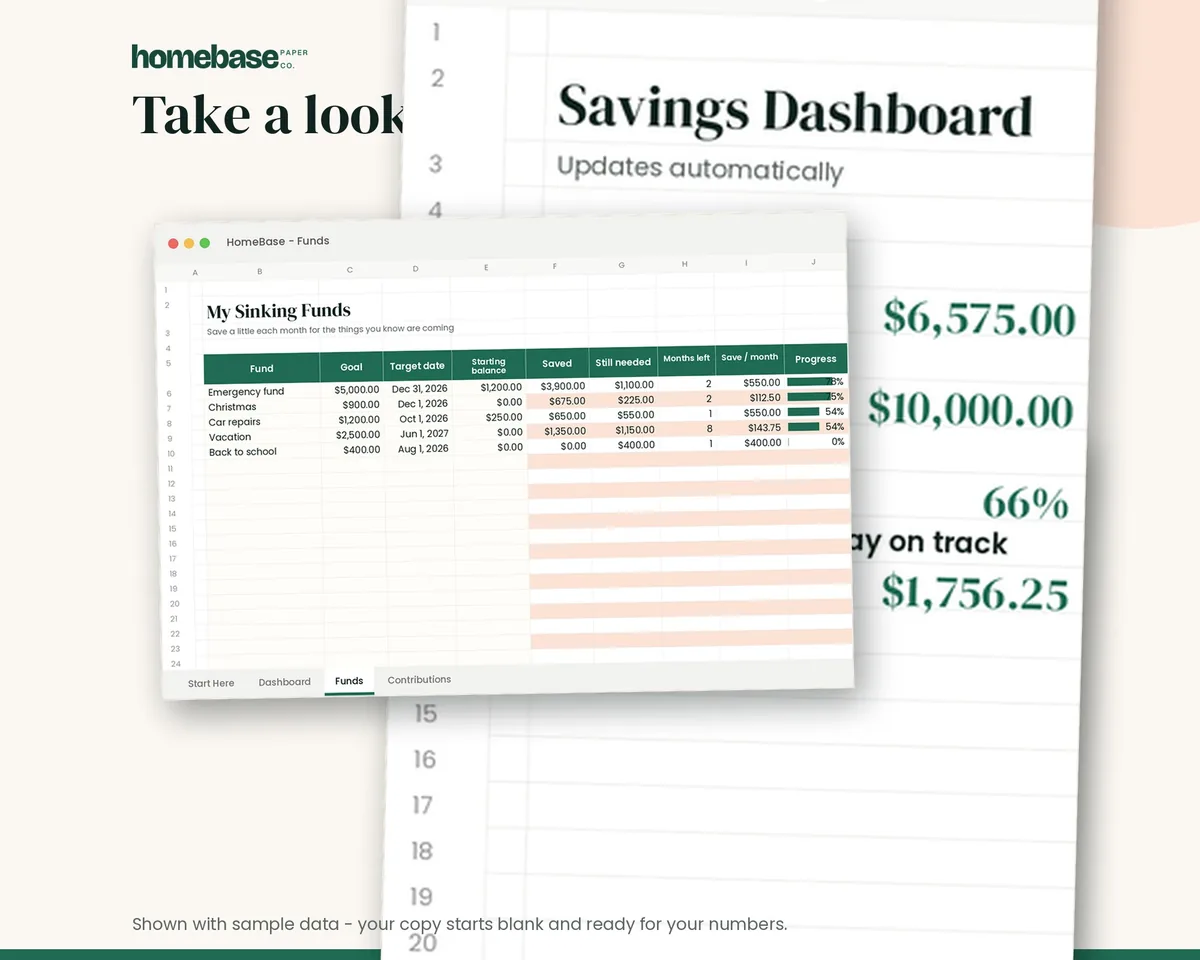
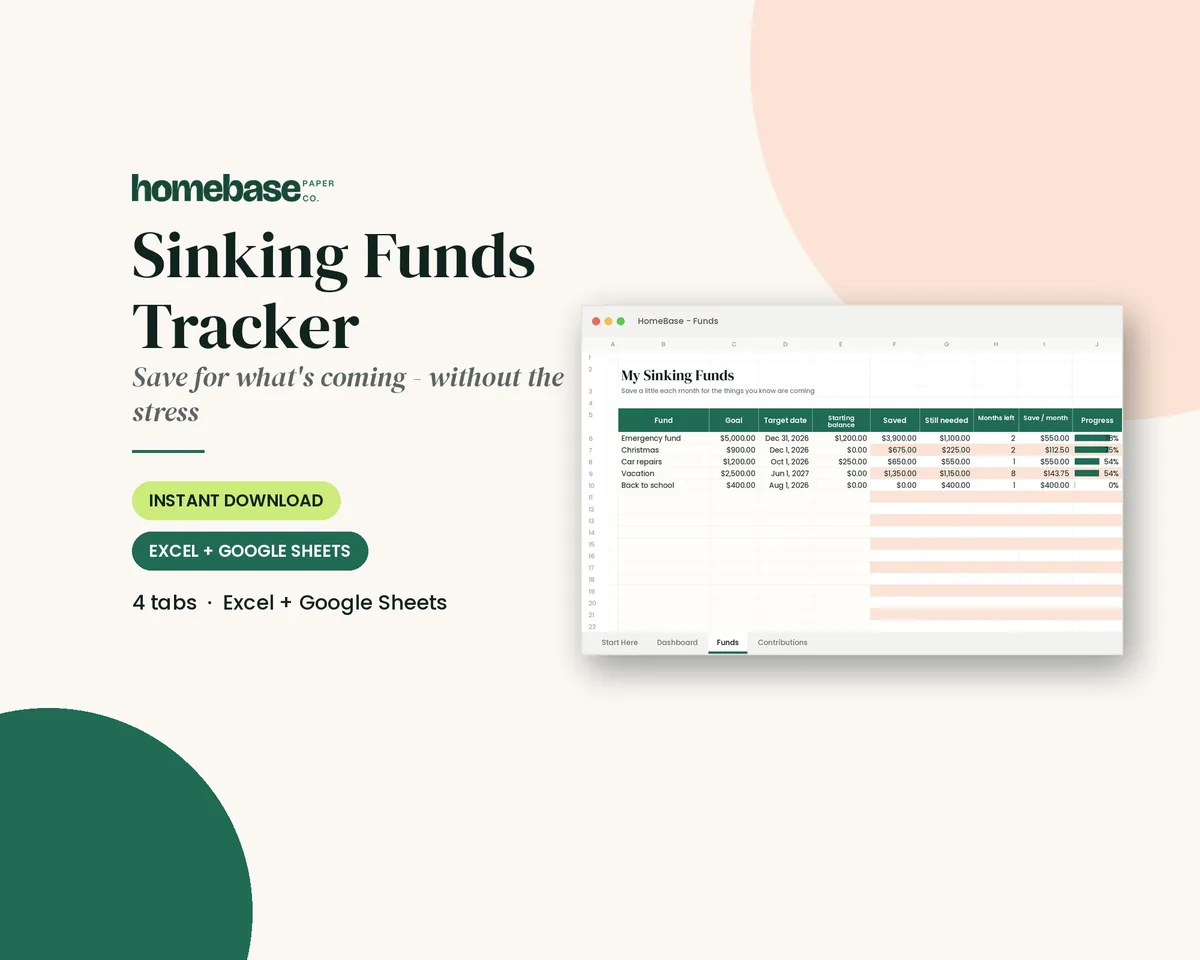
Our Sinking Funds Tracker ($4.99) tracks up to 20 goals, including your emergency fund, a down payment and travel. It shows the monthly amount needed to hit each one by its date, logs deposits and withdrawals and has progress bars and a dashboard.
The Paycheck Budget Spreadsheet ($5.99) plans every paycheck. Choose your pay schedule, and your bills are scheduled for the year and assigned to the right check, so you can see what's left to save.
The Ultimate Budget Bundle ($19.99) includes both, plus the Debt Payoff Planner and annual, zero-based and bill tracker spreadsheets and two printables. That's $46.42 if bought separately.
Your next step
Add up what you have today: cash savings, retirement accounts and debts. Compare it with the targets above, then choose one action from the plan that fits your level and set it up this week. Where you are at 30 matters far less than what you do next.
One of the best tools for savers in their 20s and 30s is a Roth IRA, which grows tax-free for retirement.
Make it easier
Tools for this

Spreadsheets
Sinking Funds Tracker
It does the math: how much to set aside each month to hit every goal on time.

Spreadsheets
Paycheck Budget Spreadsheet
Enter your bills once. The sheet tells you which paycheck pays each one, all year.

Spreadsheets
Debt Payoff Planner
Pick snowball or avalanche, add any extra payment, and get your debt-free month instantly.
Frequently asked questions
How much money should I have saved by 30? A common rule of thumb is to have about one year's salary saved for retirement by 30, plus an emergency fund of three to six months of expenses. Many people are not there, and that is okay. What matters most is saving steadily from every paycheck and starting now.
How much does the average 30-year-old have saved? Families headed by someone under 35 had a median net worth of $33,000 in 2025, according to the Federal Reserve's Survey of Consumer Finances. Exact figures for single ages are rarely published. Among those families with retirement accounts, the mean balance was $48,400.
Is one year of salary by 30 realistic? Yes, one year of salary saved by 30 is realistic for people who started saving 10% to 15% of pay in their early 20s and got an employer match. If you started later or had student loans, it is a stretch goal. Treat it as a direction, not a pass-or-fail test.
How much should I have in my emergency fund at 30? At 30, aim for an emergency fund of three to six months of essential expenses. If your essentials are $3,000 a month, that is $9,000 to $18,000. Start with a $1,000 starter fund and build from there.
Is $10,000 saved at 30 good? Yes, $10,000 saved at 30 is a good start and puts you ahead of many people your age. The Federal Reserve found fewer than half of adults aged 18 to 29 would cover a $400 expense with cash. Keep building, and make sure retirement savings are growing too.
Is $50,000 saved at 30 good? Yes, $50,000 saved at 30 is very good. It is above the median net worth of $33,000 for families under 35 in the Federal Reserve's latest survey. If most of it is in retirement accounts, you are close to the one-year-salary rule for many incomes.
Should my savings include my 401(k)? Yes, your savings by 30 should include your 401(k), IRA and other retirement accounts, plus cash savings. Think of it in two parts: retirement savings measured against salary, and cash savings measured against monthly expenses.
What if I have nothing saved at 30? If you have nothing saved at 30, you still have decades for compound growth to work. Start with a $1,000 emergency fund, get your full employer match, then raise your savings rate by 1% every few months. Saving $500 a month from 30 could grow to over $400,000 by 60 at a 5% return.
Should I pay off debt or save in my 20s and 30s? In your 20s and 30s, do both: keep a small emergency fund and your employer match, then put extra money on high-interest debt. Once credit cards are gone, move those payments into savings. Low-rate debt can be paid on schedule while you save.
How much should I save each month in my 20s? In your 20s, try to save 15% to 20% of your pay each month, counting retirement contributions and any employer match. If that is too much, start at 5% to 10% and raise it with each raise. Starting early matters more than starting big.
How much can I put in my 401(k) at 30? At 30, you can defer up to $24,500 into a 401(k) in 2026, according to the IRS. Few people hit the limit, but it means there is plenty of room to grow your contributions as your pay increases.
Does net worth matter more than savings at 30? Net worth is a broader measure than savings because it subtracts what you owe from what you own. At 30, track both: savings to see your safety net, and net worth to see whether debt is shrinking. Our net worth guide shows how to calculate it.
More from HomeBase
You may also like

Printables
Budget Planner Printable
Twelve undated pages you can print every month: budget, bills, spending, savings and debt.

Spreadsheets
Bill Tracker Spreadsheet
Bills due in 3 days or less light up red, so nothing slips through.

Spreadsheets
Zero-Based Budget Spreadsheet
The 'Left to budget' counter turns green when every dollar has a job.

Spreadsheets
Annual Budget Spreadsheet
See exactly where your money goes every month - without complicated software.
 Club
Monthly club
Money Club
Anyone who wants a clear plan for the month's bills, holiday spending and savings.
Free printable
Give every dollar a job: get the free monthly budget template
A printable zero-based monthly budget: income, bills, everyday spending and savings on one page, with a planned vs. actual column. You'll also get our weekly HomeBase email with simple budgeting and bill-paying tips.

Sources
- Federal Reserve: Changes in U.S. Family Finances, Survey of Consumer Finances (PDF) federalreserve.gov
- Federal Reserve: SHED data, ability to cover a $400 expense federalreserve.gov
- IRS: 401(k) contribution limits irs.gov