


The short answer: for how to pay off student loans fast, there is only one real lever: more money going to principal, sooner.
- $100 extra a month: 86 months instead of 120
- That saves $3,359 in interest in the example
- $500 extra a month: 40 months
- When paying early isn't best: PSLF, a missed employer match or no emergency fund
- Next step: Plan it with the Paycheck Budget Spreadsheet ($5.99).
If you want to know how to pay off student loans fast, the honest answer is that there is only one real lever: more money going to principal, sooner. Everything else, from autopay discounts to picking the right loan, makes that extra money work harder. This guide shows exactly how much time and interest an extra payment saves, which steps are free, and the cases where paying early is not your best move. If you work in public service or plan to stay on an income-driven plan, read our guide to student loan forgiveness first, because paying extra may not be the best use of your money.
How much faster extra payments get you there
Take a $30,000 federal loan at 6.52%, the 2026–27 fixed rate for new undergraduate loans. On a standard 10-year schedule, the payment is about $341 a month and you'd pay about $10,914 in interest. Here's what happens when you add a fixed amount on top every month:
| Extra each month | Time to pay off | Interest paid | Interest saved |
|---|---|---|---|
| $0 | 120 months (10 years) | $10,914 | — |
| $50 | 100 months | $8,921 | $1,993 |
| $100 | 86 months | $7,555 | $3,359 |
| $200 | 67 months | $5,796 | $5,118 |
| $500 | 40 months | $3,439 | $7,475 |
Even $50 a month, about the cost of one dinner out, cuts almost two years. With $200 extra, you're done in under six years.
Know your rates first
You can't plan a fast payoff without knowing what each loan costs. Log in to your servicer and list every loan with its balance, interest rate and minimum. For reference, Federal Student Aid's interest rate page lists 2026–27 fixed rates of 6.52% for undergraduate Direct Loans, 8.07% for graduate unsubsidized loans and 9.07% for PLUS loans. Older loans have their own fixed rates from the year they were made. Private loans may be variable.
Federal Direct Loans charge interest daily. Unpaid interest can be capitalized, which means it's added to your principal, and then you pay interest on that interest. Paying interest as it builds stops that from happening.
9 steps to pay off student loans fast
1. Turn on autopay for the rate cut
This is the easiest win on the list. According to Federal Student Aid's repayment page, autopay normally gives you a 0.25% rate reduction on Direct Loans. Starting July 1, 2026, that reduction went from 0.25% to 1% for Direct Loans disbursed on or after July 1, 2012. It's a temporary benefit that runs through June 30, 2028, and FFEL, Perkins and HEAL loans don't qualify for the larger cut. On a $30,000 balance, a full point off is worth about $25 a month in lower interest at the start. If you're not enrolled yet, contact your servicer, and check the current deadlines on that page.
2. Pay more than the amount due
Federal Student Aid says plainly that you can make payments before they're due or pay more than the amount due each month, and that paying a little extra reduces the interest you pay and your total cost. There's no fee for paying ahead on federal loans. Pick an extra amount from the table above and make it automatic.
3. Tell your servicer where the extra goes
Payments cover accrued interest first, then principal. If you just send extra money, some servicers will use it to push your next due date out instead of cutting principal on the right loan. Use your servicer's online account or a written note to say: apply extra to principal on loan X, and don't advance my due date. Then check your next statement.
4. Target one loan at a time
Keep paying the minimum on every loan and put all the extra on one. For the most savings, choose the highest rate, which is often a graduate or PLUS loan. That's the avalanche method. For quick wins, choose the smallest balance first, which is the snowball method. Our guide to debt snowball vs. avalanche compares the two with numbers.
5. Roll paid-off payments forward
When a loan is paid off, add its full payment to the next loan on your list. Your total monthly payment never drops, so each loan goes faster than the one before.
6. Split payments with your paychecks
If you're paid every two weeks, sending half of your payment each payday adds up to 26 half-payments, or 13 full payments a year, one more than the 12 you owe. On the $30,000 example, half of the $341 payment every two weeks pays the loan off in about 9 years instead of 10. Because interest accrues daily, paying a bit sooner also trims interest slightly. Check that your servicer applies the half-payments right away rather than holding them.
7. Send windfalls straight to principal
Tax refunds, raises, bonuses and side income are the fastest way to make a dent without changing your monthly budget. A $2,000 refund on a 6.52% loan saves that 6.52% on $2,000 every year it would have stayed on the books.
8. Pay interest during school and grace
If you're still in school or in your grace period, interest is building on unsubsidized loans. Paying it as it builds keeps it from being added to your balance when repayment starts. One catch: payments made during school or grace don't count toward forgiveness programs.
9. Think carefully before refinancing
A private refinance can lower your rate, but Federal Student Aid warns you may give up deferment, forbearance, income-driven plans and forgiveness. If your job or income is uncertain, those protections may be worth more than a lower rate.
When paying fast isn't the smartest move
You qualify for PSLF. Public Service Loan Forgiveness forgives the remaining balance on Direct Loans after 120 qualifying monthly payments while you work full time for a qualifying employer, such as a government or nonprofit organization. Extra payments only shrink the amount that would be forgiven.
You're missing an employer match. If your employer matches retirement contributions, get the full match before you add extra loan payments. It's an instant return no loan payoff can beat.
You have no emergency fund. If one car repair would go on a credit card at 22%, build a small cash cushion first. Credit card debt costs far more than most student loans.
Your rate is low. A loan under about 4% to 5% can reasonably be paid on schedule while extra money goes to retirement or savings. Above about 7%, extra payments are hard to beat.
A note on new repayment plans
Federal repayment is changing. Federal Student Aid says new loans made on or after July 1, 2026 are repaid under a Tiered Standard Plan with fixed payments or the new Repayment Assistance Plan, while some older income-driven plans are being phased out. If you're choosing a plan, compare your options on Federal Student Aid's repayment plans page. Whatever plan you're on, extra payments still shorten the timeline.
A sample fast-payoff plan
Here's how the steps fit together for someone with three loans: $8,000 at 9.07% (PLUS), $12,000 at 6.52% and $10,000 at 5.05%. Minimums total about $345 a month, and they've found $150 extra in their budget.
- Month 1: turn on autopay with every loan included, and set up the $150 extra to go to the 9.07% loan as a principal-only payment.
- Every payday: check the paycheck plan to confirm the payment and the extra are covered before anything else gets spent.
- When a refund or bonus arrives: send at least half of it to the 9.07% loan.
- When the PLUS loan is gone: add its whole minimum plus the $150 to the 6.52% loan, then do the same for the last loan.
The plan never asks for more than the original $495 a month, but each loan disappears faster than the last. Write the steps down once and the plan keeps working for you without new decisions every month.
Find the money for extra payments
The extra payment has to come from somewhere, and for most people that's the budget. Our Paycheck Budget Spreadsheet ($5.99) helps you see it. Enter your pay schedule once and your bills are scheduled for the year and assigned to the right paycheck. It also shows what's left to spend from each check, so you can choose a realistic extra payment and send it on payday.
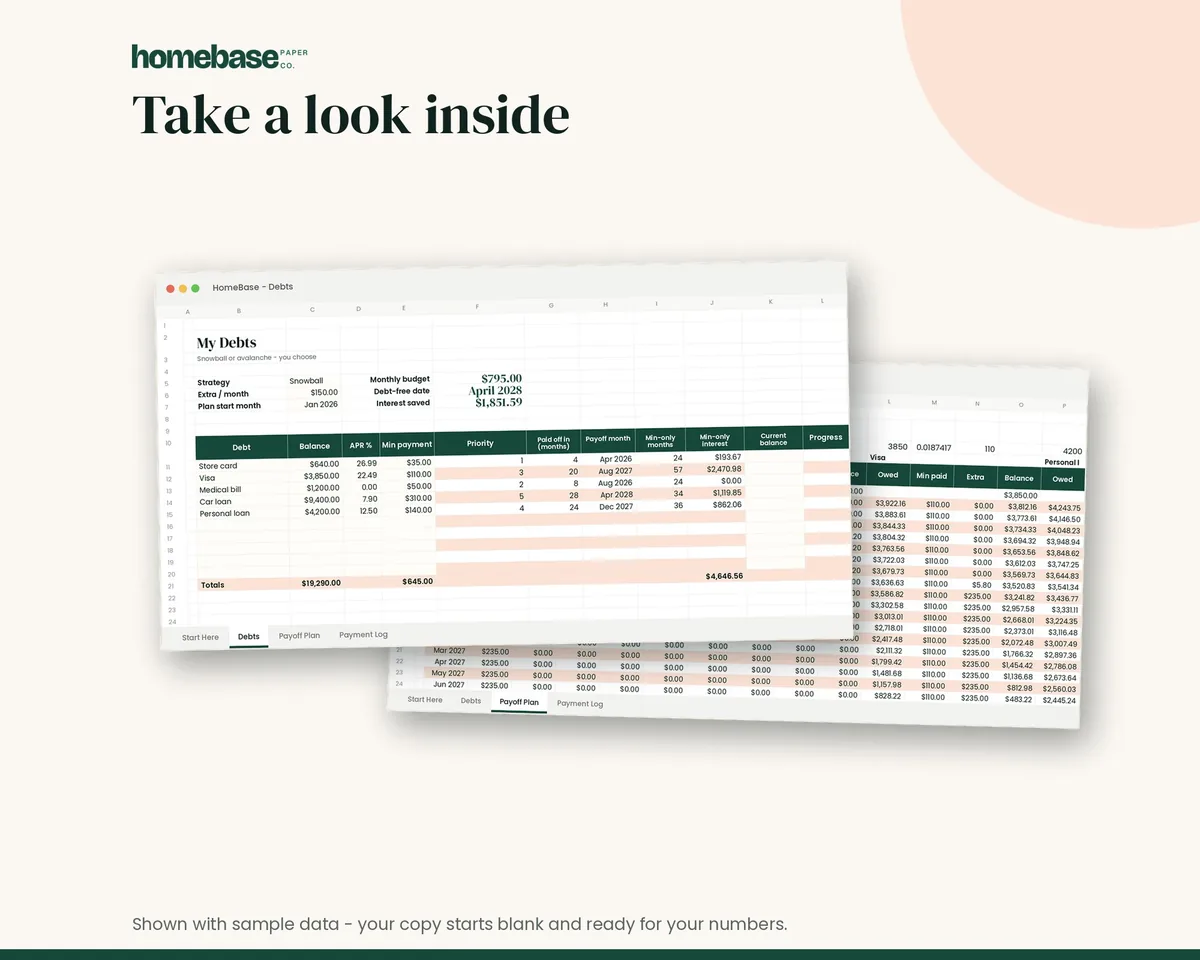
Then plug your loans into the Debt Payoff Planner ($6.99). It handles up to 10 debts, switches between avalanche and snowball, and rolls each paid-off payment into the next loan. It builds a month-by-month schedule and shows the payoff month for each loan, your debt-free date and the interest you save. It works in Excel and Google Sheets.
Want the whole system? The Ultimate Budget Bundle ($19.99) includes both spreadsheets plus annual, zero-based, bill tracker and sinking funds spreadsheets and two printables. That's $46.42 if bought separately.
Once the last loan is gone, our guide to being debt free covers the habits that keep you there.
Start today
Log in to your servicer, list your loans by rate, turn on autopay and choose one extra amount you can sustain. Then write your new payoff month somewhere you'll see it. Each extra dollar you send moves that date closer.
If your loan rate is low and you already have an emergency fund, parking spare cash may mean comparing CD rates instead of prepaying.
Make it easier
Tools for this

Spreadsheets
Debt Payoff Planner
Pick snowball or avalanche, add any extra payment, and get your debt-free month instantly.

Spreadsheets
Paycheck Budget Spreadsheet
Enter your bills once. The sheet tells you which paycheck pays each one, all year.
 Save 57%
Bundles
Ultimate Budget Bundle
All 6 spreadsheets + both printable planners - for less than half the price of buying them separately.
Frequently asked questions
What is the fastest way to pay off student loans? The fastest way to pay off student loans is to pay more than the amount due every month and send the extra to principal on your highest-rate loan. On a $30,000 loan at 6.52%, an extra $200 a month cuts payoff from 10 years to about 5 and a half and saves about $5,100 in interest.
How to pay off student loans fast on a low income? To pay off student loans fast on a low income, start with free wins: sign up for autopay for the rate cut, round your payment up, and send windfalls to principal. Small amounts still help. An extra $50 a month on $30,000 at 6.52% saves about two years and $2,000 in interest.
Does autopay lower my student loan interest rate? Yes, autopay lowers the interest rate on federal Direct Loans. The standard cut is 0.25%, and Federal Student Aid says that starting July 1, 2026 it rose to 1% for Direct Loans disbursed on or after July 1, 2012. That larger cut is temporary, through June 30, 2028.
Is there a penalty for paying off student loans early? No, there is no penalty for paying off federal student loans early. Federal Student Aid says you can pay before payments are due or pay more than the amount due, which reduces interest and total cost. Check a private loan's terms, though most private lenders also allow early payoff.
Should I pay off student loans or invest? Whether to pay off student loans or invest depends mostly on your rate. Always take any employer retirement match first, since it is an instant return. After that, extra payments on a loan above about 7% are a guaranteed return at that rate, while a low-rate loan can be paid on schedule as you invest.
Which student loan should I pay off first? Pay off the student loan with the highest interest rate first to save the most money. Graduate and PLUS loans usually carry higher rates than undergraduate loans. If you need motivation, paying the smallest balance first also works. Keep making the minimum on every loan either way.
How do I make sure extra payments go to principal? To make sure extra payments go to principal, tell your servicer in writing or in your online account to apply extra money to the principal of a specific loan and not to advance your due date. Payments cover accrued interest first, then principal, so check your next statement.
Can I pay off student loans in 5 years? Yes, you can pay off student loans in 5 years by paying the amount that clears the balance in 60 months. For $30,000 at 6.52%, that is about $587 a month, compared with about $341 on a 10-year plan. Interest drops from about $10,900 to about $5,200.
Should I refinance federal student loans to pay them off faster? You usually shouldn't refinance federal student loans to pay them off faster. Refinancing federal student loans into a private loan can lower your rate, but you give up federal benefits. Federal Student Aid lists deferment, forbearance, income-driven plans and forgiveness as things you may lose. Compare the savings against those protections first.
Should I pay off student loans early if I qualify for PSLF? No, you usually shouldn't pay off student loans early if you qualify for PSLF. If you qualify for Public Service Loan Forgiveness, paying off student loans early usually costs you money. PSLF forgives the remaining balance after 120 qualifying monthly payments while you work full time for a qualifying employer, so extra payments shrink what gets forgiven.
Do payments during school or grace help? Yes, payments during school or the grace period help, because they cover interest before it can be added to your balance. Unsubsidized loans build interest the whole time. Note that payments made during school or grace do not count toward forgiveness programs.
How do I track several student loans at once? To track several student loans at once, list every loan with its servicer, balance, rate and minimum payment. Then choose one to attack with extra money. Our Debt Payoff Planner handles up to 10 debts and shows the payoff month for each loan and your debt-free date.
More from HomeBase
You may also like

Printables
Budget Planner Printable
Twelve undated pages you can print every month: budget, bills, spending, savings and debt.

Spreadsheets
Bill Tracker Spreadsheet
Bills due in 3 days or less light up red, so nothing slips through.

Spreadsheets
Sinking Funds Tracker
It does the math: how much to set aside each month to hit every goal on time.

Spreadsheets
Zero-Based Budget Spreadsheet
The 'Left to budget' counter turns green when every dollar has a job.
 Club
Monthly club
Money Club
Anyone who wants a clear plan for the month's bills, holiday spending and savings.
Free printable
Never miss a payment: get the free bill calendar
A printable monthly bill calendar with room for due dates, amounts and paydays, so every payment has a plan before the month starts. You'll also get our weekly HomeBase email with simple budgeting and bill-paying tips.

Sources
- Federal Student Aid: Repaying your loans studentaid.gov
- Federal Student Aid: Interest rates and fees studentaid.gov
- Federal Student Aid: Public Service Loan Forgiveness studentaid.gov
- Federal Student Aid: Repayment plans studentaid.gov