

The short answer: CD rates are the APYs banks and credit unions pay when you lock money for a set term. Use the FDIC national average rates below as a benchmark, then read each bank's own rate sheet the day you apply. This page does not invent today's bank-by-bank APYs.
- Benchmark source: FDIC National Rates and Rate Caps (as of October 19, 2026)
- 12-month national average CD rate: 1.76% APY-style national deposit rate in that FDIC table
- Insurance: confirm FDIC deposit insurance (or NCUA for credit unions) before you fund
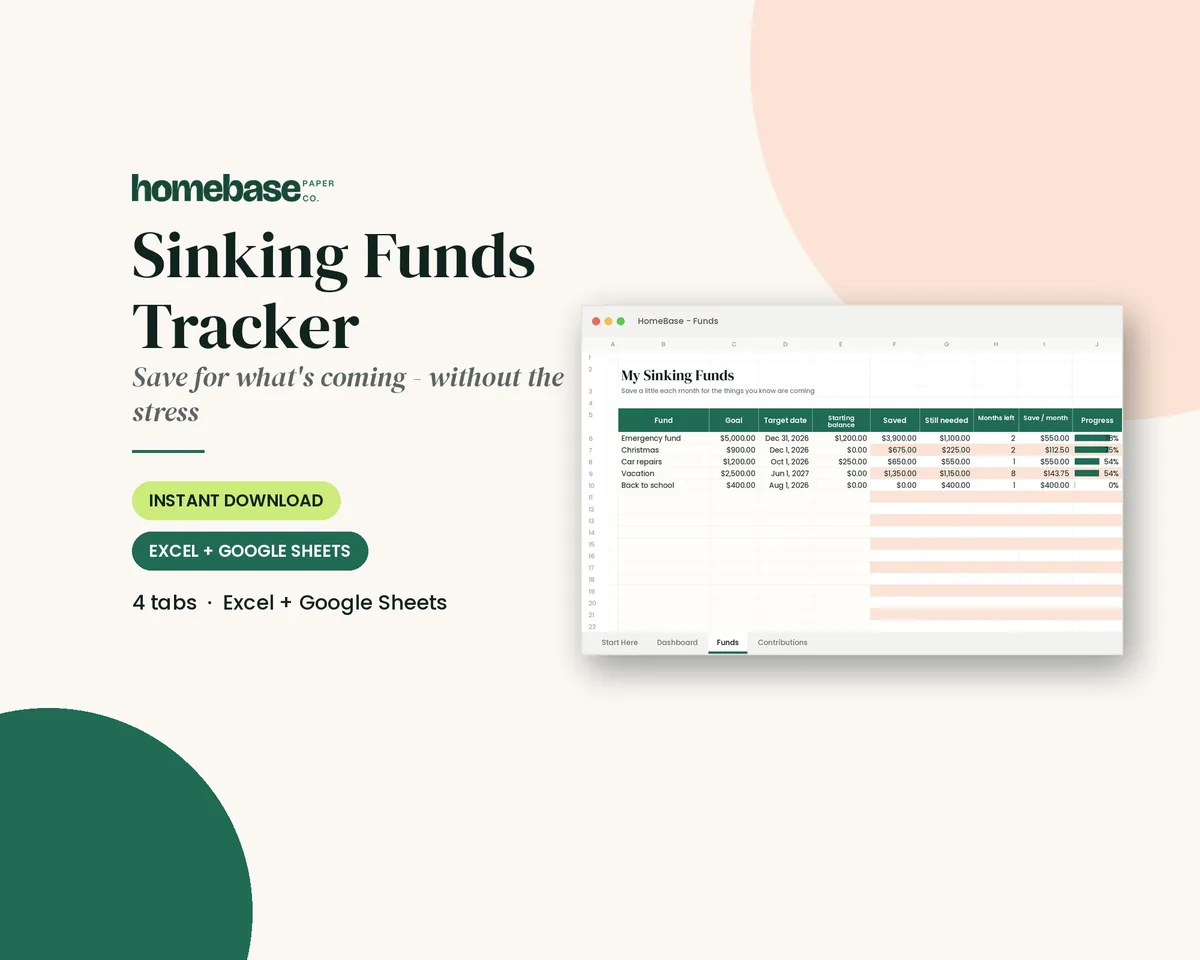
- Next step: get the free monthly budget template (we email it to you). Plan the cash you can lock with the Sinking Funds Tracker ($4.99).
Checked November 5, 2026 against the FDIC October 19, 2026 national rates table. For payoff planning that competes with saving, see how to pay off student loans fast, sinking funds, how to build an emergency fund and financial planning.
FDIC national average CD rates (October 19, 2026)
These figures are national deposit rates from the FDIC table, not an offer from HomeBase and not a promise from any one bank. Shop live APYs on the issuer's site.
| Deposit product | National deposit rate | National rate cap |
|---|---|---|
| 1 month CD | 0.23% | 5.57% |
| 3 month CD | 1.14% | 5.79% |
| 6 month CD | 1.39% | 5.95% |
| 12 month CD | 1.76% | 6.20% |
| 24 month CD | 1.55% | 6.61% |
| 36 month CD | 1.39% | 6.75% |
| 48 month CD | 1.31% | 6.75% |
| 60 month CD | 1.41% | 6.86% |
Source: FDIC National Rates and Rate Caps - October 2026. The FDIC also publishes savings (0.38%), interest checking (0.07%) and money market (0.63%) national deposit rates in the same update.
How CD rates work
- You deposit a fixed amount for a stated term.
- The bank pays a stated APY if you leave the money until maturity.
- Early withdrawal usually costs a penalty (months of interest are common).
- At maturity you can withdraw or roll into a new CD at the then-current rate.
The CFPB's CD explainer is a plain-language overview of terms and penalties.
Comparison table: what to record before you buy
| Field | Why it matters | Where to find it |
|---|---|---|
| APY | Apples-to-apples yearly yield | Bank rate sheet / Truth in Savings |
| Term | When you can access principal without penalty | Account disclosure |
| Minimum deposit | Whether your balance qualifies | Account disclosure |
| Early withdrawal penalty | Cost if plans change | Account disclosure |
| Auto-renewal rules | Stops surprise rollovers | Account disclosure |
| FDIC or NCUA insurance | Safety of principal | Bank About / NCUA lookup |
Printable tip: copy this table into the notes page of the Annual Budget Spreadsheet ($6.99) or print the free monthly budget template and write the APY you actually accepted.
CD ladder example (illustration only)
Suppose you have $4,000 you will not need for everyday bills:
| CD | Amount | Term |
|---|---|---|
| A | $1,000 | 6 months |
| B | $1,000 | 12 months |
| C | $1,000 | 18 months |
| D | $1,000 | 24 months |
When A matures, either use the cash or open a new 24-month CD. Rates in this example are intentional blanks: fill them from the bank's live APY the day you buy.
When a CD is a poor fit
- You still need a basic emergency fund in a savings account you can reach the same day.
- The money is earmarked for a bill inside the CD term.
- High-interest debt costs more than the CD earns (pay that first; see debt snowball vs avalanche).
Early withdrawal penalties
Leaving a CD early usually costs interest, not principal, but the penalty can wipe out months of earnings. The CFPB CD explainer notes that banks set their own penalties in the account disclosure. Before you buy, write down:
- How many days or months of interest the bank charges if you withdraw early.
- Whether the penalty can invade principal if you have not earned enough interest yet.
- Whether a hardship exception exists (some banks waive penalties for death or court orders; that is not universal).
If you may need the cash inside the term, keep that money in savings or a shorter CD instead of forcing a long lock.
Taxes on CD interest
Interest from a bank or credit union CD is generally taxable as ordinary interest income in the year it is credited or paid, even if you leave it in the CD until maturity. Your bank usually reports it on Form 1099-INT. State tax rules vary. This page is not tax advice; confirm with a tax professional if you hold large balances or brokered CDs in a taxable account. Retirement-account CDs (IRA CDs) follow retirement-account tax rules instead of annual 1099-INT on the interest while it stays inside the account.
Bank CDs vs brokered CDs
A bank or credit union CD is opened directly with the issuer. You see the APY, term, minimum and penalty on that institution's Truth in Savings disclosure, and FDIC or NCUA insurance applies under the usual limits.
A brokered CD is bought through a brokerage. You may see CDs from many banks on one platform. Call features, step-up rates and secondary-market sale rules can differ from a simple bank CD. Read the brokerage's CD disclosure the day you buy, and confirm which bank issues the CD so you can track FDIC coverage across institutions.
How to shop a CD without guessing APYs
- Decide the cash you can lock after your emergency fund and near-term bills.
- Pick a term that matches when you will need the money.
- Compare APY, minimum deposit, compounding, auto-renewal and early withdrawal penalty on each issuer's rate sheet the same day.
- Confirm FDIC or NCUA insurance and how your ownership category is titled.
- Save a screenshot of the APY, term and penalty before you fund.
- On maturity, decide withdraw vs roll before the grace period ends.
Use the ladder table above as a worksheet, not a rate promise. Fill each APY from the live disclosure.
FAQ
Make it easier
Tools for this

Spreadsheets
Sinking Funds Tracker
It does the math: how much to set aside each month to hit every goal on time.

Spreadsheets
Annual Budget Spreadsheet
See exactly where your money goes every month - without complicated software.

Spreadsheets
Paycheck Budget Spreadsheet
Enter your bills once. The sheet tells you which paycheck pays each one, all year.
Frequently asked questions
What is a CD rate? A CD rate is the interest rate a bank or credit union pays on a certificate of deposit for a set term. You agree to leave the money until maturity. Early withdrawals usually trigger a penalty. Compare APY, term length, minimum deposit and whether the account is FDIC or NCUA insured.
What are today's national average CD rates? As of the FDIC National Rates and Rate Caps update dated October 19, 2026, national average CD rates were about 0.23% (1 month), 1.14% (3 month), 1.39% (6 month), 1.76% (12 month), 1.55% (24 month), 1.39% (36 month), 1.31% (48 month) and 1.41% (60 month). These are national averages, not a single bank's offer.
Are CDs FDIC insured? Yes, CDs at FDIC-insured banks are covered as deposits, generally up to $250,000 per depositor, per insured bank, per ownership category. Credit union share certificates are insured by NCUA on a similar limit. Confirm the institution's insurance before you fund the account.
What is the difference between APY and interest rate on a CD? The interest rate is the stated rate. APY (annual percentage yield) includes compounding over a year, so APY is the better number for comparing offers. Ask for APY, term, compounding frequency, minimum opening deposit and early withdrawal penalty in writing.
Should I get a short CD or a long CD? Choose a short CD when you may need the money within a year or you expect rates to change soon. Choose a longer CD when you can lock funds and want a known rate for that whole term. Many people ladder CDs so one matures every 6 to 12 months.
What is a CD ladder? A CD ladder splits your cash across several CDs with different maturity dates, such as 6, 12, 18 and 24 months. When the shortest CD matures, you can spend it or roll it into a new longer CD. Ladders improve access without putting every dollar in one long term.
Why doesn't this page list today's bank-by-bank APYs? Bank APYs change often and must come from each bank's own disclosures. This page explains how CD rates work and publishes the FDIC national average rates. For a live offer, open the bank's rate sheet the day you apply and save a screenshot of the APY, term and penalty.
Which HomeBase tracker helps me plan money going into CDs? The Sinking Funds Tracker ($4.99) maps upcoming expenses so you only lock money you will not need mid-term. The Annual Budget Spreadsheet ($6.99) shows how CD interest fits your yearly savings plan.
More from HomeBase
You may also like

Printables
Budget Planner Printable
Twelve undated pages you can print every month: budget, bills, spending, savings and debt.

Spreadsheets
Bill Tracker Spreadsheet
Bills due in 3 days or less light up red, so nothing slips through.

Spreadsheets
Zero-Based Budget Spreadsheet
The 'Left to budget' counter turns green when every dollar has a job.
 Save 57%
Bundles
Ultimate Budget Bundle
All 6 spreadsheets + both printable planners - for less than half the price of buying them separately.
 Club
Monthly club
Money Club
Anyone who wants a clear plan for the month's bills, holiday spending and savings.
Free printable
Give every dollar a job: get the free monthly budget template
A printable zero-based monthly budget: income, bills, everyday spending and savings on one page, with a planned vs. actual column. You'll also get our weekly HomeBase email with simple budgeting and bill-paying tips.

Sources
- FDIC: National Rates and Rate Caps (October 2026) fdic.gov
- FDIC: Deposit Insurance fdic.gov
- Consumer Financial Protection Bureau: Certificates of deposit (CDs) consumerfinance.gov