


The short answer: being debt free means you don't owe money to anyone: no credit card balances, car payment, student loans, personal loans or medical bills. Many treat "debt free except the house" as the first big milestone.
- Start with your debt-to-income ratio
- Find your debt-free date: list every debt, decide the extra payment, choose an order
- Follow the 7-step plan
- Stay there with debt-free living habits
- Next step: Plan it with the Debt Payoff Planner ($6.99).
Being debt free means you don't owe money to anyone. No credit card balances, no car payment, no student loans, no personal loans or medical bills. Some people include the mortgage; many treat "debt free except the house" as the first big milestone. Whichever definition you choose, the result is the same: your paycheck belongs to you instead of your lenders. Here's what it takes to get there, how to find your own debt-free date and the habits that keep you there once you arrive. Federal student loans also have their own exits, covered in our guide to student loan forgiveness.
Want your own debt-free date? Our Debt Payoff Planner lists up to 10 debts, switches between snowball and avalanche, rolls each paid-off payment into the next one and shows your debt-free date and the interest saved vs. minimums.
Why being debt free matters
Debt is expensive. The Federal Reserve's G.19 consumer credit report put the average credit card rate at 22.36% for accounts paying interest in August 2026. On a $6,000 balance, that's more than $100 a month in interest alone.
Debt also makes life fragile. The Fed's survey of household finances in 2025 found 59% of adults had a major unexpected expense in the past year, and only 63% would cover a $400 emergency with cash or its equivalent. When most of your income goes to payments, every surprise turns into more debt.
Being debt free reverses that. The money that used to go to payments becomes savings, investments or room to breathe.
Where are you now? Find your debt-to-income ratio
Before you plan, measure. The CFPB defines your debt-to-income ratio, or DTI, as all your monthly debt payments divided by your gross monthly income. Its example: $1,500 for a mortgage, $100 for a car loan and $400 for other debts is $2,000 a month. On $6,000 gross monthly income, that's a DTI of 33%.
Your DTI tells you how much of your pay is spoken for. As you pay off debts, watch it fall. A debt-free life, except perhaps a mortgage, means a DTI near zero on everything else.
How to find your debt-free date
Your debt-free date is the month your last balance hits zero if you follow your plan. To find it:
- List every debt with its balance, interest rate and minimum payment.
- Decide how much extra you can pay each month on top of the minimums.
- Choose an order: highest rate first (avalanche) or smallest balance first (snowball).
- Calculate month by month: extra money goes to the first debt; when it's paid off, its payment rolls into the next.
Here's an example with $18,000 of debt and $250 extra a month:
| Debt | Balance | Rate | Minimum |
|---|---|---|---|
| Store card | $1,200 | 27% | $40 |
| Credit card | $4,800 | 22% | $120 |
| Car loan | $8,000 | 7% | $250 |
| Personal loan | $4,000 | 12% | $130 |
Minimums total $540. Adding $250 makes $790 a month. Here's how the plans compare, assuming the minimum payments stay fixed and no new charges are made:
| Plan | Debt-free in | Total interest |
|---|---|---|
| Minimums only ($540/month) | 44 months | about $5,414 |
| Snowball, smallest balance first ($790/month) | 27 months | about $2,739 |
| Avalanche, highest rate first ($790/month) | 26 months | about $2,475 |
With the snowball, the store card is gone in month 5, the personal loan in month 14, the credit card in month 23 and the car loan in month 27. With the avalanche, the store card goes in month 5, then the credit card in month 18. Either way, $250 extra a month brings the debt-free date about 17 or 18 months closer and saves around $2,700 to $2,900 in interest. Running numbers like these in a planner is how you get an actual month and year you can circle on the calendar.
A 7-step plan to become debt free
If you're asking how to be debt free, these seven steps are the answer, in this order.
1. Stop adding new debt
Take cards out of your wallet and off shopping apps. You can't fill a bucket with a hole in it.
2. Build a starter emergency fund
Save $500 to $1,000 first. It keeps the next flat tire from going on a card.
3. Pay every minimum, every month
Late fees and penalty rates undo progress. Autopay the minimums.
4. Pick your method
The avalanche method saves the most interest. The snowball method gives quick wins. Our guide to debt snowball vs. avalanche compares them.
5. Find extra money
Cut two or three expenses, sell things you don't use, pick up extra hours and send windfalls to debt.
6. Roll payments forward
When a debt is paid off, add its whole payment to the next. Your total payment never shrinks.
7. Track and celebrate milestones
Color in a chart, cross off each debt and celebrate each payoff in a way that doesn't cost much. For a deeper step-by-step guide, see how to get out of debt.
Debt free living: how to stay debt free
Getting debt free is half the job. Staying there is the other half. Debt free living rests on a few habits:
Keep a budget
A monthly or paycheck budget tells every dollar where to go before you spend it. Our guide to the zero-based budget is a good place to start.
Keep an emergency fund
After you're debt free, build your emergency fund to three to six months of essential expenses. It's the single best protection against new debt.
Save ahead with sinking funds
Most new debt comes from expenses that weren't really surprises: car repairs, holidays, insurance premiums, a new phone. Save a little each month for each one in sinking funds, and you'll pay cash when they come.
Pay credit cards in full
You can still use cards for convenience and rewards. Just pay the full statement balance every month. If a balance sneaks back, stop using the card until it's gone.
Buy cars with cash, or as close as you can
Car loans are one of the most common debts. Keep paying yourself your old car payment into a car fund, and your next car can be mostly or fully paid for. When you are ready to buy, see how to budget for a car.
Review monthly
Once a month, check your spending, savings and net worth. Catching a drift early keeps it small.
What if you slip back into debt?
It happens. A job loss, a medical bill or a big car repair can put a balance back on a card even after you've been debt free. Don't treat it as failure. Instead:
- Pause and figure out why. Was it a true emergency, an expense you could have saved for or spending creep?
- Stop the bleeding. Put the card away and switch to cash or debit until the balance is gone.
- Restart your payoff plan. Add the new balance to your planner and give it the payment you were using for savings, keeping a small emergency cushion.
- Fix the gap. If it was a predictable cost, add a sinking fund for it. If it was a real emergency, grow your emergency fund once the balance is paid.
Most people who've been debt free once find it faster the second time. They know the plan works.
What to do with your money once you're debt free
The day you make your last payment, you suddenly have hundreds of dollars a month with no job. Give it one right away, or it will get absorbed by spending:
- Finish the emergency fund to three to six months.
- Raise retirement savings to at least 15% of pay.
- Fund your sinking funds for big goals.
- Decide on the mortgage: pay it down faster or invest.
- Give and enjoy. Debt free living isn't about deprivation. It's about choosing where your money goes.
Tools for getting debt free
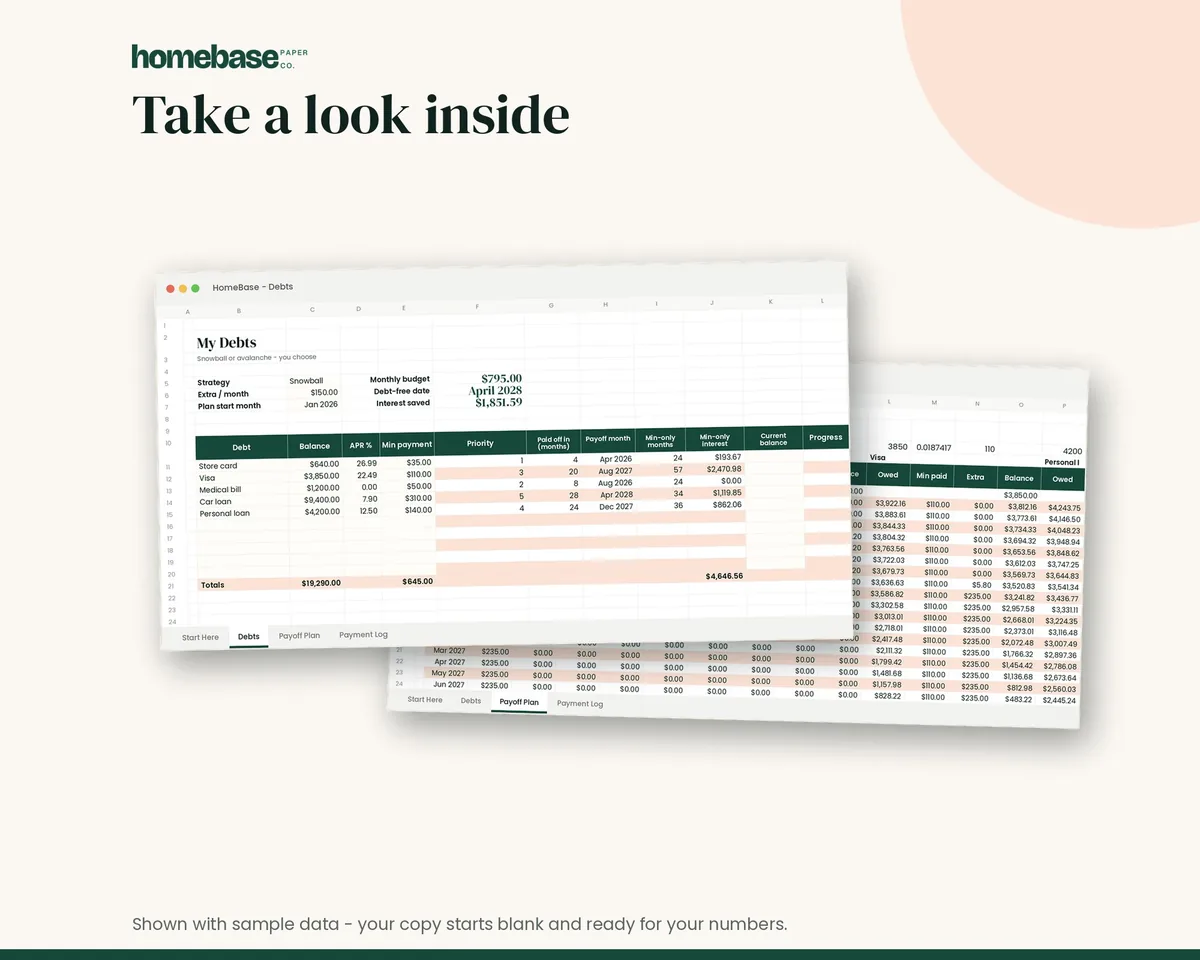
Our Debt Payoff Planner ($6.99) is built to find your debt-free date. Enter up to 10 debts and switch between snowball and avalanche. It rolls each paid-off payment into the next debt, builds a month-by-month schedule for up to 30 years and shows each debt's payoff month, your debt-free date and the interest you save compared with minimums. It works in Excel and Google Sheets.
To stay debt free, the Sinking Funds Tracker ($4.99) tracks up to 20 goals, including your emergency fund, with the monthly amount needed for each date and progress bars. If you prefer paper, the Budget Planner Printable ($5.99) has 12 undated pages, including a Debt Payoff Tracker, Monthly Budget and Sinking Funds page.
The Ultimate Budget Bundle ($19.99) includes the Debt Payoff Planner and Sinking Funds Tracker plus annual, zero-based, paycheck and bill tracker spreadsheets and two printables. That's $46.42 if bought separately.
For a worked example of the math, see our debt snowball spreadsheet guide.
Your next step
Write down every debt you have today with its balance, rate and minimum. That list is the starting line. Then pick a method, add your extra payment and find your debt-free date. Once you can see the date, it's much easier to keep moving toward it.
Make it easier
Tools for this

Spreadsheets
Debt Payoff Planner
Pick snowball or avalanche, add any extra payment, and get your debt-free month instantly.
 Save 57%
Bundles
Ultimate Budget Bundle
All 6 spreadsheets + both printable planners - for less than half the price of buying them separately.

Spreadsheets
Sinking Funds Tracker
It does the math: how much to set aside each month to hit every goal on time.
Frequently asked questions
What does debt free mean? Debt free means you owe no money to anyone: no credit card balances, car loans, student loans, personal loans or medical bills. Some people use debt free to mean free of everything except the mortgage. Decide which definition fits your goal before you start.
How do I become debt free? To become debt free, list every debt, stop adding new debt, build a small emergency fund, pay the minimum on everything and put all extra money on one debt at a time. When it is paid off, roll its payment into the next. Repeat until every balance is zero.
Does debt free include a mortgage? Debt free doesn't always include a mortgage: it can include or exclude one, depending on whom you ask. Many people aim to be debt free except the mortgage first, because a mortgage is usually lower-rate and tied to an asset. Paying off the house is often a separate, later goal.
How long does it take to become debt free? How long it takes to become debt free depends on how much you owe, your interest rates and how much extra you can pay. For example, $18,000 of consumer debt paid at $790 a month takes about 27 months. A payoff planner can calculate your exact debt-free date.
What is a debt-free date? A debt-free date is the month your last debt will be paid off if you stick to your plan. You find it by listing each debt's balance, rate and payment, adding your extra payment and calculating the payoff month for each. It is a powerful motivator.
Is it good to be completely debt free? Yes, being completely debt free is good for most people because it frees up income, lowers stress and protects you in a job loss. Some people keep a low-rate mortgage on purpose and invest instead. The key is never carrying high-interest debt like credit cards.
What is debt free living? Debt free living means paying for everything with money you already have instead of borrowing. It relies on a budget, an emergency fund and sinking funds for known costs like cars and holidays, so you never need a credit card balance or a loan for everyday life.
Can you be debt free and still use credit cards? Yes, you can be debt free and still use credit cards if you pay the full statement balance every month. You get the convenience and rewards without interest. If carrying a balance becomes a habit again, stop using the cards until your budget is back on track.
Should I save or pay off debt first? Save a small emergency fund of $500 to $1,000 first, then put extra money on debt. Without a cushion, the next car repair goes on a card and you go backward. Once you are debt free, build the emergency fund up to three to six months of expenses.
Will being debt free hurt my credit score? No, being debt free will not hurt your credit score in any lasting way. Paying off an installment loan can cause a small, temporary dip, but keeping old cards open and paying them in full keeps your history active. Low balances generally help your score.
What should I do after I become debt free? After you become debt free, redirect your old debt payments to savings right away. Build your emergency fund to three to six months, increase retirement savings and start sinking funds for big purchases. Then celebrate in a way that does not add new debt.
How do I stay debt free? To stay debt free, keep a budget, keep an emergency fund, save ahead for known costs in sinking funds and pay credit cards in full every month. Review your spending monthly. Most people fall back into debt from surprise expenses, so cash reserves are the best protection.
More from HomeBase
You may also like

Spreadsheets
Bill Tracker Spreadsheet
Bills due in 3 days or less light up red, so nothing slips through.

Spreadsheets
Paycheck Budget Spreadsheet
Enter your bills once. The sheet tells you which paycheck pays each one, all year.

Spreadsheets
Zero-Based Budget Spreadsheet
The 'Left to budget' counter turns green when every dollar has a job.

Spreadsheets
Annual Budget Spreadsheet
See exactly where your money goes every month - without complicated software.
 Club
Monthly club
Money Club
Anyone who wants a clear plan for the month's bills, holiday spending and savings.
Free printable
Never miss a payment: get the free bill calendar
A printable monthly bill calendar with room for due dates, amounts and paydays, so every payment has a plan before the month starts. You'll also get our weekly HomeBase email with simple budgeting and bill-paying tips.

Sources
- CFPB: What is a debt-to-income ratio? consumerfinance.gov
- Federal Reserve: Consumer Credit G.19 federalreserve.gov
- Federal Reserve: Economic Well-Being of U.S. Households in 2025, executive summary federalreserve.gov