

The short answer: how much car can I afford? For most people, a monthly payment of about 10% of gross monthly income or less, and a price at or under 35% of yearly gross pay. On $60,000 a year, that's near $500 a month and about $21,000.
- 20/4/10 rule: 20% down, 4 years or less, car costs at or under 10% of gross monthly income
- Take-home test: payment plus insurance, gas and upkeep must fit after needs and savings
- Loan length matters more than you think
- 5-step test and a worked example are below
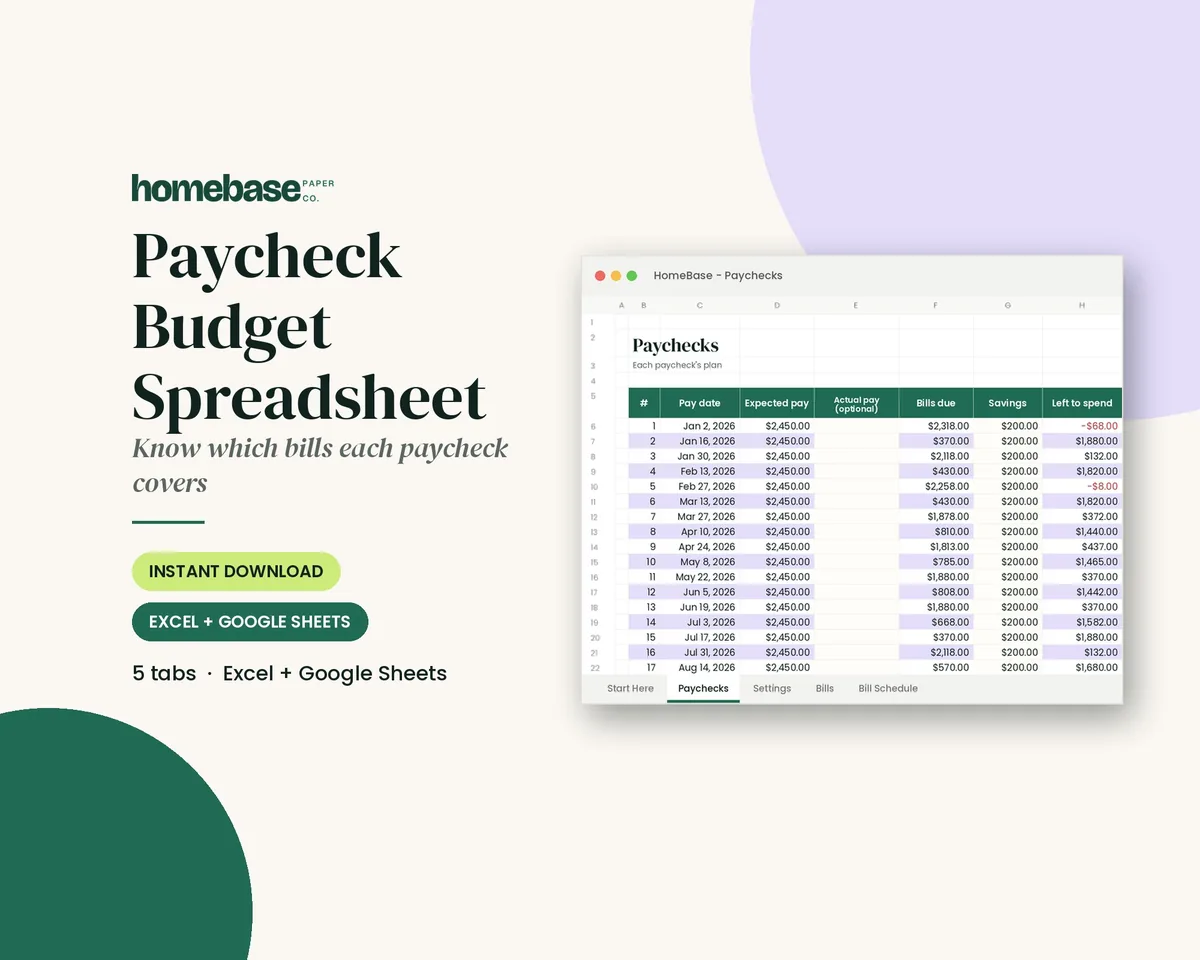
- Next step: Plan it with the Paycheck Budget Spreadsheet ($5.99).
How much car can I afford? For most people, the answer is a car whose monthly payment is about 10% of your gross monthly income or less, with a price at or under 35% of your yearly gross pay. On $60,000 a year, that's a payment near $500 a month and a car price around $21,000. Then check that payment, insurance, gas and upkeep still fit your take-home budget.
That's the quick version. The rest of this guide shows the common car affordability rules side by side, a salary table you can read in seconds, what $300, $400 and $500 a month really buys, and a five-step budget test. Every dollar amount here is an example, so swap in your own numbers before you shop.
The quick answer: three car affordability rules
There's no single official rule for how much car you can afford. Lenders will often approve you for more than is comfortable, so these rules of thumb exist to keep the number sane. Here are the three you'll see most often.
| Rule | What it says | On $60,000 a year |
|---|---|---|
| 20/4/10 rule | Put 20% down, finance for 4 years or less, keep car costs at or under 10% of gross monthly income | About $500 a month in car costs |
| 35% rule | Keep the car's price at or under 35% of your yearly gross income | About $21,000 |
| Take-home test | Payment plus insurance, gas and upkeep fit your budget after needs and savings | Depends on your bills |
The 20/4/10 rule has two versions. The strict version counts the payment, insurance, gas and maintenance inside that 10%. The looser version counts only the payment. If you have other debt or an uneven income, use the strict version.
The 35% rule is a price ceiling, not a target. It works well as a quick check at the lot, because you only need your salary to use it.
The take-home test matters most, because your budget runs on the pay that actually lands in your account. A car that passes the first two rules can still fail here if you already carry student loans or high rent.
How much car can I afford based on my salary?
This table uses the looser 20/4/10 version: a payment of 10% of gross monthly income, a 48-month loan at 7.5% and 20% down. The last column shows the 35% price ceiling. When the two price columns disagree, the lower one is the safer target.
| Yearly gross income | Monthly gross | Payment at 10% | Loan you can carry (48 mo, 7.5%) | Car price with 20% down | 35% price ceiling |
|---|---|---|---|---|---|
| $30,000 | $2,500 | $250 | $10,300 | $12,900 | $10,500 |
| $40,000 | $3,333 | $333 | $13,800 | $17,200 | $14,000 |
| $50,000 | $4,167 | $417 | $17,200 | $21,500 | $17,500 |
| $60,000 | $5,000 | $500 | $20,700 | $25,800 | $21,000 |
| $70,000 | $5,833 | $583 | $24,100 | $30,200 | $24,500 |
| $80,000 | $6,667 | $667 | $27,600 | $34,500 | $28,000 |
| $100,000 | $8,333 | $833 | $34,500 | $43,100 | $35,000 |
| $120,000 | $10,000 | $1,000 | $41,400 | $51,700 | $42,000 |
| $150,000 | $12,500 | $1,250 | $51,700 | $64,600 | $52,500 |
Why 7.5%? The Federal Reserve's G.19 consumer credit release put the average commercial bank rate on a 60-month new car loan at 7.54% in August 2026. Your rate could be higher or lower, depending on your credit, the lender and whether the car is new or used.
If your income is $100,000 or more, notice how fast the "approved" number climbs. That doesn't mean you should spend it. Many households with strong incomes still choose a car well under the ceiling and send the difference to savings.
What does $300, $400 or $500 a month buy?
A lot of shoppers start with a monthly payment in mind. That's fine, as long as you also look at the loan length. Stretching the term lowers the payment but buys you a bigger loan you'll carry longer.
| Monthly payment | 36 months | 48 months | 60 months | 72 months |
|---|---|---|---|---|
| $300 | $9,600 | $12,400 | $15,000 | $17,400 |
| $400 | $12,900 | $16,500 | $20,000 | $23,100 |
| $500 | $16,100 | $20,700 | $25,000 | $28,900 |
| $600 | $19,300 | $24,800 | $29,900 | $34,700 |
| $700 | $22,500 | $29,000 | $34,900 | $40,500 |
These are loan amounts at 7.5%, before your down payment and trade-in. Add your down payment to the loan amount to get a rough car price. Then subtract taxes and fees, which many states and dealers add on top.
Why the loan length matters more than you think
Here's a $30,000 loan at 7.5% over five different terms. The payment drops as the term grows, but the interest climbs every time.
| Loan term | Monthly payment | Total interest |
|---|---|---|
| 36 months | $933 | $3,595 |
| 48 months | $725 | $4,818 |
| 60 months | $601 | $6,068 |
| 72 months | $519 | $7,347 |
| 84 months | $460 | $8,652 |
The CFPB's guide to comparing auto loan offers makes the same point with a smaller loan. On a $20,000 loan, a three-year term costs $1,498 in interest, while a six-year term costs $3,024. The CFPB also notes that some financial experts recommend keeping an auto loan to five years or less.
Long loans carry a second risk: negative equity. The CFPB's auto loan key terms define it as owing more on the vehicle than it's worth. If you need to sell or trade in early, you'd have to cover that gap. A real down payment and a shorter term are the two simplest ways to avoid it.
For context, the same Fed release shows that new car loans through finance companies averaged 67 months and $41,705 financed in the second quarter of 2026. Longer, bigger loans are common. That doesn't make them a good fit for your budget.
The real monthly cost of owning a car
The payment is only part of the bill. The CFPB suggests thinking about the total cost of ownership, including taxes, insurance, registration, maintenance, gas and repairs. A newer car can cost more to insure and tax than an older one.
| Monthly car cost | Example amount | How to find your number |
|---|---|---|
| Loan payment | $400 | Lender's quote for your term and rate |
| Insurance | $150 | Get a quote on the exact car before you buy |
| Gas or charging | $140 | Your miles per month divided by the car's MPG, times your local price |
| Maintenance and repairs | $60 | Set aside a monthly amount, more for older cars |
| Registration, fees and parking | $25 | Yearly costs divided by 12 |
| Total | $775 | Compare this to 10% to 15% of gross pay |
Every number in that table is an example. Insurance alone can swing a lot by age, ZIP code and driving record. That's why the quote comes before the test drive, not after.
Gas is the cost people underestimate most. Our guide on how to save money on gas has ways to bring it down. For upkeep, our car maintenance schedule shows what's due and when, so you can budget a fair monthly amount.
A 5-step test to find your number
Rules of thumb get you close. This test gets you to a number that fits your actual life.
- Start with your take-home pay. Use the amount that lands in your account each month, not your salary. If your pay changes, use your lowest normal month. Our guide on how to read a pay stub can help you find it.
- Subtract your must-pay bills. List housing, utilities, groceries, insurance, child care and minimum debt payments. Our budget categories list works as a checklist so you don't miss one.
- Subtract savings first. Keep your regular savings and any emergency fund deposits in place. A car shouldn't stop you from building a cushion. See how to build an emergency fund if you're starting from zero.
- Price the full monthly cost. Add the payment, insurance quote, gas, maintenance and fees from the table above. This is your real car number.
- Leave breathing room. If the car takes every dollar that's left, it's too expensive. Aim to keep some money unassigned each month for surprises.
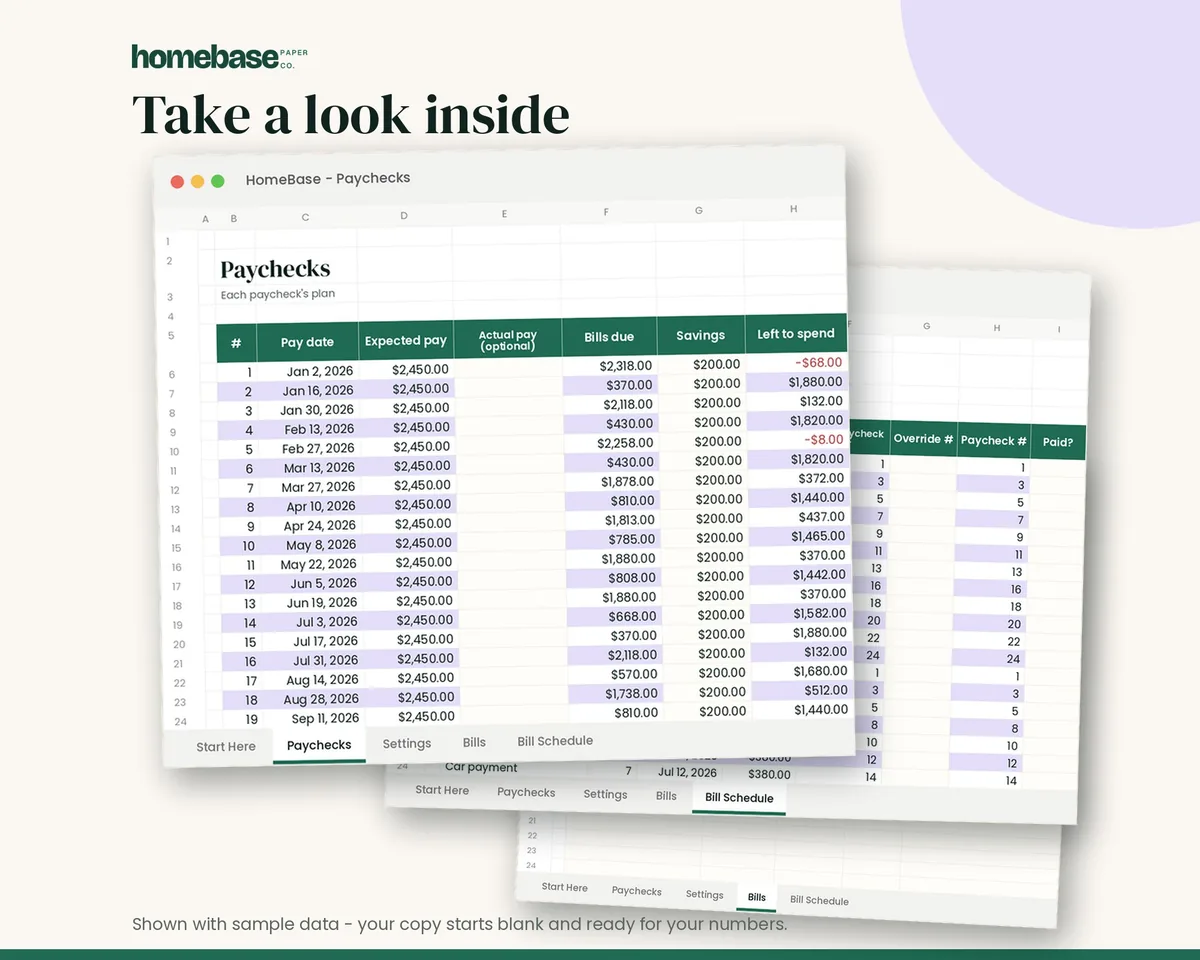
The Paycheck Budget Spreadsheet ($5.99) makes steps 1 through 4 quick. You enter your bills once, including the new car payment and insurance, and it shows which paycheck covers each one and what's left from every check. It works in Excel and Google Sheets.
A worked example on $60,000 a year
Here's how the rules and the test fit together for one example household. The numbers are made up but realistic.
- Gross pay: $60,000 a year, or $5,000 a month.
- Take-home pay: about $3,900 a month after taxes and benefits.
- Must-pay bills: $2,600 for rent, utilities, groceries, phone, insurance and a student loan.
- Savings: $300 a month.
- Left for a car: $1,000 a month on paper.
The 20/4/10 rule allows about $500 a month in car costs under the strict version. The take-home test says $1,000 is technically available. Using all of it would leave no room for anything else, though.
So this buyer sets a total car budget of $600 a month. After $150 for insurance and $200 for gas and upkeep, that leaves about $250 for the payment. With $4,000 down and a 48-month loan, that points to a car around $14,000. That's well under the 35% ceiling of $21,000, and it keeps $400 a month free for surprises.
How to budget and save for a car before you buy
The cheapest car loan is a smaller one. Saving ahead does three things at once: it builds your down payment, it proves the payment fits and it shrinks the loan.
- Pick a target down payment. Twenty percent is the classic goal. Even 10% helps you avoid negative equity early on.
- Run a practice payment. For three months, move your planned car payment into savings on payday. If it hurts, the car is too expensive. If it doesn't, you've also grown your down payment.
- Use a sinking fund. A sinking fund is money you set aside monthly for a known future cost. A car fund is one of the most useful ones you can keep.
- Keep a separate repair fund. Even after you buy, put a set amount aside each month for tires, brakes and surprises.
The Sinking Funds Tracker ($4.99) does the math for you. Enter the down payment you want and your target date, and it tells you how much to set aside each month to get there on time.
New, used and dealer checks before you sign
Most of what you can afford is decided before you reach the finance office. A few checks protect the number you worked out.
- Get preapproved first. A rate from your bank or credit union gives you something to compare. Our guide on what APR is explains how to compare offers.
- Negotiate the price, not the payment. A dealer can hit any payment you name by stretching the term. Agree on the out-the-door price first.
- Check your debt-to-income ratio. Lenders look at it, and you should too. Here's how to calculate your debt-to-income ratio.
- Inspect a used car independently. The FTC's guide to buying a used car from a dealer explains the Buyers Guide every dealer must display. It also recommends paying an independent mechanic to inspect the car, even if it's certified.
- Read "as is" carefully. On a used car sold "as is," the dealer won't pay for repairs after the sale. Get every promise written on the Buyers Guide.
Is a car loan good debt or bad debt? It depends on the rate, the term and whether the car keeps your income coming in. Our guide to good debt vs. bad debt walks through the gray areas.
Car, rent and the rest of your budget
Your car and your housing are usually your two biggest bills, so check them together. If you're also moving, our guide on how much rent you can afford uses the same take-home test. Under a 50/30/20 budget, a basic car counts as a need, while upgrades beyond what you need count as wants.
If you already have a car loan you'd like to pay down faster, the Debt Payoff Planner ($6.99) shows your payoff date and the interest you'll save with extra payments. You can also try our free debt payoff calculator.
For the full set, the Ultimate Budget Bundle ($19.99, regularly $46.42 bought separately) includes all six budget spreadsheets and both printable planners. You can also browse all our budget spreadsheets.
Why I care about this number
I'm Malaysia. I grew up in Detroit as the oldest of three, in a working family that rebuilt after 2008. I learned early that the right number isn't the biggest one a lender will approve. It's the one you can keep paying in a hard month, with something left over. Slow progress is still progress, and a car that fits your budget is part of that.
Get a few car insurance quotes before you buy, because the same budget can look very different once coverage for a newer car is added.
Make it easier
Tools for this

Spreadsheets
Paycheck Budget Spreadsheet
Enter your bills once. The sheet tells you which paycheck pays each one, all year.

Spreadsheets
Sinking Funds Tracker
It does the math: how much to set aside each month to hit every goal on time.

Spreadsheets
Debt Payoff Planner
Pick snowball or avalanche, add any extra payment, and get your debt-free month instantly.
Frequently asked questions
How much car can I afford? Most people can afford a car payment of about 10% of gross monthly income and a car price of no more than 35% of yearly gross pay. On $60,000 a year, that's roughly $500 a month and a $21,000 car. Then confirm that the payment, insurance, gas and upkeep fit your take-home budget, and pick the lower number if the checks disagree.
What is the 20/4/10 rule for buying a car? The 20/4/10 rule says to put at least 20% down, finance for no more than four years and keep car costs at or under 10% of your gross monthly income. The strict version counts insurance, gas and maintenance inside that 10%. The looser version counts only the loan payment.
How much car can I afford making $50,000 a year? On $50,000 a year, you can afford a car payment of about $417 a month and a car price of about $17,500 under the 35% rule. With 20% down on a 48-month loan at 7.5%, that payment supports a car near $21,500, so the 35% ceiling is the safer target. Check insurance and gas before you commit.
How much car can I afford making $60,000 a year? On $60,000 a year, you can afford a car price of about $21,000 and a monthly payment near $500. If you use the strict 20/4/10 rule, that $500 has to cover insurance, gas and upkeep too, which points to a lower payment and a cheaper car.
How much car can I afford making $100,000 a year? On $100,000 a year, the 35% rule puts your ceiling at about $35,000, with a payment of about $833 a month under the 10% rule. That's a ceiling, not a goal. Choosing a cheaper car and saving the difference can build your emergency fund and other goals much faster.
How much car can I afford for $400 a month? At $400 a month and 7.5%, you can borrow about $16,500 over 48 months or about $20,000 over 60 months. Add your down payment and trade-in to that loan amount to get a rough car price. Remember that taxes and fees often come on top.
How much car can I afford for $300 a month? At $300 a month and 7.5%, you can borrow about $12,400 over 48 months or about $15,000 over 60 months. A larger down payment is the easiest way to buy more car without stretching the loan to six or seven years.
What percentage of my income should go to a car payment? Aim for a car payment of 10% of gross monthly income or less, and total car costs of about 10% to 15%. Total costs include insurance, gas, maintenance, registration and parking. If you have other debt or an uneven income, stay at the low end.
Should I base my car budget on gross or net income? Use gross income for the quick rules and net income for the final check. The 20/4/10 rule and the 35% rule use gross pay. Your budget, though, runs on take-home pay. The Paycheck Budget Spreadsheet ($5.99) shows what's left from each paycheck after the car payment and your other bills.
How long should a car loan be? A car loan of four years or less is ideal, and five years is a common upper limit. The CFPB notes that some financial experts recommend five years or less. Longer loans lower the payment but cost more interest and raise your risk of owing more than the car is worth.
How much should I put down on a car? Put down 20% if you can, and at least 10% if you can't. A bigger down payment shrinks your loan, lowers the payment and helps you avoid negative equity. The Sinking Funds Tracker ($4.99) tells you how much to save each month to reach your down payment by a target date.
How do I save for a car? Save for a car by setting a down payment goal and moving money into a separate car fund every payday. The Sinking Funds Tracker ($4.99) does the monthly math for you. A good test is to save your planned car payment for three months before you buy; if it's hard, choose a cheaper car.
What costs should I budget for besides the car payment? Budget for insurance, gas or charging, maintenance, repairs, registration, taxes and parking. Get an insurance quote on the exact car before you buy, since it varies a lot. The Vehicle Maintenance Log ($3.99) helps you track oil changes, repairs and fuel so you can see your real monthly cost.
Is it better to buy a new or used car? A used car usually costs less to buy, insure and tax, so it's often easier to afford. New cars may cost less in repairs at first. If you buy used from a dealer, read the FTC Buyers Guide on the window and have an independent mechanic inspect the car first.
How do I fit a car payment into my budget? Assign the car payment to the paycheck that comes before the due date and set that money aside on payday. The Paycheck Budget Spreadsheet ($5.99) does this for you: enter the payment and insurance once, and it shows which paycheck covers each bill all year. It works in Excel and Google Sheets.
More from HomeBase
You may also like

Printables
Budget Planner Printable
Twelve undated pages you can print every month: budget, bills, spending, savings and debt.

Spreadsheets
Bill Tracker Spreadsheet
Bills due in 3 days or less light up red, so nothing slips through.

Spreadsheets
Zero-Based Budget Spreadsheet
The 'Left to budget' counter turns green when every dollar has a job.

Spreadsheets
Annual Budget Spreadsheet
See exactly where your money goes every month - without complicated software.
 Club
Monthly club
Money Club
Anyone who wants a clear plan for the month's bills, holiday spending and savings.
Free printable
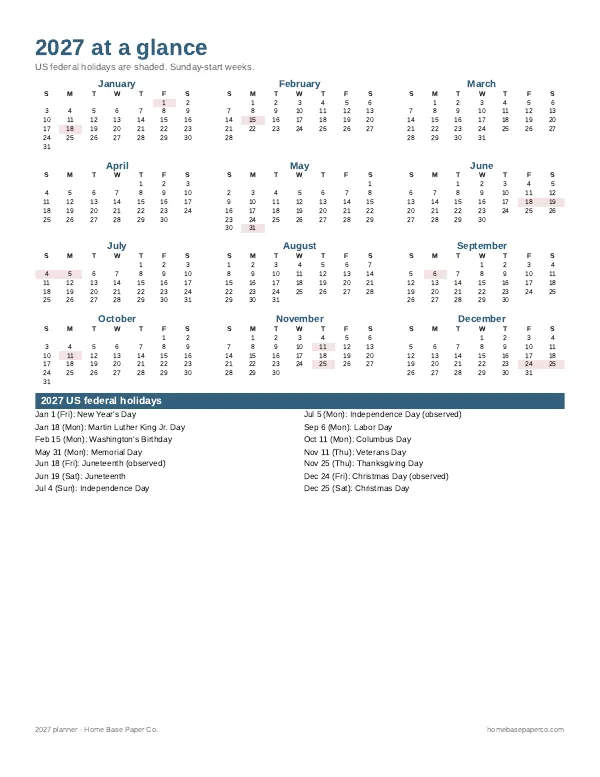
Get organized for the new year: get the free 2027 planner
A 16-page printable 2027 planner with a year-at-a-glance page and monthly calendars with US holidays marked. You'll also get our weekly HomeBase email with simple planning and home organization tips.
Sources
- Consumer Credit G.19 (Federal Reserve) federalreserve.gov
- How do I compare auto loan offers? (CFPB) consumerfinance.gov
- Auto loan key terms (CFPB) consumerfinance.gov
- Buying a Used Car From a Dealer (FTC) consumer.ftc.gov