


The short answer: to calculate debt to income ratio, divide your monthly debt payments by your gross monthly income and multiply by 100. Lenders use it to decide how much they'll lend.
- Example: $2,150 in payments on $5,000 gross income is 43%
- Under about 36%: most lenders see this as comfortable
- About 36% to 43%: many loans are still possible, with less room for surprises
- Over 43%: a common upper limit for many mortgages, though some lenders go higher
- Next step: Plan it with the Debt Payoff Planner ($6.99).
Knowing how to calculate debt to income ratio tells you how much of your income already goes to debt before you pay for anything else. Lenders use it to decide how much they'll lend. You can use it to see how much breathing room your budget has. This guide gives you the formula, what to include, worked examples and ways to lower your number.
The formula
Debt to income ratio, or DTI, is simple:
Monthly debt payments ÷ gross monthly income × 100 = DTI (%)
The CFPB's debt-to-income ratio explainer uses the same formula and explains how lenders read the result.
Step 1: Add up monthly debt payments
Include payments you must make every month:
Not sure what counts? Our guide to what is debt lists the main types, from mortgages to buy now, pay later plans.
- Rent, or a mortgage payment with property taxes, insurance and HOA dues
- Car loans and leases
- Student loans (the required payment, even if it's in deferment for some lenders)
- Minimum credit card payments
- Personal loans and buy now pay later plans
- Child support or alimony you pay
Leave out everyday costs like groceries, utilities, phone, gas, health insurance premiums and subscriptions. They matter for your budget, but lenders don't count them in DTI.
Step 2: Find your gross monthly income
Use income before taxes and deductions:
If your pay varies or you have more than one income, our guide to gross monthly income has formulas for every pay type and a salary-to-monthly table.
- Salary: divide your yearly salary by 12.
- Hourly: hourly rate × usual weekly hours × 52 ÷ 12.
- Self-employed: lenders often average net business income from your last two tax returns.
- Other steady income: add Social Security, pensions, disability and support you receive.
If your pay changes a lot, our guide to how to budget with irregular income shows how to find a fair monthly figure.
Step 3: Divide and multiply by 100
Here's a worked example for one household:
| Monthly payment | Amount |
|---|---|
| Rent | $1,500 |
| Car loan | $350 |
| Student loan | $200 |
| Credit card minimums | $100 |
| Total debt payments | $2,150 |
| Gross monthly income | $5,000 |
$2,150 ÷ $5,000 = 0.43. Multiply by 100 and the DTI is 43%.
Housing alone is $1,500 ÷ $5,000 = 30%. That's the front-end ratio.
Front-end vs. back-end DTI
- Front-end DTI counts only housing: rent or mortgage, property taxes, insurance and HOA dues.
- Back-end DTI counts housing plus every other debt payment.
Mortgage lenders look at both. When someone says "DTI" without saying which, they usually mean back-end. To turn those limits into a price, see how much house you can afford on your salary.
What the number means
There's no single cutoff that applies to every lender or loan. As general guides:
- Under about 36%: most lenders see this as comfortable, and so will your budget.
- About 36% to 43%: many loans are still possible, but there's less room for surprises.
- Over 43%: the CFPB notes 43% has long been a common upper limit for many mortgages, though some lenders go higher.
If you're thinking about buying a home, the CFPB's buying a house tools walk through how DTI fits with your down payment and loan options. Renters can use our how much rent can I afford guide.
How to lower your debt to income ratio
Paying down debt while you also plan how to save for a house improves your ratio and your savings at the same time.
- Pay off a small debt completely. Removing a $150 monthly payment drops DTI more than spreading the same money across several balances.
- Pay down card balances. Lower balances often mean lower minimum payments.
- Avoid new loans in the months before you apply for a mortgage or car loan.
- Refinance to a lower payment if it doesn't add big fees or years. Our mortgage refinance guide covers when a lower rate or cash-out makes sense.
- Raise income with a documented raise, more hours or steady side work.
The snowball method, which targets the smallest balance first, often lowers DTI fastest because it wipes out whole payments. Read debt snowball vs. avalanche to compare methods. For more on this topic, see our financial calculators hub.
A second example: a lower ratio
Say a single parent earns $4,200 a month before taxes. Rent is $1,100, a car loan is $280 and credit card minimums total $60. Debt payments add up to $1,440.
$1,440 ÷ $4,200 = 0.343, or about 34%. The front-end ratio is $1,100 ÷ $4,200, or about 26%.
If the car loan is paid off next year, the total drops to $1,160 and the ratio falls to about 28%. That one change frees $280 a month for savings or other goals. It also shows why paying off a whole loan matters so much for DTI.
DTI for a joint application
When two people apply together, lenders add both incomes and both sets of debt payments. A partner with high student loan payments can raise the joint ratio even if their income is good. Run the numbers for each person and together before you apply, so there are no surprises.
Common mistakes
- Using take-home pay instead of gross income, which makes DTI look worse than lenders see it.
- Using full card balances instead of minimum payments.
- Forgetting buy now pay later plans or a co-signed loan.
- Counting one-time income like a tax refund.
Track it once a year
Recalculate your DTI every January or after a big change, like a raise or a paid-off loan. Watching it fall is a clear sign your plan is working.
Your ratio shows how much of your income goes to debt. For the bigger picture, learn how to calculate net worth: what you own minus what you owe.
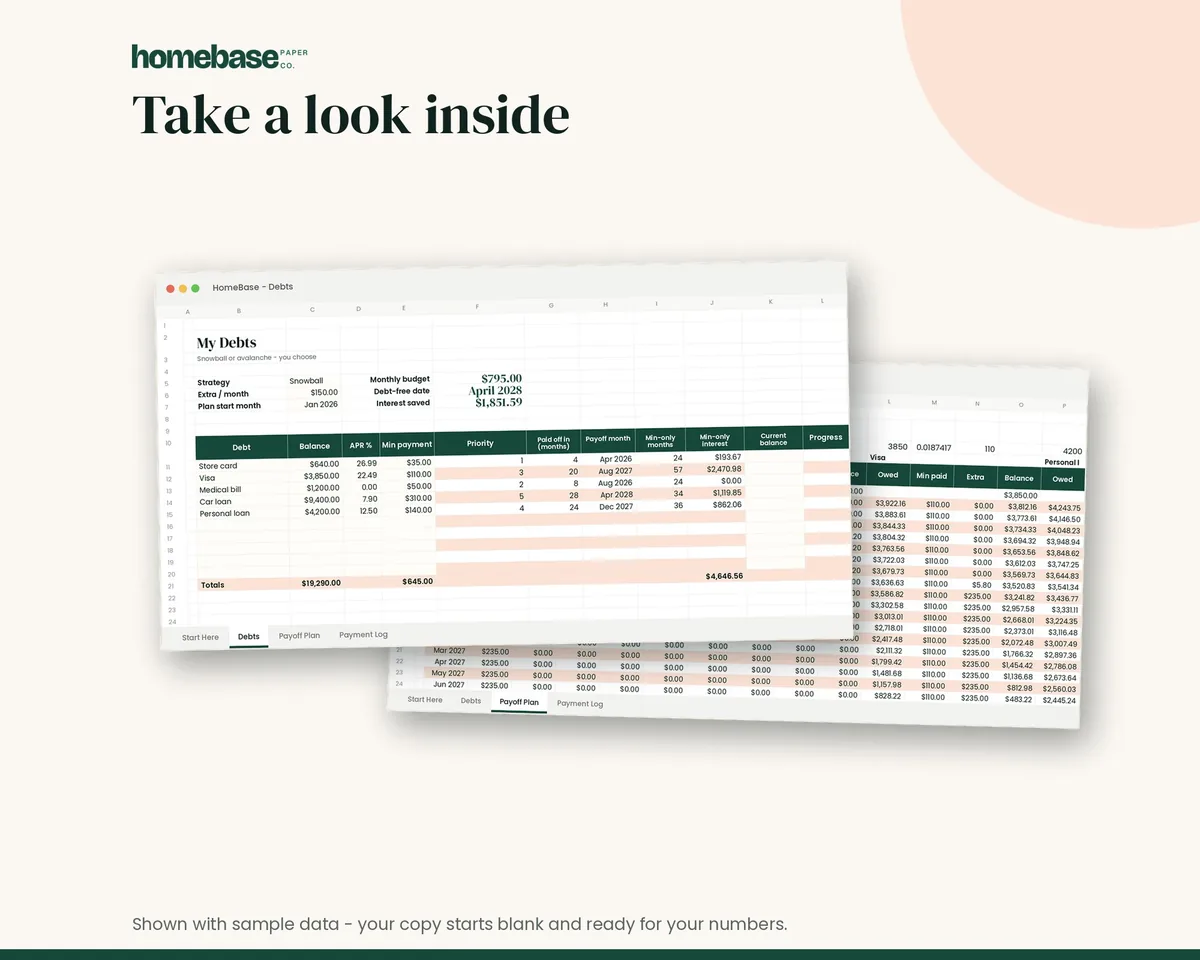
The Debt Payoff Planner ($6.99) tracks up to 10 debts, switches between snowball and avalanche, and shows a month-by-month schedule, each debt's payoff month, your debt-free date and interest saved. The Paycheck Budget Spreadsheet ($5.99) assigns each bill to the right paycheck so you can see what's left to spend.
Next steps: how to get out of debt, the debt tracker and how to build credit.
Before you apply for a loan, it also helps to check your credit report for free and fix any errors. Lenders look at your score too; our guide to credit score ranges shows where yours stands.
Make it easier
Tools for this

Spreadsheets
Debt Payoff Planner
Pick snowball or avalanche, add any extra payment, and get your debt-free month instantly.

Spreadsheets
Paycheck Budget Spreadsheet
Enter your bills once. The sheet tells you which paycheck pays each one, all year.
Frequently asked questions
How do I calculate my debt to income ratio? Add up your monthly debt payments, such as rent or mortgage, car loan, student loan, minimum credit card payments and any personal loans. Divide that total by your gross monthly income, which is your pay before taxes. Multiply by 100. If you pay $2,000 a month in debt and earn $6,000 before taxes, your ratio is about 33%.
What counts as debt in a debt to income ratio? Lenders usually count recurring debt payments: rent or a mortgage payment (including property taxes and insurance), car loans, student loans, minimum credit card payments, personal loans, and court-ordered payments like child support. Everyday bills such as groceries, utilities, phone and insurance premiums usually aren't included.
Do I use gross or net income for DTI? You use gross income for DTI, which is your pay before taxes and other deductions. If you're paid hourly, multiply your hourly rate by your usual weekly hours and by 52, then divide by 12. If you're self-employed, lenders often use the net business income on your tax return averaged over two years.
What is a good debt to income ratio? Many lenders prefer a ratio of 36% or lower, and a lower number gives you more room in your budget. The CFPB notes that 43% has long been a common upper limit for many mortgages, though some lenders allow more. Lower is generally better for both approval and your own peace of mind.
What is the difference between front-end and back-end DTI? Front-end DTI counts only housing costs: your rent or mortgage, property taxes, homeowners insurance and HOA dues. Back-end DTI counts housing plus all other debt payments. Mortgage lenders look at both. When people say DTI without saying which, they usually mean back-end.
Does my debt to income ratio affect my credit score? No, your debt-to-income ratio doesn't affect your credit score. Credit scores don't include your income, so DTI isn't part of the score. Your credit utilization, which is how much of your credit limits you're using, does affect scores. Paying down card balances improves both your utilization and your DTI at the same time.
How can I lower my debt to income ratio? You can lower it by paying down debt or raising income. Paying off a small loan entirely removes its whole monthly payment from the calculation, which can help more than spreading extra money across many debts. Avoid taking on new loans before you apply for a mortgage or car loan.
Is rent included in debt to income ratio? Sometimes: rent is often included for other loans or a rental application, but not for a mortgage. When you apply for a mortgage, the lender uses the new housing payment, not your current rent. For other loans or a rental application, current rent is often included. If you're figuring DTI for your own budget, include rent, since it is a fixed monthly obligation.
Do lenders include minimum credit card payments or full balances? Lenders include the minimum monthly payment shown on your credit report, not the full balance. If your card is paid in full every month, the reported minimum might still count. Paying the balance down before you apply lowers the minimum and your ratio.
Why does debt to income ratio matter if I'm not buying a house? It's a quick health check for your budget. A high ratio means a big share of each paycheck is already spoken for before groceries, gas and savings. Knowing how to calculate debt to income ratio lets you check progress each year as you pay debts down.
What income counts for debt to income ratio? Lenders count steady income you can document: wages, salary, overtime or bonuses with a track record, self-employment income, Social Security, pensions, disability, alimony and child support you receive. One-time gifts and irregular side income without a history usually don't count.
More from HomeBase
You may also like

Printables
Budget Planner Printable
Twelve undated pages you can print every month: budget, bills, spending, savings and debt.

Spreadsheets
Bill Tracker Spreadsheet
Bills due in 3 days or less light up red, so nothing slips through.

Spreadsheets
Sinking Funds Tracker
It does the math: how much to set aside each month to hit every goal on time.

Spreadsheets
Zero-Based Budget Spreadsheet
The 'Left to budget' counter turns green when every dollar has a job.
 Club
Monthly club
Money Club
Anyone who wants a clear plan for the month's bills, holiday spending and savings.
Free printable
Never miss a payment: get the free bill calendar
A printable monthly bill calendar with room for due dates, amounts and paydays, so every payment has a plan before the month starts. You'll also get our weekly HomeBase email with simple budgeting and bill-paying tips.

Sources
- CFPB: What is a debt-to-income ratio? consumerfinance.gov
- CFPB: Buying a house consumerfinance.gov