

The short answer: a no buy challenge is a set stretch of time, from one week to a full year, when you buy only a short list of needs and send the money saved to a clear goal.
- You still pay bills and buy groceries and essentials
- Write your rules before day one
- Use a 48-hour pause and keep a wish list
- Track and transfer what you save
- Next step: Plan it with the 100 Envelope Savings Challenge ($3.99).
A no buy challenge is a set stretch of time, from one week to a full year, when you stop buying anything that is not on a short list of needs, then send the money you would have spent to a clear goal. You still pay bills and buy groceries and essentials. The challenge works when you write your rules before day one, choose a realistic length and track what you save. Here is how to plan a no buy challenge that lasts past the first week.
I grew up in Detroit as the oldest of three and became the family coordinator, the one who keeps plans on track. A no buy challenge is a plan with a pause button: it stops the small, unplanned purchases so you can see where the money really goes. If the pause sticks, it can turn into a longer habit of minimalism, where you buy less by choice all year.
How to start a no buy challenge in 7 steps
- Pick your goal. Emergency fund, debt payoff, a trip or simply breaking the shopping habit.
- Choose a length. One week, one month, a season or a full year.
- Write your no list. The categories you will not buy, such as clothes, decor, beauty or gadgets. If decor is on your list, our home decor ideas start with rearranging what you already own.
- Write your yes list. Groceries, bills, medicine, gas and true replacements.
- Take inventory. Look at what you already own so you are not tempted to rebuy it.
- Remove triggers. Unsubscribe from store emails and delete shopping apps.
- Track and transfer. Log each skipped purchase and move that money to savings weekly.
Investopedia's overview of the no-buy challenge describes it as listing the items you will avoid for anywhere from a week to a year and tying the challenge to a goal. It also suggests rotating your list from month to month if a full ban feels like too much.
Start a no buy challenge now or on January 1, 2027?
You can start any day, and a start date you will actually keep matters more than a symbolic one. Starting now means you face the holiday spending season head on, so write your rules around gifts first: set a gift budget and a "buy" list, and treat everything else as paused. Starting January 1, 2027 gives you a clean month, but you still need a plan for the weeks before it. A middle path many people use is a no buy month in December for everything except gifts, food and travel, then a longer challenge in the new year.
Worked example: what a no buy month can save
The numbers below are an example, not a promise. Replace them with your own last three months of spending, which you can pull from your bank statement or a spending tracker.
| Category | Usual month (example) | Paused during the challenge | Estimated saved |
|---|---|---|---|
| Takeout and coffee | $180 | Most of it | $120 |
| Online shopping and apps | $90 | All of it | $90 |
| Clothes and decor | $70 | All of it | $70 |
| Hobby supplies | $40 | Use what you own | $40 |
| Total | $380 | $320 |
Move the money on the day you skip the purchase, not at month end, and point it at one goal such as a holiday fund or an emergency fund. The no-spend January challenge is the stricter next step once you have finished a no buy month.
Choose the right length
| Length | Best for | What to expect |
|---|---|---|
| One week | Testing the idea | Shows your quick impulse habits |
| No buy month | A first real challenge | Enough time to notice triggers and patterns |
| One week per month | Busy seasons | Steady savings without long restrictions |
| Season (3 months) | A specific savings goal | Real progress toward a fund or payoff |
| No buy year or low buy year | Long-term habit change | Needs flexible rules and planned exceptions |
If a no buy year sounds like too much, a low buy year sets limits instead of bans. For example, you might allow one planned clothing purchase per season or a small monthly hobby amount.
Sample no buy rules
Your rules are the heart of the challenge. Write them out, keep them on your phone and review them each week.
| Category | No buy | Allowed |
|---|---|---|
| Clothes and shoes | New items for fun | Replacing worn-out basics |
| Home and decor | Decor, gadgets, organizing bins | Repairs and safety items |
| Beauty and personal care | New products to try | Refills of what you use up |
| Food | Takeout and coffee runs (optional) | Groceries on a meal plan |
| Entertainment | New books, games, subscriptions | Library, free events, what you own |
| Gifts | Unplanned extras | Planned gifts within a set amount |
Habits that keep a no buy challenge going
The Consumer Financial Protection Bureau's tips on sticking to a budget say that if you know you are prone to impulse spending, you should make a doable plan to limit it. They also suggest setting a goal, rewarding yourself in small ways for progress and leaning on family or friends for support. Those ideas map neatly onto a no buy challenge.
- Use a 48-hour pause. If you are unsure whether something is a need, wait two days before you decide.
- Delete store apps and unsubscribe from store emails. Fewer prompts mean fewer impulse buys.
- Keep a wish list. Write items down instead of buying them. Many lose their appeal within a few weeks.
- Shop your home first. Use up pantry, bathroom and craft supplies before you replace them.
- Plan known costs ahead. Birthdays, car repairs and holidays should come from sinking funds, not from breaking rules.
- Find a partner. A friend or spouse doing the challenge with you makes it easier to stay on track.
- Make an exit plan. Decide in advance what the first purchase after the challenge will be, so it does not turn into a spree. A big haul the week the challenge ends can erase much of what you saved.
Where the money you save should go
A no buy challenge only pays off if the money lands somewhere on purpose. Pick one destination before you start:
- An emergency fund, especially if yours covers less than one month of expenses
- Extra payments on your highest-interest debt
- A sinking fund for a trip, holidays or a big planned purchase
- A fun savings challenge, such as 100 envelopes, to make progress visible
If you want to go stricter for a short stretch, our no spend January challenge guide covers zero-spend days. For more ways to cut costs, see how to save money.
Savings tools for your no buy challenge
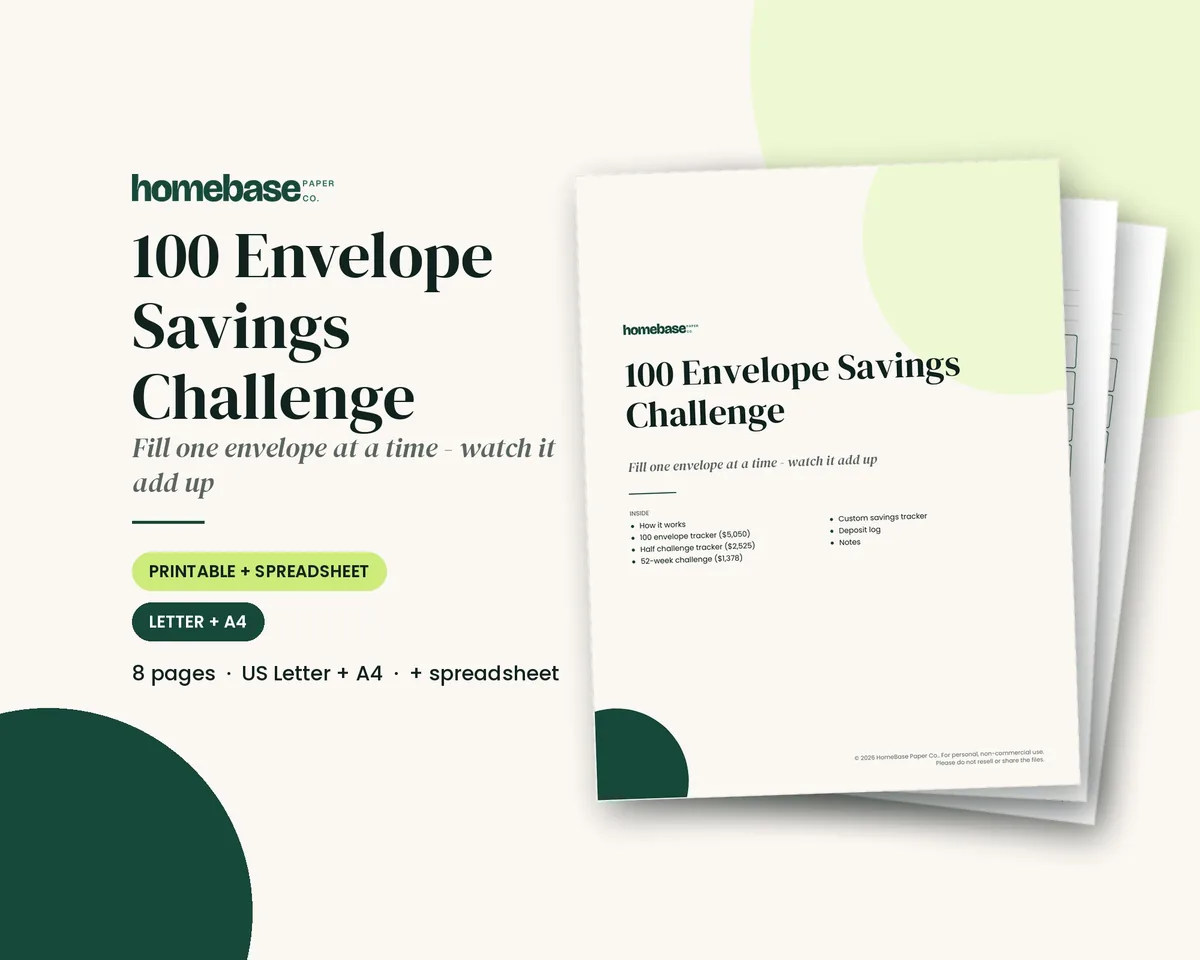
- 100 Envelope Savings Challenge ($3.99): a visual tracker for the money you save.
- Sinking Funds Tracker ($4.99): plan gifts, repairs and holidays so they do not break your rules.
- Budget Planner Printable ($5.99): monthly budget and savings goal pages.
- Ultimate Budget Bundle ($19.99, $46.42 if bought separately): budget spreadsheets and printables together.
HomeBase planners are undated or can start in any month, so you can begin your challenge any time. Browse every printable in the shop. Our free Holiday Budget Starter Kit is three US Letter pages we email you after you join our list.
See also
Not ready for a full no-buy? Our guide on how to stop spending money has 30 smaller fixes and a 7-day spending reset.
Make it easier
Tools for this
 Starter pick
Printables
100 Envelope Savings Challenge
Classic, half and 52-week challenges to print, plus a spreadsheet that tracks every envelope and tells you how much to save each week.

Spreadsheets
Sinking Funds Tracker
It does the math: how much to set aside each month to hit every goal on time.

Printables
Budget Planner Printable
Twelve undated pages you can print every month: budget, bills, spending, savings and debt.
Frequently asked questions
What is a no buy challenge? A no buy challenge is a set period, from a week to a year, when you stop buying anything outside an approved list of needs. You still pay bills and buy groceries and essentials. The goal is to break autopilot shopping and redirect that money toward savings or debt.
What are the rules of a no buy challenge? The rules are the ones you write before you start: a length, a list of things you will not buy, a list of things you still can buy and a plan for the money you save. Write them down and keep them where you shop, such as a note on your phone.
How long should a no buy challenge last? Most people start with one week or one month, then try a no buy month again or move to a low buy year if it goes well. A short first round teaches you where your spending leaks are without feeling impossible. Longer challenges work best after you have a few wins.
What is the difference between a no buy year and a low buy year? A no buy year bans whole categories of purchases for twelve months, while a low buy year sets limits instead, such as a small monthly amount for clothes or hobbies. A low buy year is easier to sustain for most families because it allows planned purchases.
What can you buy during a no buy challenge? You can buy what is on your approved list, which usually includes groceries, household essentials, medicine, gas, bills and replacements for things that truly wear out. Many people also allow planned gifts. Everything else waits until the challenge ends or goes on a wish list.
What is the difference between a no buy challenge and a no spend challenge? A no spend challenge usually means spending zero on anything but bills for a short stretch, such as a weekend or a month of no spend days. A no buy challenge targets categories of stuff, like clothes or decor, and often lasts longer. Our no spend January guide covers the stricter version.
How do I track my savings during a no buy challenge? Write down what you would have bought and its price, then move that amount to savings each week. The 100 Envelope Savings Challenge gives that saved money a fun, visible place to land. Seeing the total grow is one of the best ways to keep going.
What do I do if I slip up during a no buy challenge? Note what you bought and why, then keep going instead of quitting. A slip shows you a trigger, such as a store email or a stressful day, that you can plan around. One purchase does not cancel weeks of progress.
How do I prepare for a no buy challenge? Take inventory of what you already own, use up what is on hand, unsubscribe from store emails and delete shopping apps before day one. A Sinking Funds Tracker helps you plan for known costs like gifts and car repairs so they do not break your rules.
Is a no buy challenge good for the new year? Yes, January is a popular time to start because holiday spending is fresh and many people set money goals. Pair the challenge with a fresh budget so the money you save goes somewhere specific. The Budget Planner Printable has pages for monthly budgets and savings goals.
Should I start a no buy challenge before January? You can start a no buy challenge any day, and starting in November or December works if you set gift, food and travel exceptions first. Many people start a no buy month in December for non-essentials and a longer challenge on January 1, 2027, once the holiday spending is behind them.
More from HomeBase
You may also like

Spreadsheets
Bill Tracker Spreadsheet
Bills due in 3 days or less light up red, so nothing slips through.

Spreadsheets
Paycheck Budget Spreadsheet
Enter your bills once. The sheet tells you which paycheck pays each one, all year.

Spreadsheets
Zero-Based Budget Spreadsheet
The 'Left to budget' counter turns green when every dollar has a job.

Spreadsheets
Annual Budget Spreadsheet
See exactly where your money goes every month - without complicated software.
 Club
Monthly club
Money Club
Anyone who wants a clear plan for the month's bills, holiday spending and savings.
Free printable
Give every dollar a job: get the free monthly budget template
A printable zero-based monthly budget: income, bills, everyday spending and savings on one page, with a planned vs. actual column. You'll also get our weekly HomeBase email with simple budgeting and bill-paying tips.

Sources
- No-Buy Challenge (Investopedia) investopedia.com
- Budgeting: How to create a budget and stick with it (CFPB) consumerfinance.gov