

The short answer: the Dave Ramsey baby steps are a seven-step plan for getting out of debt and building wealth, done in a set order.
- Step 1: save a $1,000 starter emergency fund
- Step 2: pay off all debt except the house with the debt snowball
- Step 3: save 3 to 6 months of expenses
- Steps 4 to 7: invest 15% for retirement, college, pay off the house, build wealth and give
- Next step: Plan it with the Debt Payoff Planner ($6.99).
The Dave Ramsey baby steps are a seven-step plan for getting out of debt and building wealth, done in a set order. Investopedia's summary of Ramsey's plan lists them as a $1,000 emergency fund, paying off non-mortgage debt with the debt snowball, three to six months of expenses, 15% of gross income to retirement, college savings, paying off the mortgage early and building wealth. Below we explain each step, what it looks like with real numbers, where many planners disagree and the tools that make each step easier. HomeBase is not affiliated with Ramsey Solutions.
For baby step 2, our Debt Payoff Planner has a snowball or avalanche switch, an extra payment roll-over and a debt-free date for up to 10 debts.

The 7 baby steps at a glance
| Step | Goal | Done when |
|---|---|---|
| 1 | Save $1,000 starter emergency fund | $1,000 is in savings |
| 2 | Pay off all debt except the house (debt snowball) | Only the mortgage is left |
| 3 | Save 3 to 6 months of expenses | Full emergency fund in savings |
| 4 | Invest 15% of household income for retirement | Ongoing |
| 5 | Save for children's college | Ongoing, alongside step 4 |
| 6 | Pay off your home early | Mortgage is paid off |
| 7 | Build wealth and give | Ongoing |
Steps 1 to 3 are done one at a time. Steps 4, 5 and 6 run together, in that priority order.
Baby step 1: $1,000 starter emergency fund
The first step is a small cash cushion so a car repair or urgent bill does not go on a credit card. The goal is speed: sell things you do not use, pick up overtime and cut spending hard until you have $1,000.
The Consumer Financial Protection Bureau's guide to building an emergency fund gives practical ways to get there: set a savings goal, make saving automatic, save tax refunds and other windfalls, and track your progress. Keep the money in a separate savings account so it is not mixed with spending money.
Baby step 2: pay off all debt with the debt snowball
List every debt except the mortgage from the smallest balance to the largest. Pay the minimum on all of them and put every extra dollar toward the smallest. When it is paid off, add its payment to the next one. NerdWallet's explainer on the debt snowball notes the quick early wins keep people motivated, though paying the highest rate first (the avalanche) usually costs less interest.
| Debt | Balance | Minimum | Snowball order |
|---|---|---|---|
| Store card | $450 | $25 | 1 |
| Medical bill | $1,200 | $50 | 2 |
| Credit card | $4,800 | $120 | 3 |
| Car loan | $11,500 | $310 | 4 |
With $300 extra a month, the store card is gone in under two months. Then $325 goes at the medical bill, and the payment keeps growing.
The Debt Payoff Planner ($6.99, Excel and Google Sheets) handles up to 10 debts and switches between snowball and avalanche. Add any extra monthly payment and it rolls each paid-off payment forward, shows a month-by-month schedule and updates your debt-free date and the interest saved right away. For a step-by-step look at the method, read our debt snowball vs. avalanche guide.
Baby step 3: 3 to 6 months of expenses
Once the debt is gone, the money you were sending to creditors builds a full emergency fund. Count essential expenses, not income: housing, utilities, groceries, insurance, transportation and any remaining minimums. A household spending $3,500 a month on essentials needs $10,500 to $21,000. Ramsey suggests aiming toward six months with one income and three with two incomes. Our emergency fund tracker page has ways to chart the progress.
Baby steps 4, 5 and 6: invest, save for college, pay off the house
- Step 4: invest 15% of gross household income in retirement accounts such as a 401(k) and IRA.
- Step 5: save for children's college, for example in a 529 plan or education savings account.
- Step 6: put anything left toward extra mortgage payments.
Retirement comes before college in this plan because students can borrow or get aid for school, but nobody lends you money to retire.
Baby step 7: build wealth and give
With no debt and no mortgage, your income is freed up for investing, generosity and leaving an inheritance. This step lasts the rest of your life.
A worked example: steps 1 to 3 for one household
Here is how the first three steps might play out for a household taking home $5,000 a month with $3,500 of essential expenses and the four debts in the table above (total balance $17,950, total minimums $505).
| Stage | Monthly amount going to the goal | Goal | Rough time |
|---|---|---|---|
| Step 1 | $300 extra, plus a $400 sale of unused items | $1,000 | About 2 months |
| Step 2 | $300 extra plus the $505 in minimums, rolling forward | $17,950 of debt | About 2 years, a little longer once interest is added |
| Step 3 | The full $805 that used to go to debt | $10,500 (3 months) | About 13 months |
The numbers are illustrations, not a promise. A raise, a tax refund or a side job shortens every stage, while a job loss or a big repair can pause it. The Debt Payoff Planner recalculates the debt-free date as soon as you change the extra payment, which makes it easy to see what an extra $100 a month does.
What counts as debt in baby step 2
| Debt | In baby step 2? |
|---|---|
| Credit cards and store cards | Yes. |
| Car loans | Yes. |
| Student loans | Yes. |
| Medical bills and personal loans | Yes. |
| Buy now, pay later plans | Yes. |
| Your home mortgage | No, that is step 6. |
Adapting the steps to your situation
- Irregular income: budget on your lowest typical month and send the extra from good months straight to the current step.
- Couples: agree on the step you are on and budget together. Ramsey's three-months guideline for two-income households assumes both incomes are reasonably steady.
- Renters: step 6 does not apply yet, so many renters use that stage to save toward a down payment.
- Very high-interest debt: if one card has a much higher rate, some people pay it first and then return to the snowball. That is the avalanche, and it is a reasonable change to make on purpose.
Where planners disagree
The baby steps are popular because they are simple. Common criticisms are worth knowing so you can adapt them:
- Pausing the 401(k) match in step 2 gives up an employer contribution that many planners consider too valuable to skip.
- The snowball over the avalanche can cost more interest when a high-rate card has a large balance.
- $1,000 is the same for everyone, which is a lot for some households and very little for others.
- Paying off a low-rate mortgage early may matter less than investing more, depending on rates.
None of these make the plan wrong. They are choices to make on purpose.
The budget behind every step
Every step depends on knowing where your money goes. Ramsey teaches a zero-based budget: before the month starts, give every dollar a job until income minus planned spending equals zero. The Zero-Based Budget Spreadsheet ($6.99) has 12 monthly tabs, each with a "Left to budget" counter that turns green when every dollar has a job. It works in Excel and Google Sheets, so you and a partner can plan in the same file and see how much is free for the current baby step.
Tips for sticking with it
- Write the current step on your budget. One goal at a time is the whole point.
- Celebrate each paid-off debt with something small and free.
- Get your partner on board before you start. Budget together once a month.
- Use windfalls. Tax refunds, bonuses and gifts can finish a step months early.
- Expect setbacks. If an emergency drains the $1,000, pause step 2 and refill it.
If you want to compare plans, our page on the financial order of operations shows a different priority list, and how to get out of debt covers other payoff strategies.
Make it easier
Tools for this

Spreadsheets
Debt Payoff Planner
Pick snowball or avalanche, add any extra payment, and get your debt-free month instantly.

Spreadsheets
Zero-Based Budget Spreadsheet
The 'Left to budget' counter turns green when every dollar has a job.
Frequently asked questions
What are the Dave Ramsey baby steps? The Dave Ramsey baby steps are seven money goals done in order: 1) save $1,000 for a starter emergency fund, 2) pay off all debt except the house with the debt snowball, 3) save three to six months of expenses, 4) invest 15% of household income for retirement, 5) save for children's college, 6) pay off the home early, and 7) build wealth and give.
What is baby step 1? Baby step 1 is saving $1,000 as a starter emergency fund as fast as you can. The idea is to have cash for a flat tire or a broken appliance so a small emergency does not go on a credit card while you pay off debt. Many people reach it by selling things, picking up extra hours and cutting spending for a month or two.
What is baby step 2? Baby step 2 is paying off all debt except your mortgage using the debt snowball: list debts from smallest balance to largest, pay minimums on all of them and throw every extra dollar at the smallest. When it is gone, roll that payment into the next one. Investing is paused during this step. A Debt Payoff Planner shows your payoff order and debt-free date.
How much should be in the baby step 3 emergency fund? Baby step 3 is three to six months of essential expenses, not three to six months of income. Ramsey suggests closer to six months for single-income households and closer to three for two-income households. Add up rent or mortgage, utilities, food, insurance, transportation and minimum payments, then multiply by your number of months.
Does the debt snowball or avalanche save more money? The avalanche usually saves more money because it pays the highest-interest debt first, while the snowball pays the smallest balance first for quicker wins. NerdWallet notes the snowball can cost more in interest but helps many people stay motivated. The Debt Payoff Planner has a snowball or avalanche switch so you can compare both with your real numbers.
Should I stop my 401(k) match during baby step 2? Not necessarily: Ramsey says to pause retirement investing, including the match, during baby step 2, but many financial planners disagree and suggest keeping at least the employer match because it is an immediate return. Pausing can shorten your debt payoff; keeping it protects free money. Decide based on how much debt you have and how long step 2 will take.
Is baby step 4 15% of gross or net income? Baby step 4 is investing 15% of gross household income, before taxes, for retirement. Investopedia describes it as 15% or more of gross income into accounts like a 401(k) or IRA. An employer match does not count toward the 15% in Ramsey's version, although many planners count it.
Can you do baby steps 4, 5 and 6 at the same time? Yes, baby steps 4, 5 and 6 are meant to be worked at the same time once you are debt-free with a full emergency fund. You invest 15% for retirement first, then save for children's college, then put anything left toward the mortgage. Steps 1 to 3 are done one at a time and in order.
How long does it take to complete the baby steps? It takes most households several years to finish steps 1 to 3 and decades to finish all seven, because step 6 means paying off a mortgage and step 7 lasts the rest of your life. Step 1 often takes a month or two. Your pace depends on your income, your debt total and how much you can cut from your budget.
Do the baby steps work for everyone? Not perfectly: the baby steps work well for people who want a simple, motivating plan, but they are less ideal if you have high-interest debt where the avalanche saves a lot, an employer match you would lose, or very low income where $1,000 takes months. Treat them as a framework and adjust the order to your situation.
What budget does Dave Ramsey recommend? Dave Ramsey recommends a zero-based budget, where you give every dollar of income a job, such as bills, savings or debt payments, until income minus planned spending equals zero. You make a new one each month before it starts. The Zero-Based Budget Spreadsheet has a "left to budget" counter on every month so you can see when you reach zero.
Is Dave Ramsey's emergency fund advice the same as the CFPB's? Partly: both say to start small and build up, but the CFPB does not set a fixed $1,000 first step. The Consumer Financial Protection Bureau suggests saving a small amount regularly, using automatic transfers and tax refunds, and growing the fund over time. Ramsey's plan adds a firm $1,000 target, then three to six months after debt payoff.
What are the Dave Ramsey 7 baby steps in order? The Dave Ramsey 7 baby steps in order are: save $1,000, pay off all non-mortgage debt with the debt snowball, save three to six months of expenses, invest 15% of household income for retirement, save for college in an ESA or 529, pay off your home early, and build wealth and give.
Do student loans count in baby step 2? Yes, student loans count in baby step 2, along with credit cards, car loans, medical bills and personal loans. Ramsey Solutions says to pay off credit cards and loans except the mortgage. List student loans by balance with everything else and pay them in snowball order, smallest first.
What if an emergency happens during baby step 2? If an emergency happens during baby step 2, use the $1,000 starter fund to cover it, pause the extra debt payments and rebuild the $1,000 first. Then go back to the snowball where you left off. Keep paying every minimum during the pause so no account falls behind.
How long does baby step 6 take? Baby step 6 often takes 10 years or less, according to Ramsey Solutions, if you are intentional about extra mortgage payments. The real time depends on your balance, rate and how much you can add each month. Even one extra payment a year can take years off a typical 30-year loan.
More from HomeBase
You may also like

Printables
Budget Planner Printable
Twelve undated pages you can print every month: budget, bills, spending, savings and debt.

Spreadsheets
Bill Tracker Spreadsheet
Bills due in 3 days or less light up red, so nothing slips through.

Spreadsheets
Sinking Funds Tracker
It does the math: how much to set aside each month to hit every goal on time.

Spreadsheets
Paycheck Budget Spreadsheet
Enter your bills once. The sheet tells you which paycheck pays each one, all year.
 Club
Monthly club
Money Club
Anyone who wants a clear plan for the month's bills, holiday spending and savings.
Free printable
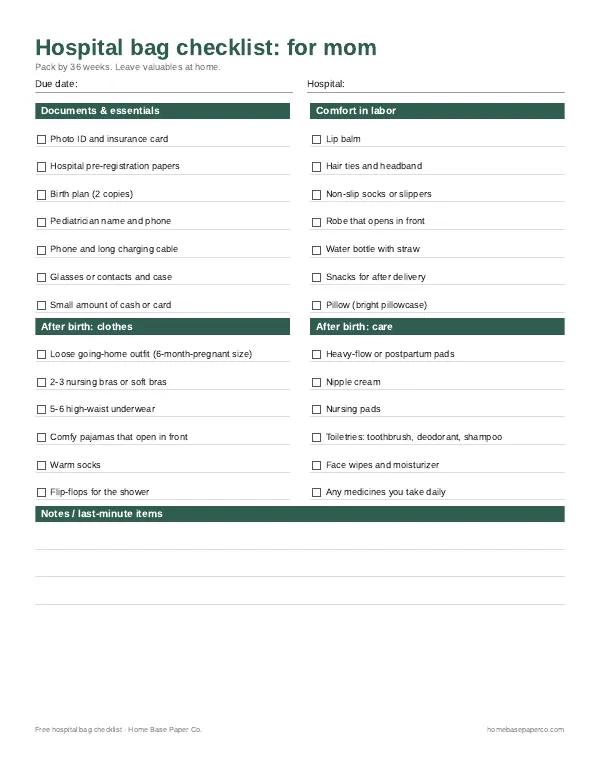
Pack once, pack right: get the free hospital bag checklist
A printable hospital bag checklist for mom, baby and partner, with documents and comfort items grouped so nothing is forgotten. You'll also get our weekly HomeBase email with simple, practical tips for getting ready for baby.
Sources
- Who Is Dave Ramsey? (Investopedia) investopedia.com
- An essential guide to building an emergency fund (CFPB) consumerfinance.gov
- What Is a Debt Snowball? (NerdWallet) nerdwallet.com