

The short answer: the 52 week savings challenge has you save $1 in week one, $2 in week two and so on up to $52 in week 52, for $1,378 by the end of the year.
- By quarter: $91 in Q1, $260 in Q2, $429 in Q3 and $598 in Q4
- The rule: the week number is the dollar amount you save that week
- Six variations fit tighter or bigger budgets, including running it in reverse
- To finish: name your goal, set a deposit day and check off each week on a printed chart
- Next step: Plan it with the 100 Envelope Savings Challenge ($3.99).
The 52 week savings challenge is simple: save $1 in week one, $2 in week two and keep going until you save $52 in week 52. By the end of the year you'll have $1,378. It's popular because it starts almost painlessly and builds a habit before the amounts get big. Below you'll find the full weekly chart, the math by quarter, six variations that fit different budgets, where to keep the money and how to actually finish.
How the 52 week savings challenge works
The rule is one line: the week number is the dollar amount you save that week. Week 7, save $7. Week 30, save $30. Week 52, save $52.
Add 1 through 52 and you get $1,378. That works out to an average of $26.50 a week, but you don't pay the average. You start small and finish big. Need money sooner than a year? Try our 30-day plan to save money fast.
Here's how the year breaks down by quarter:
| Quarter | Weeks | Saved that quarter | Running total |
|---|---|---|---|
| Q1 | 1–13 | $91 | $91 |
| Q2 | 14–26 | $260 | $351 |
| Q3 | 27–39 | $429 | $780 |
| Q4 | 40–52 | $598 | $1,378 |
Notice the pattern: you save more in the last quarter than in the first half of the year combined. That's the main thing to plan for, and it's why several of the variations below exist. Each quarter is 13 weeks, or just under three months; our weeks to months converter turns any stretch of the challenge into months.
The full 52 week savings challenge chart
Use this chart to see exactly what to save each week and where your total should be. Read down each set of columns.
| Week | Save | Total | Week | Save | Total | Week | Save | Total | Week | Save | Total |
|---|---|---|---|---|---|---|---|---|---|---|---|
| 1 | $1 | $1 | 14 | $14 | $105 | 27 | $27 | $378 | 40 | $40 | $820 |
| 2 | $2 | $3 | 15 | $15 | $120 | 28 | $28 | $406 | 41 | $41 | $861 |
| 3 | $3 | $6 | 16 | $16 | $136 | 29 | $29 | $435 | 42 | $42 | $903 |
| 4 | $4 | $10 | 17 | $17 | $153 | 30 | $30 | $465 | 43 | $43 | $946 |
| 5 | $5 | $15 | 18 | $18 | $171 | 31 | $31 | $496 | 44 | $44 | $990 |
| 6 | $6 | $21 | 19 | $19 | $190 | 32 | $32 | $528 | 45 | $45 | $1,035 |
| 7 | $7 | $28 | 20 | $20 | $210 | 33 | $33 | $561 | 46 | $46 | $1,081 |
| 8 | $8 | $36 | 21 | $21 | $231 | 34 | $34 | $595 | 47 | $47 | $1,128 |
| 9 | $9 | $45 | 22 | $22 | $253 | 35 | $35 | $630 | 48 | $48 | $1,176 |
| 10 | $10 | $55 | 23 | $23 | $276 | 36 | $36 | $666 | 49 | $49 | $1,225 |
| 11 | $11 | $66 | 24 | $24 | $300 | 37 | $37 | $703 | 50 | $50 | $1,275 |
| 12 | $12 | $78 | 25 | $25 | $325 | 38 | $38 | $741 | 51 | $51 | $1,326 |
| 13 | $13 | $91 | 26 | $26 | $351 | 39 | $39 | $780 | 52 | $52 | $1,378 |
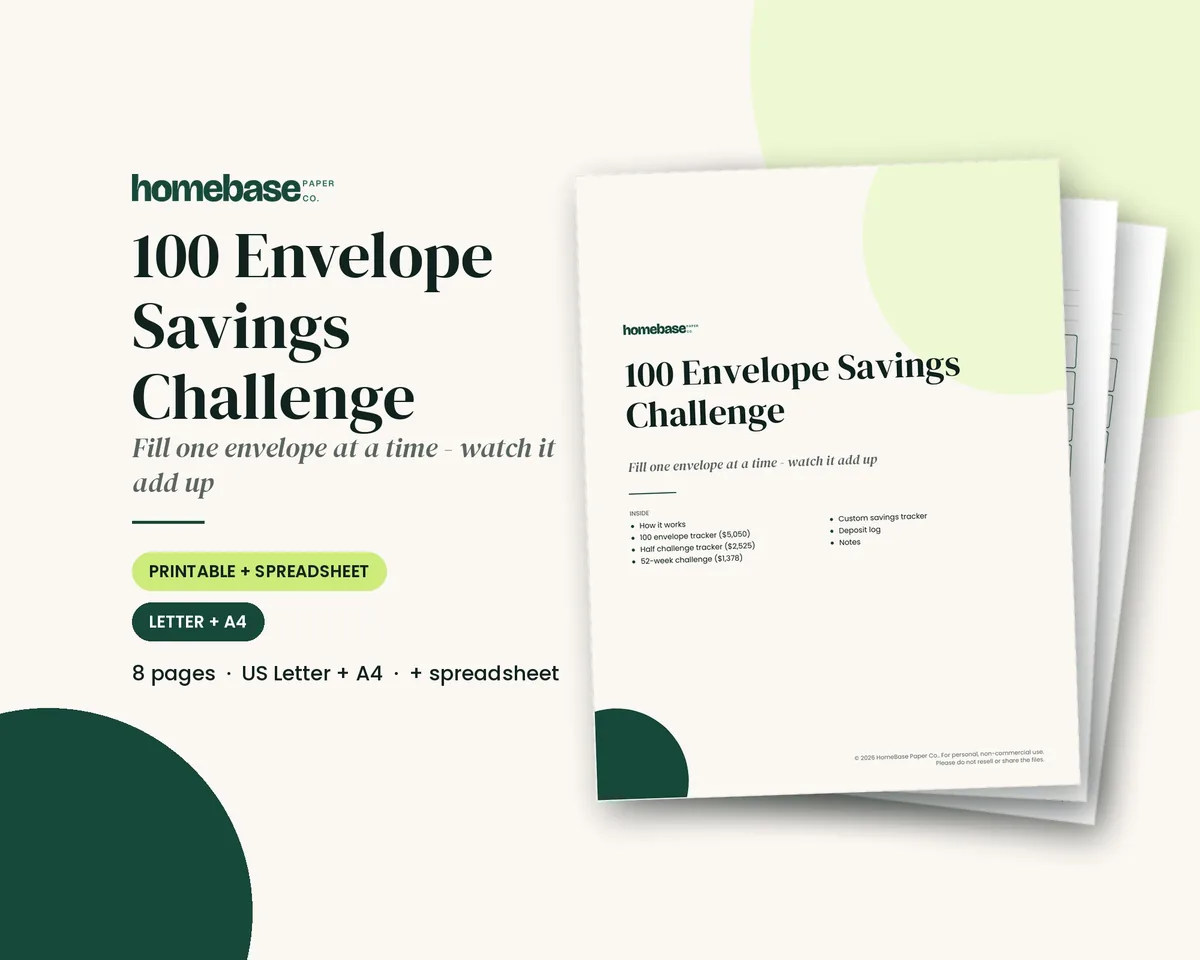
Prefer to check off boxes on paper? Our 100 Envelope Savings Challenge ($3.99) includes a printable 52-Week Savings Challenge page along with the classic and half envelope challenges, a custom savings tracker, a deposit log and a 100 Envelope Challenge spreadsheet for Excel and Google Sheets.
How to start the 52 week challenge: 6 steps
- Pick your version. Classic, reverse, biweekly or another variation below. Choose the one your budget can carry in its hardest month.
- Name your goal. The CFPB's guide to building an emergency fund notes that a specific goal helps you stay motivated. "$1,378 for a starter emergency fund" beats "save more."
- Choose where the money goes. A separate savings account keeps it out of your everyday spending. More on this below.
- Set a deposit day. Payday or the day after works best for most people.
- Print or save your chart. Put it somewhere you'll see it, like the fridge, your planner or a pinned file on your phone.
- Check off each week. The CFPB also suggests regularly monitoring your progress and celebrating milestones. Watching the boxes fill up is half the fun.
6 variations of the 52 week savings challenge
The classic version doesn't fit every paycheck. These versions keep the idea and change the shape.
| Variation | How it works | First deposit | Biggest deposit | Year total | Best for |
|---|---|---|---|---|---|
| Classic | $1, $2, $3 … $52 | $1 | $52 | $1,378 | Beginners |
| Reverse | $52, $51 … $1 | $52 | $52 | $1,378 | Anyone worried about the holidays |
| Biweekly | Two weeks per paycheck: $3, $7, $11 … $103 | $3 | $103 | $1,378 | People paid every two weeks |
| Fixed amount | $26.50 every week | $26.50 | $26.50 | $1,378 | Automating with a bank transfer |
| Half | $0.50, $1 … $26 | $0.50 | $26 | $689 | Tight budgets, kids and teens |
| Double | $2, $4, $6 … $104 | $2 | $104 | $2,756 | A bigger goal |
Reverse 52 week challenge
You start at $52 in week one and count down. The total is the same $1,378, but the big deposits land when your motivation is fresh, and the end of the year, when gifts and travel cost the most, only asks for a few dollars a week. In reverse, your first quarter costs $598 and your last quarter costs $91.
Biweekly 52 week challenge
If you're paid every two weeks, combine two weeks into one deposit. Paycheck one is $1 + $2 = $3. Paycheck two is $3 + $4 = $7. Each deposit goes up by $4, ending with $51 + $52 = $103 on paycheck 26. Same $1,378, half as many transfers.
Fixed-amount version
Saving $26.50 every week gets you to the same total with no planning at all. It's the easiest to automate, and the CFPB points out that automatic transfers are one of the easiest ways to make saving consistent.
Half and double versions
The half version ($0.50 steps) totals $689 and is a great first challenge for teens or anyone easing in. The double version ($2 steps) totals $2,756. There's also a $5-step version ($5, $10, $15 … $260) that totals $6,890, but its last weeks are large, so only choose it if your income clearly supports it.
Pick-your-week version
Print the chart and cross off any week you like, in any order. On a tight week, pick a small number. After a bonus, knock out week 52. You still save $1,378 once every box is crossed off. This flexibility is the main idea behind the 100 envelope challenge, which our 100 envelope challenge vs. 52-week challenge comparison covers in detail. If you are still choosing, our roundup of savings challenge ideas compares eight options side by side. For more on this topic, see our savings challenges.
52 week envelope challenge and when to start
The 52 week envelope challenge is the same challenge done in cash: label 52 envelopes 1 through 52, and each week put the matching number of dollars in one envelope. After 52 envelopes you will have $1,378, the same total as the chart above. It works best for people who like seeing the money, and the cash envelope idea is explained in our money envelopes guide. Want fewer, bigger steps? Compare it with the 100 envelope challenge.
If you are reading this in November 2026, you do not have to wait for January to start. Starting on Friday, January 1, 2027, week 52 falls on Friday, December 24, 2027, which gets you the full $1,378 before the holidays. Starting this week, you can use the "reverse" version so the largest deposits land before December and the smallest ones in the busy final weeks, or use a broader savings challenge that fits your pay dates.
Where to keep your 52 week challenge savings
Cash envelopes are satisfying, but keeping more than a thousand dollars at home is risky and earns nothing. A few options:
| Where | Pros | Cons |
|---|---|---|
| Separate savings account at your bank | Easy transfers, out of sight | Easy to transfer back |
| High-yield savings account | Earns more interest | May take a day or two to move money |
| Cash envelopes, then deposit | Hands-on and visual | Cash at home can be lost or spent |
| Credit union savings account | Often low fees | Branch access varies |
If you use a bank, make sure it's FDIC-insured. The FDIC insures deposits up to at least $250,000 per depositor, per ownership category, at each insured bank. Credit unions have their own federal insurance through the NCUA. A nice compromise: fill an envelope each week, deposit it, and keep the empty envelope or the checked-off chart as your record.
What to do with $1,378
Decide before you start so you're less tempted to spend it halfway through. Popular goals:
- A starter emergency fund. The Federal Reserve's 2025 household survey found that 63% of adults would cover a hypothetical $400 emergency expense entirely with cash or its equivalent. Finishing this challenge more than triples that cushion. See our emergency fund tracker for the next step.
- Holiday gifts and travel, so December goes on cash, not a card.
- Irregular bills like car registration, insurance premiums or back-to-school costs. That's exactly what sinking funds are for.
- A specific purchase, like a new mattress or a laptop.
- Paying down a small debt. Knocking out a balance can free up a monthly payment.
Saving for more than one goal? The Sinking Funds Tracker ($4.99) tracks up to 20 goals, shows the monthly amount you need to hit each date, logs deposits and withdrawals, and has progress bars and a savings dashboard for Excel and Google Sheets. For a single goal, our savings goal tracker guide shows simple ways to track it.
The 52 week challenge by month
Weekly amounts are easy to follow, but bills are usually monthly. If you start the first week of January and use a 4-4-5 pattern (four deposits in the first two months of each quarter, five in the third), here's roughly what each month asks of you:
| Month | Weeks | Classic: saved this month | Reverse: saved this month |
|---|---|---|---|
| January | 1–4 | $10 | $202 |
| February | 5–8 | $26 | $186 |
| March | 9–13 | $55 | $210 |
| April | 14–17 | $62 | $150 |
| May | 18–21 | $78 | $134 |
| June | 22–26 | $120 | $145 |
| July | 27–30 | $114 | $98 |
| August | 31–34 | $130 | $82 |
| September | 35–39 | $185 | $80 |
| October | 40–43 | $166 | $46 |
| November | 44–47 | $182 | $30 |
| December | 48–52 | $250 | $15 |
Your exact months will shift with your start date. Both columns total $1,378.
Set the classic column next to your own calendar. If December already holds gifts, travel and a holiday meal, $250 of savings that month may be the moment the challenge breaks. That's the clearest case for the reverse version.
Common 52 week challenge mistakes
- Saving into checking. If the money sits with your spending money, it tends to get spent. Move it somewhere separate.
- No goal. Without a reason, a $40 week is easy to skip. Write the goal at the top of your chart.
- Ignoring the calendar. Big weeks that collide with big expenses are where people quit.
- Raiding it for non-emergencies. Decide in advance what counts as a real reason to withdraw.
- Quitting after one missed week. One gap doesn't undo 30 good weeks.
How to finish the 52 week challenge (and not quit in week 30)
Most people who quit do it in the second half, when the deposits climb past $30. Here's how to get through it:
- Look ahead. Check your calendar for the weeks over $40 and plan around them. In the classic version those fall in the last 13 weeks.
- Automate the boring part. Set a recurring transfer for the week's amount, or use the fixed $26.50 version.
- Front-load when you can. Got a tax refund, bonus or cash gift? The CFPB suggests saving all or part of one-time money. Use it to cross off the biggest weeks early.
- Fill gaps with small wins. Returned an item? Skipped takeout? Move that money and cross off a matching week.
- Make it visible. A paper chart on the fridge works better than a note buried in an app for many people.
- Do it together. Partners, roommates or friends can each run a chart and check in monthly.
- Don't let a miss end it. Catch up over a few weeks, or switch to the pick-your-week version.
Is the 52 week savings challenge worth it?
For most beginners, yes. It costs almost nothing to start, it builds a weekly habit and it ends with a real amount of money. Its weakness is the back-loaded schedule, which the reverse, biweekly and fixed versions fix. If you already save a set amount every month, you may not need a challenge at all, but many people find the chart makes saving feel like a game they want to win.
Why I plan this way
I grew up in Detroit, the oldest of three, in a working family that rebuilt after 2008. That rebuild taught me that savings don't start with a big number. They start with a small one you repeat until it's a habit. A $1 week is how a lot of good habits begin.
Make it easier
Tools for this
 Starter pick
Printables
100 Envelope Savings Challenge
Classic, half and 52-week challenges to print, plus a spreadsheet that tracks every envelope and tells you how much to save each week.

Spreadsheets
Sinking Funds Tracker
It does the math: how much to set aside each month to hit every goal on time.
Frequently asked questions
How does the 52 week savings challenge work? You save the week number in dollars: $1 in week one, $2 in week two and so on up to $52 in week 52. By the end of the year you've saved $1,378. The 100 Envelope Savings Challenge ($3.99) includes a printable 52-Week Savings Challenge chart to check off each week.
How much do you save with the 52 week challenge? The classic version saves $1,378. That's the sum of 1 through 52. The double version ($2, $4, $6 and so on) saves $2,756, and the $5 version ($5, $10, $15 and so on) saves $6,890.
Is it better to do the 52 week challenge in reverse? For many people, yes: doing the 52-week challenge in reverse is easier on the holiday budget. In reverse you start at $52 in January, when motivation is high, and end at $1 in December, when holiday costs peak. You still save $1,378, but the hardest weeks come first instead of during the holidays.
What is the 52 week envelope challenge? The 52 week envelope challenge is the 52 week savings challenge done with cash: you label 52 envelopes 1 to 52 and put in the matching number of dollars each week, ending with $1,378. It follows the same weekly pattern as the chart, but with physical envelopes you can see fill up.
Can I start the 52 week challenge any time of year? Yes, you can start the 52-week challenge any time of year. Week one is simply the first week you start. Starting in a lighter month, or right after a raise or tax refund, can make the bigger weeks easier. Just write your actual start date on your chart so you know when week 52 lands.
What if I miss a week? If you miss a week of the 52-week challenge, don't quit. Either catch up the missed amount over the next few weeks or fill in a smaller week from the chart instead. The goal is to finish the year with savings, not to be perfect. Printing a chart, like the one in the 100 Envelope Savings Challenge ($3.99), makes it easy to see which weeks are still open.
Can I do the 52 week challenge biweekly? Yes, you can do the 52-week challenge biweekly by combining two weeks into each paycheck. On paycheck one you save $3 (weeks 1 and 2), and on paycheck 26 you save $103 (weeks 51 and 52). You still reach $1,378 with 26 deposits that line up with your pay.
Where should I keep the money from a savings challenge? A separate savings account is usually safer than cash at home, since cash can be lost or spent. Money in an FDIC-insured bank is insured up to at least $250,000 per depositor, per ownership category, at each insured bank. You can still use envelopes as a record and deposit the amount.
Is the 52 week savings challenge good for beginners? Yes, the 52-week savings challenge is good for beginners. It's one of the easiest challenges to start because the first months cost very little. Week one is $1 and the first 13 weeks total just $91, which helps you build the habit before the amounts get larger.
What is the difference between the 52 week challenge and the 100 envelope challenge? The 52 week challenge saves $1,378 over a year with set weekly amounts. The 100 envelope challenge saves $5,050 by filling envelopes numbered 1 to 100 in any order. The 100 Envelope Savings Challenge ($3.99) includes both, plus a half envelope version and a custom tracker.
What can I use 52 week challenge savings for? Common goals include a starter emergency fund, holiday gifts, car repairs, insurance premiums, back-to-school costs or a trip. If you're saving for several goals at once, the Sinking Funds Tracker ($4.99) tracks up to 20 goals and shows how much to set aside each month.
Can I do a 52 week challenge with a fixed amount instead? Yes, you can do a 52-week challenge with a fixed amount instead of a rising one. Saving $26.50 every week also adds up to $1,378 in 52 weeks. It's less exciting than a rising chart, but it's easier to automate with a recurring bank transfer.
How do I stick with the 52 week savings challenge? Automate what you can, keep a chart where you'll see it, check off every week, and plan ahead for the weeks over $40, which land in the last quarter of the classic version. Telling a friend or doing it as a family also helps.
More from HomeBase
You may also like

Printables
Budget Planner Printable
Twelve undated pages you can print every month: budget, bills, spending, savings and debt.

Spreadsheets
Bill Tracker Spreadsheet
Bills due in 3 days or less light up red, so nothing slips through.

Spreadsheets
Paycheck Budget Spreadsheet
Enter your bills once. The sheet tells you which paycheck pays each one, all year.

Spreadsheets
Zero-Based Budget Spreadsheet
The 'Left to budget' counter turns green when every dollar has a job.
 Club
Monthly club
Money Club
Anyone who wants a clear plan for the month's bills, holiday spending and savings.
Free printable
Give every dollar a job: get the free monthly budget template
A printable zero-based monthly budget: income, bills, everyday spending and savings on one page, with a planned vs. actual column. You'll also get our weekly HomeBase email with simple budgeting and bill-paying tips.
