

The short answer: budgeting for young adults comes down to one habit: give every paycheck a plan before you spend it. Start with real take-home pay, cover rent and bills first, set up any 401(k) match and save a little every payday.
- Use net pay, not gross pay or your salary
- First apartment: count the deposit, application fees and renter's insurance (the sample move-in total is $2,940)
- Worked example: a first-job budget on $3,000 a month
- Plan student loan payments before they start
- Next step: Plan it with the Paycheck Budget Spreadsheet ($5.99).
Budgeting for young adults comes down to one habit: give every paycheck a plan before you spend it. Start with your real take-home pay, cover rent and bills first, set up your workplace benefits (especially any 401(k) match), plan for student loan payments before they start, and save a little for emergencies every payday. The rest of this guide shows you how, with a first-month template, a worked example and a checklist for your first job and first apartment.
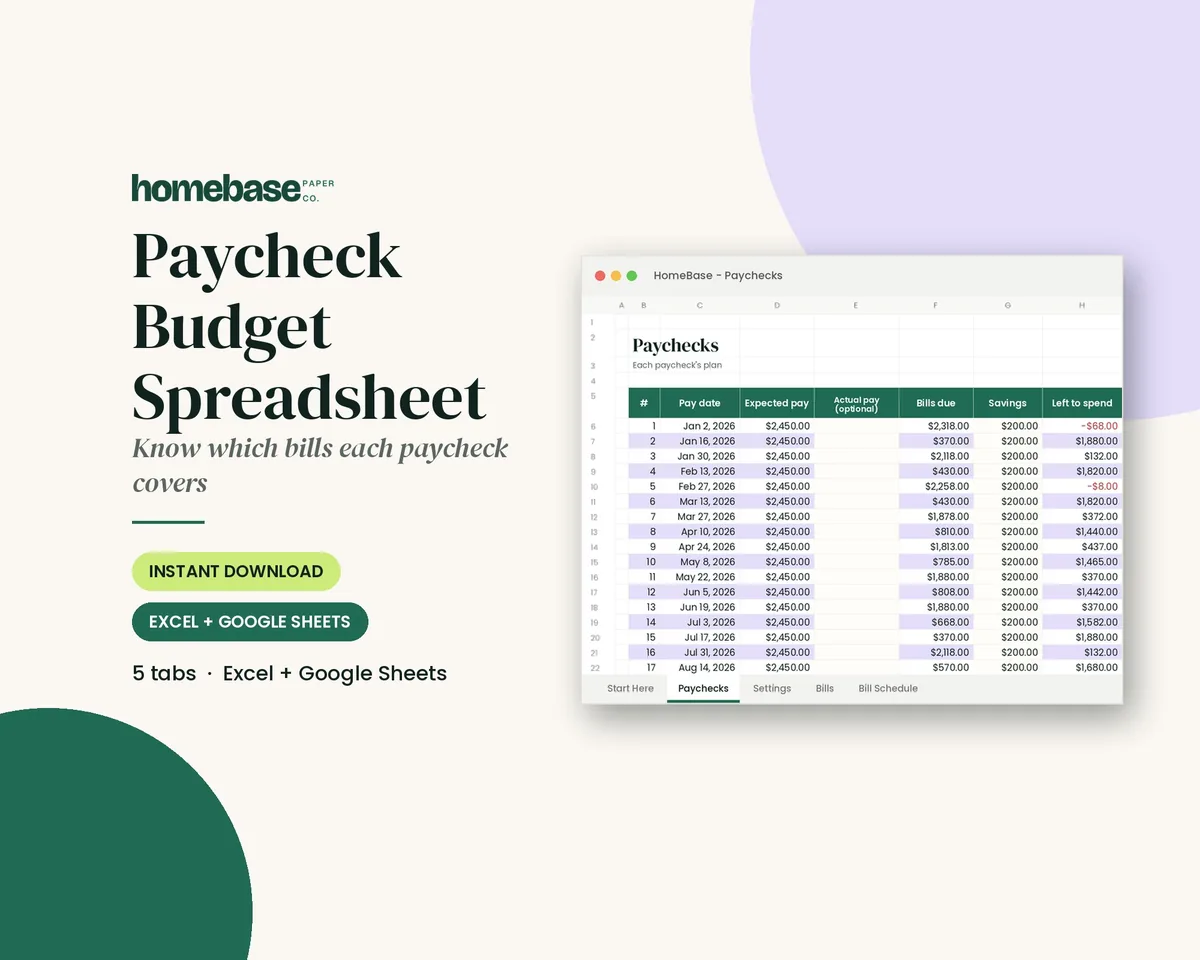
Our Paycheck Budget Spreadsheet is built for this: enter your bills once, and it shows which paycheck pays each one, all year.
Every dollar amount in this guide is an example to show the math. Your paycheck, your city, your lease and your loans will set your real numbers, so swap in your own.
Why budgeting in your 20s is different
A budget for young adults isn't a smaller version of a family budget. It's a budget built during a stretch of firsts: the first full-time paycheck, the first lease in your own name, the first benefits enrollment, the first student loan bill and, for many people, the first credit card. Each one comes with its own deadline, and most of them show up in the same few months.
Asking yourself how much money should I have saved by 30? Our guide breaks down the common benchmarks and a step-by-step plan to catch up.
That's why the biggest money mistakes in your 20s are usually timing mistakes, not spending sprees. A security deposit lands the same month as your first rent check. A student loan payment starts six months after graduation, right when you thought you had a little breathing room. A benefits window closes before you've read the packet. A good young adult budget puts those dates on the calendar first, then fills in the everyday spending around them.
How to budget as a young adult in 8 steps
Step 1: Learn your real take-home pay
Your salary is not your budget. Your budget is what actually lands in your bank account. Your offer letter shows gross pay, but taxes, health insurance premiums and retirement contributions come out before you see a dime. Wait for your first pay stub, or use your first one or two paychecks, and write down the net pay for each check. That number, and how often it arrives (weekly, every two weeks, twice a month or monthly), is the foundation of everything else.
If you're paid every two weeks, remember that some months have three paychecks. Our biweekly budget guide shows how to plan for those months instead of letting the extra check disappear.
Step 2: Put the big dates on a calendar
Before you budget a single grocery trip, write down every date that comes with a bill or a deadline:
- rent due date and lease start
- your pay dates for the next few months
- your benefits enrollment deadline at work
- when your student loan grace period ends
- the date you come off a parent's health or phone plan, if that applies
- car insurance and registration renewals
These dates decide which paycheck has to cover what. Rent due on the first means the paycheck before the first has to hold the rent money.
Step 3: Cover the four walls first
Housing, utilities, food and transportation are the bills that keep you housed, fed and able to get to work. Budget them first, before anything else. If those four lines take almost all of your take-home pay, that's important information, and it's better to know it before you sign a lease than after.
Step 4: Set up your benefits on purpose
Your first job may come with a benefits packet that's easy to skim and sign. Slow down on three things.
Health insurance. HealthCare.gov explains that if a parent's plan covers dependents, you can usually stay on a parent's health plan until you turn 26. On a parent's job-based plan, that's generally true even if you're married, living on your own or turning down your own employer's coverage. Compare what your parent's plan costs the family with what your own plan would cost from your paycheck, then decide. Put your 26th birthday on the calendar so you don't have a gap.
Retirement match. If your employer matches 401(k) contributions, the match is part of your pay. A common setup is a match on the first few percent of salary you contribute, but every plan is different, so read yours. For 2026, the IRS says you can contribute up to $24,500 to a 401(k) and up to $7,500 to an IRA. You don't have to hit those limits in your first job. The goal is to contribute at least enough to collect the full match if you can.
Everything else. Look for things like a health savings account, commuter benefits and life or disability coverage. Write down what each one costs per paycheck so your take-home number in Step 1 stays accurate.
Step 5: Plan student loan payments before they start
Federal student loans usually have a grace period. Federal Student Aid describes it as the six-month period before you have to start making payments after you graduate, leave school or drop below half-time enrollment. Use those six months. Find your loan servicer, check your balance and estimated payment, and add the payment to your budget as if it's already due.
Federal repayment options changed in 2026. Federal Student Aid says that if all of your loans were disbursed on or after July 1, 2026, the only income-driven plan available is the Repayment Assistance Plan (RAP), with payments of 1–10% of your adjusted gross income divided by 12 and a $10 minimum. It also notes you can apply for an income-driven plan online 60 days before your grace period ends, and that borrowers enrolled in auto pay by Dec. 31, 2026, get a 1% interest rate reduction through June 30, 2028. Rules depend on your loan types and dates, so log in to StudentAid.gov and check your own options.
Step 6: Build a starter emergency fund
An emergency fund is what keeps a flat tire or a surprise vet bill off a credit card. Start small and automatic: set a fixed amount to move into savings every payday, even $25. Once you have a first cushion, keep building toward a few months of the four-wall costs from Step 3. Our emergency fund tracker shows one way to watch it grow. For known costs that aren't emergencies, like holiday gifts, a new laptop or annual car registration, a sinking fund works better.
Step 7: Build credit slowly and safely
Your credit history affects more than loans. The FTC notes that credit reports are used in decisions about credit, insurance, renting a home and sometimes hiring. If you use a credit card to build credit, use it for one or two small bills you already budget for and pay the full statement balance every month.
Check your reports, too. The FTC says you can get a free credit report from each of the three nationwide bureaus, Equifax, Experian and TransUnion, once a week at AnnualCreditReport.com, which is the only authorized site for free reports. Look for accounts you don't recognize and mistakes you can dispute.
Step 8: Give every remaining dollar a job
Subtract all of your planned costs from your take-home pay:
Take-home pay − bills − savings − debt payments − spending money = what's left
If what's left is positive, assign it: extra emergency savings, an extra student loan payment, a Roth IRA or a goal like a move or a trip. If it's negative, adjust now, starting with flexible lines like eating out, subscriptions and shopping. Then check in once a week for the first few months. Your first budget is a draft, and each month gets more accurate. To run these numbers fast, our free budget calculator shows what's left and your 50/30/20 split.
What goes into a young adult budget
Use this table as a checklist when you build your first budget. The "often forgotten" column is where first budgets usually come up short.
If money is tight, see how to budget on a low income one paycheck at a time.
| Category | What to count | Often forgotten |
|---|---|---|
| Housing | Rent or your share of rent | Security deposit, application fees, renter's insurance |
| Utilities and internet | Electric, gas, water, Wi-Fi | Setup fees and deposits, summer and winter swings |
| Food | Groceries and eating out | Work lunches, coffee, delivery fees |
| Transportation | Car payment, gas, insurance, transit pass | Parking, maintenance, registration |
| Phone | Your own plan | The month you leave a family plan |
| Health | Premiums, copays, prescriptions | Dental and vision, the year you turn 26 |
| Student loans | Monthly payment | When the grace period ends |
| Other debt | Credit card, car loan, personal loan | Interest if you only pay the minimum |
| Savings | Emergency fund, sinking funds | Annual costs like gifts and renewals |
| Retirement | Your 401(k) or IRA | It comes out before take-home pay, so check your stub |
| Personal | Clothes, haircuts, toiletries | Work clothes for a new job |
| Fun | Going out, hobbies, streaming | Weddings, birthdays and group trips |
For a longer list of categories, see our budget categories list.
First apartment budget: the move-in math
Your first apartment usually costs more in the first month than in any month after it. Before you sign, add up the move-in total:
Not sure what each line on your check means? Learn how to read a pay stub line by line.
| Move-in cost | Example |
|---|---|
| First month's rent | $1,050 |
| Security deposit | $1,050 |
| Application and admin fees | $75 |
| Utility setup and deposits | $100 |
| Renter's insurance (first month) | $15 |
| Basic furniture and kitchen items | $500 |
| Moving help or a truck | $150 |
| Move-in total | $2,940 |
In this example, moving in takes nearly three times the monthly rent. If you're planning a move in four months, that's $735 a month to set aside ($2,940 ÷ 4). Our moving checklist covers the rest of the to-do list.
Worked example: a first-job budget on $3,000 a month
Here's the eight steps filled in for a young adult with $3,000 a month in take-home pay after taxes, health insurance and a 401(k) contribution. These are example numbers, and every line adds up.
| Line | Per month |
|---|---|
| Rent | $1,050 |
| Utilities and internet | $150 |
| Renter's insurance | $15 |
| Groceries and food | $350 |
| Phone | $45 |
| Transportation (gas, insurance, parking) | $250 |
| Student loan payment | $250 |
| Emergency fund | $250 |
| Sinking funds (car repair, gifts, travel) | $130 |
| Personal (clothes, haircuts, toiletries) | $80 |
| Subscriptions | $30 |
| Fun | $250 |
| Next goal (extra loan payment or Roth IRA) | $150 |
| Total | $3,000 |
Money in minus money out is $0, so every dollar has a job. The 401(k) contribution doesn't appear here because it already came out of the paycheck. In this example, if the employer matches 4% of a $48,000 salary, contributing 4% ($1,920 a year) adds another $1,920 a year from the employer. Check your own plan's match rules.
Want a ready-made split? Compare this with the 50/30/20 budget, which divides take-home pay into needs, wants and savings, or the pay yourself first budget, which moves savings out the moment you're paid.
Your first-month checklist
- Write down your net pay and pay dates from your first stub
- Put rent, bills, benefits deadlines and loan dates on one calendar
- Enroll in benefits and set your 401(k) contribution to at least the full match, if you can
- Look up your student loan servicer and estimated payment
- Open a separate savings account and set an automatic payday transfer
- Pull your free credit reports at AnnualCreditReport.com
- Fill in a budget for the month and check it every week
Common mistakes in your 20s (and easy fixes)
Carrying federal student loans? Our guide on how to pay off student loans fast covers extra payments, repayment plans and when to hold off.
- Budgeting from your salary. Use net pay from your actual stub, not the number in the offer letter.
- Forgetting the move-in month. Deposits and fees can make month one far more expensive than month two.
- Skipping the match. If your employer matches contributions, not contributing can mean leaving part of your pay on the table.
- Letting the grace period surprise you. Put the end date on your calendar the week you graduate.
- Carrying a card balance. Pay the full statement balance so credit building doesn't turn into credit card debt.
- Never updating the budget. Raises, roommates and new loans all change the plan. Redo it when they happen.
Why I plan this way
I'm Malaysia. I grew up in Detroit as the oldest of three, and I was the one my family leaned on for guidance and keeping everyone coordinated. I worked to put myself through Oakland University, and it took much longer than the usual four years. Later I worked as an HR associate, so I know a benefits packet is easy to rush through when there's so much else to learn in a new job. A written plan with the dates on it is how I make sure the important things don't get missed.
Budget your first paychecks with the Paycheck Budget Spreadsheet
The Paycheck Budget Spreadsheet ($5.99) is built for the first-job stage, when you're learning to live on a paycheck. It works in Excel and Google Sheets and:
- handles weekly, biweekly, semi-monthly or monthly pay
- lets you enter bills once and shows which paycheck pays each one, all year
- shows what's left to spend from each paycheck
If student loans or a credit card balance are part of your budget, the Debt Payoff Planner ($6.99) lists up to 10 debts, switches between snowball and avalanche order, and shows your debt-free month when you change your extra payment. Our guide to the debt snowball method vs. avalanche explains the difference.
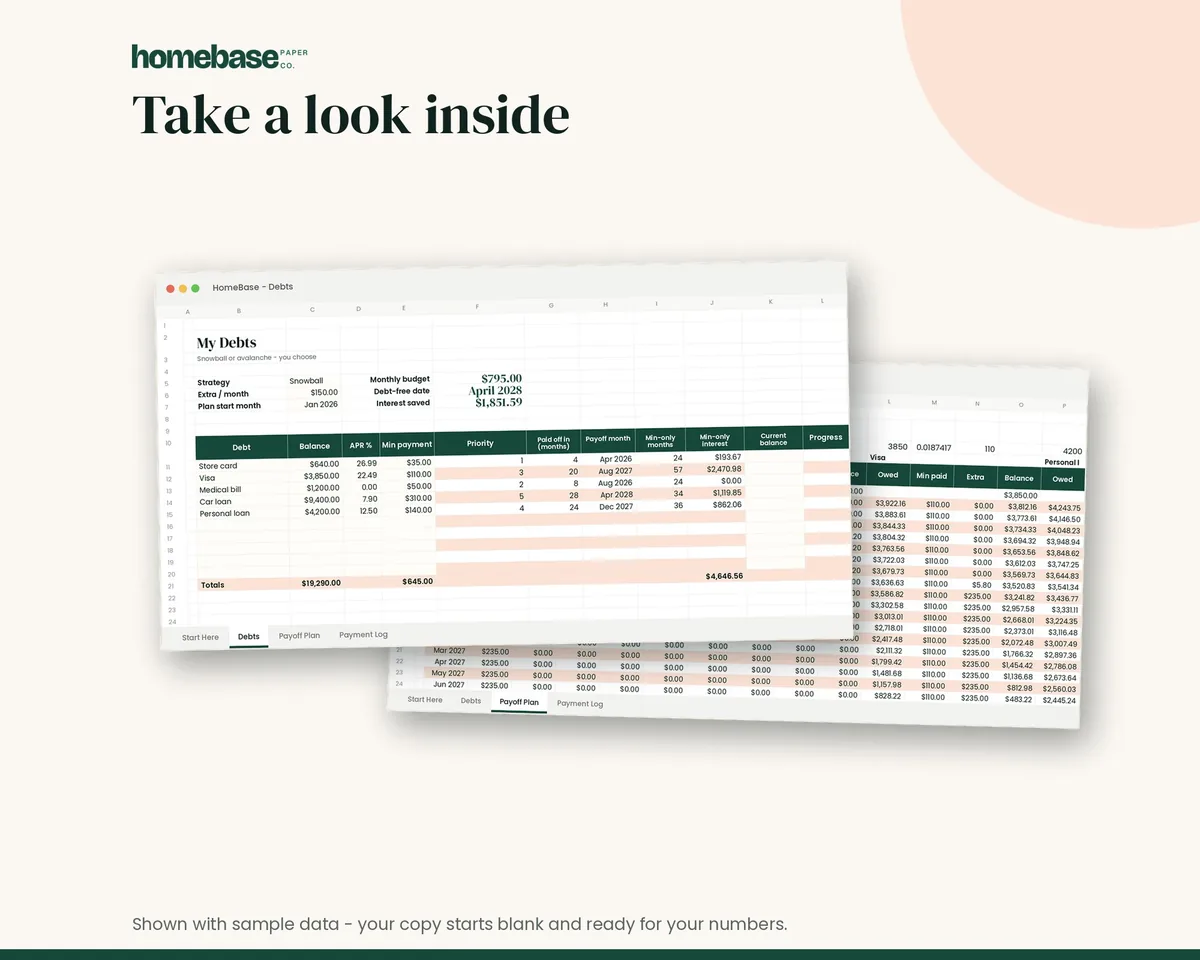
Setting up everything at once? The Ultimate Budget Bundle ($19.99) includes all six budget spreadsheets, including both of the above, plus both printable planners. Bought one by one, those eight tools cost $46.42. Prefer paper? The Budget Planner Printable ($5.99) has twelve undated pages for your budget, bills, spending, savings and debt, so you can start any month.
Browse every tool in Spreadsheets, see the paper versions in Printables, or compare sets in Bundles. New to budgeting in general? Our budgeting for beginners guide covers the basics, and our guide to setting financial goals helps you decide what your extra dollars are for.
Getting ready to move out? Use our room-by-room first apartment checklist to plan move-in costs and essentials.
New to money basics? Our financial literacy guide breaks them into six simple skills, and how to start investing covers your first account.
Make it easier
Tools for this

Spreadsheets
Paycheck Budget Spreadsheet
Enter your bills once. The sheet tells you which paycheck pays each one, all year.

Spreadsheets
Debt Payoff Planner
Pick snowball or avalanche, add any extra payment, and get your debt-free month instantly.
 Save 57%
Bundles
Ultimate Budget Bundle
All 6 spreadsheets + both printable planners - for less than half the price of buying them separately.
Frequently asked questions
What is the best way for young adults to budget? The best way for young adults to budget is to plan each paycheck before spending it: cover rent and bills first, then savings and debt, then spending money. The Paycheck Budget Spreadsheet ($5.99) shows which paycheck pays each bill, so you can see a tight pay period coming weeks ahead. Start from your real take-home pay, not your salary, and check in weekly for the first few months.
How do I budget in my 20s? To budget in your 20s, start with your take-home pay, put rent, bills, benefits deadlines and student loan dates on one calendar, cover housing, utilities, food and transportation first, then give every remaining dollar a job. Build a starter emergency fund with an automatic transfer every payday, and redo the budget whenever your pay, rent or roommates change.
How should I budget my first paycheck? Budget your first paycheck from the net pay on your stub, not the salary in your offer letter. Taxes, health premiums and retirement contributions come out first, so the first stub tells you what you really have to work with. Assign that check to the bills due before your next payday, then send a small amount to savings.
How much of my paycheck should go to rent? Aim for rent that still leaves room for bills, savings and your loan payment; there's no single right share of your paycheck. Before you sign a lease, fill in a full budget with the new rent and see what's left, for example in the Paycheck Budget Spreadsheet. If housing, utilities, food and transportation take almost all of your take-home pay, look for a cheaper place or a roommate.
How much does it cost to move into a first apartment? Moving into a first apartment usually costs much more than one month's rent, because you often pay first month's rent, a security deposit, fees, utility setup and basic furniture at the same time. In this guide's example, the move-in total is $2,940 on a $1,050 rent. Add up your own list and save for it monthly before you move.
Should I contribute to my 401(k) at my first job? Yes, if your employer offers a match, try to contribute at least enough to get the full match, because the match is part of your pay. For 2026 the IRS limit is $24,500 for a 401(k) and $7,500 for an IRA, but you don't need to hit the limit. Start with the match and raise your contribution when you get a raise.
When do student loan payments start after graduation? For most federal student loans, payments start after a six-month grace period. Federal Student Aid says the grace period follows graduating, leaving school or dropping below half-time enrollment. Use those months to find your servicer, check your estimated payment and add it to your budget before the first bill.
What student loan repayment plans are available in 2026? If all of your federal loans were disbursed on or after July 1, 2026, the only income-driven plan is the Repayment Assistance Plan (RAP). Federal Student Aid says RAP payments are 1–10% of your adjusted gross income divided by 12, with a $10 minimum. Borrowers with older loans may have other options, so check your account at StudentAid.gov.
How do I fit student loans into my budget? Treat your student loan payment as a fixed bill, like rent, and budget it from the start. The Debt Payoff Planner ($6.99) lists up to 10 debts, lets you choose snowball or avalanche order and shows your debt-free month when you add an extra payment. Federal Student Aid also notes a 1% interest rate reduction for borrowers enrolled in auto pay by Dec. 31, 2026.
Can I stay on my parents' health insurance? Usually yes, until you turn 26, if a parent's plan covers dependents. HealthCare.gov says that on a parent's job-based plan this is generally true even if you're married, living on your own or turning down your own employer's coverage. Compare the cost of staying with the cost of your own plan, and mark your 26th birthday on the calendar.
How can a young adult build credit safely? Build credit by using one card for a small bill you already budget for and paying the full statement balance every month. The FTC notes credit reports are used in decisions about credit, insurance and renting a home. Check your reports for free each week at AnnualCreditReport.com, the only authorized site for free reports.
How big should my emergency fund be in my 20s? Start with a small first cushion, then build toward a few months of your essential costs. The size matters less at first than the habit, so set an automatic transfer every payday, even $25. Use separate sinking funds for known costs like gifts, registration or a new laptop so the emergency fund stays for emergencies.
Is a budget spreadsheet or a printable planner better for young adults? Either works; pick the one you'll actually open every week. A spreadsheet like the Paycheck Budget Spreadsheet ($5.99) does the math and works in Excel and Google Sheets, while the Budget Planner Printable ($5.99) gives you twelve undated paper pages for budget, bills, spending, savings and debt. If you want both, the Ultimate Budget Bundle ($19.99) includes eight tools that cost $46.42 bought separately.
What budgeting method works best for young adults? The best method is the one that matches how you're paid and how much structure you want. A paycheck-by-paycheck plan suits weekly or biweekly pay, the 50/30/20 budget gives a simple split of needs, wants and savings, and pay yourself first moves savings out the moment you're paid. Many people start with one and adjust after a few months.
More from HomeBase
You may also like

Spreadsheets
Bill Tracker Spreadsheet
Bills due in 3 days or less light up red, so nothing slips through.

Spreadsheets
Sinking Funds Tracker
It does the math: how much to set aside each month to hit every goal on time.

Spreadsheets
Zero-Based Budget Spreadsheet
The 'Left to budget' counter turns green when every dollar has a job.

Spreadsheets
Annual Budget Spreadsheet
See exactly where your money goes every month - without complicated software.
 Club
Monthly club
Money Club
Anyone who wants a clear plan for the month's bills, holiday spending and savings.
Free printable
Give every dollar a job: get the free monthly budget template
A printable zero-based monthly budget: income, bills, everyday spending and savings on one page, with a planned vs. actual column. You'll also get our weekly HomeBase email with simple budgeting and bill-paying tips.

Sources
- Health Insurance Coverage for Children and Young Adults Under 26 (HealthCare.gov) healthcare.gov
- 401(k) limit increases to $24,500 for 2026, IRA limit increases to $7,500 (IRS) irs.gov
- Top FAQs About Income-Driven Repayment Plans (Federal Student Aid) studentaid.gov
- Free Credit Reports (FTC) consumer.ftc.gov