The short answer: a biweekly budget template plans by payday instead of by month. You get 26 paychecks a year, so give each one its own short list of bills, spending and savings.
- The rule: the paycheck that lands between the 1st and the 14th pays bills due from the 15th to the end of the month
- The other paycheck: one that lands between the 15th and the 28th pays next month's bills due from the 1st to the 14th
- Budget on 2 checks a month and plan the 2 or 3 extra checks ahead of time
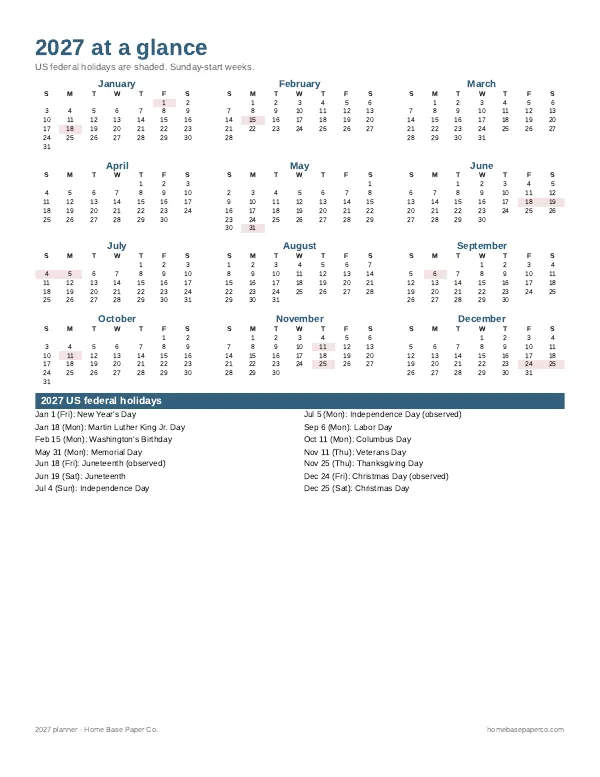
- 2027 pay calendars below show which months have three paychecks
- Next step: Plan it with the Paycheck Budget Spreadsheet ($5.99).
A biweekly budget template splits your plan by payday instead of by month. You get 26 paychecks a year, so give each one its own short list of bills, spending and savings, then decide ahead of time what the two "extra" paychecks will do. The easy rule: the paycheck that lands between the 1st and the 14th pays bills due from the 15th to the end of the month, and the paycheck that lands between the 15th and the 28th pays next month's bills due from the 1st to the 14th. That rule works every month, even as your paydays drift. Our weeks to months converter shows why 26 biweekly checks don't fit neatly into 12 months.
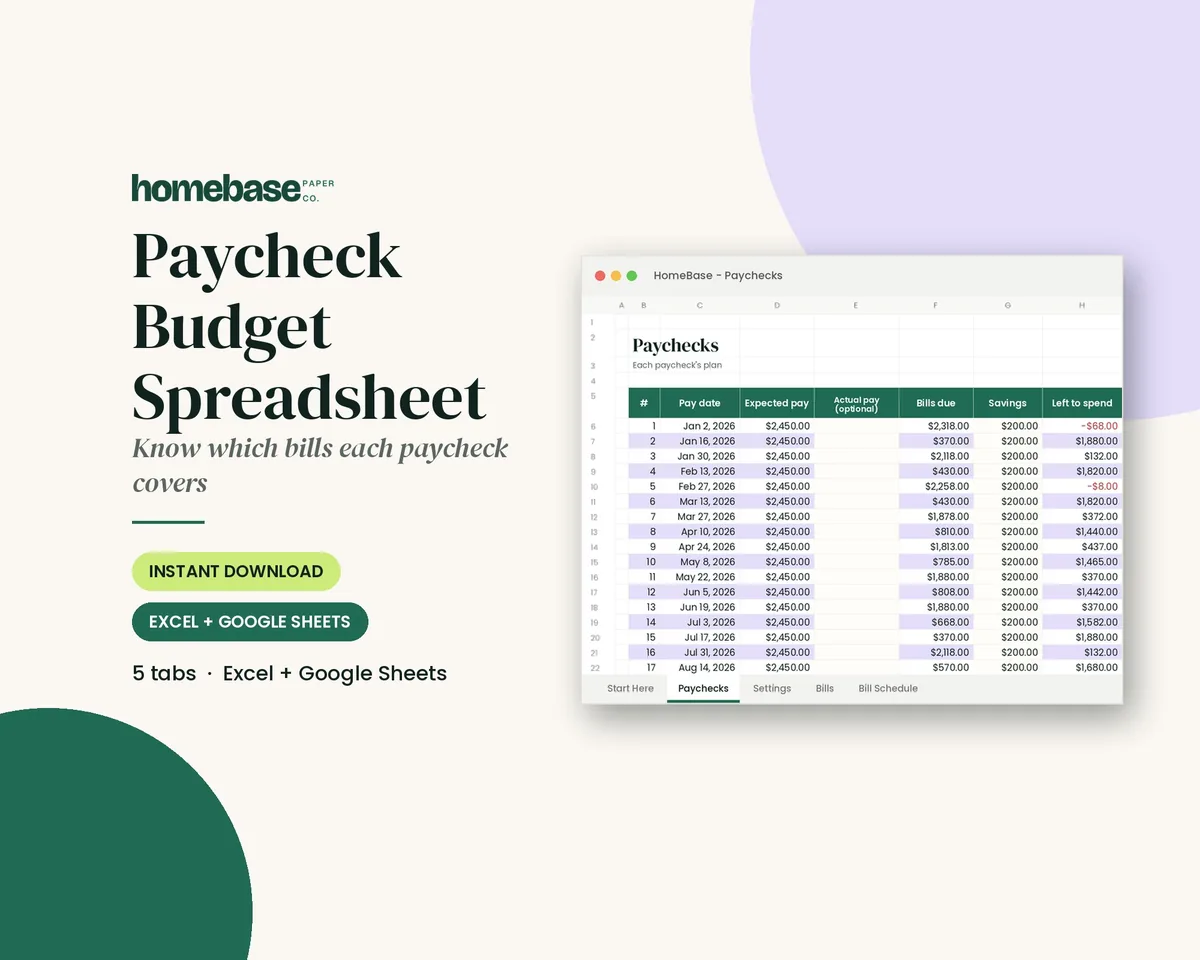
If you'd rather not map it by hand, our Paycheck Budget Spreadsheet takes weekly, biweekly, semi-monthly or monthly pay, enters your bills once and tells you which paycheck pays each one, all year.
Below you'll find a fill-in template, the 2027 pay calendars for both Friday pay cycles (one of them has 27 paydays), a worked bill-to-paycheck example with real numbers, and a plan for three-paycheck months.
What is a biweekly budget?
A biweekly budget is a spending plan built around a paycheck that arrives every 14 days. Instead of one monthly budget, each paycheck gets a small budget: which bills it pays, what goes to groceries and gas until the next payday, and what goes to savings.
Biweekly is not the same as semi-monthly. Our guide to semi monthly pay explains the difference: 24 paychecks on set dates instead of 26 every other Friday.
New to budgeting? Start with how to make a budget for the basics, then come back and split that plan across two paychecks. Our family budgeting guide lists the other methods in the order most families try them.
Prefer to plan the full year online? A Google Sheets budget template with 12 monthly tabs does the math.
It's the most common way Americans get paid. In the Bureau of Labor Statistics' length of pay period data, biweekly was the most common pay schedule in February 2023, used by an estimated 43.0% of U.S. private establishments, ahead of weekly (27.0%), semimonthly (19.8%) and monthly (10.3%). If a shorter planning period fits your bills better, compare a weekly budget with your biweekly schedule.
Biweekly vs. semimonthly vs. weekly pay
"Biweekly" means every other week. "Semimonthly" means twice a month on set dates, such as the 15th and the last day.
| Pay schedule | Paychecks per year | Paychecks per month | How to budget it |
|---|---|---|---|
| Weekly | 52 | 4, sometimes 5 | Budget on 4 checks; four months a year bring a 5th |
| Biweekly (every other week) | 26 (27 in some years) | 2, sometimes 3 | Budget on 2 checks; plan the 2 or 3 extra checks |
| Semimonthly (twice a month) | 24 | Always 2 | Same two dates every month, so a monthly budget split in half works |
| Monthly | 12 | 1 | A classic monthly budget |
Your employer picks the schedule, within your state's rules. The U.S. Department of Labor keeps a table of state payday requirements showing which states allow weekly, biweekly, semimonthly or monthly paydays. Your pay stub or HR office can tell you which one you're on.
Why a monthly budget fails on biweekly pay
A monthly budget assumes your money arrives all at once. Biweekly pay doesn't. Rent is due on the 1st, but your paychecks might land on the 9th and the 23rd, so you can be fine on paper and short in your checking account the morning rent is due. On top of that, your paydays drift to new dates every month, and two paychecks cover only 28 days of a 30- or 31-day month. A biweekly budget template fixes this by giving every paycheck a job before it arrives.
Budgeting by paycheck is one of the best ways to stop living paycheck to paycheck. Our guide has 10 steps and a sample plan.
Your biweekly budget template (fill in one per paycheck)
Copy this for each payday. Start with net pay, the amount that actually hits your account, not your salary.
| Line | Paycheck A (lands 1st–14th) | Paycheck B (lands 15th–28th) |
|---|---|---|
| Payday date | ||
| Net pay | $ | $ |
| Bills this paycheck covers (list each with its due date) | $ | $ |
| Bill set-aside (half of a big bill, like rent) | $ | $ |
| Groceries for 14 days | $ | $ |
| Gas and transportation for 14 days | $ | $ |
| Savings (emergency fund, goals) | $ | $ |
| Sinking funds (car repairs, holidays, gifts) | $ | $ |
| Debt payments above the minimum | $ | $ |
| Personal and household spending | $ | $ |
| Buffer | $ | $ |
| Left to budget (aim for $0) | $ | $ |
That last line is the zero-based idea: every dollar gets a job, even if the job is "buffer." If you're new to it, our guide to the zero-based budget explains it in detail.
How to budget biweekly paychecks in 7 steps
Not sure how much of my paycheck should I save? Our guide has savings percentages by goal and a sample split.
Step 1: Write down your real pay dates for the year
Find your next payday on your pay stub, then count forward 14 days at a time. Mark every date on a calendar. You'll use this calendar for the rest of the year, so do it once and do it carefully. (The 2027 Friday calendars are in the next section.)
Step 2: List every bill with its due date
Use two or three months of statements to list each bill, its amount and due date, including annual subscriptions, twice-a-year insurance and car registration. The CFPB's Your Money, Your Goals toolkit includes a free bill calendar, a bill-prioritizing worksheet and a cash flow budget worksheet that work well for this step if you'd like a printable to fill in.
Step 3: Assign each bill to Paycheck A or Paycheck B
Use the 1st–14th / 15th–28th rule:
- Paycheck A is whichever paycheck lands between the 1st and the 14th. It pays bills due from the 15th to the end of the month.
- Paycheck B is whichever paycheck lands between the 15th and the 28th. It pays next month's bills due from the 1st to the 14th.
Here's why it never breaks. Paydays are 14 days apart, so every month one lands in the 1st–14th window and one in the 15th–28th window. Paycheck A always arrives before the 15th, and Paycheck B always arrives before the next 1st. A payday on the 29th, 30th or 31st is your third paycheck, with no bills assigned.
Matching each bill to the closest paycheck also works, but you'd redo it monthly as paydays drift. Our paycheck budget planner walks through that payday-by-payday method with a two-paycheck example.
Step 4: Balance the two paychecks
Add up each side. If one paycheck carries far more than the other, fix it one of two ways:
- Split a big bill. Set aside half of rent or the mortgage from each paycheck and move it to a separate bills account until it's due.
- Move a due date. Many lenders, utilities and card issuers will let you change a due date if you ask. Moving one bill from the 5th to the 20th can even out a lopsided month.
Step 5: Fund 14 days of living, not a month
Groceries, gas and personal spending come out of every paycheck, sized for two weeks, including a third paycheck.
Step 6: Give savings and sinking funds a line on every paycheck
Small, regular amounts add up: $75 from every paycheck is $1,950 over 26 paychecks. Our guide to sinking funds shows how to pick the categories, and pay yourself first explains why savings goes near the top of the list rather than at the end.
Step 7: Check in on payday
Every payday, spend ten minutes marking bills paid and moving set-aside money. If your pay changes from check to check, see how to budget with irregular income.
2027 biweekly pay calendar: which months have three paychecks?
If you're paid every other Friday, you're on one of two cycles. Cycle A includes Friday, January 15, 2027; Cycle B includes Friday, January 8, 2027.
| Month (2027) | Cycle A: paid Jan 1, 15, 29… | Cycle B: paid Jan 8, 22… |
|---|---|---|
| January | 1, 15, 29 (3 paychecks) | 8, 22 |
| February | 12, 26 | 5, 19 |
| March | 12, 26 | 5, 19 |
| April | 9, 23 | 2, 16, 30 (3 paychecks) |
| May | 7, 21 | 14, 28 |
| June | 4, 18 | 11, 25 |
| July | 2, 16, 30 (3 paychecks) | 9, 23 |
| August | 13, 27 | 6, 20 |
| September | 10, 24 | 3, 17 |
| October | 8, 22 | 1, 15, 29 (3 paychecks) |
| November | 5, 19 | 12, 26 |
| December | 3, 17, 31 (3 paychecks) | 10, 24 |
| Paychecks in 2027 | 27 | 26 |
- Cycle A gets 27 paychecks in 2027. A year is 26 two-week periods plus a day or two, and every so often that leftover pushes a 27th payday into the year. If you're salaried, your employer may divide your annual pay by 27 that year instead of 26, which makes each check slightly smaller. Ask payroll before you build your budget on last year's amount.
- Holiday paydays can move. Cycle A's January 1, 2027 payday falls on New Year's Day, and Cycle B's last 2026 payday falls on Christmas Day, December 25, 2026. Many employers pay the business day before, but check your payroll calendar.
If you're paid on a different weekday, the pattern is the same: start from your first payday of the year and count forward 14 days.
Worked example: assigning bills to biweekly paychecks
Here's a sample household with a net paycheck of $1,850 every other Friday. These are example numbers only, so swap in your own.
Monthly bills:
| Bill | Due date | Amount | Paid from |
|---|---|---|---|
| Rent | 1st | $1,400 | Half set aside from Paycheck A, half from Paycheck B (previous month) |
| Car payment | 8th | $325 | Paycheck B (previous month) |
| Phone | 12th | $90 | Paycheck B (previous month) |
| Car insurance | 15th | $150 | Paycheck A |
| Electric | 18th | $130 | Paycheck A |
| Internet | 22nd | $65 | Paycheck A |
| Streaming | 26th | $25 | Paycheck A |
| Credit card minimum | 27th | $75 | Paycheck A |
| Total | $2,260 |
Without the rent split, Paycheck B would carry $1,815 of bills and Paycheck A only $445.
The two paycheck budgets:
| Line | Paycheck A | Paycheck B |
|---|---|---|
| Net pay | $1,850 | $1,850 |
| Bills | $445 | $415 |
| Rent set-aside | $700 | $700 |
| Groceries (14 days) | $300 | $300 |
| Gas (14 days) | $80 | $80 |
| Emergency fund | $150 | $150 |
| Sinking funds | $75 | $75 |
| Personal and household | $50 | $80 |
| Buffer | $50 | $50 |
| Left to budget | $0 | $0 |
Every bill gets paid on time, with $300 going to the emergency fund, $150 to sinking funds and a $100 buffer.
How much is a biweekly paycheck per month?
For a true monthly average, multiply one paycheck by 26 and divide by 12. In the example, $1,850 × 26 = $48,100 a year, or about $4,008 a month. But in most months, only two checks, or $3,700, actually arrive.
| Way to count it | Example ($1,850 per check) | When to use it |
|---|---|---|
| Two paychecks per month | $3,700 | Your everyday budget |
| True monthly average (× 26 ÷ 12) | About $4,008 | Comparing your income to rent or a loan payment |
| Extra paychecks per year | $3,700 (two extra checks) | Your plan for three-paycheck months |
Budget regular months on two paychecks. A budget built on the $4,008 average comes up short in every two-paycheck month.
What to do with a third paycheck
A third paycheck isn't all free money. It pays no assigned bills, but it still has to cover two weeks of groceries, gas and everyday spending. In the example, that's $300 + $80 + $80 = $460, which leaves about $1,390 truly free.
Holiday premiums can also boost a check. Our guide to holiday pay explains how it is figured and how to budget the extra.
Decide where it goes before it arrives. A sample split of the $1,390:
| Goal | Amount |
|---|---|
| Emergency fund | $500 |
| Extra debt payment | $400 |
| Holiday or gift sinking fund | $300 |
| Get ahead on next month's rent | $190 |
Over time, third-paycheck money can build one full month of bills in checking. Then you pay each month from last month's income and stop worrying about which paycheck lands when. An emergency fund tracker makes that progress easy to see.
For the 2026 holidays, check your calendar now: Cycle B's last two 2026 paychecks are December 11 and December 25. Our holiday budget guide walks through the whole season, and the free Holiday Budget Starter Kit (3 printable pages, free when you join our email list) is on the free holiday budget kit page.
Make it automatic with the Paycheck Budget Spreadsheet
As the oldest of three growing up in Detroit, I was the family coordinator. A biweekly budget is the same work: dates, amounts and who covers what. A spreadsheet can do that coordinating for you.
If you'd rather build your own version, here's how to create a budget spreadsheet with the same paycheck columns and simple formulas.
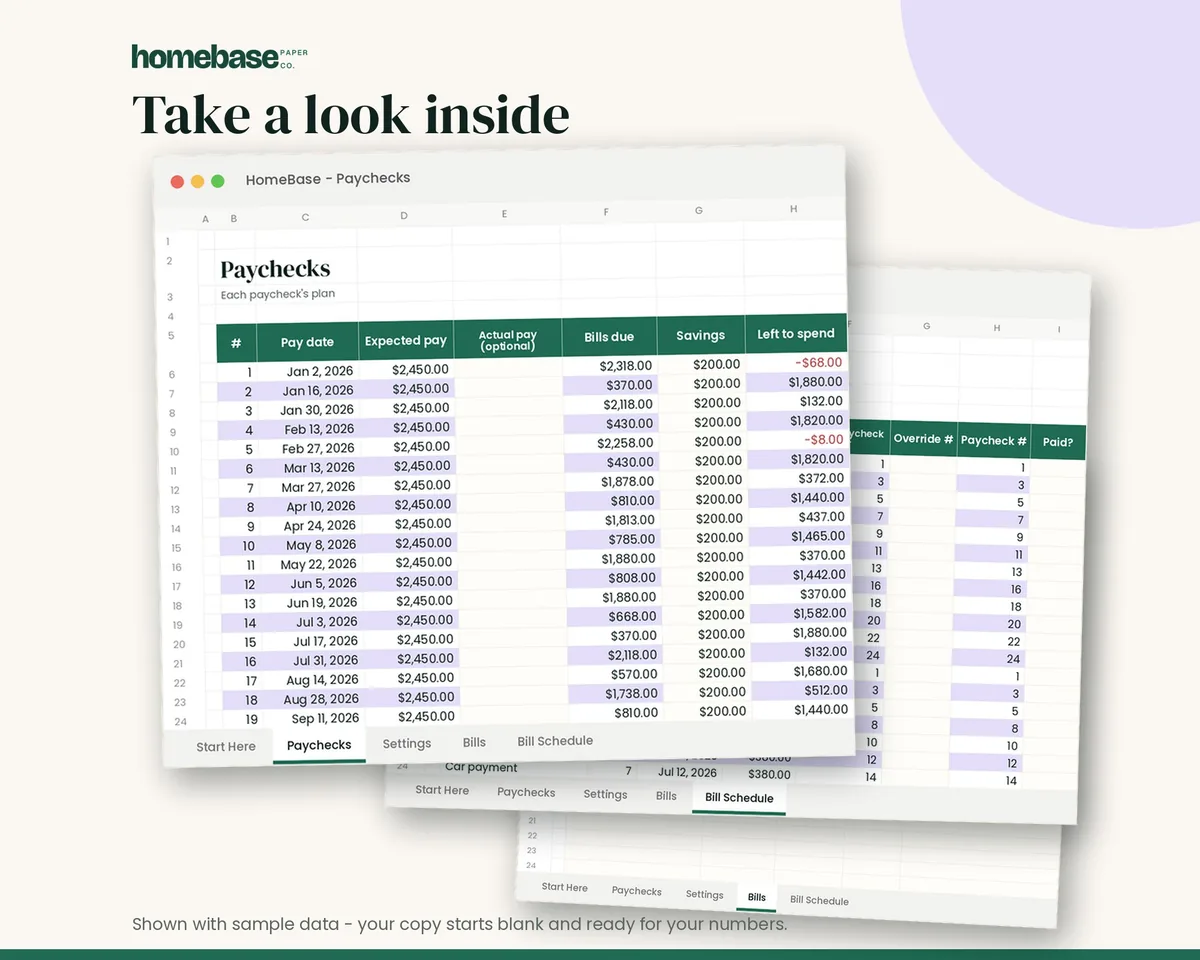
Our Paycheck Budget Spreadsheet ($5.99) is made for this. It works for weekly, biweekly, semi-monthly or monthly pay and calculates your pay dates for the year. You enter your bills once, it schedules all 12 months and assigns each bill to the right paycheck automatically, and you can override any bill's paycheck when you want to split rent or move a payment. Every paycheck shows its left-to-spend amount, with paid checkmarks as you go. It's an .xlsx file for Excel and Google Sheets, with a Start Here guide.
Two tools pair well with it:
- The Bill Tracker Spreadsheet ($4.99) shows each bill's next due date and days left, and bills due in 3 days or less light up red.
- The Sinking Funds Tracker ($4.99) handles up to 20 savings goals and does the math on how much to set aside to hit each one on time, which is where third-paycheck money can go.
For the whole set, the Ultimate Budget Bundle ($19.99) includes all three plus five more budgeting tools: 8 products in all. Browse every option in Spreadsheets, and if you're still organizing the paper side, our guide on how to organize bills can help.
Print your pay calendar, put each bill under Paycheck A or Paycheck B, and decide today what your next third paycheck will do. Once each paycheck has a plan, you'll know which bills are covered before payday.
Make it easier
Tools for this

Spreadsheets
Paycheck Budget Spreadsheet
Enter your bills once. The sheet tells you which paycheck pays each one, all year.

Spreadsheets
Bill Tracker Spreadsheet
Bills due in 3 days or less light up red, so nothing slips through.

Spreadsheets
Sinking Funds Tracker
It does the math: how much to set aside each month to hit every goal on time.
Frequently asked questions
What is a biweekly budget template? A biweekly budget template is a fill-in plan that gives each paycheck its own list of bills, spending and savings. Because biweekly pay arrives every 14 days, 26 times a year, a per-paycheck plan matches your cash flow better than a single monthly budget. The Paycheck Budget Spreadsheet ($5.99) is a ready-made version that calculates your pay dates for the year and assigns each bill to the right paycheck automatically.
How do I budget biweekly paychecks? Budget biweekly paychecks by assigning every bill to a specific paycheck before it arrives. List your pay dates and bill due dates, then use a simple rule: the paycheck that lands between the 1st and 14th pays bills due the 15th through the end of the month, and the paycheck that lands between the 15th and 28th pays next month's bills due the 1st through the 14th. Then fund two weeks of groceries, gas, savings and sinking funds from each check.
How do I decide which bills to pay with which paycheck? Pay each bill with the paycheck that lands before its due date window. Paycheck A, landing on the 1st through 14th, covers bills due the 15th through 31st. Paycheck B, landing on the 15th through 28th, covers next month's bills due the 1st through 14th. The Paycheck Budget Spreadsheet ($5.99) does this assignment automatically and lets you override any bill if you'd rather pay it from a different check.
What if one paycheck has to cover too many bills? If one paycheck has to cover too many bills, balance the load by splitting a big bill or moving a due date. Many people set aside half of rent or the mortgage from each paycheck and hold it until the due date. You can also ask a lender, utility or card issuer to change a due date, which can move a bill from one paycheck to the other.
How much is a biweekly paycheck per month? A biweekly paycheck averages out to the paycheck amount times 26, divided by 12. For example, $1,850 every two weeks is $48,100 a year, or about $4,008 a month. But in most months only two paychecks, or $3,700 in that example, actually arrive, so build your everyday budget on two checks.
Which months have three paychecks in 2027? For Friday paydays, the 2027 three-paycheck months are January, July and December if you're paid January 1, 15 and 29, or April and October if you're paid January 8 and 22. If you're paid on another weekday, count forward 14 days from your first 2027 payday and look for months with three dates.
Are there 27 pay periods in 2027? Yes, some biweekly workers will get 27 paychecks in 2027. If your Friday paydays include January 1, 2027, your last payday of the year is December 31, for 27 in total. Salaried employees may see their annual pay divided by 27 that year, so ask payroll whether your per-check amount will change.
What should I do with a third paycheck? Give a third paycheck a plan before it arrives, after covering two weeks of everyday spending. A third check has no assigned bills, but it still has to pay for groceries, gas and personal spending until the next payday. Split the rest among goals like your emergency fund, extra debt payments and a holiday sinking fund. The Sinking Funds Tracker ($4.99) shows how much each goal still needs.
Should I budget with two paychecks or the monthly average? Budget your regular months on two paychecks, not the monthly average. The average includes the two extra paychecks you only receive a few times a year, so a budget built on it runs short in most months. Treat extra paychecks as planned money for savings and goals.
What's the difference between biweekly and semimonthly pay? Biweekly pay comes every other week, 26 times a year, while semimonthly pay comes twice a month on set dates, 24 times a year. Semimonthly paychecks land on the same dates each month, so a monthly budget split in half works. Biweekly paydays drift through the month and sometimes produce a third paycheck, which is why a per-paycheck plan helps.
Is a biweekly budget the same as a paycheck budget? Not exactly: a biweekly budget is one kind of paycheck budget, built for pay every 14 days. A paycheck budget can follow any schedule, weekly, biweekly, semimonthly or monthly. The Paycheck Budget Spreadsheet ($5.99) handles all four schedules, and our paycheck budget planner guide covers the general payday-by-payday method.
Can I use a biweekly budget template in Google Sheets? Yes, a spreadsheet template is the easiest way to run a biweekly budget in Google Sheets or Excel. The Paycheck Budget Spreadsheet ($5.99) is an .xlsx file that works in both, with a Start Here guide, pay dates calculated for the year, bills scheduled across 12 months and a left-to-spend amount for every paycheck.
How do I track which bills I've paid each paycheck? Track paid bills with a checkmark next to each bill on the paycheck that covers it. The Paycheck Budget Spreadsheet ($5.99) includes paid checkmarks for every paycheck, and the Bill Tracker Spreadsheet ($4.99) adds next due dates, days left and red alerts for bills due in 3 days or less.
What happens when a payday falls on a holiday? When a payday falls on a bank holiday, many employers deposit pay on the business day before, but policies vary. In the 2027 Friday calendars, January 1 is a payday for one cycle, and in 2026, December 25 is a payday for the other. Check your employer's payroll calendar before counting on a holiday deposit to cover a bill.
How often should I update my biweekly budget? Check your biweekly budget every payday, which takes about ten minutes. Mark the bills you paid, move any set-aside money, and look at what's left until the next deposit. Update your bill list whenever a bill amount or due date changes, and review the full year's pay calendar once a year.
Is this financial advice? No, this guide is general education, not financial advice. The numbers in the examples are samples to show how the method works. Use your own net pay, bills and pay calendar, and confirm your pay dates and per-check amount with your employer's payroll department.
More from HomeBase
You may also like

Printables
Budget Planner Printable
Twelve undated pages you can print every month: budget, bills, spending, savings and debt.

Spreadsheets
Zero-Based Budget Spreadsheet
The 'Left to budget' counter turns green when every dollar has a job.

Spreadsheets
Annual Budget Spreadsheet
See exactly where your money goes every month - without complicated software.

Spreadsheets
Debt Payoff Planner
Pick snowball or avalanche, add any extra payment, and get your debt-free month instantly.
 Club
Monthly club
Money Club
Anyone who wants a clear plan for the month's bills, holiday spending and savings.
Free printable
Get organized for the new year: get the free 2027 planner
A 16-page printable 2027 planner with a year-at-a-glance page and monthly calendars with US holidays marked. You'll also get our weekly HomeBase email with simple planning and home organization tips.