

The short answer: variable expenses are the part of your budget that moves, like groceries, gas, the electric bill and takeout, and they're the fastest place to find money.
- 30 examples of variable expenses
- Pull three months of statements and find the monthly average
- Set a limit a little below the average, split into weeks
- 12 ways to lower variable costs
- Next step: Plan it with the Zero-Based Budget Spreadsheet ($6.99).
Variable expenses are the part of your budget that moves. Rent stays the same each month, but groceries, gas, the electric bill and Saturday takeout all go up and down. That makes variable expenses harder to plan, but it also makes them the fastest place to find money. You can't cut your rent this week. You can spend $40 less at the grocery store. This guide lists 30 examples of variable expenses, shows how to put a realistic number on each one, and gives you a weekly system that keeps them from eating the month.
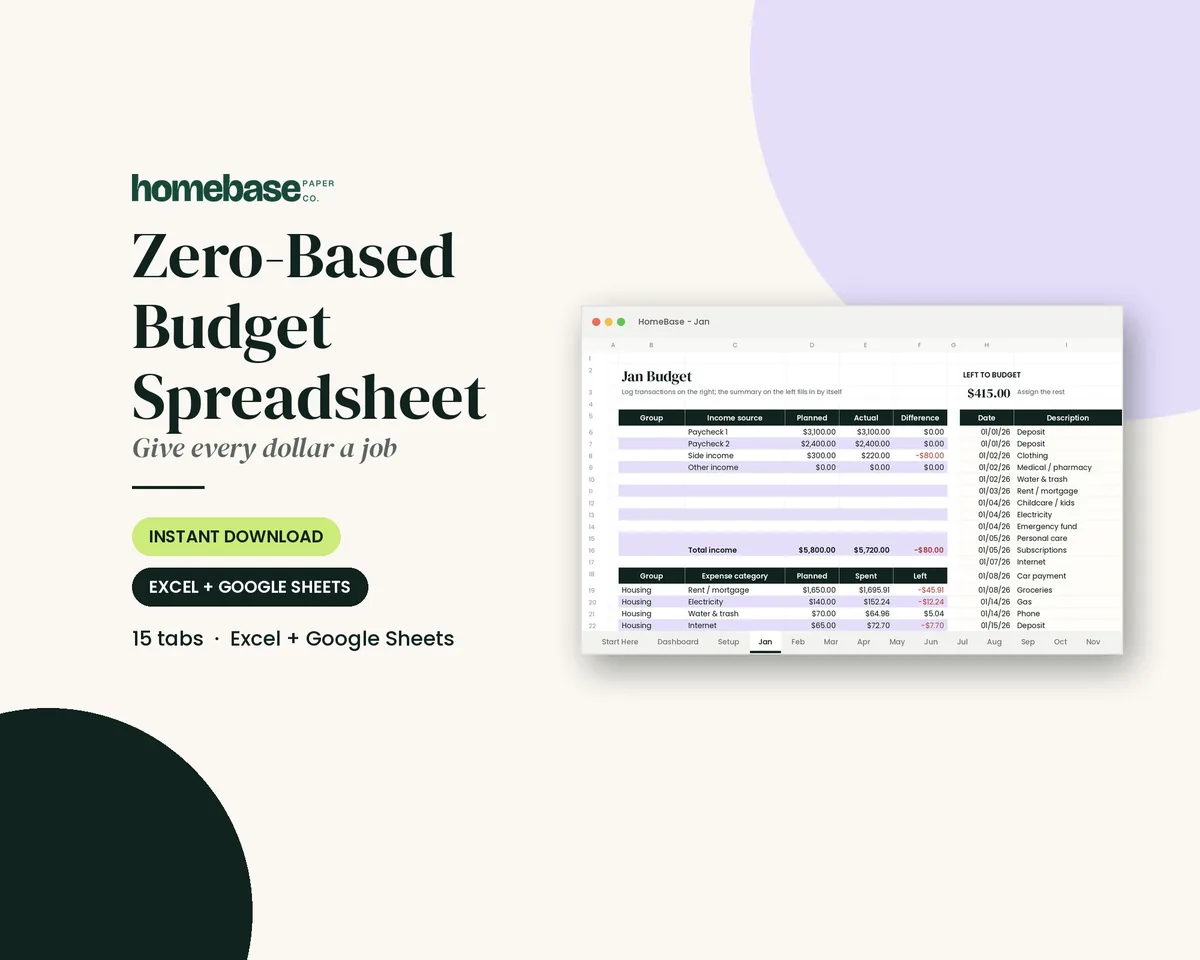
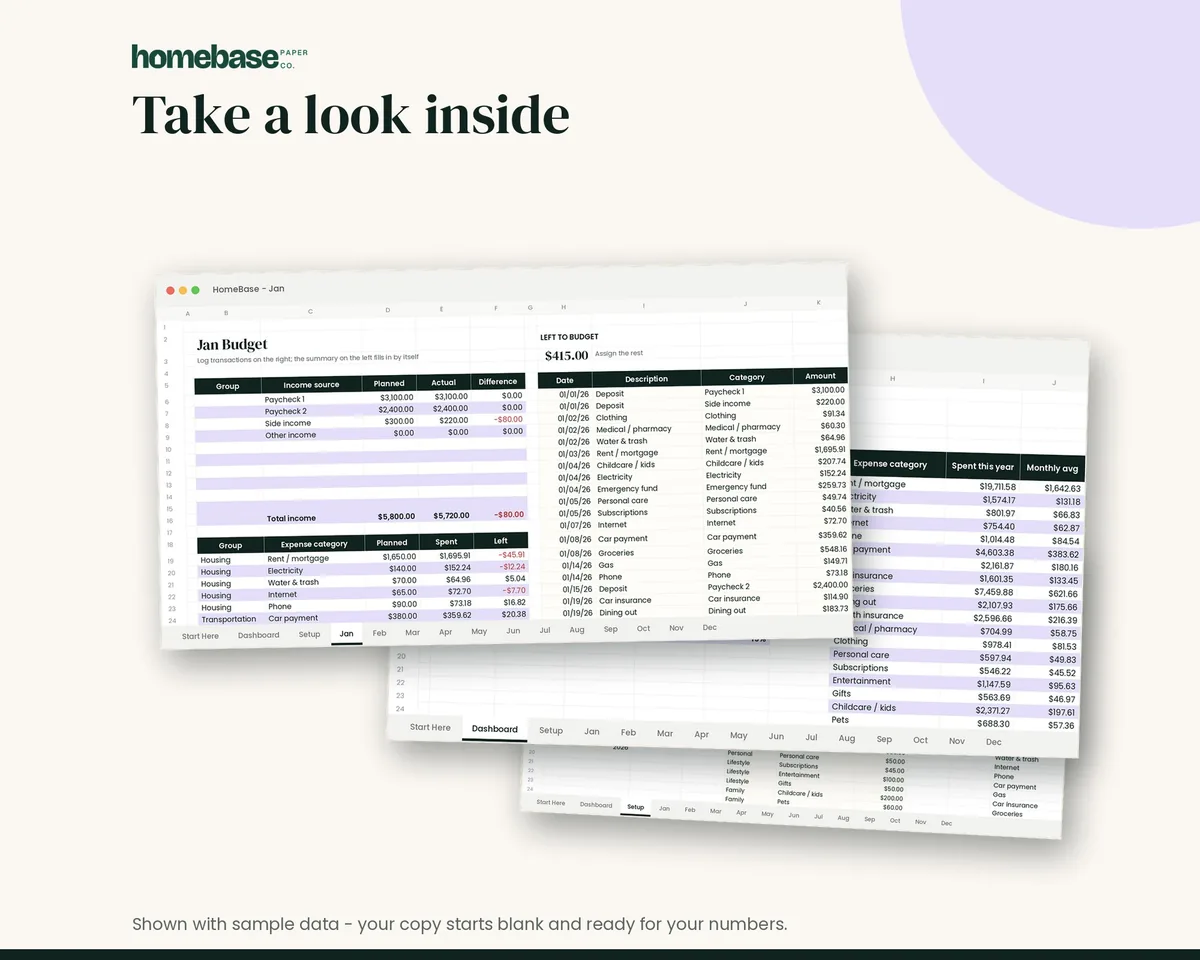
To plan the moving lines each month, our Zero-Based Budget Spreadsheet has planned vs. spent vs. left columns and a 'Left to budget' counter on all 12 monthly tabs, plus a transaction log with dropdowns.
What are variable expenses?
A variable expense is any cost whose amount changes from month to month based on what you use or buy. Groceries are the classic example: one week you restock the pantry and spend $180, the next you buy milk and fruit and spend $60.
The opposite is a fixed expense, a cost you've agreed to in advance that stays about the same each month, like rent, a car payment or insurance. Our guide to fixed expenses covers that side of the budget in detail, with 25 examples and how to lower them. This page focuses on the moving costs and how to plan for them.
A quick test: if you could change the amount this month just by changing your habits, it's variable. If changing it would take a phone call, a new contract or a move, it's fixed.
Variable expenses are paid out of your disposable income, the money left after taxes.
30 examples of variable expenses
Food
- Groceries
- Restaurant meals and takeout
- Coffee and snacks out
- School or work lunches
- Alcohol
Home
- Electricity
- Natural gas or heating oil
- Water and sewer (if billed by usage)
- Household supplies like cleaning products and paper towels
- Home repairs and small maintenance
- Furniture and decor
Transportation
- Gas or EV charging
- Parking and tolls
- Rideshares and transit fares (if you don't buy a monthly pass)
- Car repairs and maintenance
Personal and health
- Clothing and shoes
- Haircuts and personal care
- Medical and dental copays
- Prescriptions
- Gym classes or drop-in fees
Family and kids
- Kids' activities and sports fees
- Babysitting
- School supplies and field trips
- Pet food, treats and vet visits
Fun and giving
- Entertainment, movies and events
- Hobbies
- Gifts and birthdays
- Holiday spending
- Travel and weekend trips
- Charitable giving (if it isn't a set monthly amount)
Some items sit on the line. A phone plan is fixed, but overage charges are variable. Childcare at a center is fixed, while a sitter you pay by the hour is variable. Put each item where it behaves in your life. Our budget categories list shows where each cost belongs in a full budget.
What variable expenses look like in a typical household
It helps to know what "normal" looks like. The U.S. Bureau of Labor Statistics' Consumer Expenditure Survey tracks what American households spend. For 2024, the average household (BLS calls it a "consumer unit") spent $78,535 for the year. Here are some of the biggest variable categories, divided by 12 to show a monthly figure:
| Category (2024 BLS average) | Per year | About per month |
|---|---|---|
| Food at home (groceries) | $6,224 | $519 |
| Food away from home | $3,945 | $329 |
| Gasoline and motor fuel | $2,411 | $201 |
| Entertainment | $3,609 | $301 |
| Apparel and services | $2,001 | $167 |
| Personal care products and services | $978 | $82 |
These are averages across all households, so a single person or a family of six will look very different. Still, the table shows why variable expenses matter: food, gas, fun and clothes alone add up to more than $1,500 a month for the average household. A 10% trim across those categories is roughly $150 a month, or $1,800 a year.
How to budget for variable expenses in 5 steps
Fixed expenses are easy to budget because you know the number. Variable expenses take one extra step: you need a realistic estimate first.
- Pull three months of statements. Use your checking account and every credit or debit card. One month can be skewed by a birthday or a car repair, so three gives a truer picture.
- Sort every purchase into a category. Groceries, dining out, gas, household, kids, fun and so on. Utah State University Extension suggests marking each expense as fixed or variable as you track it, then building the budget from what you really spent.
- Find the monthly average. Add each category and divide by three. That's your starting number, not your goal.
- Set a limit a little below the average. Pick one or two categories to trim by 5% to 10%. Leave the rest at the average for now. Cutting everything at once is the fastest way to give up.
- Split each limit into weeks. A $520 grocery budget becomes $120 a week, with the extra few dollars as a cushion for five-week months. Our weekly budget guide shows how to run the whole month this way.
The Consumer Financial Protection Bureau's budgeting steps follow the same order: find out where money comes from, track where it goes, list bills and due dates, then build a working budget. Variable expenses are the "where it goes" step, and they're usually where the surprises are.
A weekly system that keeps variable expenses in check
Monthly limits are hard to feel. By the 20th, you may not remember what you spent on the 4th. A weekly rhythm fixes that.
- Pick a check-in day. Sunday evening works for most families. It takes 10 to 15 minutes.
- Log purchases within a day. Snap a photo of the receipt or jot it down. Batch entry on Sunday is fine, but daily is easier.
- Compare spent with planned. For each variable category, note what's left for the month.
- Move money on purpose. If dining out ran over, take it from fun money or clothing, not from savings or bills.
- Plan the next week. Write the meal plan, note any birthdays or school fees, and set the grocery limit.
Our Zero-Based Budget Spreadsheet ($6.99) does the math for you, showing what's left in each category as you log purchases, and the "Left to budget" counter turns green when every dollar has a job. If you'd rather write it down, our Budget Planner Printable ($5.99) has 12 undated pages you can print every month: budget, bills, spending, savings and debt.
Fixed vs. variable expenses at a glance
| Fixed expenses | Variable expenses | |
|---|---|---|
| Amount each month | About the same | Changes |
| Examples | Rent, car payment, insurance, loan payments | Groceries, gas, dining out, utilities, clothing |
| How to budget | Use the bill amount | Use a 3-month average |
| How fast you can cut | Slowly, often at renewal | This week |
| Best tool | Bill tracker and due dates | Weekly limits and spending log |
Both matter. A budget with low fixed costs gives you room to breathe, and a budget with controlled variable costs is where savings actually come from month to month.
12 ways to lower variable expenses
- Plan meals before you shop. A weekly plan and a list cut impulse buys and food waste.
- Set a weekly grocery limit. Use cash or a separate debit card if it helps.
- Swap one takeout night for a freezer meal. Keep two or three easy meals ready.
- Use the 48-hour rule. Wait two days before any nonessential purchase over $50.
- Unsubscribe from store emails. Fewer sale alerts means fewer "deals" you didn't need.
- Lower heating and cooling costs. Adjust the thermostat a couple of degrees and seal drafts.
- Combine errands. One loop for the week saves gas and time.
- Shop your closet first. Make a list of what you actually need before clothes shopping.
- Set a gift budget per person. Birthdays and holidays are variable costs that sneak up.
- Price-check prescriptions. Ask your pharmacist about generics.
- Give everyone fun money. A set amount per person, no questions asked, stops arguments and overspending.
- Cut the biggest category first. A 10% cut to a $500 category saves more than giving up a $5 coffee.
Don't forget periodic variable costs
Some variable expenses don't show up every month: holiday gifts, back-to-school shopping, summer camp, car repairs and vet bills. They feel like emergencies, but most are predictable. List the ones you had last year, estimate this year's cost, divide by 12 and save that amount each month. Our guide to sinking funds shows how, and our Sinking Funds Tracker ($4.99) works out the monthly amount for every goal.
Get every category in one place
If you want the full set, our Ultimate Budget Bundle ($19.99) includes all six budget spreadsheets plus both printable planners, for less than half the price of buying them separately. Start with your three-month average this weekend. Once you can see your variable expenses, you can decide where every dollar goes.
The easiest way to get variable costs under control is to write them down as they happen. Our spending tracker guide shows how.
To see how variable costs fit into your total living expenses, read our guide to living expenses, with average costs by category.
Make it easier
Tools for this

Spreadsheets
Zero-Based Budget Spreadsheet
The 'Left to budget' counter turns green when every dollar has a job.

Printables
Budget Planner Printable
Twelve undated pages you can print every month: budget, bills, spending, savings and debt.

Spreadsheets
Sinking Funds Tracker
It does the math: how much to set aside each month to hit every goal on time.
Frequently asked questions
What are variable expenses? Variable expenses are costs that change from month to month depending on how much you use or buy, such as groceries, gas, dining out, clothing, entertainment and most utility bills. You control most of them day to day, which makes them the easiest part of a budget to adjust when money is tight.
What are examples of variable expenses? Common examples of variable expenses are groceries, restaurant meals, gas, electricity, water, clothing, haircuts, household supplies, gifts, entertainment, kids' activities, pet food, medical copays and car repairs. If the amount depends on your choices or your usage that month, it is usually variable.
What is the difference between fixed and variable expenses? Fixed expenses stay about the same every month, like rent, a car payment or insurance. Variable expenses change with usage or choices, like groceries and gas. Fixed costs are hard to change quickly. Variable costs can be cut this month, so they are where most people find money first.
Are groceries a variable expense? Yes, groceries are a variable expense because the total changes from week to week. They are also an essential expense, so give groceries a firm weekly limit based on your real spending rather than skipping them as a place to plan. A meal plan is the simplest way to keep the total steady.
Are utilities fixed or variable expenses? Most utilities are variable expenses, because electricity, gas and water bills rise and fall with the season and your usage. Internet and phone plans are usually fixed. Some utilities offer budget billing, which spreads the year's cost into equal payments and makes the bill act like a fixed expense.
How do you budget for variable expenses? Budget for variable expenses by averaging what you spent in each category over the last three months, then setting that average, or a little less, as your limit. Split the monthly limit into weekly amounts and check your spending once a week. Adjust the number after a month or two of real data.
How do I estimate variable expenses? You can estimate variable expenses by pulling three months of bank and card statements, sorting each purchase into a category and adding up each category. Divide by three for a monthly average. Utah State University Extension suggests tracking every expense for one month and marking each one fixed or variable.
What percentage of a budget is variable expenses? Variable expenses often take roughly a quarter to a third of take-home pay, though there is no set percentage. Housing is usually the largest fixed cost. In federal spending data for 2024, food alone took 12.9% of the average household's spending and transportation took 17%.
How can I lower my variable expenses? Lower variable expenses by planning meals before you shop, setting a weekly cash or debit limit for groceries and fun money, waiting 48 hours before nonessential purchases, cutting energy use at home and pausing subscriptions you do not use. Start with your biggest category, since a 10% cut there saves the most.
Is a credit card payment a variable expense? Yes, a credit card payment is usually a variable expense. A credit card payment is often treated as a variable expense because the minimum payment changes with your balance. If you pay the same planned amount each month toward a balance, list it as a fixed debt payment instead, and track what you charge on the card under its real categories.
What is a periodic expense? A periodic expense is a cost that comes once or twice a year rather than monthly, such as car registration, holiday gifts, school supplies or an annual membership. Divide each one by 12 and save that amount every month in a sinking fund, so it does not wreck the month it arrives.
What is the easiest way to track variable expenses? The easiest way to track variable expenses is to log each purchase within a day, either in a spreadsheet or on a printed spending page, and total each category every Sunday. Our Zero-Based Budget Spreadsheet ($6.99) shows what is left in each category as you go.
More from HomeBase
You may also like

Spreadsheets
Bill Tracker Spreadsheet
Bills due in 3 days or less light up red, so nothing slips through.

Spreadsheets
Paycheck Budget Spreadsheet
Enter your bills once. The sheet tells you which paycheck pays each one, all year.

Spreadsheets
Annual Budget Spreadsheet
See exactly where your money goes every month - without complicated software.

Spreadsheets
Debt Payoff Planner
Pick snowball or avalanche, add any extra payment, and get your debt-free month instantly.
 Club
Monthly club
Money Club
Anyone who wants a clear plan for the month's bills, holiday spending and savings.
Free printable
Give every dollar a job: get the free monthly budget template
A printable zero-based monthly budget: income, bills, everyday spending and savings on one page, with a planned vs. actual column. You'll also get our weekly HomeBase email with simple budgeting and bill-paying tips.
