

The short answer: living expenses are the regular costs of running your household: housing, utilities, food, transportation, healthcare, insurance and basic personal needs. In 2025 the average U.S. household spent $81,905, about $6,825 a month (BLS).
- Housing was the biggest share at 33.9%
- Find yours: total three months of statements by category and divide by three
- Add yearly bills divided by 12
- Don't forget car upkeep, school costs, holidays and birthdays
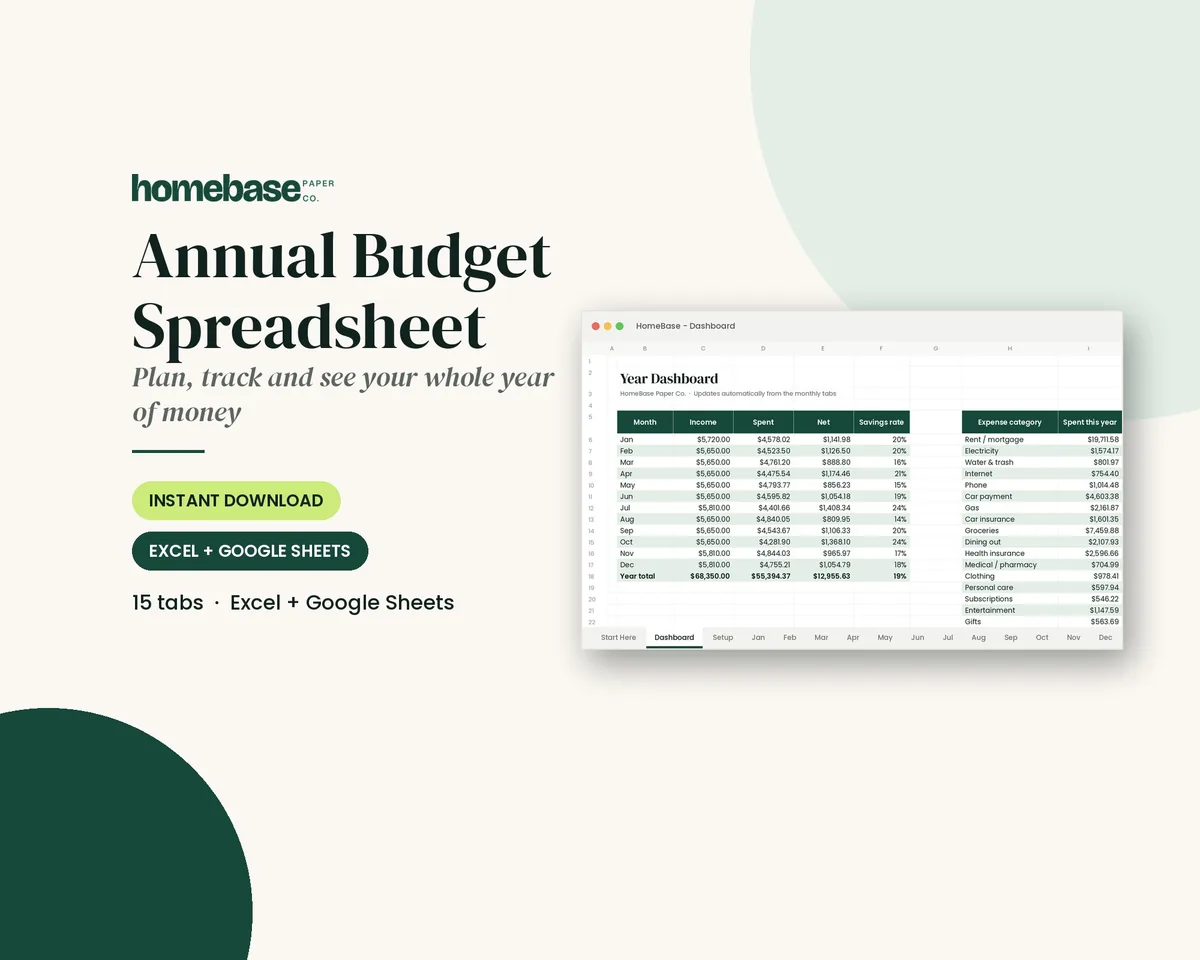
- Next step: Plan it with the Annual Budget Spreadsheet ($6.99).
Living expenses are the regular costs of running your household: housing, utilities, food, transportation, healthcare, insurance and basic personal needs. In 2025 the average U.S. household spent $81,905, about $6,825 a month, according to the Bureau of Labor Statistics. Housing was the biggest share at 33.9%. To find your own living expenses, total three months of statements by category, divide by three, and add yearly bills divided by 12.
The Annual Budget Spreadsheet ($6.99) is the easiest way to keep that total up to date: set your categories once, log purchases with dropdowns, and see planned vs. actual for all 12 months. It works in Excel and Google Sheets. Browse all of our Spreadsheets for more money tools.
This page explains what counts, what the national averages look like and how to work out your own number. If you want a full list of budget lines, our budget categories list has 40 of them. Every dollar figure in the examples below is an example, so swap in your own.
What counts as living expenses?
Living expenses are the costs you'd still have to pay in a month with no extras. A simple test: if you skipped it, would your household stop running smoothly? If yes, it's a living expense.
| Category | Examples | Usually fixed or variable? |
|---|---|---|
| Housing | Rent or mortgage, property tax, renters or homeowners insurance, HOA fees | Mostly fixed |
| Utilities | Electricity, gas, water, sewer, trash | Variable |
| Phone and internet | Cell phone plan, home internet | Mostly fixed |
| Food | Groceries, household basics | Variable |
| Transportation | Car payment, gas, car insurance, maintenance, transit passes | Mixed |
| Healthcare | Health insurance premiums, copays, prescriptions | Mixed |
| Insurance | Life and disability insurance | Fixed |
| Debt minimums | Minimum payments on credit cards and loans | Fixed |
| Childcare and school | Daycare, after-school care, school fees | Mostly fixed |
| Personal basics | Toiletries, haircuts, basic clothing | Variable |
Fixed costs stay about the same each month, and variable costs move around. Our guides to fixed expenses and variable expenses go deeper on each type.
What usually doesn't count
Some spending is real, but most budgets treat it as wants or goals instead of living expenses:
- Dining out, takeout and coffee runs
- Streaming services and subscriptions beyond the basics
- Vacations and travel
- Hobbies, entertainment and gifts
- Savings, retirement contributions and investing
- Extra debt payments above the minimum
This matters most when someone asks you how much you need to live on, like when you set an emergency fund goal. Use the essentials total, not your full spending.
Living expenses people often forget
When people total their living expenses for the first time, the number usually comes out too low. That's rarely because they spend less than they think. It's because the costs that don't show up every month get left off the list. Check for these before you call your total final:
- Yearly and twice-yearly bills. Car registration, renters or homeowners insurance paid in full, membership renewals and property taxes paid outside a mortgage.
- Seasonal utility swings. A winter heating bill or a summer cooling bill can be much bigger than an average month.
- Car upkeep. Oil changes, tires and inspections come around on a schedule, even if it isn't monthly.
- Medical costs beyond the premium. Copays, prescriptions, dental cleanings and glasses or contacts.
- School and activity costs. Fees, supplies and the field trip money that always seems due tomorrow.
- Household restocking. Toilet paper, cleaning supplies, laundry soap and light bulbs.
- Holidays and birthdays. Gifts aren't essentials, but they arrive every year, so plan for them like a bill.
One person vs. a whole household
Living expenses don't scale in a straight line. Rent, internet and the electric bill don't double when a second person moves in, while groceries, phone lines and health insurance usually go up with each person. That's why a single person's budget can't simply be multiplied by household size, and why a family's total can't be divided evenly to get a per-person number. When you compare your total with anyone else's, compare households that look like yours.
Average living expenses in America
The Bureau of Labor Statistics tracks household spending every year in its Consumer Expenditure Surveys. The 2025 Consumer Expenditures release, published October 29, 2026, shows average annual spending of $81,905 per household (BLS calls them "consumer units"), up 4.3% from 2024. Average income before taxes was $110,847.
Here's how that spending broke down. Monthly figures are the annual BLS numbers divided by 12 and rounded.
| Category | Average per year (2025) | About per month | Share of spending |
|---|---|---|---|
| Housing | $27,790 | $2,316 | 33.9% |
| Transportation | $13,492 | $1,124 | 16.5% |
| Food | $10,633 | $886 | 13.0% |
| Personal insurance and pensions | $10,175 | $848 | 12.4% |
| Healthcare | $6,470 | $539 | 7.9% |
| Entertainment | $4,084 | $340 | 5.0% |
| Cash contributions | $2,237 | $186 | 2.7% |
| Apparel and services | $2,010 | $168 | 2.5% |
| Education | $1,583 | $132 | 1.9% |
| Miscellaneous | $1,335 | $111 | 1.6% |
| Personal care | $986 | $82 | 1.2% |
| All spending | $81,905 | $6,825 | 100% |
A few lines inside those totals are useful for comparing with your own bills:
| Inside the totals | Average per year (2025) | About per month |
|---|---|---|
| Shelter (part of housing) | $17,626 | $1,469 |
| Utilities, fuels and public services | $4,931 | $411 |
| Food at home (groceries) | $6,491 | $541 |
| Food away from home | $4,142 | $345 |
| Health insurance | $4,310 | $359 |
| Gasoline and other fuels | $2,503 | $209 |
Keep in mind these are averages across every kind of household: renters and homeowners, single people and big families, cities and small towns. Your numbers can look very different and still be completely normal. For a closer look at food, see our guide to the average grocery cost per month.
Living expenses by income level
Spending rises with income, but not evenly. The BLS splits households into five equal groups by income before taxes. Here's what each group spent in 2025.
| Income group | Average income before taxes | Average spending per year | About per month |
|---|---|---|---|
| Lowest fifth | $18,125 | $37,935 | $3,161 |
| Second fifth | $46,080 | $51,405 | $4,284 |
| Middle fifth | $78,584 | $68,983 | $5,749 |
| Fourth fifth | $126,349 | $92,250 | $7,688 |
| Highest fifth | $286,188 | $159,512 | $13,293 |
Two things stand out. First, average spending in the lowest group was higher than its average income before taxes, which is why so many households feel squeezed. Second, the middle group's average spending, about $5,749 a month, is a more realistic benchmark for many families than the overall average, which the highest earners pull up.
How to figure out your own living expenses
National averages are a starting point. The number that matters is yours, and it takes about an hour to find.
- Gather three months of statements. Bank accounts, credit cards and any payment apps. Three months smooths out odd months.
- Sort every charge into a category. Use the categories in the table above, or the ones in our budget categories list.
- Mark each category as essential or not. Use the "would the household stop running smoothly" test.
- Average the variable costs. Add three months of groceries, gas and utilities, then divide each by three.
- Add irregular bills as a monthly amount. Take yearly or twice-yearly costs like car registration, insurance premiums and school fees, and divide the yearly total by 12. Our sinking funds guide shows how to save for them.
- Add it all up. That's your monthly living expenses. Keep a second total that includes wants, so you know both numbers.
- Compare it with your take-home pay. If essentials take most of your paycheck, start with the biggest line, not the smallest.
The Sinking Funds Tracker ($4.99) handles step 5 for you: enter each irregular bill and it shows how much to set aside each month.
Example: one household's monthly living expenses
Here's how the math might look for a family with a $5,200 monthly take-home pay. These are example numbers, not recommendations.
| Line | Example monthly amount |
|---|---|
| Rent | $1,650 |
| Utilities | $260 |
| Phone and internet | $140 |
| Groceries | $720 |
| Car payment, insurance and gas | $690 |
| Health insurance and copays | $310 |
| Childcare | $600 |
| Debt minimums | $150 |
| Personal basics | $90 |
| Irregular bills (yearly total divided by 12) | $120 |
| Total living expenses | $4,730 |
In this example, essentials take about 91% of take-home pay, leaving $470 for savings and wants. That's tight, and it points to the next step: look hardest at the biggest lines first.
Living expenses vs. related terms
These phrases get mixed up a lot, so here's a quick guide.
| Term | What it means |
|---|---|
| Living expenses | What your household spends to keep running each month |
| Cost of living | How expensive a place is for things like housing, food and transportation |
| Fixed expenses | Costs that stay about the same each month, like rent |
| Variable expenses | Costs that change month to month, like groceries and utilities |
| Discretionary spending | Wants you could skip, like dining out and travel |
How many months of living expenses to save
A common rule of thumb is to keep three to six months of essential living expenses in an emergency fund. The CFPB's essential guide to building an emergency fund takes a more personal approach: it says the amount you need depends on your situation, suggests looking at the unexpected expenses you've had before to set a goal, and points out that even a small amount can provide some financial security.
This is where your essentials total matters. If your living expenses are $4,730 a month, one month of savings is $4,730, and three months is $14,190. That can feel far away, so start with a smaller first goal. Our guide on how to build an emergency fund breaks it into steps, and our emergency fund tracker helps you watch it grow.
How to lower your living expenses
Start where the money is. Based on the BLS shares, housing, transportation and food make up more than 60% of average household spending, so even one change in those lines can beat a dozen small cuts.
- Housing. Check whether your rent fits your income with our guide on how much rent you can afford, shop your renters or homeowners insurance each year, and ask about a roommate or a smaller place at renewal time.
- Utilities. Our guide on how to lower your heating bill covers the easy winter fixes.
- Transportation. Shop car insurance, keep up with maintenance before it turns into repairs, and compare transit or carpool costs.
- Food. Plan meals before you shop and shop with a list. Our guide to grocery shopping on a budget has more.
- Bills. Call providers about lower rates and cancel what you don't use. See how to lower monthly bills.
Lowering living expenses works best when you can see the result. Track one change at a time for a month, then move to the next. Food is a big share of that total, so free food on your birthday is a small recurring cut when you remember to ask.

Track your living expenses all year
Your living expenses aren't one number you find once. They change with the seasons, the heating bill, the school year and the holidays. The households that stay on top of them check in once a week and review once a month.
The Annual Budget Spreadsheet ($6.99) gives you a setup tab for your categories, 12 monthly tabs, a transaction log with dropdowns, planned vs. actual by category, over-budget alerts and a year dashboard. Pair it with the Bill Tracker Spreadsheet ($4.99) so no due date slips by. Or get both, plus the Zero-Based Budget Spreadsheet, Paycheck Budget Spreadsheet, Debt Payoff Planner, Sinking Funds Tracker and both printable planners, in the Ultimate Budget Bundle for $19.99 (reg. $46.42 bought separately). See every set in our Bundles shop.
Make it easier
Tools for this
Spreadsheets
Annual Budget Spreadsheet
See exactly where your money goes every month - without complicated software.

Spreadsheets
Bill Tracker Spreadsheet
Bills due in 3 days or less light up red, so nothing slips through.

Spreadsheets
Sinking Funds Tracker
It does the math: how much to set aside each month to hit every goal on time.
Frequently asked questions
What are living expenses? Living expenses are the regular costs of keeping your household running: housing, utilities, food, transportation, healthcare, insurance and basic personal needs. They're the bills you'd still have to pay in a month with no extras. The Annual Budget Spreadsheet ($6.99) lets you set these up as categories once and see planned vs. actual for every month of the year.
What counts as living expenses? Living expenses usually include rent or mortgage, utilities, phone and internet, groceries, transportation, health insurance and medical costs, other insurance, minimum debt payments, childcare and basic personal care. Things like vacations, dining out and hobbies are usually counted as wants rather than living expenses, even though they're real spending.
What are the average living expenses in America? The average U.S. household spent $81,905 in 2025, or about $6,825 a month, according to the Bureau of Labor Statistics Consumer Expenditures release. Housing was the largest share at 33.9%, followed by transportation at 16.5%, food at 13.0% and personal insurance and pensions at 12.4%.
How do I figure out my monthly living expenses? Pull your last three months of bank and card statements, total each category, and divide by three to get a monthly average. Add yearly bills divided by 12. The Annual Budget Spreadsheet ($6.99) has a transaction log with category dropdowns, so the totals add themselves up as you enter purchases.
Are living expenses the same as cost of living? No, living expenses are what your own household actually spends, while cost of living describes how expensive it is to live in a place. Two families in the same city can have very different living expenses depending on their housing, cars and household size.
Is rent a living expense? Yes, rent is a living expense, and for most households it's the biggest one. In the 2025 BLS data, housing (which includes shelter, utilities, household operations, supplies and furnishings) averaged $27,790 a year, about $2,316 a month, across all households.
Are car payments a living expense? Yes, car payments are usually counted as living expenses, along with gas, insurance, maintenance and registration. Transportation was the second-biggest category in the 2025 BLS data at $13,492 a year, or about $1,124 a month for the average household.
Is debt a living expense? Minimum debt payments are usually counted as living expenses because you have to make them every month. Extra payments above the minimum are better treated as a goal, like savings. The Bill Tracker Spreadsheet ($4.99) lists every bill and minimum payment and highlights what's due soon.
How many months of living expenses should I save? A common rule of thumb is three to six months of essential living expenses, but the right amount depends on your situation. The CFPB suggests looking at the unexpected costs you've had in the past to set a goal, and says even a small amount helps. Start with one month and build from there.
What percentage of income should go to living expenses? A popular guideline is the 50/30/20 budget, which puts about 50% of take-home pay toward needs like housing, utilities, food and transportation. It's a starting point, not a rule. In high-cost areas needs can take more, so adjust the other two buckets instead of giving up on the plan.
What is the biggest living expense for most people? Housing is the biggest living expense for most households. It made up 33.9% of average household spending in the 2025 BLS Consumer Expenditures data, more than twice the share of transportation, which came second at 16.5%.
How can I lower my living expenses? Lower your living expenses by starting with the biggest lines: housing, transportation and food. Small fixes like canceling unused subscriptions help, but one change to a big line usually saves more. The Ultimate Budget Bundle ($19.99, reg. $46.42 bought separately) includes the budget, bill, sinking fund and debt tools to track every change.
Are groceries a living expense? Yes, groceries are a living expense. The average household spent $6,491 on food at home in 2025, about $541 a month, per the BLS. Restaurant meals and takeout are tracked separately as food away from home, which averaged $4,142 a year.
Should I track living expenses in a spreadsheet or on paper? Use whichever you'll keep up with every week. The Annual Budget Spreadsheet ($6.99) works in Excel and Google Sheets and does the math, with over-budget alerts in red. If you'd rather write things down, the Budget Planner Printable ($5.99) gives you paper pages to fill in by hand.
Free printable
Give every dollar a job: get the free monthly budget template
A printable zero-based monthly budget: income, bills, everyday spending and savings on one page, with a planned vs. actual column. You'll also get our weekly HomeBase email with simple budgeting and bill-paying tips.

Sources
- BLS: Consumer Expenditures 2025 (news release) bls.gov
- CFPB: An essential guide to building an emergency fund consumerfinance.gov