

The short answer: cash on cash return tells you how hard the money you actually put into a rental is working: the property's yearly cash flow divided by the cash you invested.
- Formula: annual pre-tax cash flow ÷ total cash invested × 100
- Cash flow: income minus operating expenses minus debt service
- Cash invested: down payment, closing costs and upfront repairs
- It leaves out principal paydown, appreciation and tax benefits
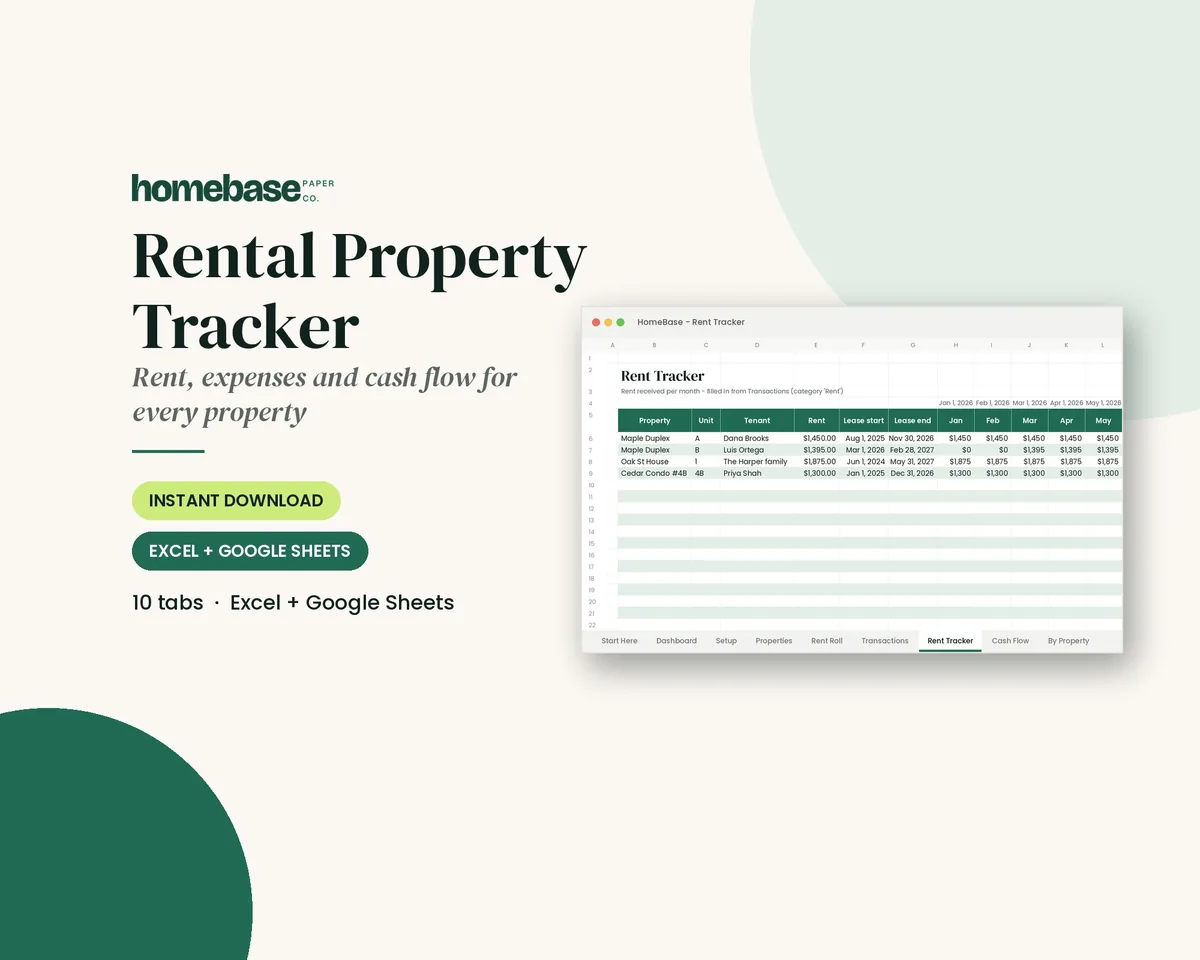
- Next step: Plan it with the Rental Property Tracker ($11.99).
Cash on cash return tells you how hard the money you actually put into a rental is working. It is the property's yearly cash flow divided by the cash you invested. Investopedia's guide to cash-on-cash return describes it as the annual return on the cash invested, separate from the full price of a property bought with a loan. Below is the formula, a full worked example, what counts as a good number, and how it differs from cap rate and ROI.
The cash on cash return formula
Cash on cash return = annual pre-tax cash flow ÷ total cash invested × 100.
| Part | What goes in it |
|---|---|
| Annual income | Rent, plus parking, laundry, pet fees and other income. |
| Operating expenses | Taxes, insurance, repairs, management, HOA, utilities, vacancy allowance. |
| Debt service | Mortgage principal and interest for the year. |
| Annual pre-tax cash flow | Income minus operating expenses minus debt service. |
| Total cash invested | Down payment, closing costs, upfront repairs and other cash paid to buy. |
What counts as cash invested
Count every dollar that left your pocket to buy the property and get it rented. That includes the down payment, lender fees, title and escrow charges, inspection and appraisal fees, loan points, upfront repairs, appliances and the first months of carrying costs before a tenant moves in. Do not count money the lender covered. If you add cash later for a major improvement, add it to cash invested when you recalculate.
Worked example
You buy a single-family rental for $250,000 with 25% down.
| Item | Amount |
|---|---|
| Down payment | $62,500. |
| Closing costs | $7,500. |
| Repairs before renting | $5,000. |
| Total cash invested | $75,000. |
| Rent, $2,200 a month | $26,400 a year. |
| Operating expenses | $8,400 a year. |
| Mortgage, $187,500 at 7% over 30 years | About $14,969 a year. |
| Annual pre-tax cash flow | About $3,031. |
| Cash on cash return | About 4.0%. |
The math: $26,400 minus $8,400 minus $14,969 is about $3,031. Divide by $75,000 and you get about 4.0%.
How the numbers move
| Change | Cash flow | Cash on cash return |
|---|---|---|
| Base case above | $3,031. | 4.0%. |
| Rent $100 a month higher | $4,231. | 5.6%. |
| 20% down instead of 25% | $2,033. | 3.3%. |
| Paid all cash, $262,500 in | $18,000. | 6.9%. |
Two lessons stand out. Small rent changes move the return a lot. And at a 7% mortgage rate, borrowing more lowered this deal's cash on cash return, because the loan costs more than the property earns on its price. Leverage helps only when the property's yield beats the cost of the debt.
What each return means in dollars
Using the $75,000 of cash invested in the example above, here is what different cash on cash returns would look like each year before taxes:
| Cash on cash return | Annual cash flow on $75,000 | Monthly |
|---|---|---|
| 4% (the example) | $3,000 | $250 |
| 8% | $6,000 | $500 |
| 10% | $7,500 | $625 |
| 12% | $9,000 | $750 |
Seeing the dollars helps you compare a rental with other uses of the same cash, such as a savings account or Treasury bills, and shows how much rent or expense changes it takes to move from 4% to 8%.
What is a good cash on cash return?
There is no official standard. Many rental investors aim for roughly 8% to 12%. In high-priced cities, buyers often accept 4% to 6% because they expect rents and values to rise. Ask yourself three things:
- What could this cash earn with less work and risk, such as in a high-yield savings account or Treasury bills?
- Did you include realistic vacancy and repairs?
- Will the return hold if rates, taxes or insurance go up?
A 4% return with a large repair reserve may be safer than a 10% return built on optimistic rent.
Comparing two deals
Cash on cash return is most useful side by side. Suppose you have $75,000 to invest and two options:
| Property A | Property B | |
|---|---|---|
| Price | $250,000. | $180,000. |
| Cash invested | $75,000. | $75,000. |
| Annual cash flow | $3,031. | $5,400. |
| Cash on cash return | 4.0%. | 7.2%. |
| Location and condition | Newer home, rising area. | Older duplex, steady area. |
Property B pays more cash now. Property A may grow more in value and need fewer repairs. Cash on cash return does not pick the winner for you. It shows the trade-off clearly, so you can decide whether expected growth is worth less cash each year.
Strengths and limits
Investors like cash on cash return because it is simple, uses real dollars and reflects the loan you will actually get. It answers a practical question: will this property put money in my pocket?
Its limits matter just as much. It covers one year at a time, so it says nothing about later rent growth or a big repair in year five. It ignores equity you build by paying down the loan, and any change in value. And it depends on your estimates, so a careless expense list makes the number meaningless. Use it with cap rate, a long-term cash flow projection and a careful inspection.
Multifamily and short-term rentals
For a duplex or small apartment building, add rent from every unit and expenses for the whole building, including shared utilities and common-area upkeep. Vacancy on one unit hurts less than on a single-family home, which is one reason small multifamily properties appeal to new investors.
Short-term rentals need more careful numbers. Income swings by season, and costs include cleaning, platform fees, furnishings, supplies and higher insurance. Count furniture and setup costs in cash invested. Use a conservative occupancy rate, and check local rules, since many cities limit short-term rentals.
Cash on cash return vs. cap rate
| Feature | Cap rate | Cash on cash return |
|---|---|---|
| Formula | Net operating income ÷ price or value. | Cash flow after debt ÷ cash invested. |
| Includes mortgage? | No. | Yes. |
| Best for | Comparing properties to each other. | Comparing deals as you will finance them. |
| In the example | $18,000 ÷ $250,000 = 7.2%. | $3,031 ÷ $75,000 = 4.0%. |
Use both. Cap rate tells you if the property is fairly priced. Cash on cash return tells you if your financing works.
Cash on cash return vs. ROI
Cash on cash return looks only at the cash you receive each year. A total return or ROI figure can add three more things:
- Principal paydown, the part of each mortgage payment that builds equity.
- Appreciation, if the property gains value.
- Tax benefits, mainly depreciation.
Investopedia notes that cash on cash return and ROI are often used interchangeably but differ when debt is involved. Keep them separate when comparing deals.
Depreciation and taxes
Cash on cash return is usually a pre-tax number. Your actual tax bill depends on depreciation and deductible expenses. IRS Publication 527 covers residential rental property, including which expenses are deductible, how to depreciate the building, and the difference between repairs and improvements. Residential rental buildings are generally depreciated over 27.5 years, and land is not depreciated. Depreciation lowers taxable income without costing cash, which is why after-tax returns can look better than pre-tax ones.
Cash on cash return after year one
Most investors calculate cash on cash return before buying, then never look again. The number changes every year. Rents usually rise, while taxes, insurance and repairs rise too. If your loan is fixed, your mortgage payment stays flat, so cash flow often improves over time. Recalculate each year with real figures. A falling return is an early warning that rent is below market or costs are creeping up.
Common mistakes
| Mistake | Fix |
|---|---|
| Leaving out vacancy | Budget several percent of rent for empty months. |
| No repair or capital reserve | Set aside for roofs, HVAC and appliances. |
| Forgetting closing costs in cash invested | Add every dollar you paid to buy. |
| Using asking rent, not market rent | Check comparable rentals nearby. |
| Comparing pre-tax and after-tax numbers | Use the same basis for every deal. |
| Not updating after year one | Recalculate with real numbers each year. |
Before you buy: a quick checklist
- Get real tax and insurance quotes, not estimates from the listing.
- Ask for the current lease and rent history.
- Price out repairs with a contractor before closing.
- Run the numbers at today's rate and at a rate 1% higher.
- Recalculate cash on cash return with vacancy and reserves included.
Track the real number every year
Your projected cash on cash return is only a guess until the first year of real numbers comes in. The Rental Property Tracker ($11.99, Excel and Google Sheets) tracks up to 10 properties with a rent roll and lease-end alerts, an income and expense log, rent received per tenant per month with short or missed rent highlighted, cash flow by month and property, and category totals for tax time. Divide a year's cash flow by your cash invested and you have the actual return.
See also how to track rental property income and expenses.
To track the rent that feeds this number, keep a rent roll template for each property.
Make it easier
Tools for this
Spreadsheets
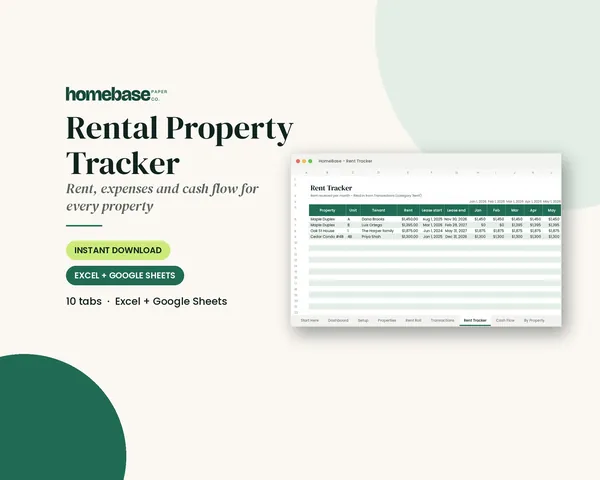
Rental Property Tracker
Log rent and expenses once - see who has paid each month, cash flow per property and category totals for tax time.
Frequently asked questions
What is cash on cash return? Cash on cash return is the annual pre-tax cash flow from a property divided by the total cash you invested, shown as a percentage. Investopedia describes it as a measure of annual return on the actual cash put in. It is popular for rentals bought with a mortgage, because it focuses on your own money rather than the full price.
How do you calculate cash on cash return? To calculate cash on cash return, divide annual pre-tax cash flow by total cash invested and multiply by 100. Annual cash flow is rent and other income minus operating expenses and mortgage payments. Total cash invested is the down payment plus closing costs, upfront repairs and other cash you put in to buy the property.
What is a good cash on cash return? Many rental investors look for a cash on cash return of about 8% to 12%, though there is no single standard. In expensive markets, investors often accept lower returns, such as 4% to 6%, in exchange for expected appreciation. Compare the number with what your cash could safely earn elsewhere.
What is the difference between cash on cash return and cap rate? The difference is financing: cap rate divides net operating income by the property's price or value and ignores the mortgage, while cash on cash return divides cash flow after mortgage payments by the cash you actually invested. Cap rate compares properties; cash on cash return compares deals as you will finance them.
What is the difference between cash on cash return and ROI? Cash on cash return measures only the yearly cash you receive against the cash you put in. ROI, or total return, can also include loan principal paid down, appreciation and tax benefits. Investopedia notes the two are often used interchangeably but are not the same when debt is used.
Does cash on cash return include appreciation? No, cash on cash return does not include appreciation, loan principal paydown or tax savings from depreciation. It counts only the cash that actually lands in your account each year. That makes it conservative, and a useful check on whether a rental pays its own way.
Is cash on cash return before or after taxes? Cash on cash return is usually calculated before income taxes. Income taxes depend on your whole situation, including depreciation, which the IRS explains in Publication 527. You can also figure an after-tax version, but say which one you are using when you compare deals.
Can cash on cash return be negative? Yes, cash on cash return is negative when the property's expenses and mortgage payments are more than its income, so you add money each year to keep it running. That can happen with high vacancy, big repairs or a rate rise on an adjustable loan. Some investors accept it short-term while they expect rents to rise.
What expenses go into cash on cash return? Include every recurring cash cost: mortgage principal and interest, property taxes, insurance, HOA fees, repairs and maintenance, property management, utilities you pay, and an allowance for vacancy and big future repairs. Leaving out vacancy and repairs is the most common reason estimates look better than reality.
Does refinancing change cash on cash return? Yes, refinancing changes cash on cash return in two ways: it changes your mortgage payment, and a cash-out refinance pulls some of your invested cash back out. Recalculate using your new payment and the cash you still have in the deal. If you pull out most of your cash, the return can look very high, so also check the cash flow in dollars.
How do I track cash on cash return over time? Track actual rent and every expense each month, then compare the yearly cash flow with your cash invested. The Rental Property Tracker ($11.99, Excel and Google Sheets) has a rent roll, income and expense log, rent received per tenant per month and cash flow by month and property for up to 10 properties.
More from HomeBase
You may also like
Printables
Budget Planner Printable
Twelve undated pages you can print every month: budget, bills, spending, savings and debt.
Spreadsheets
Bill Tracker Spreadsheet
Bills due in 3 days or less light up red, so nothing slips through.
Spreadsheets
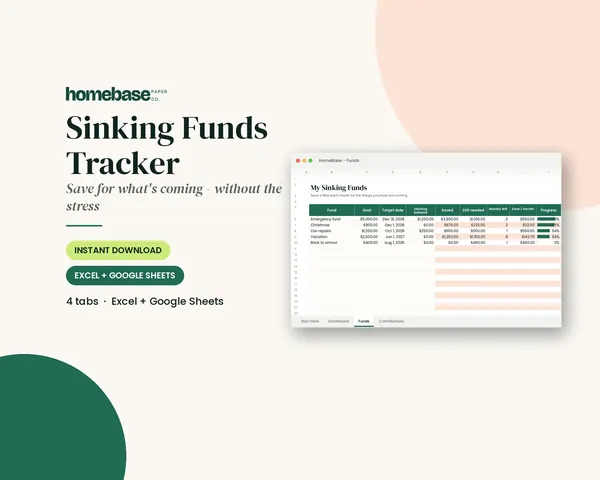
Sinking Funds Tracker
It does the math: how much to set aside each month to hit every goal on time.
Spreadsheets
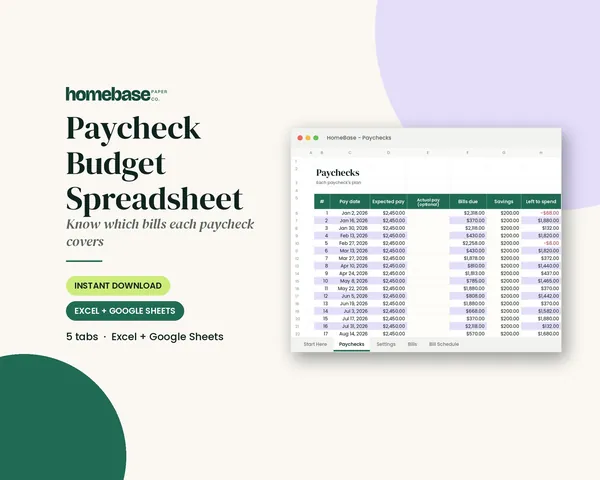
Paycheck Budget Spreadsheet
Enter your bills once. The sheet tells you which paycheck pays each one, all year.
 Club
Monthly club
Money Club
Anyone who wants a clear plan for the month's bills, holiday spending and savings.
Free printable
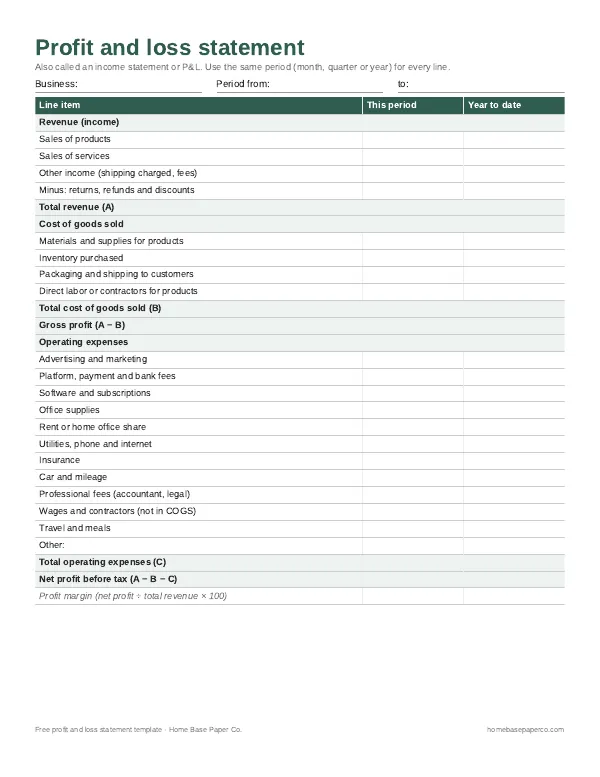
Know your real profit: get the free P&L template
A printable profit and loss statement that walks through revenue, costs and expenses line by line for any month, quarter or year. You'll also get our weekly HomeBase email with simple small business paperwork and money tips.
Sources
- Cash-on-Cash Return (Investopedia) investopedia.com
- Publication 527, Residential Rental Property (IRS) irs.gov