

The short answer: an executor of estate is the person named in a will to carry out its instructions after death: account for every asset, pay what the estate owes and transfer the rest to the right beneficiaries.
- First week: find the will, order death certificates, secure the home and pets
- First month: file with probate court and open the estate account
- Months 3 to 9: pay debts and expenses and sell property if needed
- Tax season: file the final income tax return
- Next step: Plan it with the If Something Happens to Me Binder ($11.99).
An executor of estate is the person named in a will to carry out its instructions after death. Investopedia's overview of the executor role describes the job as accounting for every asset in the will, paying what the estate owes and transferring the rest to the right beneficiaries. It is a position of trust. The executor answers to the probate court and the beneficiaries, and can be held responsible for mistakes. This page walks through the duties in order, with a timeline. This guide is general information, not legal advice. The exact duties and deadlines depend on your state, so read your state court's self-help pages or ask a licensed probate attorney.
If you're planning ahead for your own executor, our If Something Happens to Me Binder lists accounts, insurance policies, bills, digital accounts and where to find documents.

Who can be an executor of estate?
Most adults qualify. Investopedia notes an executor generally must be over 18 without prior felony convictions, and can be a relative, a friend or a professional such as a lawyer, accountant or bank. If the will names no one, or the named person cannot serve, the court appoints an administrator, usually a close relative.
You'll also hear the role called the executor of will, since the will is where the person is named.
For the basics of the document that names the executor, see what is a will.
When you are picking an executor for your own will, choose someone organized, patient, honest and likely to outlive you. Living nearby helps, since much of the work is in person. Name a backup too.
Should you accept the role?
Being named executor is an honor, not an obligation. Before you agree, think about time, distance and family dynamics. A simple estate may take a few hours a week for several months. A complex one can feel like a part-time job for a year or more.
Ask yourself whether you can stay organized, keep careful records and stay calm if relatives disagree. If you cannot take it on, you can decline before the court appoints you, and the backup named in the will steps in. You can also accept and hire professionals to do the technical parts, paid from the estate.
Executor duties checklist
- Find the original will and any later changes, called codicils.
- Order death certificates. Get several certified copies, since banks, insurers and agencies each want one.
- Secure property. Lock the home, collect keys, protect vehicles and valuables, and keep insurance in force.
- File with the probate court. Submit the will and a petition, then receive letters that prove your authority.
- Notify beneficiaries and heirs as state law requires.
- Get a tax ID for the estate and open an estate bank account. Never mix estate money with your own.
- Notify agencies and companies, including Social Security, banks, insurers, pension plans and credit bureaus.
- Inventory and value assets, with appraisals where needed.
- Notify creditors, often by mail and newspaper notice, then review claims.
- Pay valid debts, bills and expenses from the estate account.
- File tax returns, including the final personal return and any estate returns.
- Keep records of every dollar in and out.
- Prepare a final accounting and get court or beneficiary approval.
- Distribute assets and close the estate.
The California Courts probate guide breaks the court steps down in more detail. Many other states follow a similar order.
A typical executor timeline
| When | Main tasks |
|---|---|
| First week | Find the will, order death certificates, secure the home and pets. |
| First month | File with probate court, receive letters, open the estate account. |
| Months 1 to 3 | Notify creditors and agencies, list and value assets, cancel services. |
| Months 3 to 9 | Pay debts and expenses, sell property if needed, handle claims. |
| Tax season | File the final income tax return and any estate income tax return. |
| Months 9 to 18 | Final accounting, court approval, distribution and closing. |
Simple estates can move faster. Estates with real estate, a business or family disagreements usually take longer.
Tax duties
Taxes are where many executors need help. The IRS page on final income tax returns explains that the executor or administrator files the deceased person's final Form 1040 for the year of death. If a refund is due, the IRS may need Form 1310 from someone other than a surviving spouse.
| Return | When it applies |
|---|---|
| Final Form 1040 | Almost always, for the year of death. |
| Earlier unfiled returns | If the person missed past years. |
| Form 1041 (estate income tax) | If the estate earns income while it is open, above IRS thresholds. |
| Form 706 (estate tax) | Only for very large estates. |
| State returns | As your state requires. |
Keep receipts and statements for every year, and consider a tax professional for anything beyond a simple final return.
When debts are bigger than the estate
Executors are not personally responsible for the deceased person's debts, as long as they follow the rules. If the estate cannot pay everything, state law sets an order of priority. Funeral costs, administration costs and certain taxes usually come first, with ordinary unsecured debts like credit cards later. Beneficiaries may receive nothing. Family members generally do not have to pay a relative's debts from their own money unless they co-signed or the account was joint. Collectors sometimes suggest otherwise, so ask a probate attorney before paying anything from your own pocket.
Personal belongings and digital accounts
Dividing furniture, jewelry and photos often causes more tension than money. Follow any list the will refers to. For everything else, a fair method helps, such as taking turns choosing in an order set by drawing names. Photograph items and note who took what.
Digital accounts need care too. Make a list of email, social media, online banking, photo storage and subscriptions. Many platforms have a process for a legacy contact or for closing a deceased user's account. Cancel paid subscriptions early so they stop billing the estate.
Executor vs. trustee vs. administrator
| Role | Named by | Manages | Court supervision |
|---|---|---|---|
| Executor | A will | Probate assets. | Yes. |
| Administrator | The court, when there is no will or no executor | Probate assets. | Yes. |
| Trustee | A trust document | Trust assets. | Usually no. |
| Agent under power of attorney | The person, while alive | Assets they allow. | No; authority ends at death. |
Note the last row. A power of attorney ends at death, so an agent cannot act for the estate unless they are also appointed executor.
Executor fees and expenses
Executors are usually entitled to reasonable pay, set by the will or by state law. Some states set it as a percentage of the estate. Family executors who also inherit often waive it, because the fee is taxable income while the inheritance usually is not. Either way, the executor can be reimbursed from the estate for costs like court fees, appraisals, postage and travel. Keep receipts.
Mistakes executors should avoid
| Mistake | Why it is risky |
|---|---|
| Paying heirs before debts and taxes | You may have to repay creditors personally. |
| Mixing estate money with yours | It breaks your duty and muddles the records. |
| Selling assets to yourself or relatives cheaply | It can look like self-dealing. |
| Letting insurance lapse on the house | A loss could wipe out its value. |
| Missing deadlines | Courts and the IRS charge penalties. |
| Poor communication | Silence leads to suspicion and disputes. |
Send beneficiaries short updates every few months, even if nothing has changed.
When to hire help
An executor can do much of the work alone in a simple estate, and some states have streamlined procedures. Consider a probate attorney if there is a will contest, real estate in another state, a family business, debts larger than assets, or beneficiaries who disagree. A CPA or enrolled agent can handle estate tax returns. The estate usually pays these fees.
Closing the estate
Closing is the last formal step. After debts and taxes are paid and the creditor deadline has passed, the executor prepares a final accounting of everything received, spent and still on hand. Beneficiaries review it, and in many states the court approves it. The executor then distributes the remaining assets, collects signed receipts and asks the court to discharge them. Keep estate records for several years in case a tax question comes up later.
How to make your executor's job easier
Most of an executor's first month is spent finding things. You can spare yours that. The If Something Happens to Me Binder ($11.99, printable PDF) has Read me first, a letter, Personal information, Key Contacts, Dependents & pets, Bank & Financial Accounts, Insurance Policies, Bills & Subscriptions, Property & Vehicles, Digital Accounts, Where to Find Documents and My wishes. Fill it in, keep it with your will, and tell your executor where both are.
Related guides: what is probate, what is a trust and how to make a will.
Planning ahead for your own family? Use our estate planning checklist to gather the key documents.
Make it easier
Tools for this

Printables
If Something Happens to Me Binder
Accounts, insurance, bills, contacts, documents and your wishes - so your family isn't left guessing.
Frequently asked questions
What does an executor of estate do? An executor of estate carries out the instructions in a person's will after they die: they file the will with the probate court, find and protect the assets, notify creditors and pay valid debts and taxes, keep records, and then distribute what is left to the beneficiaries. They must act honestly and in the beneficiaries' interest the whole time.
Who can be an executor of an estate? Most adults can be an executor. Investopedia notes an executor generally must be over 18 without prior felony convictions, and can be a friend, family member or a professional such as a lawyer or accountant. Some states add rules for executors who live out of state, such as requiring a bond or a local agent.
Can an executor also be a beneficiary? Yes, an executor can also be a beneficiary, and it is common: Investopedia notes it is not uncommon for a will's executor to also be a named beneficiary, such as a spouse or adult child. They must still treat all beneficiaries fairly and follow the will exactly, even when it affects their own share.
How long does an executor have to settle an estate? Most estates take several months to more than a year to settle, and there is no single legal deadline that applies everywhere. Creditor claim periods set by state law, tax filings and selling property all take time. Some states expect a status report or accounting if the estate stays open past a set period, often about a year.
Do executors get paid? Yes, executors are usually entitled to a fee, set by the will or by state law, and some states use a percentage of the estate's value. Many family members who are also beneficiaries waive the fee because it is taxable income, while their inheritance generally is not. Executors can also be reimbursed for reasonable out-of-pocket costs.
Can an executor refuse the job? Yes, a person named as executor can decline before they are appointed by filing a short form with the probate court, and the court then appoints the backup named in the will or another suitable person. Once appointed, stepping down usually needs court approval, so decide early.
What is the first thing an executor should do? The first things an executor should do are find the original will, order several certified copies of the death certificate, secure the home and valuables, and make a list of assets, debts and bills. Do not pay heirs or sell property yet. Then file the will and a petition with the probate court.
Does an executor have to file taxes for the deceased? Yes, the executor generally files the deceased person's final federal and state income tax returns for the year of death. The IRS says the executor or administrator signs the return, and a surviving spouse filing jointly also signs. The estate may need its own income tax return if it earns income while open.
Can an executor sell the house? Often yes, but it depends on the will and state law. Some wills grant a power of sale, and some states require court approval or notice to beneficiaries before a sale. Until then, the executor must keep the home insured, secure and maintained, and keep paying the mortgage and taxes from estate funds.
What is the difference between an executor and a trustee? An executor manages assets that pass under a will through probate court, while a trustee manages assets held in a trust under the trust document, usually without court supervision. One person often holds both roles. An executor's job ends when the estate closes, while a trustee may serve for years.
What can an executor not do? An executor cannot ignore the will, mix estate money with their own, give themselves a bigger share, sell estate property to themselves cheaply without approval, or pay beneficiaries before valid debts and taxes. Breaking these duties can make the executor personally liable and lead the court to remove them.
How can I make my executor's job easier? Tell your executor where the original will is and keep a written list of your accounts, insurance, debts, property and key contacts. The If Something Happens to Me Binder ($11.99) has Bank & Financial Accounts, Insurance Policies, Bills & Subscriptions, Property & Vehicles, Digital Accounts and Where to Find Documents pages for that list.
More from HomeBase
You may also like
 Starter pick
Printables
Kids Chore Chart
Weekly chore chart, morning and evening routines, chore ideas by age, a sticker reward chart and an allowance tracker.

Printables
Family Recipe Binder
Section dividers, four recipe page layouts with room for the family story, 4x6 and 3x5 cards and a conversion chart - print it or type into the fillable version.

Printables
Newborn Baby Tracker
A 24-hour daily log plus feeding, diaper, sleep, growth and pediatrician-visit pages - easy to bring to checkups.

Printables
Caregiver Organizer
One place for contacts, appointments, the medication list from the doctor, and daily notes.
 Club
Monthly club
Meal Plan Club
Families who want dinner planned and a grocery list ready every week.
Free printable
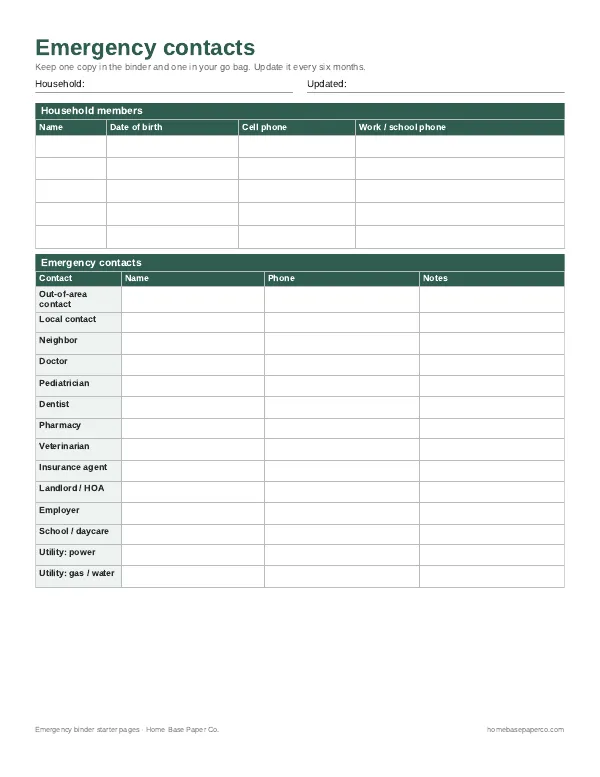
Have the important stuff in one place: get the free emergency binder pages
Printable starter pages for household members, emergency contacts, medical notes and where key documents live. You'll also get our weekly HomeBase email with simple ways to keep family records and important papers in order.
Sources
- Executor: Definition, Duties and Requirements (Investopedia) investopedia.com
- Probate (California Courts Self-Help Guide) selfhelp.courts.ca.gov
- File the Final Income Tax Returns of a Deceased Person (IRS) irs.gov