

The short answer: a will is a legal document that says how you want your property distributed after your death.
- Names an executor to carry out your instructions
- For parents: suggests a guardian for minor children
- What happens without a will
- When to update yours
- Next step: Plan it with the If Something Happens to Me Binder ($11.99).
What is a will? A will is a legal document that says how you want your property distributed after your death. It can also name the person who will carry out those instructions and, for parents, the guardian you'd choose for your minor children. It's the centerpiece of most estate plans, yet many adults put it off because it feels complicated or emotional. This guide explains what a will does in plain English, the terms you'll run into, the types of wills, what happens if you don't have one and how to keep yours current.
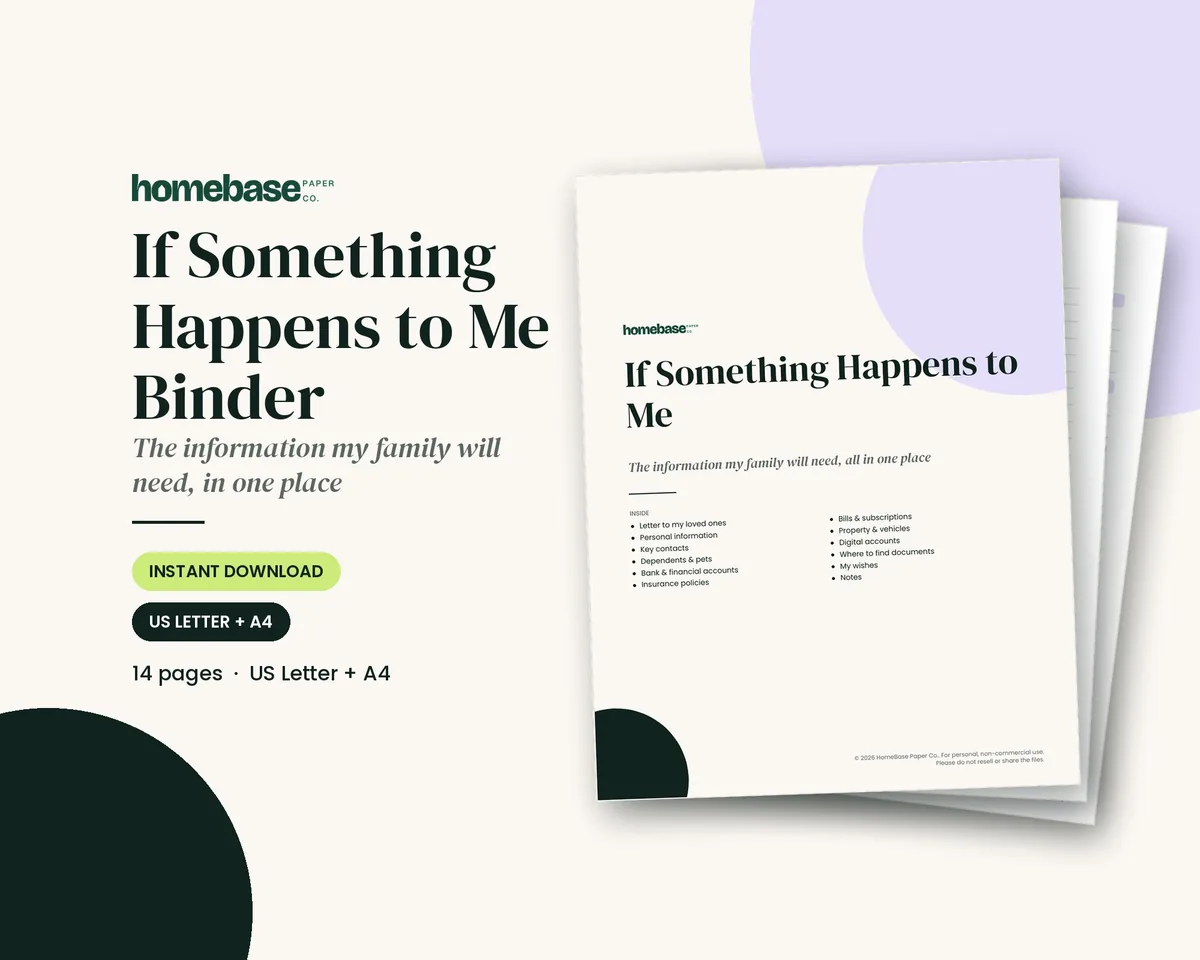
A will doesn't tell your family where your accounts and papers are. Our If Something Happens to Me Binder has pages for accounts, insurance, bills, contacts, documents and your wishes, so they aren't left guessing.
This page is general information, not legal advice. Will rules vary by state, so talk with a lawyer about your situation.
What is a will? The legal definition
NC State Extension's primer on wills describes a will as "a legal document that expresses—to the best of one's ability in written language—how they want their property distributed after their death." The words you choose are treated as the final expression of your intent, which matters most in any dispute over who gets what.
The University of Wisconsin-Madison Extension's tip sheet defines a will as a legal document that determines:
- Who you choose to inherit the assets you own
- What should happen to those assets
- Who you'd like to be legal guardian for your minor children
What a will can do
| A will can | What that means |
|---|---|
| Leave property to specific people | "My son Joseph" or a group, like "my children" |
| Separate land from other property | Real property (land) can pass differently than personal property |
| Name an executor | The person who carries out your instructions |
| Suggest a guardian for minor children | A personal and financial guardian you choose |
| Set up a testamentary trust | A way to manage children's inheritance until adulthood |
| Replace earlier wills | Generally, the last will you sign is the one that counts |
Key terms, explained
Wills come with their own vocabulary. NC State Extension defines the main terms:
| Term | Meaning |
|---|---|
| Testator | The person who makes a valid will (traditionally testatrix for a woman) |
| Intestate | Dying without a valid will |
| Legatee | Someone who inherits under a will |
| Heir | Someone who inherits without a will, under state law |
| Bequest | A gift of personal property in a will ("I bequeath my painting") |
| Devise | A gift of real property, like land ("I devise my interest in the land") |
| Executor or personal representative | The person who carries out the will's instructions |
| Codicil | An amendment to an existing will |
| Testamentary trust | A trust created by the will, often for minor children |
Wisconsin Extension adds two more you'll hear often: a beneficiary is a person you choose to receive an asset after your death, and probate is the court process that reviews your will after you die to determine what should happen to your property.
A will only speaks at death
One idea surprises many people: until you die, your will has no legal effect. NC State Extension explains that "the will speaks at death." While you're alive, it's simply a piece of paper. You can change it or replace it as many times as you like, as long as you remain competent. Nobody named in it has any legal claim until then.
That also means the most recent valid will controls. NC State notes that the last will executed is generally the one that legally expresses your final wishes, even if an older will with different instructions turns up. Wills are updated by an amendment called a codicil or by writing and signing a new one, and any will that's been replaced should be destroyed to avoid confusion.
The executor's role
Your will names an executor, also called a personal representative, to carry out your instructions and distribute property to the people you've named. NC State describes this as a fiduciary position of public trust, which in North Carolina is monitored by the county Clerk of Court. Choose someone organized and trustworthy, and tell them where your will and records are kept. Our guide to the executor of an estate covers the job in detail.
What happens without a will
If you die without a valid will, you die intestate. Your assets are then distributed under your state's intestate succession law, which divides property among relatives by class according to their relationship to you.
Wisconsin Extension puts it plainly: if you die without a will, your wishes for your property and the care of your loved ones may not be honored. NC State adds that in North Carolina, the surviving spouse's share depends on whether there are children of the marriage, and that if someone has no legal heirs at all, their assets go to the state. NC State also notes that, for survivors, even an imperfect will can be preferable to no will at all.
Types of wills
NC State Extension describes the three types recognized in North Carolina. Other states have their own rules, so check yours.
| Type | What it is |
|---|---|
| Attested will | The typical will, usually typed and prepared by a lawyer, signed in the presence of two adult witnesses |
| Holographic will | Written and signed entirely in your own handwriting |
| Nuncupative will | Spoken aloud on a deathbed in front of two competent witnesses; can pass only personal property, not land |
North Carolina also recognizes a self-proving will, where you and both witnesses sign in front of a notary public. That avoids the problem of tracking down witnesses later.
What makes a will valid?
Requirements are set by each state. Two examples from the sources:
- North Carolina: any person of sound mind, 18 or older, may make a will. An attested will needs two disinterested witnesses, meaning people who (along with their spouses) inherit nothing under it.
- Wisconsin: the will must be in writing, with your signature and the date you signed. Two people must sign as witnesses after watching you sign, and they should not be beneficiaries.
Can you write your own will?
Wisconsin Extension says it is legal to write your own will, and that all you need is a computer, a pen and paper, a printer and two witnesses. It may be a good option if your financial situation isn't complicated, you've researched how to write a will and you understand every statement in it. Even then, Wisconsin suggests having a legal expert or service review it to confirm it's enforceable, and says it may be best to work with one from the start.
NC State calls hiring a lawyer the safest approach, since a lawyer knows how courts interpret certain words and will oversee the signing so it meets your state's rules. See our step-by-step guide on how to make a will.
What a will doesn't cover
Some assets pass outside your will. Wisconsin Extension explains:
- Payable-on-death (POD) accounts, such as checking and savings accounts with a named beneficiary
- Transfer-on-death (TOD) accounts, such as brokerage accounts holding stocks, bonds and mutual funds
- Property in a living trust, which usually doesn't go through probate
- Jointly held property
Beneficiaries on these accounts can receive assets more easily and quickly than through probate, which Wisconsin says often takes as long as 12 to 18 months, includes fees and becomes public information. Wisconsin also notes you can name a beneficiary for your home by filing paperwork with your county office. A will is most useful for everything that doesn't have a beneficiary designation. Learn more in our guide to what probate is.
Money decisions while you're alive aren't covered by a will; that's the job of a durable power of attorney form. For more on this topic, see our end-of-life planning hub.
A will vs. a living will
The names are similar, but the documents are different. A will covers your property and minor children after your death. A living will covers your wishes for medical care while you're alive but unable to speak for yourself. Most estate planning checklists include both.
When to update your will
A will captures your life at one moment. NC State Extension says wills should be revisited regularly. A common guideline is every five years, but really whenever a major life event happens, such as:
- The birth or death of a child
- The death of a spouse
- Acquiring new property, such as an inheritance
- A change in plans for a farm or family business successor
- A big change in the value of certain property
Help your family find everything
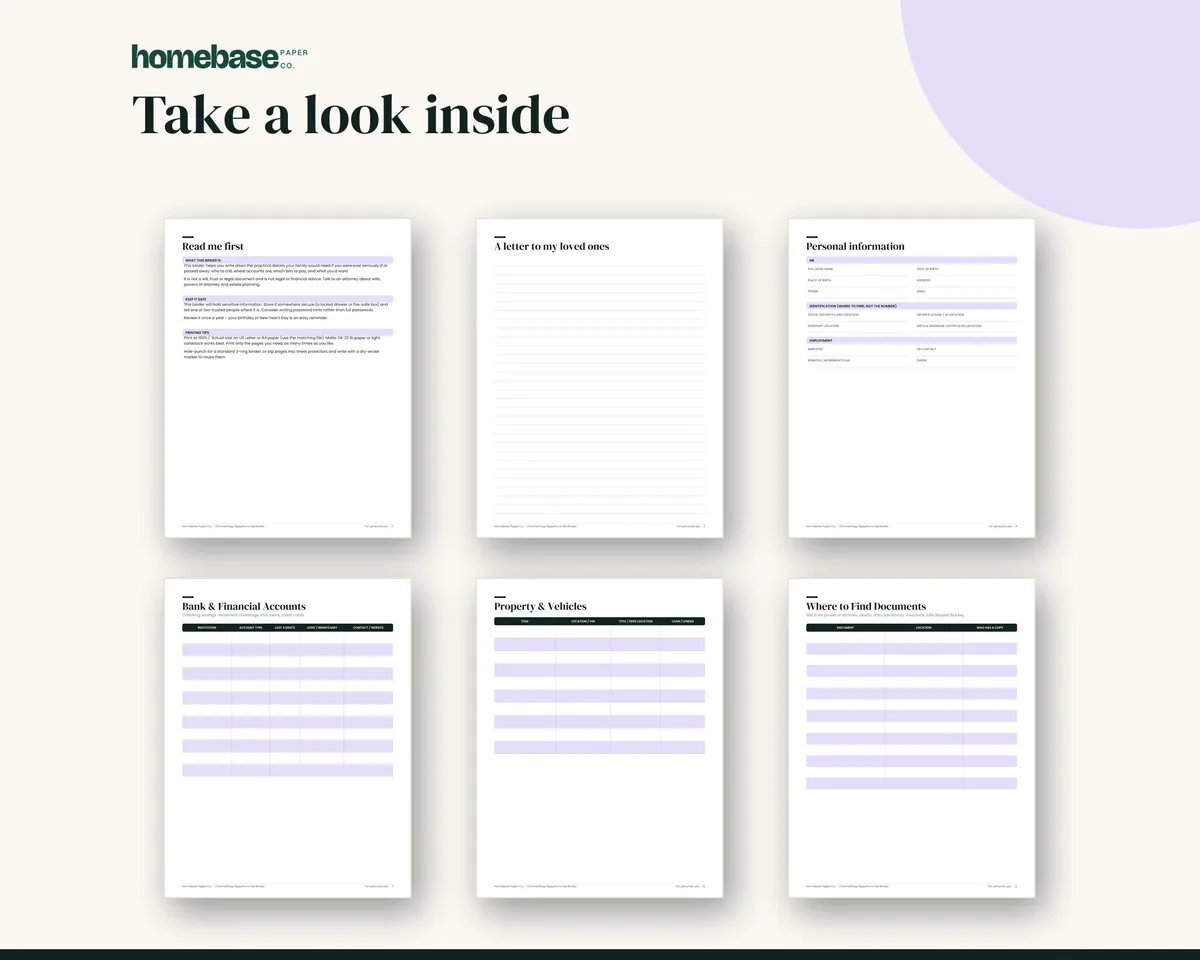
A will says what should happen. Your family still has to find your accounts, policies and passwords to make it happen. Our If Something Happens to Me Binder ($11.99) is a printable organizer with sections for Key Contacts, Bank & Financial Accounts, Insurance Policies, Bills & Subscriptions, Property & Vehicles, Digital Accounts, Where to Find Documents and My Wishes, plus a Read Me First page for whoever opens it. You can note where your will is kept and who your executor is.
To be clear: the binder is not a will or a legal document, and it doesn't replace one. It's the organized record that sits alongside your will.
For everyday household records, the Household Binder ($6.99) includes calendars, meal and grocery pages, cleaning lists, bill pages, family info and an emergency plan.
Our important document organizer guide shows how to sort and store the papers your family would need.
Your next step
This week, write down three things: who you'd want to inherit your main assets, who you'd trust as executor and, if you have young children, who you'd want as their guardian. Then check which of your accounts already have beneficiaries, and book a time with a lawyer, or read our how to make a will guide, to turn those decisions into a valid will.
Make it easier
Tools for this
Printables
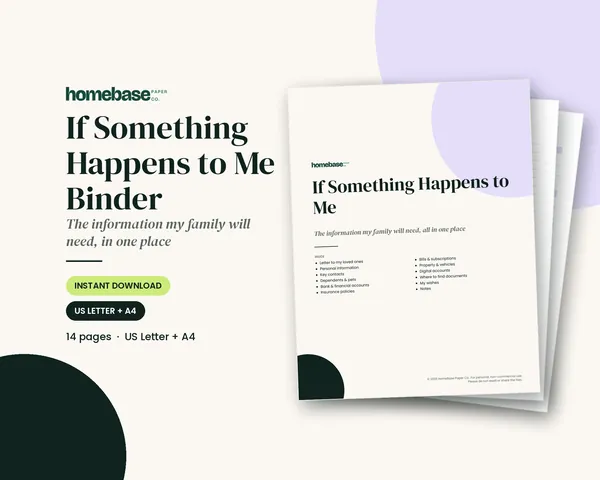
If Something Happens to Me Binder
Accounts, insurance, bills, contacts, documents and your wishes - so your family isn't left guessing.

Printables
Household Binder
Family info, emergency plan, calendars, meals, groceries, cleaning, bills and sitter notes.
Frequently asked questions
What is a will? A will is a legal document that says how you want your property distributed after your death. NC State Extension describes it as the written expression of your intent, and University of Wisconsin Extension adds that a will can also name who you want as guardian for your minor children. It takes effect only when you die.
What is the purpose of a will? The purpose of a will is to make your wishes for your property and your children legally clear after you die. It names who inherits what, who will carry out your instructions as executor, and, for parents, a chosen guardian for minor children. Without one, Wisconsin Extension notes, your wishes may not be honored.
What happens if you die without a will? If you die without a will, you die "intestate," and your assets are distributed under your state's intestate succession law, which divides property among relatives by their relationship to you. NC State Extension notes that in North Carolina, the surviving spouse's share depends on whether there are children, and assets with no legal heirs go to the state.
What is the difference between a will and a living will? A will covers what happens to your property and minor children after your death. A living will is a separate document about the medical care you want if you can't speak for yourself while you are still alive. Many people have both. See our living will guide for more on that document.
What does an executor do? An executor carries out the instructions in a will, distributing property to the people named in it. NC State Extension says the executor, also called a personal representative, holds a fiduciary position of public trust, which in North Carolina is monitored by the county Clerk of Court. You name your executor in your will.
What are the types of wills? North Carolina, as NC State Extension explains, recognizes three types: an attested will, which is typed and signed in front of two witnesses; a holographic will, written and signed entirely in your own handwriting; and a nuncupative will, spoken on a deathbed before two witnesses, which can pass only personal property. Rules vary by state.
Can you write your own will? Yes, you can write your own will in many states. University of Wisconsin Extension says it is legal to write your own will, and it may be a good option if your finances aren't complicated and you understand every statement in it. Wisconsin still recommends working with a lawyer or legal expert, or having one review a will you write, so it is legally enforceable.
What makes a will valid? Requirements depend on your state. In Wisconsin, a will must be in writing, signed and dated by you, and signed by two witnesses who watched you sign and are not beneficiaries. In North Carolina, any person of sound mind and 18 or older may make a will, and an attested will needs two disinterested witnesses.
What is probate? Probate is the court process that reviews your will after your death to decide what happens to your property. University of Wisconsin Extension says probate often takes time (as long as 12 to 18 months), includes fees and becomes public information. Some assets, like accounts with a named beneficiary, can skip probate.
Does everything go through a will? No, not everything goes through a will. Accounts with a named beneficiary, such as payable-on-death bank accounts and transfer-on-death investment accounts, pass directly to that beneficiary without probate, Wisconsin Extension explains. Property in a living trust or held jointly may also pass outside the will. A will is most helpful for what has no beneficiary designation.
How often should you update your will? Review your will about every five years and after any major life event. NC State Extension lists events such as the birth or death of a child, the death of a spouse, inheriting new property and changes in plans for a family business. You can change a will with an amendment called a codicil or by signing a new one.
Is the If Something Happens to Me Binder a will? No, the If Something Happens to Me Binder is not a will. The If Something Happens to Me Binder is an organizer, not a will or any other legal document. It helps you record key contacts, accounts, insurance, bills, property, digital accounts, where your documents are kept and your wishes, so your family and executor can find what they need. Make your will separately, ideally with a lawyer.
More from HomeBase
You may also like
 Starter pick
Printables
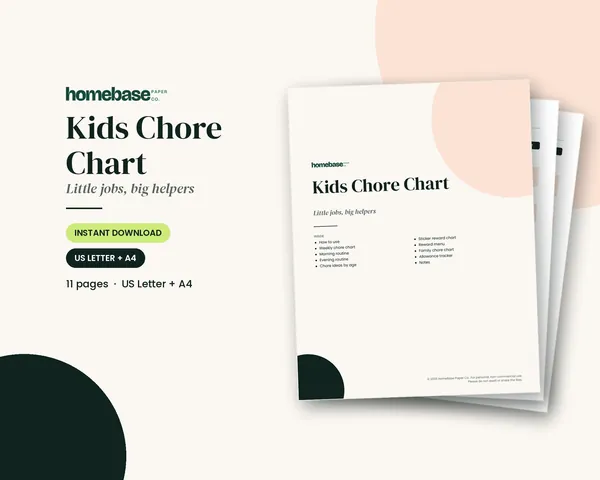
Kids Chore Chart
Weekly chore chart, morning and evening routines, chore ideas by age, a sticker reward chart and an allowance tracker.
Printables
Family Recipe Binder
Section dividers, four recipe page layouts with room for the family story, 4x6 and 3x5 cards and a conversion chart - print it or type into the fillable version.
Printables
Newborn Baby Tracker
A 24-hour daily log plus feeding, diaper, sleep, growth and pediatrician-visit pages - easy to bring to checkups.
Printables
Caregiver Organizer
One place for contacts, appointments, the medication list from the doctor, and daily notes.
 Club
Monthly club
Meal Plan Club
Families who want dinner planned and a grocery list ready every week.
Free printable
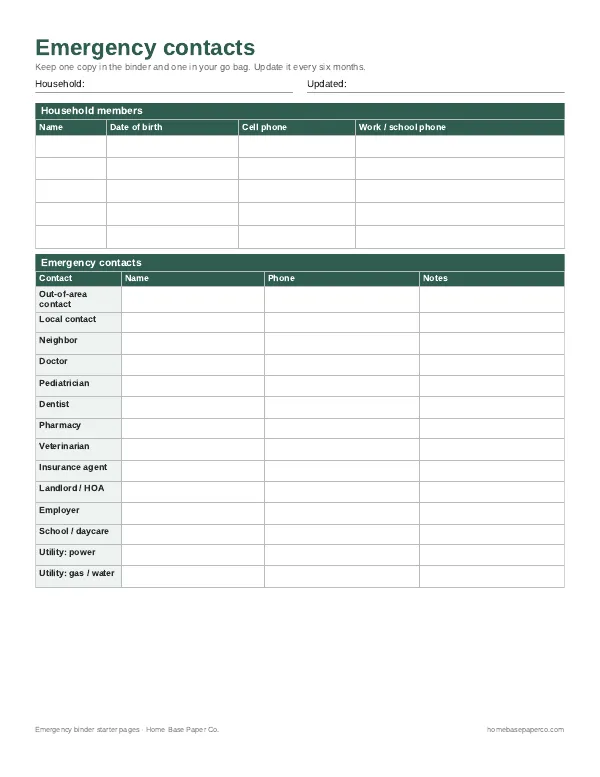
Have the important stuff in one place: get the free emergency binder pages
Printable starter pages for household members, emergency contacts, medical notes and where key documents live. You'll also get our weekly HomeBase email with simple ways to keep family records and important papers in order.
Sources
- NC State Extension: The Last Will and Testament, A Primer content.ces.ncsu.edu
- University of Wisconsin-Madison Extension: What Is a Will? Why Is It Important to Have One? finances.extension.wisc.edu