

The short answer: a power of attorney form lets someone else, your agent, act for you in money, property or health matters.
- No standard form works for all 50 states; use your state's own version
- Types: durable, general, limited, springing and medical
- Sign the way your state requires, often in front of a notary
- Who can override a power of attorney
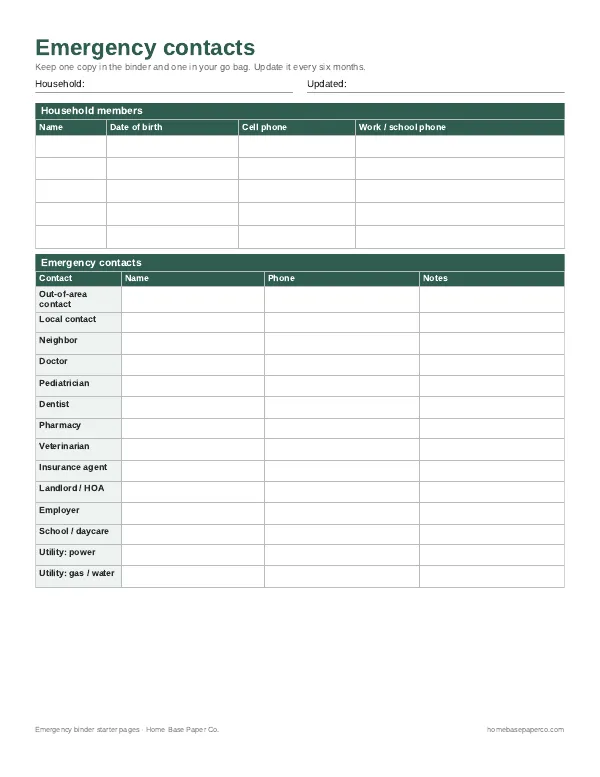
- Free printable: keep a copy where your agent can find it with our emergency binder starter pages, including a documents checklist (we email it to you)
- Next step: Plan it with the If Something Happens to Me Binder ($11.99).
A power of attorney form is the legal document you sign to let someone else, your agent, act for you in money, property or health matters. Investopedia's guide to powers of attorney explains that there is no standard form for all 50 states, so the right form is usually your state's own version, signed the way your state requires. Here is how to pick the right type, fill it out, sign it, what your agent's duties are and who can override a power of attorney if something goes wrong. This is general information, not legal advice.
Your agent can only act on what they can find. Our If Something Happens to Me Binder gathers bank and financial accounts, insurance policies, bills, key contacts and where to find documents in one binder.

Which power of attorney form do you need?
| Form | What it does | Ends when |
|---|---|---|
| Durable financial POA | Agent handles money and property, and the authority continues if you become incapacitated | You revoke it or die |
| General POA (non-durable) | Broad financial powers while you are competent | You become incapacitated, revoke it or die |
| Limited or special POA | One task or period, such as selling a house while you are abroad | The task or date passes |
| Springing POA | Takes effect only after a triggering event such as incapacity | You revoke it or die |
| Medical (health care) POA | Agent makes health decisions when you cannot | You revoke it or die |
For planning ahead in case of illness, most families pair a durable financial power of attorney with a medical power of attorney. Investopedia cautions that a springing form must be worded very carefully so it is clear when the triggering event has happened.
Where to get the form
- Your state's statutory form. Many states publish an official durable power of attorney form, often through the state bar, court system or attorney general.
- Legal aid. If cost is a barrier, the Legal Services Corporation's Get Legal Help search can point you to free help if you qualify.
- An estate planning lawyer, especially for complex situations.
- Your bank or brokerage. Some prefer their own form in addition to a general one; ask before you need it.
How to fill out a power of attorney form
- Write your full legal name and address as the principal.
- Name your agent and at least one alternate, with full names and contact details.
- Choose the powers. Many forms list powers such as banking, real estate, taxes, benefits and retirement accounts, with a box to initial for each one you grant.
- Add limits or instructions, for example "may not make gifts" or "must provide a monthly accounting to my daughter."
- Mark it durable if you want it to keep working if you become incapacitated. Investopedia notes this designation is what keeps the power in effect.
- Choose when it starts: immediately, or only on incapacity (springing).
- Sign in front of a notary and any required witnesses. Investopedia notes notarization is required in most states.
- Record it if needed. Some states require a POA used for real estate to be recorded with the county.
Financial power of attorney: what it can cover
A financial power of attorney is the version most people mean when they say "POA." The National Institute on Aging's affairs checklist lists a durable power of attorney for finances among the common legal documents to prepare, alongside a will and a living trust. Typical powers include:
| Power | Example of what the agent can do |
|---|---|
| Banking | Pay bills, deposit checks, move money between your accounts |
| Taxes | File returns and talk with the IRS for you |
| Real estate | Sell, rent or refinance property, if the form allows it |
| Insurance and benefits | Handle claims and pension paperwork |
| Retirement and investments | Manage accounts within any limits you set |
| Gifts | Only if you clearly grant it, and often with a dollar limit |
Government benefits are an exception. The CFPB has separate guides for people appointed by a government agency to manage benefits such as Social Security or VA checks, because those agencies appoint their own fiduciary and may not act on a power of attorney alone.
How to get power of attorney
For your own planning, the steps are the ones above: pick the type, use your state's form, name an agent and alternate, and sign with a notary. Estate planning resources from the American Bar Association and your state bar association explain how a POA fits with a will, trusts and health care documents if you want the bigger picture.
To get power of attorney for someone else, that person has to sign it. You cannot sign for them, and a bank will not accept a form the principal did not sign while competent.
Power of attorney for an elderly parent
Timing matters most. A parent who still understands their finances can sign a durable power of attorney naming you. A parent who has lost that ability cannot, and the family may have to ask a court to appoint a guardian or conservator, which takes longer and costs more.
- Talk while your parent is well. Bring it up alongside other planning, such as a will.
- Bring the form to their bank early. Ask whether the bank will accept it or wants its own form too.
- Ask a lawyer about fees before the appointment if you use one. NIA suggests asking about costs up front.
- Set up permissions separately. NIA notes your parent can give doctors, banks and insurers permission to talk with you, which is different from naming you as agent.
- Keep records from day one. The CFPB guides explain that agents must keep the principal's money separate and record every transaction.
NIA also suggests keeping important papers in one place, such as a fireproof and waterproof safe, and keeping copies at home if originals are in a safe deposit box.
Your agent's duties
The CFPB's Managing Someone Else's Money guides are written for people named as agents under a power of attorney. They explain four basic duties:
| Duty | What it looks like |
|---|---|
| Act only in the principal's best interest | No paying yourself or others unless the document allows it |
| Manage money and property carefully | Pay bills on time, protect assets, avoid risky moves |
| Keep the principal's money separate | Never mix it with your own accounts |
| Keep good records | Receipts, statements and notes for every transaction |
The guides also explain how to spot financial exploitation and where to report it.
Who can override a power of attorney?
- The principal, at any time while still mentally competent, by revoking it in writing and telling the agent and institutions.
- A court, which can remove an agent, require an accounting or appoint a guardian or conservator if the agent is not acting in the principal's interest. Family members or others can ask the court to step in.
- A later document. A newer power of attorney may revoke an older one if it says so.
A bank or other institution may also decline to accept a form it has concerns about, which is one reason to use your state's official form.
Choosing your agent
The agent does not need to be a lawyer. Investopedia points out the person is often a trusted family member or friend. Look for someone who:
- is organized and pays their own bills on time;
- lives close enough, or is comfortable handling things online and by phone;
- will keep records without being asked;
- gets along well enough with the rest of the family to explain decisions;
- understands that the money is yours, not an early inheritance.
Name an alternate in case your first choice cannot serve. Some people name two co-agents, but requiring both signatures can slow things down, so many forms let you choose whether co-agents may act separately.
Mistakes to avoid
- Using a form from another state that your bank or county will not accept.
- Forgetting to mark it durable, so it stops working exactly when it is needed.
- Granting gifting powers by accident. Read every initialed box.
- Never telling the agent where the original is.
- Waiting too long. Once someone has lost capacity, it is usually too late to sign, and the family may need to go to court for a guardianship.
Getting the paperwork in one place
A signed power of attorney only helps if your agent can find it and knows your accounts. The If Something Happens to Me Binder ($11.99, printable PDF) has Bank & Financial Accounts, Insurance Policies, Bills & Subscriptions, Property & Vehicles, Key Contacts and Where to Find Documents pages, so the person you name has a map of what they are managing. If you are the agent caring for a parent, the Caregiver Organizer ($6.99) keeps a Care Expense Log, insurance and documents and care team contacts together, which helps with the record-keeping duty.
See also how to make a will, the living will guide and our emergency binder checklist.
Make it easier
Tools for this

Printables
If Something Happens to Me Binder
Accounts, insurance, bills, contacts, documents and your wishes - so your family isn't left guessing.

Printables
Caregiver Organizer
One place for contacts, appointments, the medication list from the doctor, and daily notes.
Frequently asked questions
Where can I get a power of attorney form? You can get a power of attorney form from your state's official statutory form (many state bar associations, courts or attorney general offices publish one), a local legal aid office, an estate planning lawyer, or your bank, which may have its own form. Investopedia notes there is no standard form for all 50 states, so make sure it is for your state.
What types of power of attorney forms are there? The main types of power of attorney forms are durable (stays in effect if you become incapacitated), general (broad financial powers), limited or special (one task or a set period), springing (takes effect only on a triggering event such as incapacity) and medical or health care (health decisions). Many people sign a durable financial form and a separate health care form.
Does a power of attorney form need to be notarized? Yes, in most states a financial power of attorney form needs to be notarized, and some states also require witnesses. Investopedia notes that powers of attorney must be notarized in most states and that a notary seal can make the document easier for the agent to use even where it is not required. Banks and title companies often expect it.
Who can override a power of attorney? The person who signed the power of attorney (the principal) can override or revoke it at any time while they are mentally competent. After that, generally only a court can override it, for example by removing an agent who is misusing their authority or appointing a guardian. Relatives who are concerned can ask a court to review the agent's actions.
What is the difference between a durable and a general power of attorney? A durable power of attorney stays in effect if you become incapacitated, while a general (non-durable) power of attorney ends if you lose the ability to make decisions. Both end at death. For long-term planning in case of illness or dementia, most people choose a durable form, since that is exactly when help is needed.
Can I fill out a power of attorney form without a lawyer? Yes, in most states you can fill out a power of attorney form without a lawyer by using your state's official form and signing it with the required notary or witnesses. A lawyer is worth it for complex estates, a business, real estate in several states or family conflict. Legal aid offices may help for free if you qualify.
What powers can I give on a power of attorney form? A power of attorney form can give powers over banking, paying bills, filing taxes, managing investments, real estate, insurance, government benefits, retirement accounts and business matters. Many state forms list each power with a box to initial. Investopedia notes some powers generally cannot be delegated, such as making a will for you or voting.
What are an agent's duties under a power of attorney? An agent under a power of attorney must act in the principal's best interest, manage money and property carefully, keep the principal's money separate from their own and keep good records. The CFPB's Managing Someone Else's Money guides explain these duties for people named as agents. The Caregiver Organizer has an expense log that helps with record-keeping.
When does a power of attorney end? A power of attorney ends when the principal dies, and it can end before that if the principal revokes it, a court invalidates it, or the agent can no longer serve and no alternate is named. Investopedia notes a non-durable form also ends if the principal becomes incapacitated, and in some states naming a spouse ends with divorce. After death, the executor named in the will takes over.
How do I revoke a power of attorney? To revoke a power of attorney, sign a written revocation that names the original document and date, have it notarized, and send copies to your former agent and every bank or institution that had the old form. If the original was recorded with a county office, record the revocation too. Then sign a new form if you want a different agent.
Can a power of attorney make medical decisions? No, a financial power of attorney cannot make medical decisions; that takes a separate health care or medical power of attorney. Investopedia notes a durable financial agent can pay medical bills but cannot decide on treatment such as life support. Many people sign both, sometimes naming the same person for each.
Where should I keep my signed power of attorney form? Keep the signed original power of attorney form somewhere safe that your agent can reach, such as a fireproof box at home, and give your agent a copy. Do not lock it where only you have the key. The If Something Happens to Me Binder ($11.99) has a Where to Find Documents page so your family knows exactly where it is.
What is a financial power of attorney? A financial power of attorney is a legal document that lets your agent handle money and property for you, such as banking, bills, taxes, investments and real estate. A durable version keeps working if you become incapacitated. The National Institute on Aging lists a durable power of attorney for finances among the key documents to prepare.
How do I get power of attorney for an elderly parent? To get power of attorney for an elderly parent, your parent must sign their state's power of attorney form naming you as agent, usually in front of a notary, while they still understand what they are signing. You can get the form and arrange the signing. If they can no longer decide, the family may need a court guardianship or conservatorship.
Can I get power of attorney if my parent has dementia? It can still be possible in early dementia, if your parent understands what the document does when they sign it, but once they lose that capacity they can no longer sign one. A doctor's note about capacity and a lawyer's help are wise. After that point, families usually need a court to appoint a guardian or conservator.
Does a power of attorney work for Social Security benefits? No, a power of attorney on its own usually does not let an agent manage Social Security or VA benefit payments. Those agencies appoint their own fiduciary, and the CFPB has separate guides for people appointed by a government agency to manage income benefits. Contact the agency directly to apply.
How much does a power of attorney cost? A power of attorney can cost little more than a notary fee if you use your state's free statutory form, while a lawyer charges for drafting and advice, with fees that vary by area and complexity. The National Institute on Aging suggests asking a lawyer about fees before you make an appointment.
More from HomeBase
You may also like
 Starter pick
Printables
Kids Chore Chart
Weekly chore chart, morning and evening routines, chore ideas by age, a sticker reward chart and an allowance tracker.

Printables
Family Recipe Binder
Section dividers, four recipe page layouts with room for the family story, 4x6 and 3x5 cards and a conversion chart - print it or type into the fillable version.

Printables
Newborn Baby Tracker
A 24-hour daily log plus feeding, diaper, sleep, growth and pediatrician-visit pages - easy to bring to checkups.
 Save 33%
Bundles
Family Life Admin Bundle
Baby logs, chore charts, pet records, meal plans and family recipes in one tidy set.
 Club
Monthly club
Meal Plan Club
Families who want dinner planned and a grocery list ready every week.
Free printable
Have the important stuff in one place: get the free emergency binder pages
Printable starter pages for household members, emergency contacts, medical notes and where key documents live. You'll also get our weekly HomeBase email with simple ways to keep family records and important papers in order.
Sources
- Power of Attorney (POA): Meaning, Types, and How and Why to Set One Up (Investopedia) investopedia.com
- Managing someone else's money (CFPB) consumerfinance.gov
- Getting Your Affairs in Order Checklist (National Institute on Aging) nia.nih.gov