The short answer: a medical power of attorney is a legal document that names the person who will make health care decisions for you if you cannot make them yourself.
- That person may be called an agent, proxy, surrogate or representative
- Get your state's form and talk with your agent first
- Sign with the required witnesses or notary
- Review it every year and pair it with a living will
- Next step: Plan it with the Caregiver Organizer ($6.99).
A medical power of attorney is a legal document that names the person who will make health care decisions for you if you cannot make them yourself. Mayo Clinic's guide to advance directives explains that this person may be called a health care agent, proxy, surrogate or representative depending on your state. MedlinePlus adds that a health care power of attorney does not give anyone control over your legal or financial decisions. Here is how it works, how to choose your agent, how to sign the form and how to keep it ready for the day it is needed.

What is power of attorney?
Power of attorney is a legal grant of authority from you (the principal) to someone else (the agent) to act on your behalf. There are a few kinds, and people often need more than one.
| Type | What it covers | When it works |
|---|---|---|
| Medical (health care) power of attorney | Medical decisions | When you cannot decide for yourself |
| Durable financial power of attorney | Banking, bills, taxes, property | Right away or on incapacity, and it survives incapacity |
| General (non-durable) power of attorney | Broad financial matters | Ends if you become incapacitated |
| Limited power of attorney | One task, such as selling a car | For that task only |
The word "durable" means the document keeps working if you lose capacity, which is the whole point for health care. A medical power of attorney is durable by design.
How to choose your health care agent
Mayo Clinic suggests choosing someone who meets your state's requirements, is not your doctor or part of your care team, is willing to talk about end-of-life care, will follow your wishes and can speak up if there is disagreement. In practice, ask yourself:
- Will this person be reachable quickly, and live close enough to get to a hospital?
- Can they put my wishes ahead of their own feelings?
- Will they stand firm if other relatives push back?
- Do they understand my health and my values?
The agent can be a spouse, an adult child, a sibling, a friend or someone from your faith community. Name a first and second alternate in case your agent cannot serve.
How to set up a medical power of attorney
- Get your state's form. Hospitals, state health departments and aging agencies offer free forms. Many states combine the medical power of attorney and living will.
- Talk with your agent first. Ask them directly if they are willing, and explain what you would want.
- Fill in the agent and alternates with full names and phone numbers.
- Add instructions or limits. You can say what the agent may not decide, or when the authority begins.
- Sign with the required witnesses or notary. Rules differ by state, and witnesses usually cannot be your agent.
- Distribute copies to your agent, alternates and doctors, and ask that it be added to your medical record.
- Review it after marriage, divorce, a move to another state or a falling-out with your agent.
Medical power of attorney form: where to get one and what is on it
The National Institute on Aging's guide to advance directives says free state forms are available, and suggests contacting your State Attorney General's Office or your local Area Agency on Aging if you need help. Hospitals, state health departments and legal aid offices often have them too. The American Bar Association's Commission on Law and Aging and your state bar association are also good places to look for plain-language guidance. Most state forms have the same parts:
| Section of the form | What you fill in |
|---|---|
| Your details | Full legal name, date of birth and address |
| Agent and alternates | Names, relationship and phone numbers |
| Authority | What the agent may decide, often with boxes to initial |
| Limits and instructions | Treatments you do or do not want, or decisions the agent may not make |
| When it takes effect | Usually when a doctor finds you cannot decide; some forms allow right away |
| Access to records | Permission for the agent to see your medical information |
| Signatures | Your signature plus the witnesses or notary your state requires |
If you spend a lot of time in more than one state, NIA suggests preparing a form for each state and keeping a copy in each place.
How to get medical power of attorney for a parent
You cannot get medical power of attorney for someone else on your own. Your parent has to sign it while they can still understand what they are signing. What you can do is help:
- Start the conversation early, ideally while your parent is well. Ask who they would want and what matters to them.
- Get their state's form and read it together.
- Help with the signing: book the notary or arrange witnesses who meet the state's rules.
- Make copies for the doctors, the hospital record and each alternate.
- Keep it with the rest of their care paperwork so you can hand it over at admission.
NIA notes a lawyer can help but is not required. If your parent can no longer make decisions and never signed one, state law decides who speaks for them, which is typically a spouse, then parents if available, then adult children. When family members disagree or nobody qualifies, a court may need to appoint a guardian.
What your agent can and cannot do
Your agent can typically talk with your doctors, see your medical records, agree to or refuse tests and treatment, choose a hospital, nursing home or hospice, and decide about life-sustaining treatment. They must follow your known wishes, and if those are unclear, act in your best interest.
Your agent cannot use a medical power of attorney to pay your bills, sell your home or manage your bank accounts. That takes a separate durable financial power of attorney. Authority also ends at death, when the executor named in your will takes over the estate.
Common situations where it matters
A medical power of attorney is not only for end-of-life care. It is used whenever you cannot decide for yourself, even briefly:
- Surgery and anesthesia: if a complication comes up while you are under anesthesia, your agent can speak for you.
- A car accident or stroke: emergency teams act first, but the hospital will look for someone with authority for later decisions.
- Dementia: as memory declines, the agent gradually takes over medical choices you can no longer weigh.
- A college student away from home: once a child turns 18, parents no longer have automatic authority, so many families have young adults sign one before they leave.
- Unmarried couples: without a document, a partner may have no say if relatives disagree.
Medical power of attorney compared with other forms
| Document | What it does | Who signs it |
|---|---|---|
| Medical power of attorney (durable POA for health care) | Names your health care proxy, also called an agent, surrogate or representative | You |
| Living will | Writes down the treatment you would or would not want | You |
| POLST or MOLST | Turns wishes into medical orders, usually near the end of life or in serious illness | You and your doctor |
| DNR or DNI order | Tells staff not to attempt CPR or not to place a breathing tube | You and your doctor |
| Permission to share information | Lets doctors talk with a caregiver, without naming them as decision-maker | You |
NIA notes that an advance directive is legally recognized but not legally binding, which is one more reason the person you choose matters so much. Your agent is the one who speaks up for what you wrote.
For money and property, a durable financial power of attorney is a separate document. Our power of attorney form guide covers the types and how to sign one.
Review it every year
NIA recommends reviewing your advance directives at least once a year and after big changes, such as a new diagnosis, a move to another state, retirement or a divorce. Give the updated version to your proxy, your doctors and your lawyer if you have one, and ask everyone to replace the old copy. If your state has an advance directive registry and you use it, make sure the latest version is on record.
Mistakes to avoid
- Not telling your agent. Being named by surprise in a hospital hallway is hard on everyone. Talk first.
- Naming two co-agents who disagree. If you name two people to act together, decisions can stall. Most forms let you name one agent and one or more alternates instead.
- Leaving the form in a drawer. If the hospital never sees it, it cannot be used. Ask your doctor to scan it into your chart.
- Forgetting privacy permissions. Many people also sign a separate authorization letting doctors share medical information with named family members while they are still able to decide.
- Never reviewing it. Update it after a divorce, if your agent moves far away or if your relationship changes.
Pair it with a living will
A medical power of attorney names who decides. A living will says what you would decide. Together they give your agent both the authority and the instructions. MedlinePlus suggests giving copies to family, providers and your agent and keeping one with you if you go into the hospital.
Being someone's agent: keep the details in one place
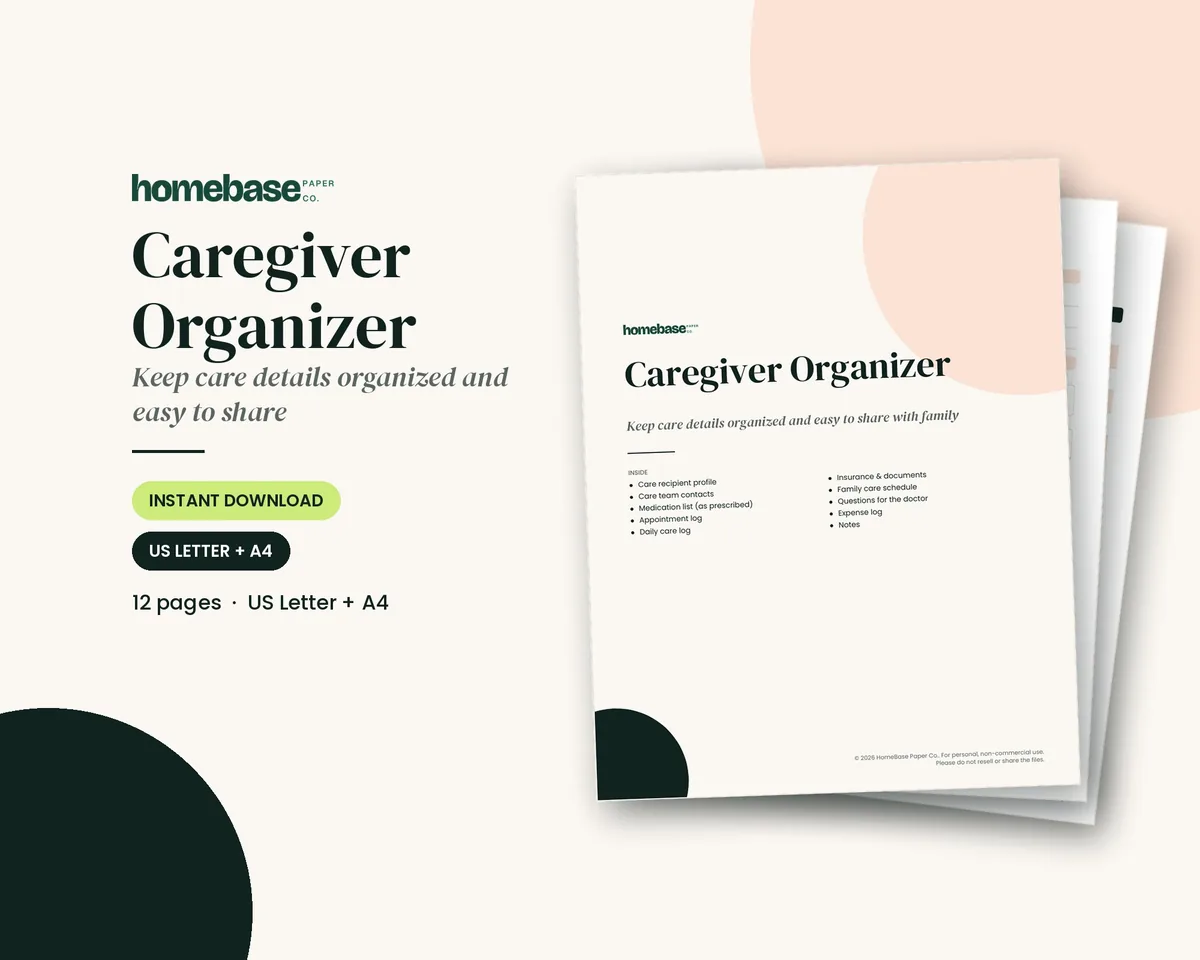
If a parent or partner has named you, the hard part is not the document. It is the phone calls, the medication changes and the forms. The Caregiver Organizer ($6.99, printable PDF) keeps a care recipient profile, Care Team Contacts, Medication List, Appointment Log, Daily Care Log, Insurance & documents, a Family Care Schedule, Questions for the Doctor and a Care Expense Log together. Slip a copy of the signed power of attorney into the same binder so it is in your hand at admission.
For your own planning, the If Something Happens to Me Binder ($11.99) records where your signed advance directives are kept, who your agent is and your medical wishes, along with bank accounts, insurance and digital accounts for the people handling your affairs. See also how to make a will, our caregiver daily log template and the medication log for tracking prescriptions.
Make it easier
Tools for this

Printables
Caregiver Organizer
One place for contacts, appointments, the medication list from the doctor, and daily notes.

Printables
If Something Happens to Me Binder
Accounts, insurance, bills, contacts, documents and your wishes - so your family isn't left guessing.
Frequently asked questions
What is a medical power of attorney? A medical power of attorney is a legal document in which you name a person, called your health care agent, to make medical decisions for you if you cannot make them yourself. Mayo Clinic notes some states call it a durable power of attorney for health care or a health care proxy. It covers health decisions only, not money.
What is power of attorney? Power of attorney is a legal document that gives another person, called your agent or attorney-in-fact, authority to act for you. A financial power of attorney covers money matters like banking and bills, and a medical power of attorney covers health care decisions. A durable power of attorney stays in effect if you become incapacitated.
Who should I choose as my medical power of attorney? Choose someone you trust who knows your values, will follow your wishes even if they disagree, and can stay calm and speak up with doctors. Mayo Clinic adds that the person should meet your state's rules and should not be your own doctor or part of your care team. Name at least one backup agent.
When does a medical power of attorney take effect? A medical power of attorney usually takes effect only after a doctor determines you cannot make or communicate your own health care decisions. Until then you make your own choices. Some state forms let you make the agent's authority effective right away, so read that section of your form carefully.
What decisions can a health care agent make? A health care agent can usually consent to or refuse treatments, tests and surgery, choose doctors and facilities, see your medical records and decide about life support, within any limits you write in. MedlinePlus notes it does not give anyone power over your legal or financial decisions. You can restrict or expand the agent's authority on the form.
Do I need a lawyer to get a medical power of attorney? No, you usually do not need a lawyer to get a medical power of attorney. Mayo Clinic notes that each state has its own forms and you may need a witness or notary, but a lawyer is not generally required. Use your state's official form and follow its signing instructions exactly.
Does a medical power of attorney need to be notarized? Sometimes: some states require a notary for a medical power of attorney, some require two witnesses and some accept either one. Check the instructions on your state's form. Witnesses usually cannot be your agent, and some states also exclude relatives, heirs or employees of your health care provider.
What is the difference between a medical power of attorney and a living will? A medical power of attorney names a person to decide for you, while a living will writes down your treatment wishes in advance. The living will guides the agent, and the agent handles situations the living will did not foresee. Many states combine both on one advance directive form, which is the easiest way to have both.
Does a medical power of attorney end at death? Yes, a medical power of attorney ends when you die. After death, your will and your executor take over decisions about your estate, and state law or your written wishes guide funeral arrangements. If you have wishes about organ donation or your funeral, write them down separately so your family can find them.
Can my spouse make medical decisions without a power of attorney? Often yes, but not always: many states have surrogate laws that let a spouse or close relative decide when there is no agent, but the order of priority varies and family members can disagree. A medical power of attorney removes that uncertainty by naming exactly who decides. Unmarried partners usually need one to be recognized.
How do I keep track of a loved one's care as their agent? Keep a care notebook with their doctors, medications, appointments, insurance and the signed power of attorney in one place. The Caregiver Organizer ($6.99) has Care Team Contacts, a Medication List, an Appointment Log, Insurance & documents and Questions for the Doctor pages, so you have what the hospital asks for when you arrive.
Where can I get a medical power of attorney form? You can get a free medical power of attorney form for your state from your State Attorney General's Office, your local Area Agency on Aging, a hospital, your state health department or a legal aid office. The National Institute on Aging points to these free state forms. Many states combine the medical power of attorney and living will on one form.
How do I get medical power of attorney for a parent? To get medical power of attorney for a parent, your parent must sign their state's form naming you as agent while they can still understand it, with the witnesses or notary the state requires. You can get the form, arrange the signing and keep copies. If your parent can no longer decide, state law or a court decides who speaks for them.
Is a medical power of attorney the same as a health care proxy? Yes, mostly: the National Institute on Aging explains that a durable power of attorney for health care is the document that names your health care proxy, who may also be called an agent, surrogate or representative. Some states use the term health care proxy for the form itself. Either way, it names who decides when you cannot.
How often should I update my medical power of attorney? Review your medical power of attorney at least once a year, as the National Institute on Aging recommends, and update it after a divorce, a move to another state, a new diagnosis or if your agent can no longer serve. Give the new version to your agent and doctors, and ask them to replace any old copies.
Is a medical power of attorney legally binding? Not in the strict sense: the National Institute on Aging explains that advance directives are legally recognized but not legally binding. Doctors generally follow them and your named agent has legal authority to speak for you, but disputes can still happen. This is general information, not legal advice, so check your state's rules.
More from HomeBase
You may also like
 Starter pick
Printables
Kids Chore Chart
Weekly chore chart, morning and evening routines, chore ideas by age, a sticker reward chart and an allowance tracker.

Printables
Family Recipe Binder
Section dividers, four recipe page layouts with room for the family story, 4x6 and 3x5 cards and a conversion chart - print it or type into the fillable version.

Printables
Newborn Baby Tracker
A 24-hour daily log plus feeding, diaper, sleep, growth and pediatrician-visit pages - easy to bring to checkups.
 Save 33%
Bundles
Family Life Admin Bundle
Baby logs, chore charts, pet records, meal plans and family recipes in one tidy set.
 Club
Monthly club
Meal Plan Club
Families who want dinner planned and a grocery list ready every week.
Free printable
Have the important stuff in one place: get the free emergency binder pages
Printable starter pages for household members, emergency contacts, medical notes and where key documents live. You'll also get our weekly HomeBase email with simple ways to keep family records and important papers in order.