

The short answer: dates are the sweet fruit of the date palm (Phoenix dactylifera), a palm first grown around the Persian Gulf thousands of years ago. Most dates in US stores are ripe and partly dried, with one long pit, a chewy texture and a caramel-like taste. One Medjool date has about 66 calories, 16 g of sugar and 1.6 g of fiber (USDA).
- Two you'll see most: big, soft Medjool (best for snacking and stuffing) and smaller, firmer Deglet Noor (best chopped into baking)
- Use them: stuffed or plain as a snack, blended into energy balls and smoothies, simmered into date syrup, or baked into bars and cookies
- Free download: get the free recipe book starter pages (we email it to you) to save your favorite date recipes
- Next step: keep holiday baking recipes in the Family Recipe Binder ($6.99)
Nutrition figures were checked against USDA FoodData Central on November 12, 2026. The sections below cover where dates come from, 9 varieties compared, fresh vs dried, how to buy and store them, nutrition and easy ways to use them.
What are dates, exactly?
Dates are the fruit of the date palm, a tree that can grow 100 feet tall. Each fruit is oblong, about 1 to 3 inches long, with thick, sweet flesh around a single hard, grooved pit, according to Julia Morton's Fruits of Warm Climates, hosted by Purdue University's NewCROP program. The fruits hang in large, heavy clusters, and a single palm can take years to bear a full crop.
The palm is believed to have originated around the Persian Gulf, with archaeological evidence of cultivation in eastern Arabia around 4,000 B.C. Dates are a traditional staple across North Africa and the Middle East, and in the US they are grown mainly in the hot, dry deserts of Southern California and Arizona, especially the Coachella Valley.
Types of dates compared
Hundreds of date varieties exist. These are the ones you're most likely to see, with descriptions from Morton's variety notes and the UC Davis postharvest fact sheet.
| Variety | Texture | Size and look | Taste and best use |
|---|---|---|---|
| Medjool | Soft | Large, plump | Rich and luscious; eating plain, stuffing, smoothies |
| Deglet Noor | Semi-dry | Medium, firm | Less sweet, firm, keeps well; chopping into baking, salads |
| Barhi (Barhee) | Soft | Nearly cylindrical, light amber to dark brown | Rich flavor; sometimes sold fresh and yellow on the branch, crunchy and mildly sweet |
| Halawy (Halawi) | Soft | Small to medium | Extremely sweet; snacking, desserts |
| Khadrawy | Soft | Dark | High-quality soft date; ripens early, doesn't keep long |
| Zahidi (Zahdi) | Semi-dry | Medium, golden brown | Very sugary, keeps for months; cooking |
| Dayri | Soft | Long, slender, nearly black | Soft and sweet; less common in the US |
| Thoory | Dry | Brown-red, very wrinkled | Sweet and nutty, firm, keeps well; travel snack |
| Sayer | Soft | Medium, dark orange-brown | Syrupy; some of the syrup is sometimes drained and sold on its own |
Shopping tip: for eating plain or stuffing, pick a soft date like Medjool. For chopping into cookies and breads, a semi-dry date like Deglet Noor holds its shape better.
Fresh vs dried dates: the four ripeness stages
Dates ripen through four stages, per Morton and the UC Davis Postharvest Research and Extension Center:
| Stage | Color and texture | Taste | Where you'll find it |
|---|---|---|---|
| Kimri | Green, hard | Bitter | Not sold for eating |
| Khalal | Full size, yellow or red, crunchy | Crisp, mildly sweet, can be astringent | Fresh yellow Barhi on the branch, seasonally |
| Rutab | Half-ripe, softening, light brown | Sweeter, juicy | Specialty markets, seasonally |
| Tamar | Ripe, brown, wrinkled, chewy | Very sweet, caramel-like | Almost every grocery store |
So, are dates dried fruit? Store dates are mostly tamar-stage fruit that has lost much of its moisture, but they aren't fully dehydrated. USDA data puts Medjool dates at about 21% water, which is why they stay soft and sticky.
What do dates taste like?
Ripe dates are very sweet, with flavors usually described as caramel, honey or brown sugar. Soft varieties like Medjool and Halawy are jammy and melt-in-your-mouth; semi-dry types like Deglet Noor are firmer, chewier and a little less sweet. Fresh khalal-stage Barhi dates are a different experience: crisp and firm, lightly sweet and sometimes a little drying on the tongue from tannins.
How to buy and store dates
What to look for:
- Plump, glossy fruit with skin that's intact (some wrinkling is normal)
- Dates that are separate, not mashed into a sticky clump
- No sour, alcohol or vinegar smell, which means fermentation
- Small white crystals are usually sugar, not mold (see below)
How to store them: keep dates in an airtight container in the fridge. UC Davis recommends 32°F for long commercial storage, about 6 to 12 months depending on variety, and 0°F for longer. Semi-dry Deglet Noor and Halawy dates keep longer than soft Medjool and Barhi. Dates absorb moisture and odors, so keep them sealed and away from garlic, onions and potatoes. For home use, check the package's best-by date and freeze any you won't eat soon.
Sugar spots vs spoilage: white specks under the skin are sugar crystallizing, which UC Davis notes changes texture and appearance, not taste. Fuzzy mold, a fermented smell or a sour taste means throw them out.
Money-saving tip: whole dates in a larger tub usually cost less per ounce than pitted or chopped ones, and pitting takes seconds. Compare unit prices with a grocery price book.
Date nutrition: Medjool vs Deglet Noor
Figures from USDA FoodData Central for Medjool dates and Deglet Noor dates (SR Legacy records 168191 and 171726). Per-date values are calculated from USDA's listed weights (24 g for one pitted Medjool, 7.1 g for one pitted Deglet Noor).
| Nutrient | 1 Medjool date (24 g) | 1 Deglet Noor date (7.1 g) | Medjool, per 100 g | Deglet Noor, per 100 g |
|---|---|---|---|---|
| Calories | 66 | 20 | 277 | 282 |
| Carbohydrates | 18.0 g | 5.3 g | 75.0 g | 75.0 g |
| Total sugars | 16.0 g | 4.5 g | 66.5 g | 63.4 g |
| Fiber | 1.6 g | 0.6 g | 6.7 g | 8.0 g |
| Protein | 0.4 g | 0.2 g | 1.8 g | 2.5 g |
| Fat | 0 g | 0 g | 0.2 g | 0.4 g |
| Potassium | 167 mg | 47 mg | 696 mg | 656 mg |
| Magnesium | 13 mg | 3 mg | 54 mg | 43 mg |
What it means: gram for gram, the two are nearly identical. A Medjool simply weighs more than three times as much, so 1 Medjool is roughly 3 Deglet Noors. Dates are a concentrated source of natural sugar with some fiber and potassium, so a typical snack is 1 to 3 dates, often paired with protein like nuts or cheese. If you track sugar or carbs for a health condition, ask your doctor or dietitian how dates fit.
10 easy ways to use dates
- Plain or stuffed: split a Medjool and fill it with peanut butter, goat cheese or an almond.
- Bacon-wrapped dates: a classic party bite; see #15 in our easy appetizers list and more in Thanksgiving appetizers.
- Energy balls: recipe below. More ideas in our healthy snacks and high-protein snacks lists.
- Smoothie sweetener: blend 1 or 2 pitted dates instead of honey; try it in our healthy smoothie recipes.
- Date syrup: recipe below; drizzle on oatmeal, pancakes or yogurt.
- Date paste: replaces part of the sugar in brownies, muffins and bars.
- Baking: chopped Deglet Noors in quick breads, oatmeal cookies, date bars and sticky toffee pudding. Browse our cookie recipes and Christmas baking list.
- Salads and grain bowls: chopped dates with feta, arugula and toasted nuts.
- Savory cooking: add a few dates to tagines, braises and barbecue sauce for sweetness that balances heat and acid.
- Cheese board: Medjools next to blue cheese, Manchego and salami.
Affiliate links: we may earn a small commission. As an Amazon Associate we earn from qualifying purchases. Details.
Measure portions with an Etekcity kitchen scale or OXO measuring cups; the nutrition table uses weight, so loosely packed cups are not equivalent to grams.
Quick recipe: 4-ingredient date energy balls
- 1 cup packed pitted Medjool dates (about 10 to 12)
- 1 cup old-fashioned oats
- ¼ cup peanut butter or sunflower seed butter
- 2 tablespoons mini chocolate chips or cocoa powder
Pulse the dates in a food processor until they form a sticky ball. Add the oats and nut or seed butter and pulse until it holds together when pinched (add a teaspoon of water if dry). Stir in the chocolate chips, roll into about 16 one-inch balls and chill 20 minutes. Keep them in a sealed container in the fridge.
Quick recipe: homemade date syrup
Simmer 1 cup pitted dates with 2 cups water for 20 minutes, until very soft. Blend until smooth, then strain through a fine sieve or cheesecloth for a pourable syrup, or skip straining for a thick spread. Cool and refrigerate in a jar. For date paste, soak 1 cup pitted dates in hot water for 10 minutes, drain (save the water) and blend with ¼ to ½ cup of the soaking water until smooth.
Quick recipe: 3 stuffed dates for a party plate
| Filling | Topping | Notes |
|---|---|---|
| Goat cheese | Honey and black pepper | Serve at room temperature |
| Peanut butter | Flaky salt and a chocolate chip | Kid-friendly; use seed butter for nut-free |
| Blue cheese | Chopped walnut | Rich, pairs with a cheese board |
For more naturally sweet treats, see our easy dessert recipes and easy snacks for kids.
Save your date recipes and plan the baking
Keep your energy ball, date syrup and holiday baking recipes in the Family Recipe Binder ($6.99), with recipe pages, cards, dividers and a conversion chart. Put date bars and cookies on the Meal Planner & Grocery List ($3.99) so dates, nuts and cheese land on one aisle-sorted list, or get it with the Christmas planner in the Holiday Season Bundle ($15.99, $25.94 bought separately). Browse all printables.
Frequently asked questions
What are dates? Dates are the sweet, single-seeded fruit of the date palm, Phoenix dactylifera, a tall palm tree first cultivated around the Persian Gulf thousands of years ago. They grow in heavy clusters and are usually sold ripe and partly dried, with a soft, chewy texture and a caramel-like sweetness.
Are dates a dried fruit? Most dates sold in US stores are ripe dates that have lost some moisture on the tree or after harvest, so they look like dried fruit, but they aren't fully dehydrated like a raisin. USDA data puts Medjool dates at about 21% water. True fresh dates, like yellow Barhi, are firm and crunchy.
What do dates taste like? Ripe dates taste very sweet, with flavors often described as caramel, honey or brown sugar, and a soft, chewy, jammy texture. Medjool dates are the richest and softest, Deglet Noor dates are drier and less sweet, and fresh yellow Barhi dates taste crisp and mildly sweet, sometimes slightly astringent.
What is the difference between Medjool and Deglet Noor dates? Medjool dates are large, soft and very rich, about 24 grams each pitted, and are best for eating plain or stuffing. Deglet Noor dates are smaller, about 7 grams each, semi-dry, firmer and less sweet, and they hold their shape when chopped for baking.
How many calories are in a date? One pitted Medjool date (24 grams) has about 66 calories, and one pitted Deglet Noor date (about 7 grams) has about 20 calories, based on USDA FoodData Central values. Medjools have more calories per date because they're more than three times as heavy.
How much sugar is in a date? One pitted Medjool date has about 16 grams of naturally occurring sugar, and one Deglet Noor date has about 4.5 grams, using USDA FoodData Central figures. That's why dates work as a sweetener in energy balls, smoothies and date syrup.
Are dates good for you? Dates provide fiber and potassium along with natural sugar: 100 grams of Medjool dates has about 6.7 grams of fiber and 696 milligrams of potassium, per USDA data. They are also calorie-dense, so a serving of 1 to 3 dates is a common snack portion.
How do you store dates? Store dates in an airtight container in the fridge, away from onions and garlic, because dates pick up strong odors and absorb moisture. UC Davis postharvest research recommends 32°F for long storage and 0°F (the freezer) for even longer. Semi-dry Deglet Noor dates keep longer than soft Medjools.
What are the white spots on dates? White spots or a gritty white coating on dates are usually sugar crystals, called sugar spotting. UC Davis postharvest experts say it changes texture and appearance but not taste. Dates that smell like alcohol or vinegar, or show fuzzy mold, have fermented or spoiled and should be thrown away.
Do dates have pits? Yes, every date has one long, narrow, very hard pit unless it's sold pitted. To remove it, slice the date lengthwise along one side and pop the pit out with your fingers. Always check pitted dates before blending, since a stray pit can damage a food processor.
How do I save my favorite date recipes? Write your energy ball, date syrup and holiday baking recipes in the Family Recipe Binder ($6.99), which has printable recipe pages, cards, dividers and a conversion chart. You can also get our free recipe book starter pages by email.
How do I plan holiday baking with dates? Put date bars, cookies and stuffed dates on the Meal Planner & Grocery List ($3.99) so the dates, nuts and cheese land on one aisle-sorted grocery list. The Holiday Season Bundle ($15.99) includes that planner plus a Christmas budget and gift planner.
Make it easier
Tools for this
Printables
Family Recipe Binder
Section dividers, four recipe page layouts with room for the family story, 4x6 and 3x5 cards and a conversion chart - print it or type into the fillable version.
 Starter pick
Printables
Meal Planner & Grocery List
Weekly meals, a grocery list sorted by aisle, and pantry and freezer inventories so you shop once and waste less.
 Save 38%
Bundles
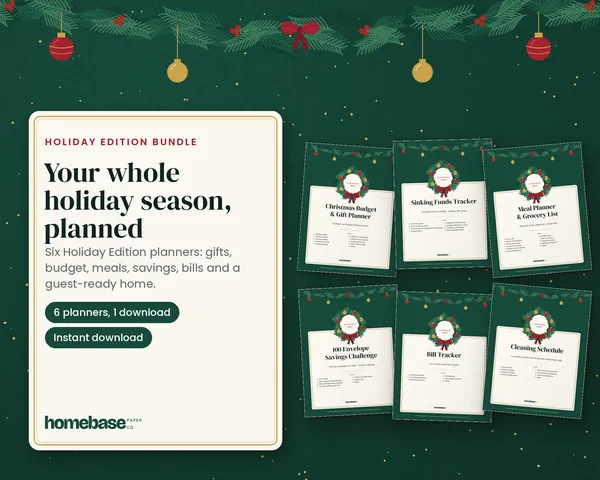
Holiday Season Bundle
Plan Christmas, save for it all year, and host without the January money hangover.
More from HomeBase
You may also like
Printables
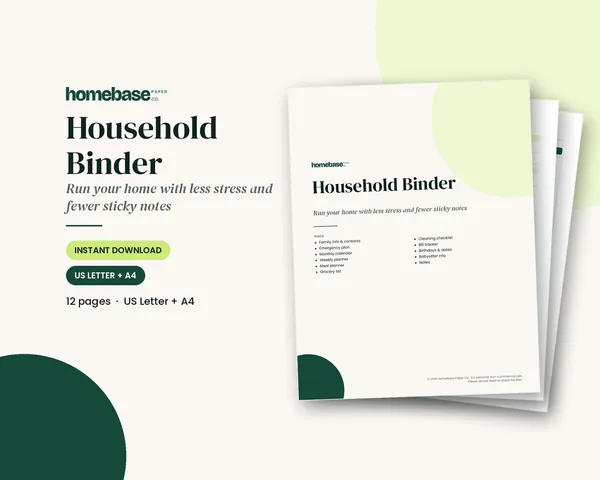
Household Binder
Family info, emergency plan, calendars, meals, groceries, cleaning, bills and sitter notes.
Printables
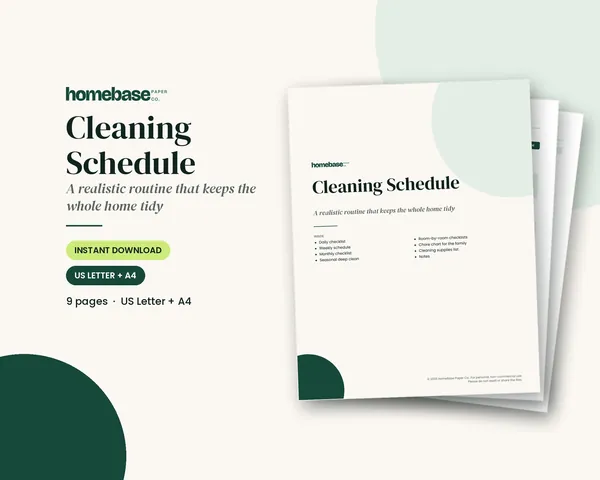
Cleaning Schedule
Daily, weekly, monthly and seasonal lists - plus a family chore chart.

Printables
Home Maintenance Log
Monthly, seasonal and annual checklists plus a record of every appliance and repair.
Printables
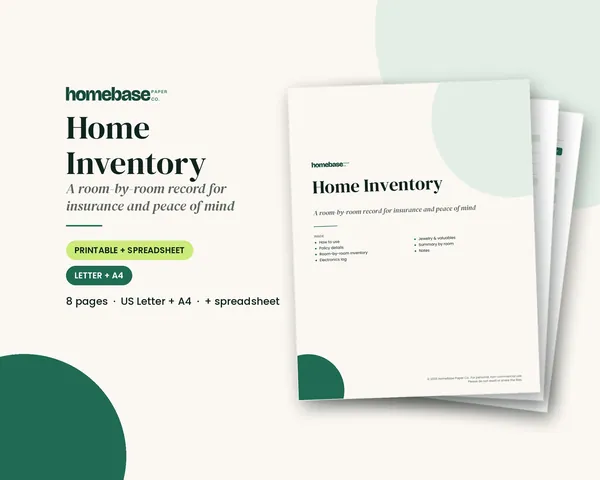
Home Inventory
Printable pages and a spreadsheet that totals the value of every room.
 Club
Monthly club
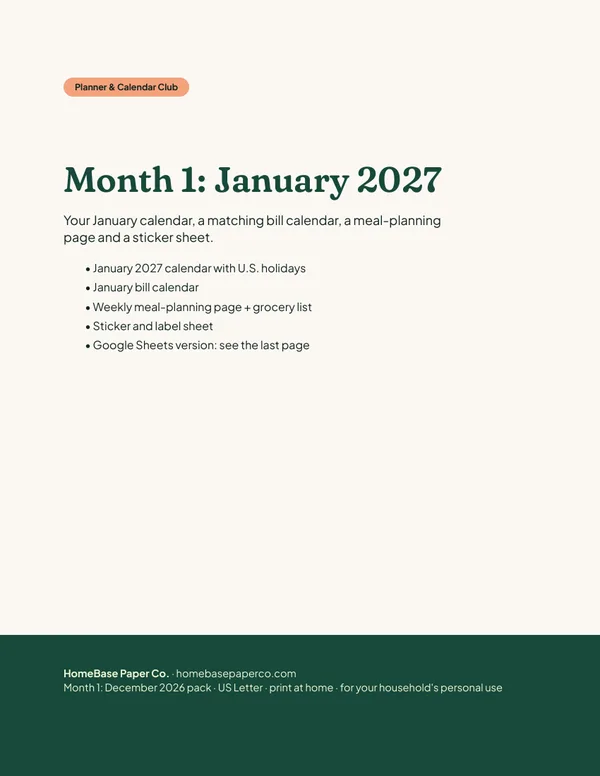
Planner & Calendar Club
Anyone who wants a monthly calendar, bill calendar and meal plan ready to print.
Free printable
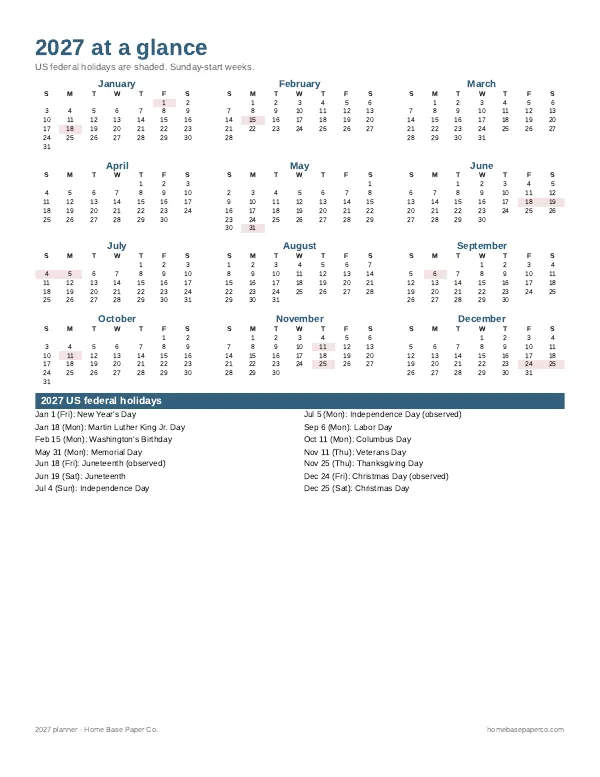
Get organized for the new year: get the free 2027 planner
A 16-page printable 2027 planner with a year-at-a-glance page and monthly calendars with US holidays marked. You'll also get our weekly HomeBase email with simple planning and home organization tips.
Sources
- USDA FoodData Central: Dates, medjool fdc.nal.usda.gov
- USDA FoodData Central: Dates, deglet noor fdc.nal.usda.gov
- UC Davis Postharvest Research and Extension Center: Date postharvest.ucdavis.edu
- Purdue University NewCROP: Date (Morton, Fruits of Warm Climates) hort.purdue.edu