The short answer: how to clean a humidifier matters because whatever grows in the tank can end up in the mist you breathe.
- Every day: empty, wipe dry and refill the tank
- Every third day: scrub portable units
- Disinfect with 3% hydrogen peroxide or the cleaner your manual names
- Use distilled water to slow new scale
- Next step: Plan it with the Home Maintenance Log ($5.99).
Knowing how to clean a humidifier properly matters more than with most appliances, because whatever grows in the tank can end up in the mist you breathe. The EPA's routine is simple: empty, wipe dry and refill the tank every day, and give portable units a full scrub every third day. This guide walks through each step, which cleaners to use, how to handle filters and white dust, and how to store it for the summer.

How to clean a humidifier: the quick version
- Unplug it before you touch the water.
- Empty the tank and base.
- Scrub scale, deposits and film off every surface with a brush.
- Disinfect with the cleaner your manual names, or 3% hydrogen peroxide if it names none.
- Rinse the tank with several changes of tap water.
- Dry every part, then refill with distilled water.
Why humidifiers need frequent cleaning
A humidifier tank is standing water, usually in a warm room. The EPA says microorganisms often grow in humidifiers with tanks of standing water, and several studies have shown that ultrasonic and impeller (cool mist) humidifiers can disperse microorganisms and minerals from the tank into indoor air. The EPA notes that the young, the elderly and people with lung disease or respiratory allergies may be especially susceptible.
Scale is part of the problem too. The EPA says minerals in tap water speed the buildup of crusty deposits, and scale can be a breeding ground for microorganisms.
What you need
| Item | Use |
|---|---|
| Soft brush or old toothbrush | Scrubbing scale and film |
| 3% hydrogen peroxide (or the cleaner your manual names) | Disinfecting surfaces that touch water |
| White vinegar (optional, if your manual allows) | Softening heavy scale |
| Clean cloths | Wiping and drying |
| Distilled water | Refilling to slow new scale |
Daily: empty, wipe and refill
The EPA's first tip: empty the tank, wipe all surfaces dry and refill with fresh water daily in portable humidifiers, to reduce growth of microorganisms. Unplug the unit first. This takes 2 minutes and does more than any deep clean to keep the tank from going slimy.
Every third day: scrub and disinfect
1. Unplug and empty. Pour out all the water from the tank and base.
2. Scrub. Use a brush or other scrubber to remove any scale, deposits or film on the sides of the tank and interior surfaces. That is the EPA's wording. Get into corners, the fill opening and the base reservoir.
3. Soften heavy scale (optional). If scale is thick, many manuals suggest soaking the base and tank in white vinegar for 20 to 30 minutes before scrubbing. Check your manual first.
4. Disinfect. Follow the manufacturer's cleaning product instructions. If your manual gives none, the EPA suggests cleaning all surfaces that contact water with a 3% solution of hydrogen peroxide, the strength sold in most drugstores.
5. Rinse thoroughly. The EPA says to rinse the tank with several changes of tap water after any cleaning or disinfecting agent, so chemicals are not released into the air when you run it.
6. Dry. Wipe all surfaces dry, let parts air out, then reassemble and refill.
Safety: never mix cleaners, especially bleach and vinegar, which together release harmful fumes. Use one product, rinse it out completely, then use the next.
Cleaning by humidifier type
| Type | How it works | Cleaning notes |
|---|---|---|
| Ultrasonic (cool mist) | Vibrations create mist | Most likely to spread minerals and microbes; use distilled water, clean every third day |
| Impeller (cool mist) | A spinning disk creates mist | Same as ultrasonic |
| Evaporative | A fan blows air through a wet wick or filter | Disperses little, but the tank can grow microbes; replace wicks as directed |
| Steam vaporizer / warm mist | Heats water into steam | Disperses few minerals, but scale builds on the heater; keep away from children (burn risk) |
| Console and central | Floor cabinets or furnace-mounted | Follow the maker's cleaning directions; do not let water stand in the tank |
The EPA says ultrasonic and impeller types generally produce the greatest dispersion of both microorganisms and minerals, which is why they need the strictest routine.
Filters, wicks and cartridges
Evaporative humidifiers use a wick or filter, and many ultrasonic models use a demineralization cartridge. The EPA advises following the manufacturer's instructions for use, maintenance and replacement of any materials supplied with the humidifier. In practice:
- Replace wicks when they turn hard, crusty, discolored or start to smell.
- Do not scrub or soak a wick in cleaner unless the manual says you can.
- Watch for white dust when using a demineralization cartridge. The EPA says it indicates minerals are not being removed.
Water: why distilled is worth it
The EPA recommends water with low mineral content, such as bottled water labeled "distilled," to slow scale and reduce minerals in the air. It notes that "spring," "artesian" and "mineral" bottled waters have not been treated to remove minerals. In areas with very hard tap water, the EPA adds, distilled water may cost less over time than cartridges or filters.
Keep humidity in the right range
A clean humidifier can still cause problems if it runs too high. The EPA says not to humidify above 50 percent indoor relative humidity, because higher levels may encourage the growth of biological organisms. Its guide to mold and moisture says to keep indoor humidity below 60 percent, ideally between 30 and 50 percent. A hygrometer, which the EPA guide says costs about $10 to $50, from a hardware store shows your actual level.
Signs it is set too high:
- Water condensing on windows, walls or pictures. The EPA says to move the humidifier, lower the setting or run it less.
- Damp carpet, drapes or tablecloths near the unit.
- A musty smell in the room.
End of season: clean, dry, store
When the dry season ends, the EPA says to clean the humidifier as directed, make sure every part is dry, dispose of used cartridges, cassettes or filters, and store the unit in a dry location. When you bring it back out, clean it again and dust the outside before the first use.
How often to clean a humidifier
| Task | How often |
|---|---|
| Empty, wipe dry, refill | Every day |
| Scrub and disinfect (portable) | Every third day |
| Replace wick or cartridge | Per the manual, or when crusty or smelly |
| Check humidity | Weekly, with a hygrometer |
| Deep clean and dry for storage | End of season |
| Clean again | Before first use after storage |
Common humidifier cleaning mistakes
Topping off instead of emptying. Adding fresh water to old water keeps the growth going. Empty it completely each day, wipe it dry, then refill.
Skipping the rinse. Disinfectant left in the tank can be released into the air when the unit runs. The EPA's instruction is several changes of tap water, not one quick swish.
Using tap water in hard-water areas. It speeds up scale and white dust, especially in ultrasonic models. Distilled water costs a little more and saves cleaning time.
Storing it damp. A tank put away wet in spring is a science project by fall. Dry every part before it goes in the closet.
Ignoring the base. The reservoir in the base often holds water even after you empty the tank. Pour it out and scrub it too.
When to stop using it
The EPA advises stopping use and contacting your doctor if you have respiratory symptoms you believe are linked to your humidifier, even if you follow the maintenance directions.
Keep a simple record
A humidifier on a three-day cleaning cycle is easy to lose track of, especially with more than one in the house. Writing it down helps.
The same mold-prevention logic applies to your washer. See our guide on how to clean a washing machine.
Our Home Maintenance Log ($5.99 printable) has monthly, seasonal and annual checklists, an Appliance Log for each unit's model, purchase date and warranty, and Service & Repair Records where you can note filter changes. Our Cleaning Schedule ($4.49) has daily and weekly checklists, so "empty humidifier" and "scrub humidifier" each get a box.
Want both and more? The Home Management Bundle ($16.99) includes the Cleaning Schedule along with the Household Binder, Home Maintenance Log, Home Inventory, Moving Planner and Password & Accounts Log. Bought separately, those six come to $32.94.
Your next step
Look inside your humidifier tank today. If you see film, pink slime or crusty scale, unplug it, scrub it, disinfect it with 3% hydrogen peroxide (or your manual's cleaner), rinse it several times and dry it. Then refill with distilled water and set a reminder for every third day.
Make it easier
Tools for this
Printables
Home Maintenance Log
Monthly, seasonal and annual checklists plus a record of every appliance and repair.
Printables
Cleaning Schedule
Daily, weekly, monthly and seasonal lists - plus a family chore chart.
 Save 48%
Bundles
Home Management Bundle
Household binder, maintenance log, moving planner, cleaning schedule, home inventory and password log.
Frequently asked questions
What is the best way to clean a humidifier? The best way to clean a humidifier is to unplug it, empty the tank, scrub off scale and film with a brush, then disinfect surfaces that touch water with 3% hydrogen peroxide unless your manual names another cleaner. Rinse the tank with several changes of tap water and dry every part. The EPA says to do this every third day for portable units.
How often should you clean a humidifier? Clean a portable humidifier every third day, the interval the EPA recommends. Every day, empty the tank, wipe surfaces dry and refill with fresh water. Clean it again at the end of the season before storage, and after storage before you use it.
How do you clean a humidifier with vinegar? To clean a humidifier with vinegar, fill the tank and base with undiluted white vinegar or equal parts vinegar and water, let it sit 20 to 30 minutes to soften scale, then scrub with a soft brush. Rinse thoroughly and dry. Check your manual first, and never mix vinegar with bleach.
Can you clean a humidifier with hydrogen peroxide? Yes, you can clean a humidifier with hydrogen peroxide. When a manufacturer gives no cleaning instructions, the EPA suggests cleaning all surfaces that contact water with a 3% hydrogen peroxide solution. Afterward, rinse the tank with several changes of tap water so no chemical is released into the air.
Can you use bleach to clean a humidifier? Only if your manual allows it. The EPA says to follow the manufacturer's suggestions on cleaning products or disinfectants. If you use bleach, dilute it as directed, never mix it with vinegar, and rinse the tank with several changes of water so no fumes go into the air.
What is the pink or black slime in my humidifier? Pink or black slime in a humidifier is usually bacteria or mold growing in standing water. Unplug it, empty it, scrub every surface with a brush, disinfect as your manual directs or with 3% hydrogen peroxide, rinse well and dry it fully. Then switch to daily emptying.
Should you use distilled water in a humidifier? Yes, use distilled or other low-mineral water, especially in ultrasonic and impeller (cool mist) models. The EPA says these types disperse minerals from tap water into the air as white dust, and scale can become a breeding ground for microorganisms.
What causes white dust from a humidifier? White dust from a humidifier comes from minerals in tap water, which ultrasonic and impeller humidifiers spray into the air. The EPA suggests using distilled water to reduce it. If you use demineralization cartridges, white dust is a sign they are not removing minerals.
How do you clean a humidifier filter? Most humidifier wick filters cannot be scrubbed; rinse them gently in cool water only if the manual allows, and replace them on the maker's schedule or when they turn hard, discolored or smelly. The EPA says to follow the manufacturer's instructions on maintenance and replacement of supplied materials.
What humidity should a humidifier be set to? Keep indoor humidity at 50% or below. The EPA warns that higher levels may encourage the growth of biological organisms, and its mold guide says ideally 30% to 50%. A hygrometer from a hardware store shows your actual level.
How do you store a humidifier at the end of the season? Before storing a humidifier, clean it as directed, make sure every part is completely dry, throw out used filters or cartridges and store it in a dry place. The EPA says to clean it again and dust the outside after storage, before the next use.
How do I keep track of humidifier filters and cleaning? Write down the filter type, the date you changed it and each deep clean. The Home Maintenance Log ($5.99) has an Appliance Log and Service & Repair Records, and the Cleaning Schedule ($4.49) puts the every-third-day clean on your checklist.
More from HomeBase
You may also like

Printables
Household Binder
Family info, emergency plan, calendars, meals, groceries, cleaning, bills and sitter notes.

Printables
Home Inventory
Printable pages and a spreadsheet that totals the value of every room.

Printables
Vehicle Maintenance Log
Oil changes, repairs, tires, fuel and MPG, trip mileage and renewal dates - so resale and warranty records are easy.

 Club
Monthly club
Planner & Calendar Club
Anyone who wants a monthly calendar, bill calendar and meal plan ready to print.
Free printable
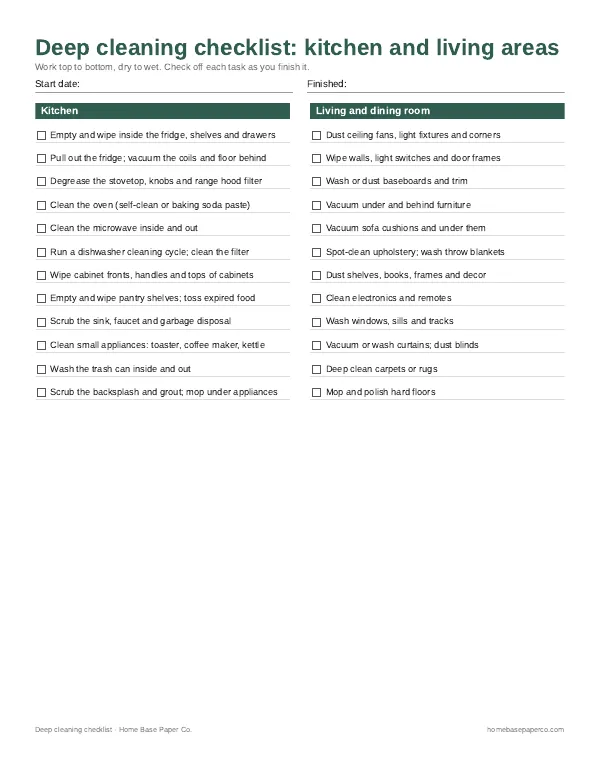
Clean the whole house in order: get the free deep cleaning checklist
A printable room-by-room deep cleaning checklist that tells you what to do first, so nothing gets cleaned twice. You'll also get our weekly HomeBase email with simple cleaning routines and chore ideas the whole family can help with.