The short answer: The traditional wedding processional order is: grandparents, the groom's parents, the bride's mother, then the officiant, groom and best man take their places. Next come the groomsmen and bridesmaids, the maid of honor, the ring bearer and flower girl, and last, the bride with her escort.
Our picks for wedding processional order

Printables
Wedding Planner Checklist
A 12-month checklist plus budget, vendors, guest list, seating, day-of timeline and packing lists.
 Save 31%
Bundles
Wedding Planning Bundle
The Wedding Budget Spreadsheet and the 13-page Wedding Planner Checklist together - for less than buying them separately.

Spreadsheets
Wedding Budget Spreadsheet
Enter each payment once - the sheet shows what you've paid, what you still owe, and what's left of your budget.
Below are step-by-step charts for traditional, Jewish, same-sex and small weddings, plus who sits where and the recessional order.
Keep the order, songs and cues on one page with the Wedding Planner Checklist ($5.99), or get it with the budget spreadsheet in the Wedding Planning Bundle ($8.99, regularly $12.98).

Traditional wedding processional order
| Order | Who walks | Notes |
|---|---|---|
| 1 | Grandparents | Groom's grandparents first, then the bride's. An usher or grandchild can escort them. |
| 2 | Groom's parents | Seated in the first row on the right. |
| 3 | Mother of the bride | The last person seated. Her entrance tells guests the ceremony is starting. |
| 4 | Officiant, groom and best man | Usually enter from the side and wait at the front. |
| 5 | Groomsmen | Walk in alone or in pairs, or enter from the side with the groom. |
| 6 | Bridesmaids | One at a time, or paired with groomsmen. |
| 7 | Maid or matron of honor | Walks alone, right before the children. |
| 8 | Ring bearer | Can walk with the flower girl if they're young. |
| 9 | Flower girl | Scatters petals just ahead of the bride. |
| 10 | Bride and her escort | Guests stand as the bridal music begins. |
Walking down the aisle order: spacing, pace and music cues
Knowing the order walking down the aisle is half the job; the other half is timing, so the walk doesn't bunch up or drag. These cues are what most coordinators use at rehearsal.
| Moment | Cue | Tip |
|---|---|---|
| Seating grandparents and parents (1 to 3) | Prelude music is playing | The mother of the bride sits last; the processional song starts once she is seated |
| Officiant, groom and best man (4) | Processional song begins | They enter from the side so the aisle stays clear |
| Wedding party (5 to 7) | Each walker starts when the person ahead is about halfway down the aisle | A slow, normal step works better than the old "step-together" walk |
| Ring bearer and flower girl (8 and 9) | Same song, or a short change in music | Seat a parent near the front so young children walk toward someone they know |
| Bride and escort (10) | A separate song or a clear pause, then guests stand | The officiant or coordinator signals guests to rise |
Do the math before you pick the song: if each walker starts about 15 seconds after the one ahead, a wedding party of 8 to 10 takes about 2 to 2 1/2 minutes, so choose a song at least that long or plan a fade-out. With only a few walkers, one verse and a chorus may be enough. Practice the walk once at the rehearsal with the actual music, and give each walker a one-line cue card ("start when Jordan reaches the third row").
Who sits where at the ceremony
The Emily Post Institute's guide to ceremony seating says the bride's parents sit in the first row on the left and the groom's parents sit in the first row on the right, facing the ceremony. Immediate family fills the next few rows on each side.
- Same-sex couples can assign each family a side, such as "Jordan's side" and "Sam's side."
- No sides is fine too, especially when one family is much larger. Still reserve the front rows for close family.
- Divorced parents can share the front row if everyone gets along. If not, one parent sits in front with their family behind them, and the other parent sits in the row after that family, often the third or fourth row.
Who walks the bride down the aisle
Tradition says the father of the bride, but there's no wrong answer. The Emily Post aisle-walk FAQs say a bride can walk with her mother, walk alone, or have her father walk her halfway and her stepfather take her the rest of the way. Choose whoever feels right, and tell them early so no one is surprised.
Jewish wedding processional order
In many Jewish ceremonies, both partners walk with their parents, and the wedding party stands under or near the chuppah.
- Rabbi and cantor
- Bride's grandparents, then groom's grandparents
- Groomsmen
- Best man
- Groom with both parents
- Bridesmaids
- Maid of honor
- Ring bearer and flower girl
- Bride with both parents
Customs vary by family and community, so confirm the order with your rabbi.
Same-sex and modern processional ideas
There's no single rule, so build an order that fits your families. Popular options:
- Two aisles or two entrances. Each partner walks in from a different side and meets in the middle.
- Walk in together. You enter side by side after your attendants.
- Each partner gets a moment. One partner walks with their parents, then the wedding party, then the other partner walks last.
- Mixed wedding party. Attendants walk in the order you choose, regardless of whose side they stand on.
Small wedding processional order
For a courthouse, backyard or micro wedding, keep it simple:
- Officiant takes their place.
- Parents and grandparents are seated.
- One partner walks in, or both partners enter together.
- Honor attendant, if you have one.
- The second partner, alone or with an escort.
Wedding recessional order
The recessional is the processional in reverse, and it's usually faster and more upbeat.
| Order | Who walks out |
|---|---|
| 1 | The newly married couple |
| 2 | Flower girl and ring bearer |
| 3 | Maid of honor and best man |
| 4 | Bridesmaids and groomsmen, in pairs |
| 5 | Bride's parents |
| 6 | Groom's parents |
| 7 | Grandparents |
| 8 | Officiant |
Processional planning tips
- Practice at the rehearsal. Walk the full order once with music, and mark a spacing cue for each person, like a count of eight.
- Choose two songs. One for the wedding party and one for the final entrance. Most processionals last 3 to 5 minutes.
- Give the honor attendants their jobs. The Emily Post guide to the wedding party notes that the maid of honor holds the bride's bouquet and the groom's ring during the ceremony, and the best man keeps the bride's ring.
- Print the order. Give a copy to the coordinator, the officiant and every attendant.
I've been the person who keeps everything coordinated since I was a kid, and a written order is the easiest way to keep a big day calm.
Plan the ceremony and the rest of the wedding
- Wedding Planner Checklist ($5.99): a 12-month checklist plus budget, vendors, guest list, seating, day-of timeline and packing lists.
- Wedding Planning Bundle ($8.99, regularly $12.98): the 13-page checklist and the spreadsheet together, for less than buying them separately.
- Wedding Budget Spreadsheet ($6.99): enter each payment once and see what you've paid, what you still owe and what's left.
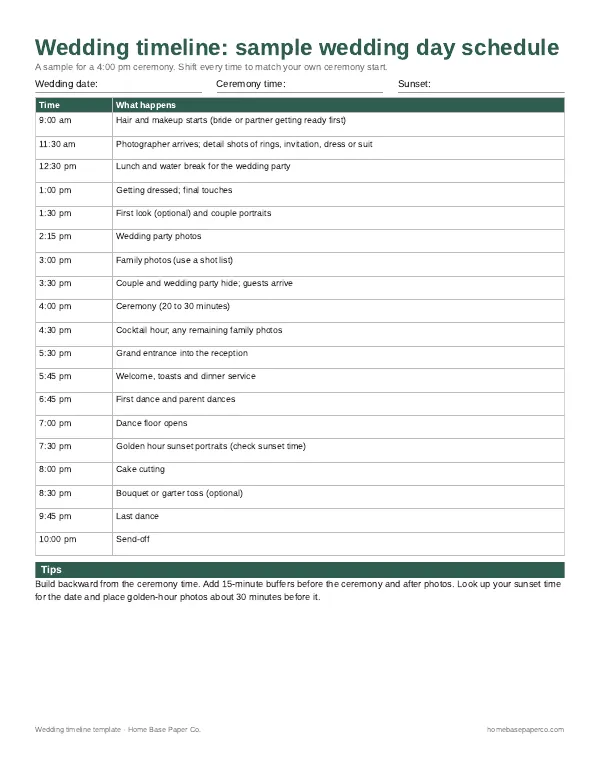
Shop the full Wedding collection or all Bundles. Related reading: wedding vows, the wedding timeline and how to plan a wedding.
Plan the day and keep the budget in one place
A 12-month checklist plus budget, vendors, guest list, seating, day-of timeline and packing lists.
$5.99 · Instant download. Print at home or fill it in on screen. Or browse the full Wedding collection.
Frequently asked questions
What is the traditional wedding processional order? The traditional wedding processional order is grandparents, the groom's parents, the bride's mother, the officiant, groom and best man, then the groomsmen and bridesmaids, the maid of honor, the ring bearer and flower girl, and finally the bride with her escort.
Who walks down the aisle first at a wedding? The grandparents usually walk down the aisle first. They are seated before the parents, and the processional music for the wedding party starts after the mother of the bride is seated.
Who is the last person seated before the bride walks? The mother of the bride is traditionally the last person seated. Her entrance signals that the ceremony is about to begin, so no other guests are seated after her.
Where do the bride's and groom's parents sit? The bride's parents sit in the first row on the left and the groom's parents in the first row on the right, facing the ceremony. Emily Post notes that same-sex couples can simply assign each family a side.
Does the groom walk down the aisle? In a traditional Christian ceremony, the groom doesn't walk down the aisle. He enters from the side with the officiant and best man. In a Jewish ceremony, the groom walks down the aisle with both of his parents.
Do bridesmaids and groomsmen walk together? They can walk in pairs or separately. Pairing them shortens the processional, while having groomsmen wait at the front puts more attention on each bridesmaid's entrance.
When does the flower girl walk? The flower girl walks right before the bride, usually just after the ring bearer. If they're very young, they can walk together or with an older sibling.
Who walks the bride down the aisle? Traditionally the father of the bride walks her down the aisle, but any choice is fine. Emily Post says a bride can walk with her mother, walk alone, or have her father walk her halfway and her stepfather walk her the rest of the way.
What is the Jewish wedding processional order? A common Jewish processional order is the rabbi and cantor, grandparents, groomsmen, the best man, the groom with both parents, bridesmaids, the maid of honor, the ring bearer and flower girl, then the bride with both parents.
What is the wedding recessional order? The recessional order is the processional in reverse. The newly married couple leaves first, followed by the flower girl and ring bearer, the maid of honor and best man, the other attendants in pairs, the parents and then the officiant.
How long does a wedding processional take? Most wedding processionals take 3 to 5 minutes. Pick one song for the wedding party and a second song for the final entrance, and practice the spacing at the rehearsal.
How do you seat divorced parents at a wedding ceremony? If divorced parents don't get along, one parent sits in the front row with their family in the next rows, and the other sits just behind that family, usually in the third or fourth row. Emily Post says that if everyone gets along, they can share the front row.
How do I keep the processional order straight on the wedding day? Write the order into your day-of timeline and give a copy to the coordinator and each attendant. The Wedding Planner Checklist ($5.99) includes seating and day-of timeline pages, so the order, the songs and the cues stay together.
Free printable
Plan the big day step by step: get the free wedding timeline
A printable wedding planning timeline, from 12+ months out to the week of, plus a day-of schedule page. You'll also get our weekly HomeBase email with wedding and shower planning tips.