

The short answer: a fire escape plan is a simple map of your home with two ways out of every room, one meeting place outside and who helps whom, practiced by everyone at least twice a year. You could have less than 2 minutes to escape once the smoke alarm sounds.
- Draw a floor map with every room, door, window and smoke alarm
- Two ways out: a main exit and a backup for every room, usually a door and a window
- Meeting place: one fixed spot outside, in front of the home
- Assign helpers for babies, older adults or anyone with limited mobility, plus a backup
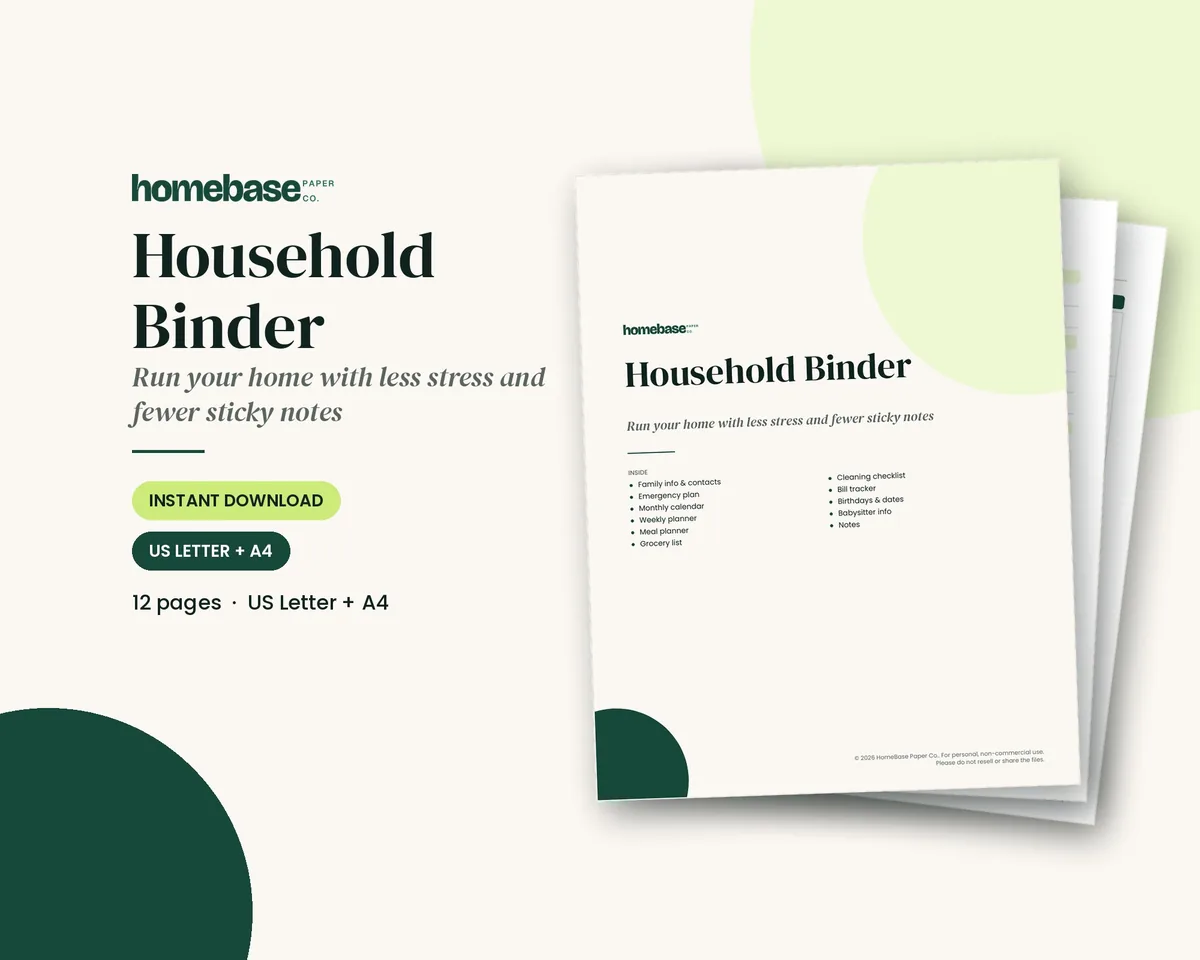
- Next step: Plan it with the Household Binder ($6.99).
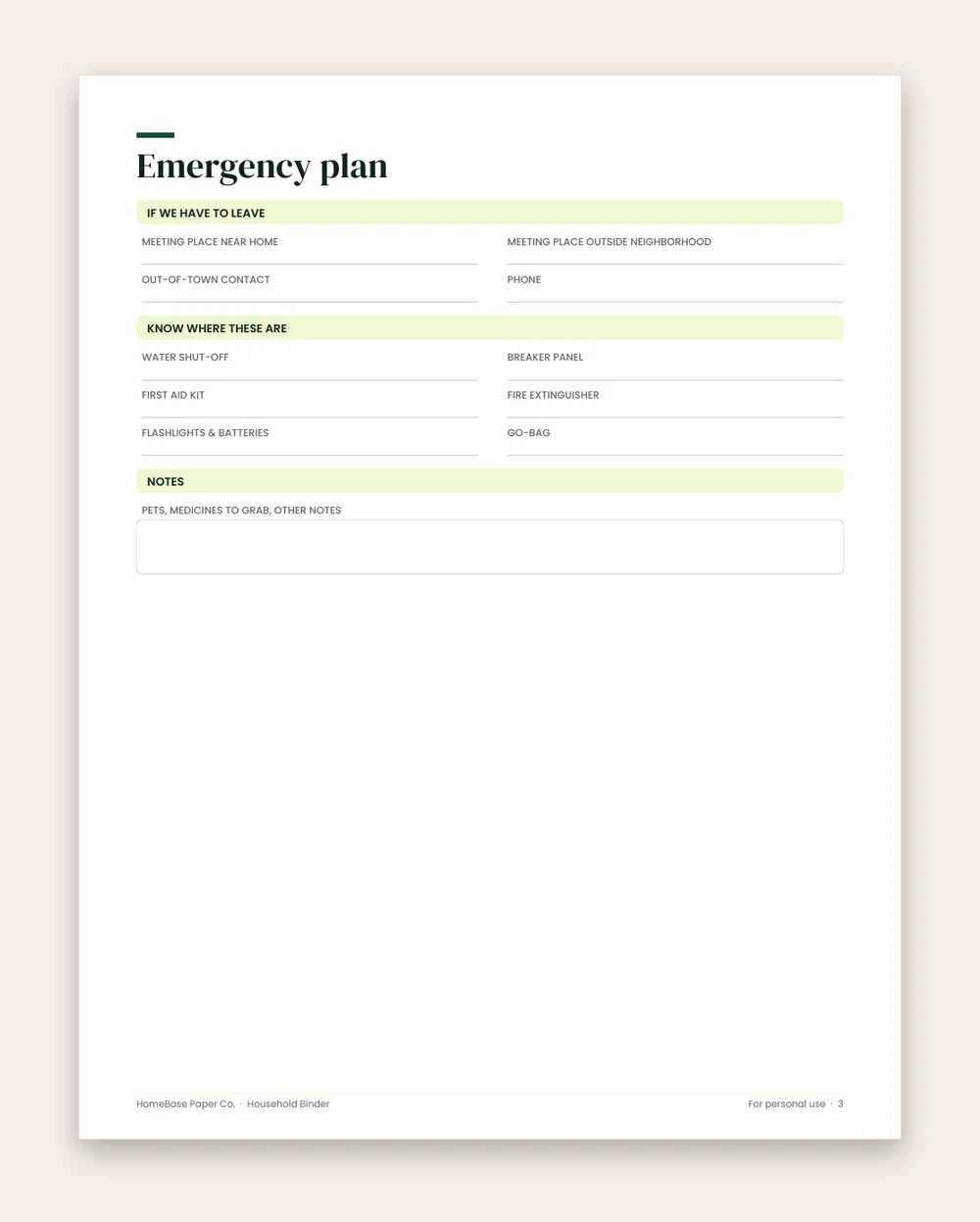
A fire escape plan is a simple map of your home that shows two ways out of every room, one meeting place outside and who helps whom, practiced by everyone at least twice a year. That's the whole idea, and it matters because the U.S. Fire Administration says you could have less than 2 minutes to escape once the smoke alarm sounds. If you want one place to write the plan down, the Emergency plan page in our Household Binder ($6.99) has lines for your meeting places, an out-of-town contact and where the shut-offs, fire extinguisher and go-bag live.
Below you'll find what a plan includes, how to make one in 8 steps, how to run a home fire drill, special cases like apartments and two-story homes, and the paperwork to keep ready in case the worst happens. Plan on about an hour for the first version and 10 minutes for each drill after that.
What a home fire escape plan includes
A good plan fits on one page and answers six questions. If anyone in your household can't answer one of them, that's the part to work on.
| Part of the plan | What to write down | Why it matters |
|---|---|---|
| Floor map | Every room, door and window on each level, plus smoke alarm spots | Everyone sees the exits the same way |
| Two ways out | A main exit and a backup for every room, usually a door and a window | Smoke or fire may block the first route |
| Meeting place | One fixed spot outside, in front of the home | You can count heads fast and tell firefighters who is missing |
| Helpers | Who helps babies, older adults or anyone with limited mobility, plus a backup | No one has to decide in the dark |
| Calling for help | The emergency number and your house number | You call from outside, and responders find you |
| Practice dates | Two drill dates a year on the calendar | A plan nobody has practiced is just a drawing |
How to make a fire escape plan in 8 steps
These steps follow the guidance from the U.S. Fire Administration and the National Fire Protection Association's escape planning tips. Do them together, with everyone who lives in the home.
- Walk through the whole home together. Go room by room. Open each door and try each window. Notice anything that sticks, is painted shut or is blocked by furniture.
- Draw a floor map. Use graph paper or plain paper, one sheet per level. Mark every room, door, window and hallway. Add a small dot where each smoke alarm is. It doesn't need to be pretty or to scale.
- Find two ways out of every room. Draw arrows for the main exit and the backup. In most bedrooms the backup is a window. Make sure windows open all the way and screens pop out quickly. If you have security bars, they need a quick-release device that everyone knows how to use.
- Clear the routes. Move anything that blocks a door, window or hallway. Keep a path to the window in each bedroom, not a dresser or a stack of boxes.
- Pick one meeting place outside. Choose something fixed and in front of the home, a safe distance away. A mailbox, a light post, a stop sign or a neighbor's tree all work. Mark it on the map.
- Assign helpers and backups. Decide who helps infants, young children, older adults and anyone with limited mobility. Name a backup person in case the helper isn't home.
- Plan the call. Everyone should memorize the emergency number (911 in most of the U.S.) and know to call from outside, never from inside a burning home. Check that your house number is easy to see from the street, day and night.
- Write it down, post it and share it. Put the map where everyone sees it, keep a copy in your home binder, and walk overnight guests through it when they arrive.
Smoke alarms: your plan starts with hearing one
An escape plan only works if the alarm wakes you up. The U.S. Fire Administration's smoke alarm guidance says to install alarms inside each bedroom, outside each sleeping area and on every level of the home, including the basement. Interconnected alarms are best, because when one sounds, they all sound.
| Task | How often | Notes |
|---|---|---|
| Press the test button | Every month | Make sure everyone can hear it from their bedroom with the door closed |
| Replace 9-volt batteries | At least once a year | Sealed 10-year lithium alarms don't need battery changes |
| Replace the whole alarm | Every 10 years | Count from the manufacture date printed on the back |
Never pull the battery to stop an alarm while you cook. Open a window or fan the air instead. If someone in your home is deaf or hard of hearing, alarms with strobe lights or bed shakers are made for that. Some local fire departments also offer free smoke alarms or installation, so it's worth a call to the non-emergency line.
How to run a home fire drill
The NFPA recommends practicing your plan twice a year. A drill turns the map into muscle memory, so people move without thinking.
- Pick a time and tell everyone. For a first drill, do it in daylight. Explain what will happen so no one is frightened.
- Start with the real alarm. Press the smoke alarm's test button so everyone learns the sound.
- Get low and go. Practice crawling under imaginary smoke, since cleaner air stays near the floor.
- Check doors before opening. Teach everyone to feel the door and the doorknob with the back of a hand. If it's hot, use the second way out.
- Close doors behind you. A closed door can slow the spread of smoke and fire.
- Meet at the meeting place. Count heads. Have one person pretend to call 911 from outside.
- Try the second exit next time. Practice both routes from every room over a few drills.
- Talk it over. Ask what was confusing, what got in the way and how long it took. Fix one thing before the next drill.
Once the daytime drill goes well, add a night drill. Tell children ahead of time, and watch whether everyone actually wakes to the alarm. The NFPA suggests assigning someone to wake anyone who sleeps through it. Ready.gov also suggests practicing in the dark, so the routes feel familiar without lights.
What to do during a real fire
A short list is easier to remember under stress. Go over these at every drill.
- Get out first and stay out. Never go back inside for anything, including pets or belongings.
- Get low under smoke and move toward your exit.
- Feel the door before you open it. If it's hot, use your second way out.
- Close doors behind you as you leave.
- Call 911 from outside once you reach the meeting place.
- Tell firefighters if anyone, including a pet, is still inside, and where.
- If you're trapped, close the door, cover the gaps with towels or tape, call 911 and say where you are, and signal from the window with a flashlight or a light-colored cloth.
Fire escape plans for apartments, two-story homes and special needs
Every home is a little different. Use this table to adjust the basic plan.
| Situation | What to add to your plan |
|---|---|
| Apartment or high-rise | Learn your building's evacuation plan. If you need to leave, close your door, pull the fire alarm, use the stairs (never the elevator) and go to your meeting place. Know at least two stairwells. |
| Two-story home | Bedrooms upstairs need a second way out. If that's a window, consider an escape ladder, and practice setting it up from a first-floor window only. |
| Older adults or limited mobility | Plan bedrooms on the ground floor if possible. Check that walkers and wheelchairs fit through doorways. Assign a helper and a backup. |
| Deaf or hard of hearing | Use strobe or bed-shaker alarms and make sure the helper knows to check on them. |
| Pets | Note where pets usually sleep. Never go back in for them. Tell firefighters where they may be. |
| Guests and sitters | Show guests the exits and meeting place. Leave the plan with any babysitter or house sitter. |
| Renters | Ask your landlord where the alarms are and how old they are, and keep your own copy of the plan. |
Keep your fire escape plan in your household binder
Here's where a plan usually falls apart: it gets drawn once, stuck on the fridge and lost under school flyers and takeout menus. I'm the oldest of three, and I was the one who kept track of the details growing up in Detroit. Later, as an executive assistant, my job was keeping important information where people could find it fast. In my work as an ABA technician, I learned that people follow a plan when the next step is small and obvious. A fire escape plan works the same way.
The Household Binder ($6.99) has an Emergency plan page made for this. It has lines for a meeting place near home and one outside your neighborhood, an out-of-town contact and phone, and where to find the water shut-off, breaker panel, first aid kit, fire extinguisher, flashlights and go-bag. There's a notes box for pets and medicines to grab. Tuck your floor map behind it, and the whole plan lives in one place with your family information, calendar and important dates. It prints on US Letter or A4.
For more on building the binder itself, see our emergency binder guide and our home management binder ideas.
The paperwork side: before and after a fire
Getting everyone out is the only goal in the moment. Recovering afterward is much easier if you prepare a few things now. Ready.gov's home fire guidance suggests keeping digital copies of important documents and, after a fire, making a list of damaged items before you throw anything away and saving receipts for what you spend.
Before a fire:
- Make digital copies of IDs, insurance policies and other key papers. Our guide on how to organize important documents walks through what to keep and where.
- Do a room-by-room home inventory with photos. The Home Inventory Printable & Spreadsheet ($5.49) has pages for policy details, a room inventory, valuables and a summary by room, plus an Excel file. Our home inventory list for insurance explains how to fill it in.
- Store a copy of the plan and the inventory outside the home, such as in cloud storage or with a trusted relative.
After a fire:
- Contact your local disaster relief services, such as the American Red Cross, if you need a place to stay or basic supplies.
- Check with the fire department that it's safe to go back in, and don't reconnect utilities yourself.
- Call your insurance company, and let your mortgage company or landlord know.
- List the damage before you throw anything away, and keep every receipt for living expenses and repairs.
A simple fire safety calendar
Pick two drill dates six months apart and put them on the calendar now. Then stack the smaller checks around them.
| When | What to do |
|---|---|
| Every month | Test smoke alarms. Glance at exit routes for clutter. |
| Twice a year | Run a fire drill. Check that windows open and screens come out. Review the helper list. |
| Once a year | Replace 9-volt alarm batteries. Update the floor map, out-of-town contact and home inventory. Check the fire extinguisher's gauge. |
| Every 10 years | Replace each smoke alarm, by its manufacture date. |
Our home maintenance checklist has the monthly safety checks and seasonal tasks in one place, and a family meeting is a good moment to review the plan together.
Your fire escape plan checklist
Use this as a quick start tonight:
- Walk the home and try every door and window
- Draw one floor map per level with two ways out of each room
- Choose a meeting place in front of the home
- Assign helpers and backups
- Test every smoke alarm
- Make your house number visible from the street
- Put two drill dates on the calendar
- Store the plan in your binder and tell your guests
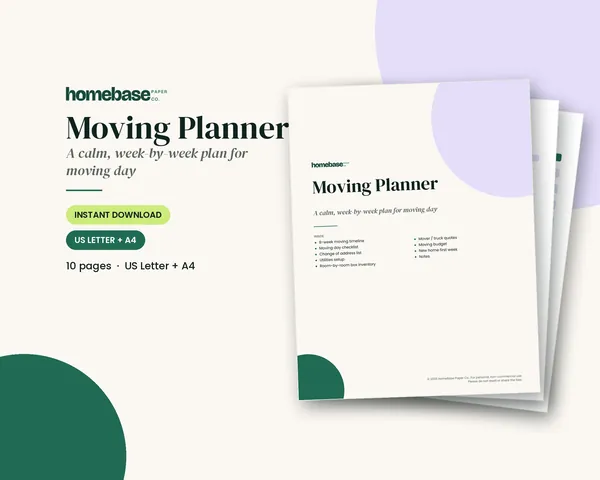
If you'd like the pages to keep it all in order, start with the Household Binder ($6.99). For the full set, the Home Management Bundle ($16.99, $32.94 if bought separately) adds the Home Inventory, a Home Maintenance Log, a Cleaning Schedule, a Password & Accounts Log and a Moving Planner. You can browse every planner in Printables or save on sets in Bundles.
The end of daylight saving time is an easy reminder to test smoke alarms and review your plan. See the daylight savings 2026 dates for when clocks change.
Make it easier
Tools for this

Printables
Household Binder
Family info, emergency plan, calendars, meals, groceries, cleaning, bills and sitter notes.
 Save 48%
Bundles
Home Management Bundle
Household binder, maintenance log, moving planner, cleaning schedule, home inventory and password log.

Printables
Home Inventory
Printable pages and a spreadsheet that totals the value of every room.
Frequently asked questions
What is a fire escape plan? A fire escape plan is a one-page map of your home showing two ways out of every room, an outside meeting place and who helps whom, and the Household Binder ($6.99) gives it a home on its Emergency plan page. Everyone in the household should know it and practice it at least twice a year.
How do you make a fire escape plan? The Household Binder ($6.99) makes a fire escape plan easy to keep, because its Emergency plan page holds your meeting places, contacts and where your shut-offs and fire extinguisher are. To make the plan, walk the home together, draw a map of each level, mark two exits per room, pick a meeting place out front, assign helpers and set two drill dates.
What should a home fire escape plan include? A home fire escape plan should include a floor map, two ways out of every room, one outside meeting place, the emergency number, helpers for anyone who needs assistance and drill dates. The Household Binder ($6.99) Emergency plan page also has lines for an out-of-town contact and for where the water shut-off, breaker panel, fire extinguisher and go-bag are.
How often should you practice a fire escape plan? Practice your fire escape plan at least twice a year, as the NFPA recommends, and put both dates on the Monthly Calendar in the Household Binder ($6.99) so they don't slip. After a daytime drill goes well, add a night drill and tell children about it ahead of time.
How long do you have to escape a house fire? You may have less than 2 minutes to get out once the smoke alarm sounds, according to the U.S. Fire Administration. That's why a practiced plan matters more than a perfect one: people who have walked the routes before move faster and don't stop to think.
Where should the meeting place be in a fire escape plan? Your meeting place should be one fixed spot in front of the home, a safe distance away, such as a mailbox, a light post or a neighbor's tree. Write it on the Emergency plan page in the Household Binder ($6.99) so sitters and guests can find it too.
Do I need a fire escape plan if I live in an apartment? Yes, apartments need a fire escape plan too, and it should follow your building's evacuation plan. If you need to leave, close your door behind you, pull the fire alarm, use the stairs instead of the elevator and go to your meeting place. Know at least two stairwells.
What if a bedroom only has one door? If a bedroom only has one door, the window is usually the second way out, so make sure it opens fully and the screen comes out quickly. On a second floor, consider an escape ladder and practice setting it up only from a first-floor window.
How do I include pets in a fire escape plan? Note where pets usually sleep and keep leashes or carriers near an exit, but never go back inside for a pet. The notes box on the Household Binder ($6.99) Emergency plan page is a good place to list pets and medicines to grab, and you should tell firefighters if a pet is still inside.
How do I plan for an older adult or someone with limited mobility? Assign a helper and a backup for anyone who needs help getting out, and if possible put their bedroom on the ground floor near an exit. Check that walkers and wheelchairs fit through the doorways on the escape route, and consider strobe or bed-shaker alarms for anyone with hearing loss.
How often should smoke alarms be tested and replaced? Test smoke alarms every month, replace 9-volt batteries at least once a year and replace each alarm every 10 years from its manufacture date, per the U.S. Fire Administration. Install them in each bedroom, outside each sleeping area and on every level of the home.
What should you do if you're trapped during a fire? If you're trapped, close the door, seal the gaps with towels or tape, call 911 and tell them where you are, then signal from a window with a flashlight or a light-colored cloth. Practicing both exits during drills makes being trapped much less likely.
What should I do after a house fire? After a house fire, check with the fire department before going back in, call your insurance company and list the damage before you throw anything away. The Home Inventory Printable & Spreadsheet ($5.49) helps here, because a room-by-room list made ahead of time makes the claim much easier to document.
Is there a printable fire escape plan template? The Household Binder ($6.99) works as a printable fire escape plan template, with an Emergency plan page for meeting places, contacts, shut-offs and your go-bag. Add a hand-drawn floor map for each level behind it. For a fuller set, the Home Management Bundle ($16.99, $32.94 bought separately) adds a Home Inventory and a Home Maintenance Log.
More from HomeBase
You may also like
Printables
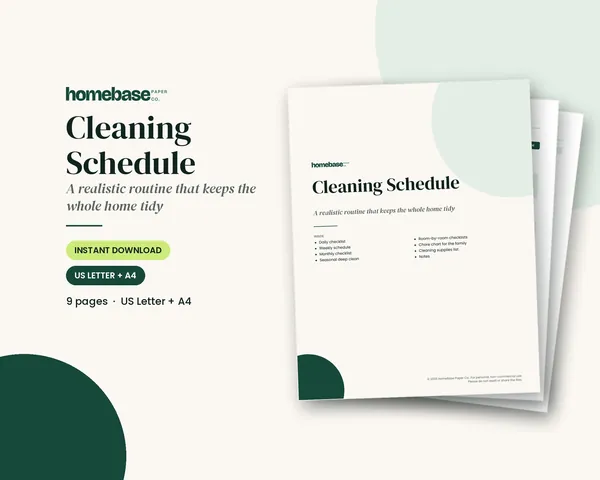
Cleaning Schedule
Daily, weekly, monthly and seasonal lists - plus a family chore chart.
Printables
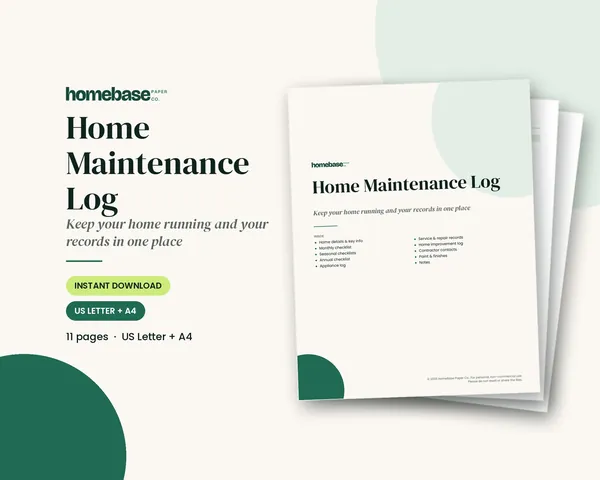
Home Maintenance Log
Monthly, seasonal and annual checklists plus a record of every appliance and repair.
Printables
Vehicle Maintenance Log
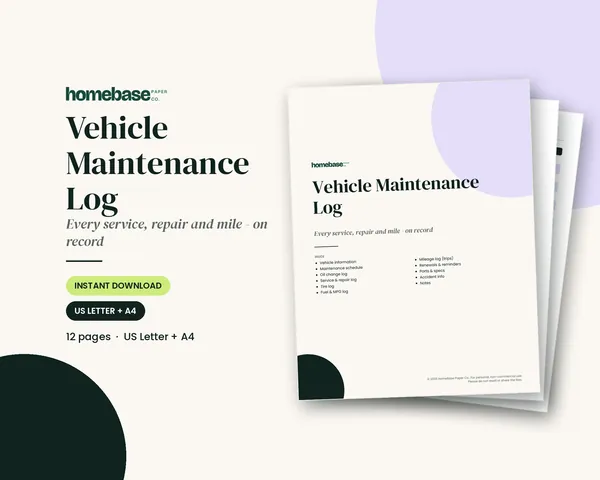
Oil changes, repairs, tires, fuel and MPG, trip mileage and renewal dates - so resale and warranty records are easy.
 Club
Monthly club
Planner & Calendar Club
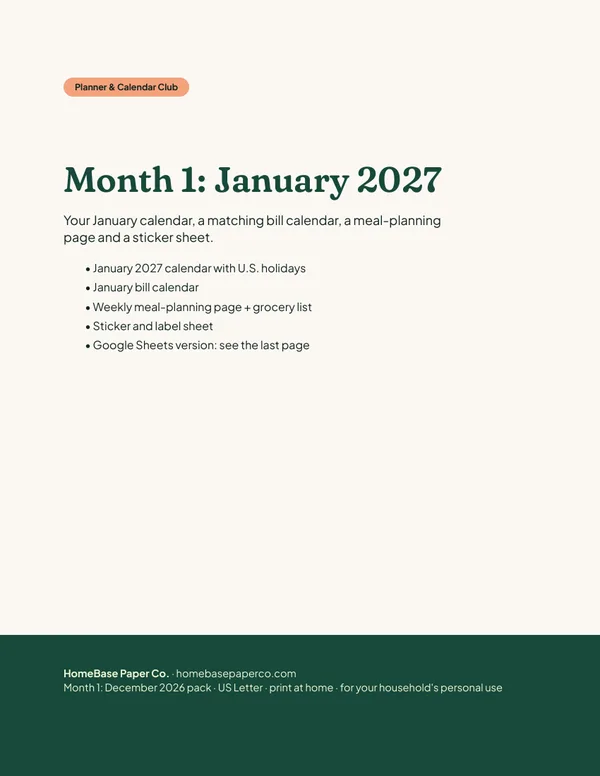
Anyone who wants a monthly calendar, bill calendar and meal plan ready to print.
Free printable
Have the important stuff in one place: get the free emergency binder pages
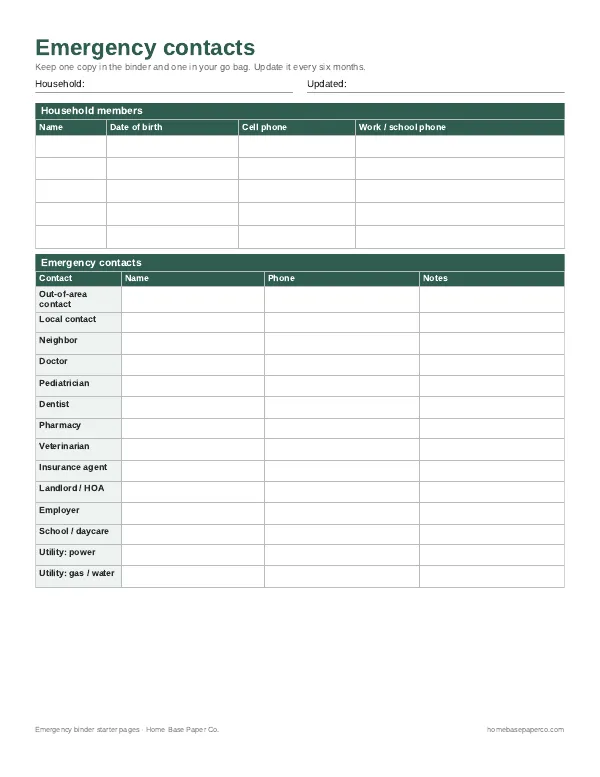
Printable starter pages for household members, emergency contacts, medical notes and where key documents live. You'll also get our weekly HomeBase email with simple ways to keep family records and important papers in order.
Sources
- Home fire escape plans (U.S. Fire Administration) usfa.fema.gov
- Escape planning (National Fire Protection Association) nfpa.org
- Smoke alarms (U.S. Fire Administration) usfa.fema.gov
- Home fires (Ready.gov) ready.gov