Free tool · no sign-up · nothing saved or sent
Macro calculator
Find how many grams of protein, carbs and fat to eat each day. Enter your daily calories, or estimate them from your age, height, weight and activity. Then pick a split and see your macros per day and per meal.
Quick answer: on 2,000 calories a day with a balanced split (50% carbs, 20% protein, 30% fat), your macros are 250 g carbs, 100 g protein and 67 g fat. Over 3 meals, that's about 83 g carbs, 33 g protein and 22 g fat per meal. Protein and carbs have 4 calories per gram and fat has 9.
How macros are calculated
Macros are the three nutrients that supply calories: carbohydrates, protein and fat. To turn a calorie number into grams, multiply calories by each percentage, then divide by the calories in one gram. MedlinePlus notes that fat has 9 calories per gram, while carbohydrates and protein each have 4.
Worked example. A 35-year-old woman who is 5 feet 5 inches, weighs 150 pounds and exercises 3 to 5 days a week:
- Resting calories (Mifflin-St Jeor): 10 × 68.0 kg + 6.25 × 165.1 cm − 5 × 35 − 161 = 1,376 calories. The BMR calculator explains this step.
- Daily calories: 1,376 × 1.55 (moderately active) = 2,133 calories to maintain weight.
- Balanced split: 50% carbs = 1,067 calories ÷ 4 = 267 g; 20% protein = 427 calories ÷ 4 = 107 g; 30% fat = 640 calories ÷ 9 = 71 g.
- Per meal (3 meals): about 89 g carbs, 36 g protein and 24 g fat.
Recommended macro ranges for adults
The Acceptable Macronutrient Distribution Ranges (AMDR) are set by the National Academies and used in the Dietary Guidelines for Americans, 2020–2025 (Appendix 1). For adults 19 and older:
| Macro | Share of calories | Calories per gram | Grams on 2,000 calories |
|---|---|---|---|
| Carbohydrate | 45–65% | 4 | 225–325 g |
| Protein | 10–35% | 4 | 50–175 g |
| Fat | 20–35% | 9 | 44–78 g |
The balanced and higher-protein presets fall inside these ranges. The lower-carb preset does not: 25% carbs is below the 45% minimum and 40% fat is above the 35% maximum, so it's there for people who have chosen that approach, ideally with input from a professional.
How much protein is enough?
The Recommended Dietary Allowance for adults is 0.8 grams of protein per kilogram of body weight, or a little over 7 grams for every 20 pounds, as Harvard's Nutrition Source explains. For a 150-pound adult that's about 54 g a day. It's a floor, not a goal: MedlinePlus puts the healthy range at 10% to 35% of daily calories, so 100 g of protein on 2,000 calories is 20%. When you use the estimate option, the results also show your protein in grams per kilogram. For easy ways to reach your number, see our chart of high-protein foods.
Turn your macros into a budget meal plan
Numbers only help if they end up on the plate. Plan meals around your protein target first, since it's usually the hardest to hit and the priciest part of the grocery bill.
- Pick a protein for each meal. Eggs, canned tuna, chicken thighs, Greek yogurt, beans and lentils cost less per gram of protein than most packaged snacks. Our high-protein meals list has ideas for breakfast, lunch and dinner.
- Batch cook. Cooking proteins and grains once for the week makes per-meal targets easy to repeat. Try these high-protein meal prep ideas at under $3 a serving.
- Lower carb on a budget. If you chose the lower-carb split, build meals from eggs, chicken, cabbage, frozen vegetables and cheese; see our low-carb meals with a 7-day starter plan.
- Write the grocery list from the plan. Once a week of meals is planned, list every ingredient by store section. A printable grocery list template keeps it quick, and our guide to how to meal plan walks through the full weekly method.
Limitations
This macro calculator gives estimates. The calorie equation does not know your body composition, medical history or medications, and activity levels are broad. Macro splits are starting points that people adjust over time. Results are meant for healthy adults; they are not suited to children, teens, or people who are pregnant or breastfeeding, whose needs differ.
Not medical advice. This tool is for general information and planning. If you have diabetes, kidney disease, an eating disorder or another health condition, talk with your doctor or a registered dietitian before changing what you eat.
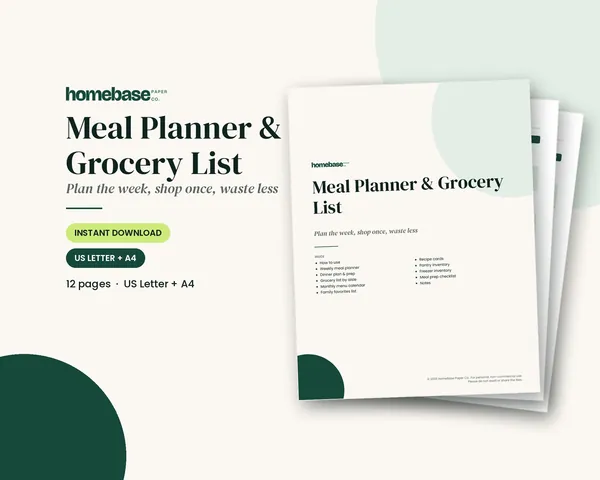
Plan the week around your macros
Put your macros on the menu
Once you know your daily grams, plan a week of meals that hits them and shop for it once. The Meal Planner & Grocery List gives you weekly menu pages and a matching grocery list.
- Weekly meal planning pages
- Grocery list to shop from your plan
- Print at home and reuse every week
Questions, answered
How do I calculate my macros? Multiply your daily calories by the percentage for each macronutrient, then divide protein and carb calories by 4 and fat calories by 9 to get grams. On 2,000 calories with 50% carbs, 20% protein and 30% fat, that's 1,000 ÷ 4 = 250 g carbs, 400 ÷ 4 = 100 g protein and 600 ÷ 9 = 67 g fat. The calculator above does the math as you type.
What is a good macro split for beginners? A balanced split of about 50% carbs, 20% protein and 30% fat is a good place to start, because it sits inside the Acceptable Macronutrient Distribution Ranges for adults (45–65% carbs, 10–35% protein, 20–35% fat). Keep it for a few weeks, notice how full and energetic you feel, then adjust one macro at a time.
How many grams of protein do I need a day? The Recommended Dietary Allowance for adults is 0.8 grams of protein per kilogram of body weight, which works out to about 54 g a day for a 150-pound adult. That's a minimum to meet basic needs, not a target. Within the adult range of 10–35% of calories, many people eat more, and the higher-protein preset uses 30%.
How many calories are in a gram of protein, carbs and fat? Protein and carbohydrates each have 4 calories per gram, and fat has 9 calories per gram. That's why a fat target in grams always looks smaller than a carb or protein target for the same share of calories.
Should I change my macros to lose weight? Total calories matter more than the split for weight change, so start by setting the goal to lose, which takes 500 calories off your daily estimate. Many people also raise protein because it helps meals feel more filling. If you have a health condition, take medication or are pregnant, ask your doctor or a registered dietitian before cutting calories.
Is the lower-carb preset a keto diet? No, the lower-carb preset is not keto. It sets carbs at 25% of calories, which is about 125 g on 2,000 calories, while ketogenic diets usually go much lower. It's also below the 45% carb minimum in the adult reference ranges, so treat it as a choice to discuss with a professional rather than a default.
How do I split my macros into meals? Divide each daily gram target by the number of meals you eat. On the default 2,000-calorie balanced split with 3 meals, each meal gets about 83 g carbs, 33 g protein and 22 g fat. If you eat snacks, choose 4 meals and treat the fourth as two smaller snacks.
How accurate is the calorie estimate? The estimate is a starting point, not a measurement. It uses the Mifflin-St Jeor equation for resting calories and multiplies by an activity factor, and real needs can differ by a few hundred calories a day. Track your weight for two to three weeks and adjust calories up or down by 100 to 200 if it moves in the wrong direction.
Does the macro calculator save my information? No. The macro calculator runs in your browser and nothing you enter is stored or sent. Write your numbers down or copy them into your meal planner before you close the page.
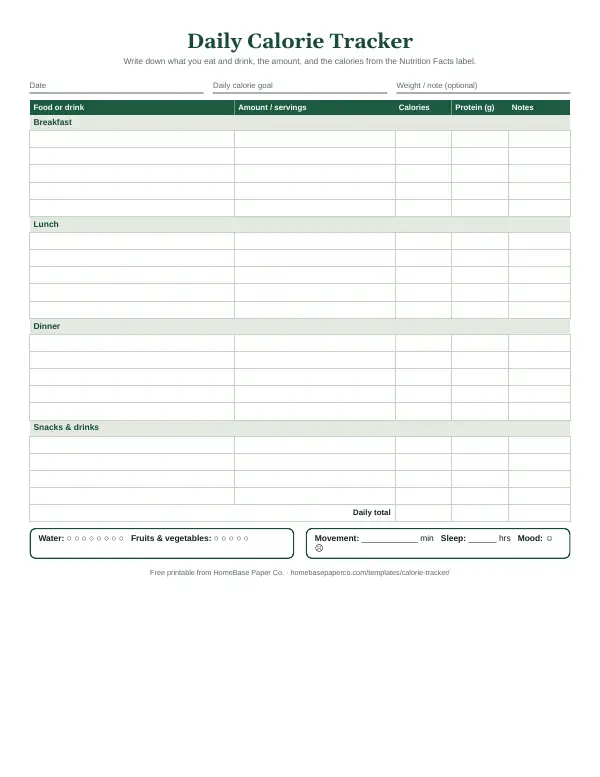
Free printable
A simple daily food log you can fill in by hand
Meals, calories, protein, water, movement, sleep and mood on one page. You'll also get our weekly HomeBase email with easy meal planning ideas and family recipe tips.