 Starter pick
Printables
Meal Planner & Grocery List
Weekly meals, a grocery list sorted by aisle, and pantry and freezer inventories so you shop once and waste less.
$3.99Buy

Free tool · no sign-up · nothing saved or sent
This free BMR calculator estimates your basal metabolic rate, the calories your body burns at complete rest. Enter your sex, age, height and weight to compare the Mifflin-St Jeor and revised Harris-Benedict equations, and add your body-fat percentage to see Katch-McArdle too.
The short answer: a 35-year-old woman who is 5'5" and 150 pounds has a BMR of about 1,376 calories a day with the Mifflin-St Jeor equation (about 1,437 with revised Harris-Benedict). That's what her body burns at rest, before any walking, work or exercise. Your real daily calorie needs are higher once activity is counted, so use BMR as the starting point, not the target.
Every BMR formula turns your size and age into an estimate of your resting calorie burn. This calculator shows three of the most widely used:
Take a 35-year-old woman who is 5 feet 5 inches and 150 pounds. First convert: 65 inches × 2.54 = 165.1 cm, and 150 pounds × 0.4536 = 68.04 kg. Then plug into Mifflin-St Jeor: (10 × 68.04) + (6.25 × 165.1) − (5 × 35) − 161 = 680.4 + 1,031.9 − 175 − 161 = 1,376 calories a day. The revised Harris-Benedict equation gives about 1,437 for the same person. If she knew she was 30% body fat, her lean mass would be 47.6 kg, and Katch-McArdle would give 370 + 21.6 × 47.6 = about 1,399.
BMR is the floor of your calorie needs, not a daily goal. Once you know it, estimate your full daily calories with activity, then plan meals that land near that number. Spread calories across the day so no meal leaves you starving: our low calorie meals and high protein meals lists are good places to find filling dinners, and low calorie snacks help bridge the gaps. If you want to see how close your plan comes to the target, log a week of meals on a printable calorie tracker. To turn it all into a routine, follow our steps for how to meal plan each week, or batch-cook from these healthy meal prep ideas.
BMR equations predict an average for people of your sex, age, height and weight; they don't measure you. A 2005 systematic review of resting metabolic rate equations found Mifflin-St Jeor was the most likely to land within 10% of measured RMR, but still warned of noteworthy errors for individuals, and noted that older adults and U.S. ethnic minorities were underrepresented in the research. The Mifflin-St Jeor authors also found the original 1919 Harris-Benedict equations overestimated measured resting energy by about 5%. Katch-McArdle is only as good as your body-fat number, and home scales can be off by several points. The only way to know your true resting rate is to have it measured, usually by indirect calorimetry.
Not medical advice. This calculator gives general estimates for healthy adults. It isn't meant for children, pregnant or breastfeeding people, or anyone with a medical condition that affects weight or metabolism. Talk with your doctor or a registered dietitian before making big changes to how much you eat.
Plan meals around your number
Knowing your BMR is step one. The Meal Planner & Grocery List helps you plan a week of meals ahead, so you shop once for exactly what you planned.
Saving the recipes that work? See the Family Recipe Binder, $6.99.
What is BMR? BMR, or basal metabolic rate, is the number of calories your body burns in a day at complete rest, just to keep you alive: breathing, circulating blood, keeping you warm and running your organs. It does not include walking, exercise or digesting food. Most calculators, including this one, estimate it from your sex, age, height and weight.
How do I calculate my BMR? The most common way to calculate BMR is the Mifflin-St Jeor equation: 10 × weight in kg + 6.25 × height in cm − 5 × age, then add 5 for men or subtract 161 for women. For a 35-year-old woman who is 5 feet 5 inches (165.1 cm) and 150 pounds (68.04 kg), that is 680.4 + 1,031.9 − 175 − 161 = about 1,376 calories a day. The calculator above does the unit conversions and the math for you.
Which BMR formula is most accurate? For most healthy adults, the Mifflin-St Jeor equation is the most reliable of the common formulas. A 2005 systematic review in the Journal of the American Dietetic Association found it predicted resting metabolic rate within 10% of the measured value in more people than the Harris-Benedict, Owen or WHO equations. If you know your body-fat percentage with reasonable accuracy, Katch-McArdle is worth comparing, because it is based on lean body mass.
Why do the BMR formulas give different numbers? The formulas give different numbers because they were built from different groups of people, at different times, using different inputs. Harris-Benedict dates to 1919 (revised in 1984), Mifflin-St Jeor to 1990, and Katch-McArdle uses lean body mass instead of sex, age and height. A spread of 50 to 100 calories between them is normal; treat the results as a range rather than one exact number.
What is the difference between BMR and TDEE? BMR is what you burn at rest, while TDEE (total daily energy expenditure) is everything you burn in a day, including movement, exercise and digesting food. TDEE is always higher than BMR. To estimate your daily calories with your activity level included, use our TDEE calculator.
Is BMR the same as RMR? BMR and RMR are close but not the same: BMR is measured under strict conditions (fasted, fully rested, right after waking), while RMR, or resting metabolic rate, is measured under looser resting conditions and usually comes out slightly higher. The Mifflin-St Jeor equation was actually developed to predict resting energy expenditure, and in everyday use the two terms are often used interchangeably.
Should I eat fewer calories than my BMR to lose weight? Most people should not plan to eat below their BMR without guidance from a doctor or registered dietitian. Your BMR is only your resting burn; your real daily needs are higher once you count activity. A weight-loss plan is usually built from your total daily calories, not from BMR alone. Very low calorie diets should be supervised by a health professional.
Does muscle increase BMR? Yes, more lean mass generally means a higher BMR. In the 1990 Mifflin-St Jeor study, fat-free mass was the best single predictor of resting energy expenditure. That is why two people with the same height and weight can have different BMRs, and why the Katch-McArdle formula, which uses lean body mass, can be useful if you know your body-fat percentage.
Why does BMR go down with age? BMR tends to drop with age largely because many people lose lean mass as they get older. Every common formula subtracts calories for each year of age: about 5 calories per year in Mifflin-St Jeor. Staying active and eating enough protein can help you hold on to muscle, but the formulas cannot see that, so they apply the same age adjustment to everyone.
Is this BMR calculator accurate for everyone? No calculator is accurate for everyone, because BMR equations predict an average for people like you, not your measured rate. Reviews have found that older adults and some ethnic groups were underrepresented in the studies behind the equations, and the revised Harris-Benedict study found the equation unreliable for malnourished patients. The only way to know your exact resting rate is to have it measured, for example with indirect calorimetry.
Free printable
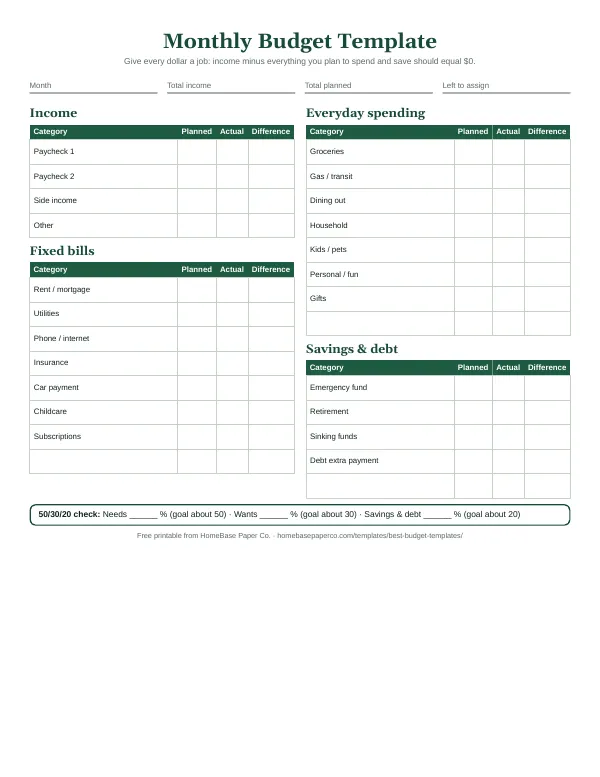
A printable zero-based monthly budget: income, bills, everyday spending and savings on one page, with a planned vs. actual column. You'll also get our weekly HomeBase email with simple budgeting and bill-paying tips.
Plan the week
Starter pickPrintables
Weekly meals, a grocery list sorted by aisle, and pantry and freezer inventories so you shop once and waste less.

Printables
Section dividers, four recipe page layouts with room for the family story, 4x6 and 3x5 cards and a conversion chart - print it or type into the fillable version.

Printables
Family info, emergency plan, calendars, meals, groceries, cleaning, bills and sitter notes.