Free tool · no sign-up · nothing saved or sent
TDEE calculator
Find out about how many calories you burn in a day. Enter your sex, age, height, weight and activity level to see your maintenance calories, plus gentle weight loss and weight gain targets you can plan meals around.
What is TDEE? Your total daily energy expenditure is the number of calories your body uses in a day: the energy you burn at rest plus everything you burn moving. Eat about that much and your weight tends to hold steady. For example, a moderately active 35-year-old woman who is 5 ft 5 in and 150 lb has a TDEE of about 2,136 calories a day. Change the numbers below to get yours.
How TDEE is calculated
The calculator works in two steps. First it estimates how many calories you burn at complete rest, often called BMR (basal metabolic rate), using the Mifflin-St Jeor equation. Then it multiplies that number by an activity factor to get your total daily energy expenditure.
- Women: BMR = (9.99 × weight in kg) + (6.25 × height in cm) − (4.92 × age) − 161
- Men: BMR = (9.99 × weight in kg) + (6.25 × height in cm) − (4.92 × age) + 5
- TDEE = BMR × activity factor
The equation comes from a 1990 study by Mifflin, St Jeor and colleagues in the American Journal of Clinical Nutrition, which measured resting energy use in 498 healthy adults aged 19 to 78 and wrote one formula for both sexes: the men's version is 166 calories higher than the women's. The same study found the older Harris-Benedict equations overestimated measured resting energy by about 5%.
Worked example
Take a 35-year-old woman who is 5 ft 5 in (165.1 cm) and 150 lb (68.04 kg) and exercises a few days a week:
- Weight: 9.99 × 68.04 = 679.7
- Height: 6.25 × 165.1 = 1,031.9
- Age: 4.92 × 35 = 172.2
- BMR: 679.7 + 1,031.9 − 172.2 − 161 = 1,378 calories
- TDEE: 1,378 × 1.55 (moderately active) = about 2,136 calories a day
Her targets are about 1,886 calories for mild weight loss (−250), 1,636 for weight loss (−500), and 2,386 or 2,636 for weight gain (+250 or +500). A man with the same height, weight, age and activity would have a BMR 166 calories higher, about 1,544, and a TDEE of about 2,394.
Activity levels and multipliers
Activity factors are the biggest guess in any TDEE estimate. These are the multipliers this calculator uses, with the result for the example above.
| Activity level | What it looks like | Multiplier | Example TDEE |
|---|---|---|---|
| Sedentary | Desk job, little or no exercise | 1.2 | 1,654 |
| Lightly active | Light exercise 1 to 3 days a week | 1.375 | 1,895 |
| Moderately active | Moderate exercise 3 to 5 days a week | 1.55 | 2,136 |
| Very active | Hard exercise 6 to 7 days a week | 1.725 | 2,378 |
| Extra active | Physical job plus hard training | 1.9 | 2,619 |
Daily movement counts too, not just workouts. The NIDDK's overview of factors affecting weight notes that the calories you use include everyday activities like walking and housework, and that taking in more than you use over time can lead to weight gain.
How to use your TDEE to plan meals on a budget
A calorie number only helps once it's on your plate. Here's a simple way to turn it into a week of meals without spending more on groceries:
- Split the day. Divide your target across the meals you actually eat. At 1,800 calories, that might be about 400 for breakfast, 500 for lunch, 600 for dinner and 300 for snacks.
- Plan before you shop. Pick dinners for the week, then build one grocery list from them. Our guide on how to meal plan walks through it step by step, and meal planning on a budget covers shopping your pantry and planning around sales.
- Lean on filling, low-cost staples. Beans, eggs, oats, rice, frozen vegetables and chicken thighs give you a lot of food for the calories and the price. Browse cheap meal ideas and high protein meals for dinners that keep you full.
- Have lighter options ready. If you're eating below your TDEE, low calorie meals and low calorie snacks make the target easier to hit without feeling hungry.
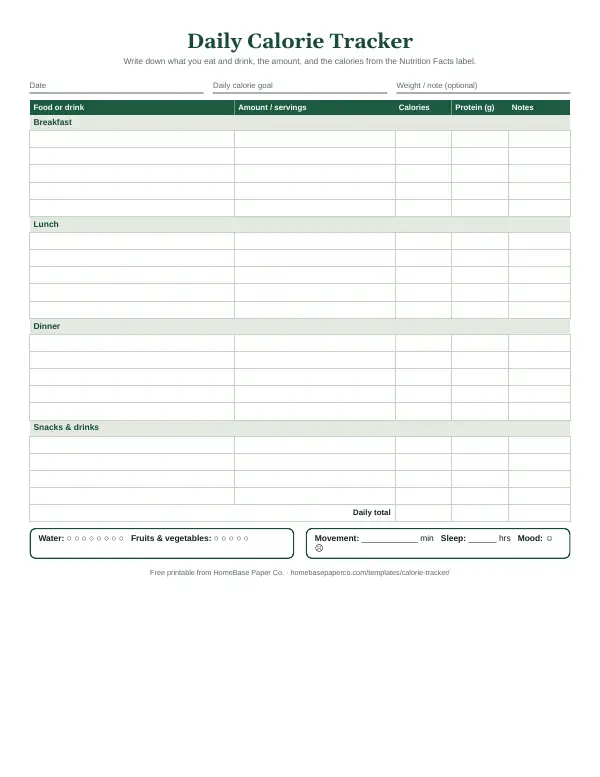
- Check in for a few weeks. Write down what you eat on a printable calorie tracker and weigh yourself once a week at the same time. If your weight isn't moving the way you expect after two or three weeks, adjust by 100 to 200 calories.
Limitations of TDEE calculators
Every TDEE calculator, this one included, predicts an average for people like you. Your real needs depend on muscle mass, genetics, health conditions, medications and how much you really move. The USDA's DRI Calculator for healthcare professionals uses the same basic inputs (sex, age, height, weight and activity) and notes that individual requirements may be higher or lower than its estimates. The NIH Body Weight Planner adds that its values will be too high for people who are very sedentary or have an unusually low metabolism, and that people often underestimate how much they eat. For a longer-term plan with a goal date, the Body Weight Planner is a good next step.
Not medical advice. This calculator and page are for general information only and aren't a substitute for advice from your doctor or a registered dietitian. Don't use it during pregnancy or breastfeeding, for anyone under 19, or to plan a diet for an eating disorder, diabetes, kidney disease or another medical condition. Talk to a clinician before starting a weight loss plan, especially one below 1,200 calories a day for women or 1,500 for men.

Plan meals around your number
Put your calories on the fridge
Knowing your TDEE is step one. The Meal Planner & Grocery List gives you a weekly meal plan page, an aisle-sorted grocery list and pantry and freezer inventories, so you can plan meals that fit your target and use up what you already have.
- Weekly meal planner and dinner prep pages
- Grocery list sorted by aisle
- Pantry and freezer inventories
Questions, answered
What is TDEE? TDEE stands for total daily energy expenditure, the estimated number of calories your body uses in a full day. It starts with the energy you burn at rest (your BMR) and adds the calories you use moving around, from walking and housework to workouts. If you eat about your TDEE, your weight should stay about the same.
How does this TDEE calculator work? It estimates your resting calories with the Mifflin-St Jeor equation, then multiplies that number by an activity factor from 1.2 (sedentary) to 1.9 (extra active). The equation uses your weight in kilograms, height in centimeters, age and sex. Your maintenance number is the result, and the loss and gain targets are 250 or 500 calories below or above it.
What is the difference between BMR and TDEE? BMR is the calories you burn at complete rest, and TDEE is BMR plus the calories you burn through activity. The Mifflin-St Jeor paper calls the resting number resting energy expenditure (REE), and many calculators label it BMR. TDEE is always the higher of the two, because everyone moves at least a little.
How accurate is a TDEE calculator? A TDEE calculator gives an estimate, not a measurement, so your real number may be higher or lower. The Mifflin-St Jeor equation was built from 498 healthy adults whose resting energy was measured in a lab, and individual people vary around that average. Treat your result as a starting point, track your weight for a few weeks and adjust by 100 to 200 calories if it moves in a direction you didn't plan.
Which activity level should I choose? Choose the level that matches a typical week, and pick the lower one if you're unsure. Most people with desk jobs who exercise a few times a week fit light or moderate. The NIH Body Weight Planner notes that its estimates run too high for people who are very sedentary, and the same caution applies here, so overestimating activity is the most common way to end up with a number that's too high.
How many calories should I eat to lose weight? A common starting point is 250 to 500 calories a day below your TDEE, which the calculator shows as mild loss and loss. The smaller cut is easier to stick with, especially if your TDEE is already low. If you have a health condition, take medication or want to lose a large amount of weight, talk with your doctor or a registered dietitian before you start.
Why doesn't the calculator show a weight loss target for me? The calculator hides loss targets that fall below 1,200 calories a day for women or 1,500 for men. Those are conservative cutoffs built into this tool, not a medical rule, because very low intakes make it hard to get enough nutrients and are best planned with a clinician. If your target is hidden, use your maintenance number and ask your doctor what's right for you.
Can I use this TDEE calculator if I'm pregnant, breastfeeding or under 19? No, this calculator isn't meant for pregnancy, breastfeeding or anyone under 19. The Mifflin-St Jeor equation was developed in adults aged 19 to 78, and the NIH Body Weight Planner is likewise limited to adults who aren't pregnant or breastfeeding. Ask your doctor or midwife about calorie needs during pregnancy and nursing, and your child's pediatrician for kids and teens.
Should I recalculate my TDEE when my weight changes? Yes, recalculate whenever your weight or activity changes noticeably, because both are part of the formula. As you lose weight your TDEE goes down, so a target that worked at the start may become maintenance later. Checking every 10 pounds or so, or after a big change in your routine, keeps the number useful.
Does the TDEE calculator save my information? No, the TDEE calculator runs entirely in your browser and doesn't store or send anything you type. If you close the page, your numbers are gone. Write your maintenance and target numbers on your meal plan or food log so you have them handy.
Free printable
A simple daily food log you can fill in by hand
Meals, calories, protein, water, movement, sleep and mood on one page. You'll also get our weekly HomeBase email with easy meal planning ideas and family recipe tips.