

The short answer: the best classroom games are quick, repeatable and tied to what students are learning. This list has 60 classroom games for grades K-8, sorted by prep time and purpose, so you can pick one in under a minute.
- No prep (10 games): Simon Says, Silent Ball, Twenty Questions, Stand Up Sit Down and six more that need nothing but students
- Top picks by goal: Four Corners for movement, Around the World for review, Sparkle for spelling and Paper Tower Challenge for teamwork
Facts checked November 15, 2026. Below: a quick chooser, then 60 classroom games in seven tables with grades, prep and how to play, followed by tips for running them, picks by grade and holiday party links. Teachers, parents and homeschoolers can all use it.
Classroom games work because they make practice feel like play. The CDC says classroom physical activity can improve concentration, reduce fidgeting and boost motivation and engagement. The American Academy of Pediatrics adds that play helps children plan, organize, get along with others and regulate their emotions. A five-minute game is a real tool, not a time-waster.
Classroom games at a glance
| Type | Games | Grades | Prep | Best moment |
|---|---|---|---|---|
| No prep | 1-10 | K-8 | None | Transitions and the last five minutes |
| Movement and brain breaks | 11-20 | K-8 | Little | After sitting for a long stretch |
| Review | 21-34 | 1-8 | Board or cards | Before a quiz or test |
| Word and language | 35-42 | K-8 | Little | Spelling, vocabulary and reading blocks |
| Team-building and SEL | 43-50 | K-8 | Little | Start of the year and after conflicts |
| Quiet and indoor recess | 51-56 | K-8 | Little | Rainy days and calm-down time |
| Printable | 57-60 | K-8 | Print once | Centers, sub days and parties |
How to choose a classroom game
| Your situation | Try these |
|---|---|
| Five minutes, nothing on hand | Simon Says, Stand Up Sit Down, Twenty Questions |
| Students are restless | Four Corners, Freeze Dance, Pass the Clap |
| Test is tomorrow | Around the World, Whiteboard Showdown, Jeopardy-Style Board |
| New class or new group | Compliment Circle, Find Someone Who, Two Truths and a Lie |
| Rainy day indoors | Dots and Boxes, Memory, Mystery Bag |
| Substitute teacher | Printable Bingo, Scoot, Crossword or Word Search |
| Working on teamwork | Paper Tower Challenge, Back-to-Back Drawing |
| Spelling or vocabulary | Sparkle, Word Scramble, Vocabulary Pictionary |
No-prep classroom games
These need no supplies. They fit the five minutes before the bell, a gap between lessons or a quiet transition.
| # | Game | Grades | Prep | How to play |
|---|---|---|---|---|
| 1 | Simon Says | K-2 | None | The leader gives commands. Students act only when the command starts with "Simon says." Use vocabulary or math facts as the commands for older kids. |
| 2 | Silent Ball | 3-8 | Soft ball | Toss a soft ball around the room without talking. A student who drops it or speaks sits out until one winner is left. |
| 3 | Heads Up, Seven Up | K-5 | None | Seven students tap a shoulder while the rest keep heads down. Each tapped student guesses who tapped them. |
| 4 | Twenty Questions | 2-8 | None | One student thinks of a person, place or thing. The class asks up to 20 yes or no questions to guess it. |
| 5 | Who Am I? | 1-8 | Index cards | Tape a card with a name on each student's back or hold it up. They ask yes or no questions to figure out who they are. |
| 6 | I Spy | K-2 | None | Describe something in the room by its color, shape or first letter. The class guesses what you spy. |
| 7 | Two Truths and a Lie | 3-8 | None | A student shares three statements about themselves. The class votes on which one is the lie. |
| 8 | Hot Seat | 2-8 | Board | One student faces the class. The class gives clues for the word on the board behind them until they guess it. |
| 9 | Stand Up, Sit Down | K-8 | None | Read statements aloud. Students stand for true and sit for false. It works for any subject. |
| 10 | Categories | 2-8 | None | Pick a category and a letter, like animals starting with B. Students take turns naming items until someone repeats or gets stuck. |
Movement and brain break games
The CDC says classroom physical activity can improve concentration and reduce fidgeting. These burn energy in a few minutes without leaving the room.
| # | Game | Grades | Prep | How to play |
|---|---|---|---|---|
| 11 | Freeze Dance | K-5 | Music | Play music while students dance. When it stops, everyone freezes. Anyone who moves does a quick review question. |
| 12 | Four Corners | K-8 | 4 signs | Label the corners A, B, C and D. Read a question and students walk to the corner of their answer. |
| 13 | Musical Chairs | K-3 | Chairs, music | Remove one chair each round. The student left without a seat sits out until a winner remains. |
| 14 | Duck, Duck, Goose | K-2 | None | Students sit in a circle. The walker taps heads saying "duck," then "goose" to start a chase around the circle. |
| 15 | Red Light, Green Light | K-2 | None | The caller faces away and says "green light." Students move until "red light." Anyone caught moving goes back. |
| 16 | Mirror Moves | K-5 | None | Partners face each other. One leads slow movements and the other mirrors them. Switch roles after a minute. |
| 17 | Animal Charades | K-2 | None | A student acts out an animal without sound. The class guesses. It is a good one for science units. |
| 18 | Pass the Clap | K-8 | None | Students stand in a circle and pass a clap from one to the next. Try to speed up or reverse direction. |
| 19 | Silent Line-Up | 2-8 | None | Students line up by birthday month or height without speaking. Time them, then try to beat the time. |
| 20 | Classroom Scavenger Hunt | K-8 | Checklist | Give each team a list of things to find, like something red or a book about animals. The first team to finish wins. |
Classroom review games
Review games turn a test or unit into a contest. Most work for any subject by swapping the questions.
| # | Game | Grades | Prep | How to play |
|---|---|---|---|---|
| 21 | Around the World | 1-8 | Flash cards | Two students stand by desks. The first to answer a flash card correctly moves on to the next desk. Track who travels farthest. |
| 22 | Trashketball | 2-8 | Paper ball, bin | Teams answer a question to earn a toss. A paper ball in the wastebasket scores a bonus point. |
| 23 | Quiz, Quiz, Trade | 2-8 | Cards | Each student holds a question card. Partners quiz each other, swap cards and find a new partner. |
| 24 | Math Baseball | 2-6 | Board | Draw bases on the board. A correct answer moves a runner, and a wrong answer is an out. Score runs per team. |
| 25 | Math Dash | 1-5 | Board | Two team members race to solve a problem on the board. First correct answer earns a point. |
| 26 | Flash Card Duel | 1-5 | Flash cards | Two students flip a card at once. The first to say the right answer wins the card. |
| 27 | Beach Ball Toss | K-8 | Beach ball | Write questions on a beach ball with a marker. The catcher answers the question under their right thumb. |
| 28 | Whiteboard Showdown | 2-8 | Boards or paper | Everyone writes an answer on a mini whiteboard or paper. On the count of three, all show them at once. |
| 29 | Hot Potato Review | 2-8 | Soft object, music | Pass an object while music plays. When it stops, the holder answers a question. |
| 30 | Jeopardy-Style Board | 3-8 | Board | Draw a grid of categories and point values. Teams pick a square, answer and keep the points. |
| 31 | Tic-Tac-Toe Review | 1-8 | Board | Draw a grid. Two teams answer in turn, and a correct answer earns an X or an O. |
| 32 | Review Bingo | 1-8 | Printable | Students fill a grid with vocabulary or answers. The teacher reads definitions and students cover matches. |
| 33 | Fix It Relay | 2-6 | Board | Write a sentence or problem with mistakes. Teams race to correct it one student at a time. |
| 34 | Correct the Teacher | 2-8 | None | Teach a mini lesson with planted mistakes. Students raise a hand to catch each one. |
Word and language games
Use these for spelling, vocabulary, reading and writing practice.
| # | Game | Grades | Prep | How to play |
|---|---|---|---|---|
| 35 | Sparkle | 1-5 | None | Students line up and spell a word one letter each. The student who says the last letter says "sparkle," and the next student sits. |
| 36 | Hangman | 1-8 | Board | Draw blanks for a word. The class guesses letters, and each wrong guess adds a part to the drawing. |
| 37 | Word Scramble | 1-8 | Paper | Scramble the letters of a vocabulary word. Teams race to unscramble it. |
| 38 | Word Chain | 2-8 | None | Each student says a word that begins with the last letter of the previous word. No repeats. |
| 39 | Fill-in-the-Blank Story | 2-8 | Paper | Students call out nouns, verbs and adjectives without seeing the story. Read the silly result aloud. |
| 40 | Vocabulary Pictionary | 2-8 | Board | One student draws a word on the board while teammates guess. No letters or numbers allowed. |
| 41 | Academic Charades | 2-8 | None | Students act out a vocabulary word, an event or a book scene. The class guesses. |
| 42 | Sight Word Pop | K-2 | Cards, cup | Draw sight word cards from a cup and read them to keep them. A "pop" card sends all of your cards back. |
Newsletter
Get more games
Get new games every Monday, Wednesday and Friday, with holiday, seasonal and year-round ideas from HomeBase.
Team-building and SEL games
These build communication and cooperation, which help the rest of the day run smoothly. Debrief for a minute afterward by asking what helped the team.
| # | Game | Grades | Prep | How to play |
|---|---|---|---|---|
| 43 | Minute to Win It Challenges | 2-8 | Cups, paper | Teams complete short timed tasks, like stacking cups or moving cotton balls with a spoon. |
| 44 | Paper Tower Challenge | 3-8 | Paper, tape | Teams build the tallest free-standing tower from ten sheets of paper and a strip of tape. |
| 45 | Back-to-Back Drawing | 3-8 | Paper, pencils | One partner describes a simple picture. The other draws it without looking. |
| 46 | Blind Square | 3-8 | Rope | Teams stand with eyes closed and try to form a square with a loop of rope. |
| 47 | Human Knot | 3-8 | None | Students hold hands across a circle, forming a knot. They untangle without letting go. |
| 48 | Compliment Circle | K-8 | None | Each student shares one kind, specific thing about the student on their left. |
| 49 | Emotion Charades | K-5 | None | A student acts out a feeling. The class names it and shares what helps when they feel that way. |
| 50 | Find Someone Who | 1-8 | Printable | Students walk around finding classmates who match a clue, like "has a pet" or "likes soccer." |
Quiet and indoor recess games
These work for rainy days and for students who need a calmer break.
| # | Game | Grades | Prep | How to play |
|---|---|---|---|---|
| 51 | Heads Down, Thumbs Up | 1-5 | None | Chosen students tap a thumb while others keep heads down. Each tapped student guesses who tapped them. |
| 52 | What Changed? | K-5 | None | One student leaves the room. The others change one thing. The returning student guesses what changed. |
| 53 | Mystery Bag | K-5 | Bag, objects | A student feels an object in a bag. They describe it and the class guesses. |
| 54 | Memory | K-5 | Cards | Place pairs of cards face down. Players flip two at a time to find matches. |
| 55 | Paper Battleship | 3-8 | Grid paper | Players hide ships on a grid and take turns calling shots. First to sink all ships wins. |
| 56 | Dots and Boxes | 1-8 | Paper, pencil | Players take turns joining dots with lines. The player who closes a box claims it. |
Printable classroom games
Printables take a little prep once and can be reused all year. Print on cardstock and laminate if you can.
| # | Game | Grades | Prep | How to play |
|---|---|---|---|---|
| 57 | Printable Bingo | K-8 | Printable | Use a caller sheet and a set of different cards. Swap in words, math facts or vocabulary for any unit. |
| 58 | Scoot | 1-8 | Task cards | Post a task card at each desk. Students move to the next card on your signal and record answers. |
| 59 | Crossword or Word Search | 2-8 | Printable | Build one from your unit vocabulary. Students solve it alone or in pairs. |
| 60 | Roll and Cover | K-5 | Dice, printable | Students roll two dice and find the sum or product on a grid. They cover it with a counter. |
How to run a classroom game smoothly
- Teach the rules once, then model them. Play one practice round before you keep score. Most arguments start with unclear rules.
- Keep it short. Five to ten minutes beats a long game that loses the class. The CDC describes classroom breaks as short and brief, so stop while students still want more.
- Use teams of four or five. Rotate who is captain, scribe and speaker so quiet students get a real role.
- Keep everyone in. Elimination games leave kids sitting out. Swap in a quick task, like answering a review question, so a student can rejoin.
- Set a noise signal. A raised hand, a chime or a countdown from five tells the class a round is over.
- Score for effort and teamwork. Give points for helping a teammate, not just for right answers.
- Adapt for every learner. Offer sentence starters, let students answer in pairs and pick physical options that work for everyone in the room.
- Reuse the same shells. Learn five formats, like Around the World, Four Corners, Hot Potato, Bingo and Whiteboard Showdown, and swap in new questions each week.
Time-saving tip: keep a "game box" with a soft ball, a timer, index cards, dice, counters and a few printed bingo cards. Then you can run a game with no prep at all.
Classroom games by grade
| Grade band | Best picks | Why they fit |
|---|---|---|
| K-2 | Simon Says, Freeze Dance, Duck Duck Goose, Sight Word Pop, Red Light Green Light | Short rules, lots of movement and one skill at a time |
| 3-5 | Four Corners, Around the World, Sparkle, Math Baseball, Paper Tower Challenge | Review plus teamwork, with simple scoring |
| 6-8 | Silent Ball, Jeopardy-Style Board, Two Truths and a Lie, Hot Seat, Human Knot | Fast-paced, social and a bit competitive |
For question ideas, our lists of would you rather questions and riddles for kids plug straight into Four Corners, Stand Up Sit Down and Hot Seat.
For younger grades, these would you rather questions for kids keep every choice short and school appropriate.
For a quick vote, read out this or that questions and have students move to the side of the room that matches their pick.
Classroom party and holiday games
Some games are made for celebrations rather than lessons. When the class party comes around, use these pages instead:
- Fall: our Thanksgiving games, Thanksgiving trivia and Thanksgiving activities
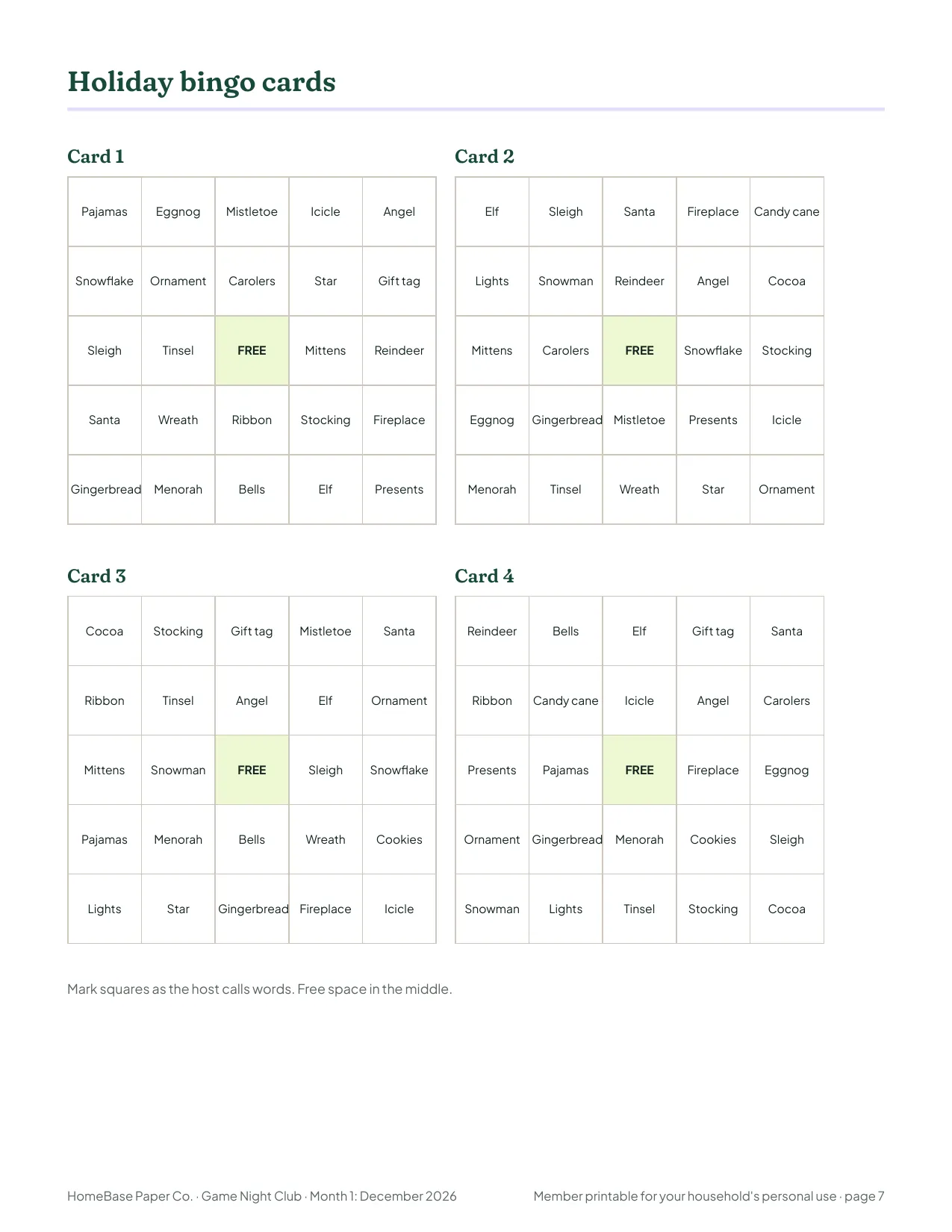
- December: Christmas party games and Christmas bingo
- Card games: for a card-game station or indoor recess, our Uno rules explain how to play and score
- Other parties: baby shower games and bridal shower games for events outside school
Printables and planners for classroom games
Printed games save time on sub days and in centers. The Christmas bingo guide shows the format: a caller sheet and a stack of different cards. You can build the same thing for vocabulary or math facts. If you teach at home, our homeschool planner helps you schedule them.
Browse more family printables on the Family & Life Admin page.
Frequently asked questions
What are good classroom games? Good classroom games are short, easy to explain and tied to a skill. Simon Says, Four Corners, Around the World, Sparkle and Hot Seat are reliable picks that need little or no prep. This guide lists 60 classroom games for grades K-8, with the grade, prep and how to play for each.
What are some fun classroom games with no prep? Simon Says, Silent Ball, Twenty Questions, Heads Up Seven Up and Stand Up, Sit Down all need no supplies. Each takes about five minutes. They work well for transitions, the last minutes of a class or a quick reset between lessons.
What are the best classroom review games? Around the World, Trashketball, Quiz Quiz Trade, Whiteboard Showdown and a Jeopardy-style board are strong review games. They turn flash cards or study questions into a contest. Swap in new questions for any subject to reuse the same game all year.
What classroom games get kids moving? Four Corners, Freeze Dance, Musical Chairs, Mirror Moves and Pass the Clap get kids out of their seats. The CDC says classroom physical activity can improve concentration and reduce fidgeting. A brief movement game after a long sit is a good use of five minutes.
What are good classroom games for kindergarten and first grade? Simon Says, Duck Duck Goose, Red Light Green Light, Freeze Dance, I Spy and Sight Word Pop suit kindergarten and first grade. Pick games with one simple rule and plenty of movement. Keep rounds short, since young children tire of long games quickly.
What are good classroom games for middle school? Silent Ball, Two Truths and a Lie, Hot Seat, a Jeopardy-style board, Paper Tower Challenge and Human Knot work well in middle school. Older students like speed, competition and a bit of humor. Keep scoring fair and give teams real roles.
What are some team-building games for the classroom? Paper Tower Challenge, Back-to-Back Drawing, Compliment Circle, Human Knot and Minute to Win It challenges build cooperation. Spend a minute afterward asking what helped the team. That conversation is where students learn the most about communication.
What indoor games can kids play when it rains? Dots and Boxes, Memory, Mystery Bag, What Changed? and paper Battleship are calm, low-supply options for indoor recess. They need little space and little noise. Keep a few in a box so a rainy day never catches you off guard.
How long should a classroom game last? A classroom game should last about five to ten minutes. The CDC describes classroom physical activity as brief periods spread across the day. Stop while students still want more, and you will keep them excited for next time.
How do I keep everyone involved in a classroom game? Use small teams, rotate roles and avoid long elimination rounds. Give each student a job, like captain, scribe or speaker, and let them rejoin with a quick task. Scoring for teamwork as well as correct answers keeps quieter students engaged.
Do kids learn from classroom games? Yes, games can reinforce skills when they are tied to learning goals. The American Academy of Pediatrics says play can improve children's abilities to plan, organize, get along with others and regulate emotions. It also helps with language, math and social skills.
What is a free printable classroom game I can use? The free Christmas bingo is a printable bingo set with a caller sheet of 48 words and 20 different cards, and you can get it by email at no cost. Use the same format for vocabulary or math facts by changing the words. For a longer school-year plan, the free teacher planner is also available by email.
Where can I find games for a classroom holiday party? Our holiday game pages cover class parties, with Thanksgiving games, Thanksgiving trivia and Christmas party games all free to read. See Thanksgiving games and Christmas party games. They include bingo and trivia that can run in a classroom.