The short answer: laundry room organization starts with emptying the room and tossing what you don't use. Set up zones for sorting, washing, treating stains, folding and hanging, with everyday supplies at arm's reach above the machines.
- Six steps: empty, sort and purge, map zones, go vertical, contain and label, reset
- Use the wall: open shelves, a hanging rod, pegboard or a drying rack
- Store supplies safely
- A five-minute reset after laundry day keeps it that way
- Next step: Plan it with the Cleaning Schedule ($4.49).
How do you organize a laundry room? Start by emptying it and tossing what you don't use, then set up simple zones for sorting, washing, treating stains, folding and hanging. Store everyday supplies at arm's reach on a shelf or rail above the machines, use the wall and the gap beside the washer for extra storage, and label bins so everyone puts things back. A five-minute reset after laundry day keeps it that way.
This guide gives you a 6-step plan to organize your laundry room in an afternoon, 30 laundry room organization ideas grouped by where they go, extra help for small laundry rooms and laundry closets, and the safety basics for storing detergent and keeping the dryer area clear. If you like a plan on paper, our Cleaning Schedule ($4.49) keeps the weekly reset on track.
I'm Malaysia, a Detroit-born mom and the oldest of three, and I've learned that the busiest rooms need the simplest systems. A laundry room works when every item has one obvious home and the people who use it can find things without asking.
How to organize a laundry room in 6 steps
Set aside two to three hours, a trash bag, a donate box and a damp cloth.
- Empty everything. Pull every bottle, bin and stray sock out of the room. Wipe the shelves, the machine tops and the floor.
- Sort and purge. Toss empty or nearly empty bottles, dried-out stain sticks and products you haven't used in a year. Donate extra hangers and baskets. Move anything that isn't laundry related, like tools or pantry overflow, to its real home if you can.
- Map your zones. Decide where you'll sort, wash, treat stains, fold and hang. Even a laundry closet has these zones; they're just stacked.
- Go vertical. Add shelves, rails, hooks and over-the-door storage before buying bins. Wall space is the most underused space in almost every laundry room.
- Contain and label. Group small items in bins or baskets, and label each one with words that match how your family talks ("stain stuff," "socks with no match").
- Set a reset routine. After each laundry day, clean the lint filter, wipe the tops, return supplies and empty the lint trash. That's the step that keeps the room organized.
Set up laundry zones
Zones turn a cluttered room into an assembly line. Here's what goes in each one:
| Zone | What it holds | Best spot |
|---|---|---|
| Sort | Hamper or three-bag sorter (darks, lights, towels) | By the door or beside the washer |
| Wash and dry | Detergent, dryer sheets or wool balls, a lint trash can | Shelf right above the machines |
| Treat | Stain remover, a scrub brush, a small bowl for soaking | Caddy or bin near the sink or washer |
| Fold | A flat surface and a basket per person | Machine tops, a countertop or a fold-down table |
| Hang | Hangers, a rod or rack for air-dry items | Wall rod, tension rod or retractable line |
| Store | Backups, seasonal items, mending kit, lint roller | Top shelf or cabinet |
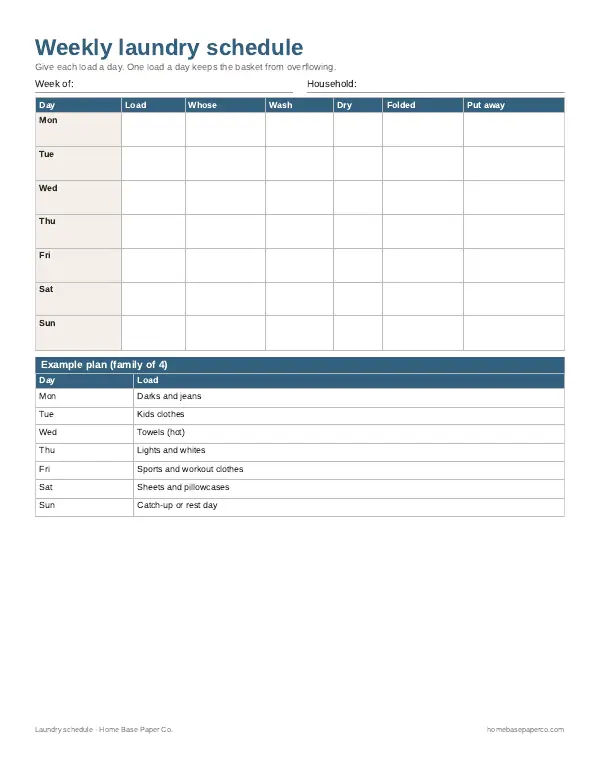
If your laundry routine itself needs help, our guide on how to do laundry covers sorting and settings, and our printable laundry schedule spreads loads across the week.
30 laundry room organization ideas
Pick the ideas that solve your biggest problem first. You don't need all 30.
Walls and vertical space
- Open shelves above the machines for daily supplies within reach.
- A hanging rod under the shelf so shirts go straight from dryer to hanger.
- Pegboard with hooks for brushes, a lint roller, scissors and a small dustpan.
- A wall-mounted accordion drying rack that folds flat when not in use.
- A retractable clothesline for delicates and swimsuits.
- Hooks for the ironing board and a steamer, so they're off the floor.
- A narrow wall cabinet for backups and anything you want behind a door.
- A wall basket or rail for dryer sheets, clothespins and mesh bags.
Above and on the machines
- A removable countertop over front-loaders for a folding surface.
- A tray on the dryer for the few things you grab every load.
- A "lost sock" bin or clip board for singles until their match turns up.
- A small dish for pocket finds like coins, hair ties and lip balm.
Between and beside the machines
- A slim rolling cart in the gap beside the washer for detergent and stain spray.
- A pull-out drawer or pedestal under front-loaders, if your machines support it.
- A gap cover or filler between machines so socks stop disappearing.
- A narrow trash can for lint and dryer sheets.
Sorting and baskets
- A three-bag rolling sorter for darks, lights and towels.
- One basket per person so clean clothes go back by owner.
- Labeled stackable hampers if floor space is tight.
- A hamper in each bedroom so sorting starts where clothes come off.
Supplies and storage
- Clear bins with labels for stain remover, delicates bags and dye catchers.
- A stain-removal caddy you can carry to the sink.
- Lazy Susan turntables in deep cabinets so bottles don't hide in the back.
- A mending kit with thread, safety pins and spare buttons.
- A backup shelf up high for refill bottles, kept separate from what's open now.
- A small first-aid style bin for lint rollers, fabric shavers and spot cleaners.
Doors, corners and renter-friendly fixes
- An over-the-door organizer with pockets for small supplies.
- Tension rods inside a closet or window frame for hanging items.
- Freestanding shelving that doesn't need drilling.
- Adhesive hooks rated for the weight to hold brooms, mops and bags.
Small laundry room organization
In a small laundry room, every inch counts, so think up and out, not across.
- Keep only weekly items in reach. Everything else goes on the top shelf or in another closet.
- Use the gap. A 6- to 8-inch rolling cart fits between many machines and the wall.
- Hang, don't pile. A rod or tension rod over the machines handles drip-dry clothes and frees the floor.
- Fold away. Wall-mounted racks, collapsible hampers and a fold-down table disappear when you're done.
- Choose one look. Matching bins and labels make a small room feel calmer, even when it's full.
Our organization hacks list has more small-space tricks that work in any room.
Laundry closet organization
A laundry closet is a laundry room stacked vertically behind a door. Treat the door as storage too:
- Add one or two sturdy shelves above the machines, or a wire shelf with a hanging rod.
- Hang an over-the-door organizer for small supplies.
- Use a tension rod at the top of the closet for hangers.
- Store a slim folding drying rack against the side wall.
- Leave breathing room around the dryer, and don't stuff the space with boxes or bags.
If your machines are in a hall closet near bedrooms, a basket per person by the closet makes putting clothes away fast.
Store laundry supplies safely
An organized laundry room should also be a safe one, especially with little ones around.
Lock up detergent and laundry packets. The U.S. Consumer Product Safety Commission warns parents about liquid laundry packets because children can mistake them for candy or toys. The agency recommends keeping them sealed in their original packaging, locked up and out of a child's sight and reach, and handling them with dry hands. If a child swallows detergent or gets it in their eyes, call Poison Help at 1-800-222-1222.
Keep products in original containers. The American Academy of Pediatrics' guide to childproofing your home for poisons lists laundry detergent, bleach and other cleaners among the items to store in a cabinet with a lock or safety latch. If you love the look of decanted detergent, label the container clearly and keep it up high.
Keep the dryer area clear. The Massachusetts Department of Fire Services' dryer fire safety tips say to clean the lint filter after every load, keep the area around the dryer clean because heat can ignite things left too close, and clean the outside vents twice a year. That means no cardboard boxes, piles of clothes or paper bags leaning on the dryer. For the full vent routine, see our guide to dryer vent cleaning.
Laundry room organization mistakes to avoid
A few common mistakes undo even a beautiful setup. Watch for these:
- Buying bins before you purge. You end up organizing products you don't use. Purge first, measure second, shop last.
- Storing everything at eye level. Prime space belongs to what you use every load. Backups and once-a-year items go up high.
- Skipping labels. Unlabeled bins turn into junk drawers within a month, especially when more than one person does laundry.
- Letting clean laundry live in the room. Baskets of clean clothes waiting to be folded become the new clutter. Fold and put away the same day, or give each person a basket to carry to their room.
- Crowding the dryer. Bins, boxes and clothing piles pushed against a hot dryer are a fire risk, not just a mess.
- Making it too complicated. If a system needs instructions, nobody will keep it up. Simple wins.
Keep your laundry room organized
Organizing is a one-time project. Staying organized is a routine. These small habits keep the room working:
| When | Task |
|---|---|
| Every load | Clean the lint filter; check pockets; return supplies to their spot |
| Weekly | Wipe machine tops; empty the lint trash; match the lost socks |
| Monthly | Run a washer cleaning cycle; check bins for empties; toss dried-out products |
| Seasonally | Clean behind the machines; check the dryer vent; donate unused hangers and baskets |
Our step-by-step guide on how to clean a washing machine covers the monthly task, and the cleaning checklist adds the laundry room to your whole-house routine. Decluttering other rooms first? Our guide on how to declutter your home has a room-by-room order.
Put your laundry room reset on paper
A system only lasts if someone remembers to run it. Writing the reset into your week makes it automatic.
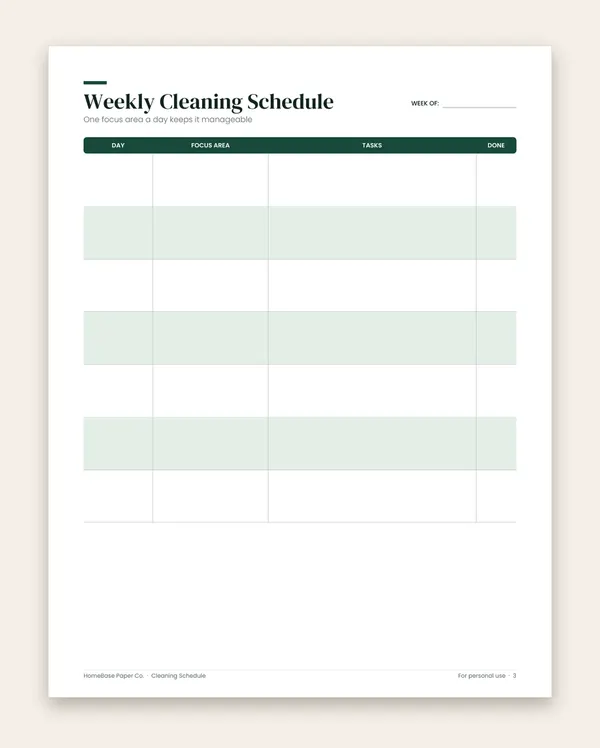
The Cleaning Schedule ($4.49) includes a daily checklist, a weekly cleaning schedule with one focus area a day, a monthly checklist, a seasonal deep-clean list, room-by-room checklists and a family chore chart. Give the laundry room its own weekly focus day, and add the monthly washer clean to the monthly list.
Want one binder for the whole house? The Home Management Bundle ($16.99, regularly $32.94 when the six items are bought separately) includes the Cleaning Schedule, the Household Binder ($6.99), a home maintenance log, a home inventory, a moving planner and a password log. You'll find more planners on our Printables page and money-saving sets on our Bundles page.
Before restocking the shelf, use our laundry detergent picks and dosing guide to match the formula to your washer and household.
Starter version: organize your laundry room this weekend
- Empty the room, wipe every surface and toss what's empty or unused.
- Put daily supplies on one shelf above the machines.
- Add one storage upgrade that fixes your biggest problem: a shelf, a slim rolling cart or a hanging rod.
- Set out a sorter and one basket per person.
- Lock detergent and packets up high, and clear anything that can burn away from the dryer.
- Schedule a five-minute reset after every laundry day.
The best laundry room organization is the system your family actually uses. Start with one shelf and one routine, and build from there.
Make it easier
Tools for this

Printables
Cleaning Schedule
Daily, weekly, monthly and seasonal lists - plus a family chore chart.
 Save 48%
Bundles
Home Management Bundle
Household binder, maintenance log, moving planner, cleaning schedule, home inventory and password log.

Printables
Household Binder
Family info, emergency plan, calendars, meals, groceries, cleaning, bills and sitter notes.
Frequently asked questions
How do I organize my laundry room? To organize your laundry room, empty it, toss what you don't use, set up zones for sorting, washing, treating stains, folding and hanging, then store supplies on shelves or rails above the machines and label everything. Keep it that way with a simple routine on the HomeBase Cleaning Schedule ($4.49), so the room gets a quick reset every week.
How do you organize a small laundry room? Organize a small laundry room by going vertical: add a shelf or two above the machines, a slim rolling cart in the gap beside them, hooks or a tension rod for hanging clothes, and over-the-door storage. Keep only the products you use every week within reach, and store backups elsewhere.
What should be stored in a laundry room? A laundry room should hold what you use for laundry: detergent, stain remover, dryer sheets or wool balls, a hamper or sorter, hangers, a lint roller, a mending kit and a small trash can for lint. Extra cleaning supplies, pet items or tools can live there too, as long as each has a labeled spot and doesn't crowd the dryer.
How do I organize a laundry closet? To organize a laundry closet, install one or two shelves above the machines, hang a door organizer for small supplies, use a tension rod for drip-dry items, and keep a rolling cart or narrow bin beside the washer. Leave space around the dryer so air can flow and nothing sits against the hot cabinet.
How can I add storage to a laundry room without drilling? You can add laundry room storage without drilling by using freestanding shelving, a rolling slim cart, over-the-door organizers, adhesive hooks rated for the weight, tension rods and stackable bins on top of the machines. These options work well for renters and can move with you.
What is the best way to store laundry detergent? The best way to store laundry detergent is in its original container, closed tightly, on a high shelf or in a cabinet that locks if you have young children. The CPSC urges families to keep single-load liquid laundry packets sealed in their packaging, locked up, and out of children's sight and reach.
Should I decant laundry detergent into jars? Decanting detergent into jars looks tidy, but keep the original label information and use a container with a child-resistant closure if children are in the home. Safety guidance from the CPSC and the AAP is to keep laundry products in their original containers, so if you decant, label the jar clearly and store it up high.
How do you organize laundry supplies? Organize laundry supplies by how often you use them: everyday detergent and stain spray at arm's reach, weekly items like bleach or delicates bags on the next shelf, and backups or seasonal items up top. Group small things in labeled bins so nothing tips over or gets lost behind the machines.
Where should I put a drying rack in a small laundry room? Put a drying rack where it can fold away, such as a wall-mounted accordion rack, a retractable clothesline, or a folding rack that slides beside the washer. A tension rod or ceiling-mounted bar over the machines also works for hanging shirts and air-dry items.
How do I keep my laundry room organized? Keep a laundry room organized with a five-minute reset after each laundry day: clean the lint filter, wipe the machine tops, return supplies to their spots and empty the lint trash. Add the reset to your weekly plan on the HomeBase Cleaning Schedule ($4.49), which has a weekly cleaning schedule page with one focus area a day.
What can I put on top of my washer and dryer? On top of a front-load washer and dryer, you can add a removable countertop or folding board, a tray for daily supplies, or a basket for clean socks. Keep anything that can burn, like boxes and piles of clothes, away from the dryer, and don't block vents or controls.
How do you sort laundry in a small space? Sort laundry in a small space with a slim three-bag rolling sorter, stackable hampers, or separate hampers in each bedroom labeled darks, lights and towels. Sorting where clothes come off means laundry day starts with ready-to-wash loads instead of a big pile.
How often should I clean my laundry room? Give your laundry room a quick reset weekly and a deeper clean monthly or seasonally. Clean the dryer lint filter after every load, and Massachusetts fire officials recommend cleaning the outside dryer vents twice a year to clear built-up lint.
What is a good laundry room organization budget? A good laundry room organization budget starts with what you already own: bins, baskets, jars and hooks from around the house. Then buy one or two items that fix your biggest problem, such as a shelf above the machines or a slim rolling cart, before adding anything decorative.
How do I organize a laundry room with a household binder? A household binder keeps the laundry routine, chore assignments and care notes in one place everyone can find. The HomeBase Household Binder ($6.99) includes family information, calendars, a cleaning routine and sitter notes, and it's also part of the Home Management Bundle ($16.99).
More from HomeBase
You may also like

Printables
Home Maintenance Log
Monthly, seasonal and annual checklists plus a record of every appliance and repair.

Printables
Home Inventory
Printable pages and a spreadsheet that totals the value of every room.

Printables
Vehicle Maintenance Log
Oil changes, repairs, tires, fuel and MPG, trip mileage and renewal dates - so resale and warranty records are easy.

 Club
Monthly club
Planner & Calendar Club
Anyone who wants a monthly calendar, bill calendar and meal plan ready to print.
Free printable
One load a day keeps the basket from overflowing
A weekly laundry schedule plus a how-often-to-wash guide. You'll also get our weekly HomeBase email with simple cleaning routines and chore ideas the whole family can help with.