The short answer: dryer vent cleaning means clearing lint out of the duct that carries hot air from your dryer to the outside, not just emptying the lint screen. Lint is flammable.
- Signs of a clog: clothes need two cycles or the laundry room feels very hot
- 8 steps: unplug, pull the dryer out, disconnect the duct and brush it from the inside
- How often to clean, by part
- DIY or hire a pro, and how to tell the cleaning worked
- Next step: Plan it with the Home Maintenance Log ($5.99).
Dryer vent cleaning means clearing lint out of the duct that carries hot air from your dryer to the outside, not just emptying the lint screen. It matters because lint is flammable: the U.S. Fire Administration reports that failure to clean was the leading factor in home clothes dryer fires from 2018 to 2020, at 31 percent. Here is how to tell your vent is clogged, how to clean it yourself step by step, how often to do it and when to call a professional.
Our Home Maintenance Log printable has monthly, seasonal and annual checklists plus service and repair records, so the date of the last vent cleaning is written down.

Why dryer vent cleaning matters
The National Fire Protection Association's report on home fires involving clothes dryers estimated about 13,820 home dryer fires a year from 2014 to 2018, causing 7 deaths, 344 injuries and $233 million in property damage each year. Failure to clean was the leading factor, in 32 percent of them, and dust, fiber or lint was the item that first caught fire in 27 percent.
A clogged vent also costs money. When hot, damp air cannot escape, clothes take longer to dry, the dryer runs longer and parts like the heating element and thermal fuse wear out sooner.
Signs your dryer vent is clogged
| Sign | What it means |
|---|---|
| Clothes need two cycles to dry | Moist air is not leaving the drum |
| Dryer top or laundry room feels very hot | Heat is backing up |
| Burning smell during a cycle | Lint may be overheating; stop and check |
| Lint around the door seal or on the floor behind | Air is escaping where it should not |
| Outside vent flap barely opens | Airflow is weak or blocked |
| Lint or a bird nest at the outside hood | The exit is restricted |
If you smell burning, stop the dryer, unplug it and do not use it until the vent is cleared.
How to clean a dryer vent in 8 steps
- Unplug the dryer. For a gas dryer, also turn off the gas valve.
- Pull the dryer away from the wall carefully, without kinking the duct or gas line.
- Disconnect the duct from the back of the dryer by loosening the clamp.
- Vacuum the dryer outlet and the floor, wall and back panel. The USFA dryer safety flyer reminds you not to forget the back of the dryer, where lint builds up.
- Brush the duct from the inside. Feed a vent brush on flexible rods into the wall duct, twisting as you go, and pull out lint. Vacuum as you work.
- Clean from the outside. Remove the outdoor vent cover, clear lint and debris, and brush inward.
- Check the duct. The flyer says to make sure the venting system is not damaged, crushed or restricted. Replace plastic or foil duct with metal.
- Reconnect and test. Reattach with a clamp or foil tape (not screws, which catch lint), push the dryer back without crushing the duct, run it on air-only and check that the outside flap opens.
How often to clean, by part
| Part | How often |
|---|---|
| Lint filter | Before and after every load |
| Lint filter wash (soap and water) | Every few months, or if dryer sheets leave a film |
| Area behind and under the dryer | Every few months |
| Full vent duct | At least once a year, more for heavy use |
| Outside vent hood | Check every season |
| Professional inspection | Long or roof vents, or after any warning sign |
The USFA says to clean the lint filter before and after each cycle and never to use the dryer without it. The yearly duct schedule is a common rule of thumb rather than a legal requirement, so check your dryer manual.
DIY or hire a professional?
You can usually do it yourself if the vent is short (a few feet straight to an outside wall), you can reach both ends and the duct is in good shape. Consider a professional if:
- the vent runs through an attic, crawlspace or to the roof;
- the run is long or has several bends;
- you find a crushed or disconnected duct inside a wall;
- a bird or rodent nest is in the vent;
- clothes still dry slowly after you have cleaned it.
The flyer also recommends having your dryer installed and serviced by a professional.
Other dryer safety habits
While you are in the laundry room, our guide on how to clean a washing machine shows how to stop mold and odors in the washer.
- Do not run the dryer when you are asleep or away from home.
- Keep the area around the dryer clear of boxes, clothes and cleaning products.
- Do not dry items stained with gasoline, cooking oil or other flammable liquids without washing them well first, and follow the label. Here's how to get oil out of clothes before they go in the dryer.
- Make sure the outdoor vent cover opens when the dryer is running.
- Keep a working smoke alarm nearby and a carbon monoxide alarm if you have a gas dryer.
How to clean dryer vent from the outside
The outside end of the duct clogs too, and it is the part most people skip. With the dryer unplugged:
- Find the exterior hood. It is usually on a wall near the laundry room, but it can also be on the roof, under a deck or in a soffit.
- Take off the cover if it unscrews or unclips. Many building codes do not allow a screen on a dryer exhaust hood because screens catch lint. If yours has one, ask a contractor about a hood with a simple flap instead.
- Pull out the lint you can reach with a gloved hand, then vacuum the opening.
- Brush inward toward the dryer with your rods, then go back inside and vacuum what came loose.
- Check the flap. It should swing freely and close when the dryer is off, so birds and rodents cannot move in.
If the vent comes out on the roof, do not climb a steep, wet or high roof to reach it. A roof vent is the most common reason to hire a professional.
Choosing a dryer vent cleaning kit
A dryer vent cleaning kit is a set of flexible rods that screw together, a brush head and sometimes a drill adapter and a lint trap brush. Here is what each part is for:
| Kit part | What it does | What to check |
|---|---|---|
| Flexible rod sections | Let the brush reach the full length of the duct | Total length should be a little longer than your vent run. |
| Brush head | Loosens lint stuck to the duct walls | Soft nylon bristles are gentler on foil and semi-rigid duct. |
| Drill adapter | Spins the rods for faster cleaning | Run the drill slowly and only in the direction the instructions give, so rod sections do not unscrew inside the duct. |
| Lint trap brush | Reaches the slot under the lint screen | Long and narrow enough for your dryer's opening. |
| Vacuum attachment | Pulls loose lint out | Fits your vacuum hose. |
Measure your vent run before you buy. A kit that is too short only cleans the first few feet, which is where you can already see.
Dryer vent cleaning cost: what changes the price
Prices for a professional visit vary by region, so the most useful thing to know is what pushes a quote up or down:
| Factor | Why it matters |
|---|---|
| Length and number of bends | Longer runs with turns take more time and tools. |
| Roof or second-story exit | Needs ladders, roof access and extra safety steps. |
| Bird or rodent nest | Takes extra time to clear and may need a new hood. |
| Crushed, plastic or foil duct | Replacing it with metal duct adds parts and labor. |
| Camera inspection or airflow test | Shows the duct is clear end to end. |
Ask two or three companies for written quotes that say what is included, such as both ends of the duct, the space behind the dryer, reconnecting the duct and an airflow check. Ask whether the price is for the dryer vent alone or bundled with other services. For a short, straight wall vent, a brush kit usually costs less than a single service visit and can be used for years.
How often to clean dryer vent for your household
The once-a-year rule is a starting point. Adjust it to how hard your dryer works:
| Household | Suggested full vent cleaning |
|---|---|
| 1 or 2 people, short wall vent | About once a year. |
| Large family or several loads a day | About every 6 months. |
| Pets that shed | Every 6 to 12 months, and clean the lint screen more often. |
| Long run, attic or roof vent | Every 6 to 12 months, with a professional check. |
| After a remodel, a nest or a warning sign | Right away. |
How to tell the cleaning worked
Time a normal load before you clean, then time it again afterwards. After a good cleaning, a regular load should dry in one cycle, the outside flap should open fully with a strong, warm airflow and the top of the dryer should feel warm rather than hot. If none of that changes, there may be a crushed section or a blockage you could not reach, and it is worth having a professional look.
Keep a record so it actually gets done
A yearly job is easy to forget. Writing it down turns it into a routine. The Home Maintenance Log ($5.99, printable PDF) has monthly, seasonal and annual checklists, an Appliance Log for your dryer's model, purchase date and warranty, Service & Repair Records for each cleaning, Contractor Contacts for the vent service you used and pages for home details. Add "dryer vent" to the fall list so it is done before winter. A bound Home Maintenance Log paperback version is planned; it isn't on Amazon yet, and its page has a Notify me button for one email when it can be ordered.
For the rest of the year's jobs, see our home maintenance checklist, the deep cleaning checklist and the property maintenance log template.
Make it easier
Tools for this

Printables
Home Maintenance Log
Monthly, seasonal and annual checklists plus a record of every appliance and repair.
Frequently asked questions
How often should you do dryer vent cleaning? A common rule of thumb is dryer vent cleaning at least once a year, and more often for large families, long vent runs or homes with pets. The lint filter is different: the U.S. Fire Administration says to clean it before and after every load. Check your dryer manual too, since some manufacturers give their own schedule.
Can a clogged dryer vent cause a fire? Yes, a clogged dryer vent can cause a fire because lint is highly flammable and trapped heat has nowhere to go. NFPA found failure to clean was the leading factor in home dryer fires, at 32 percent, and dust, fiber or lint was the item first ignited in 27 percent. The U.S. Fire Administration reports a similar 31 percent for 2018 to 2020.
What are the signs that a dryer vent needs cleaning? The main signs that a dryer vent needs cleaning are clothes taking more than one cycle to dry, the dryer or laundry room feeling very hot, a burning smell, lint collecting around the door or outside vent hood, and an outdoor flap that barely moves while the dryer runs. Any of these means it is time to clean the full duct.
Can I clean my dryer vent myself? Yes, most people can clean a short, straight dryer vent themselves with a vent brush kit and a vacuum in about an hour. Unplug the dryer (and shut off gas for a gas dryer), pull it out, disconnect the duct, brush from both ends and vacuum the lint. Long runs, roof vents or crushed ducts are better left to a professional.
What tools do I need for dryer vent cleaning? For dryer vent cleaning you need a dryer vent brush kit with flexible extension rods, a shop vacuum or vacuum with a crevice tool, a screwdriver or nut driver for the clamps, foil tape for reconnecting, and gloves. A lint trap brush helps with the filter slot. If the old duct is plastic or vinyl foil, buy a metal replacement while you are at it. To remember when you last did it, note the date in the Home Maintenance Log ($5.99 printable).
How long does dryer vent cleaning take? Dryer vent cleaning usually takes about 30 minutes to an hour for a typical short vent, including moving the dryer, brushing, vacuuming and reconnecting. A long run through an attic or a roof vent can take longer. Professionals often finish in about the same time but have rotary tools and cameras for difficult runs.
What kind of dryer duct is safest? Rigid or semi-rigid metal duct is the safest kind of dryer duct because its smooth walls catch less lint and it does not crush easily. Plastic and vinyl foil ducts trap lint and can melt, and many dryer manufacturers and local codes no longer allow them. Keep the run as short and straight as possible.
Should I clean behind the dryer too? Yes, clean behind the dryer too, because lint collects on the floor, the back panel and inside the cabinet where you cannot see it. The U.S. Fire Administration specifically says not to forget the back of the dryer. Unplug it first, pull it out and vacuum the floor, wall and the area around the cord and duct.
Do gas dryers need vent cleaning too? Yes, gas dryers need vent cleaning just as much as electric ones, and a blocked vent on a gas dryer can also push carbon monoxide back into the home. Turn off the gas valve before moving the dryer and be gentle with the gas line. Make sure you have a working carbon monoxide alarm near the laundry area.
How do I keep track of when the dryer vent was cleaned? Write the date, what you did and who did it in a home maintenance record every time you clean the dryer vent. The Home Maintenance Log ($5.99 printable) has seasonal and annual checklists plus Service & Repair Records and an Appliance Log, so you can see at a glance when the vent was last done and set the next date.
When do most dryer fires happen? Most dryer fires happen in winter, when heavy clothes and bedding mean more loads and longer cycles. U.S. Fire Administration data for 2008 to 2010 showed residential dryer fires peaked in January. That makes late fall a good time to schedule a full dryer vent cleaning before the busiest months.
How much does dryer vent cleaning cost? Dryer vent cleaning cost varies by area, but a short wall vent is usually a quick visit of under an hour, while a roof exit, a long attic run, nest removal or duct replacement adds to the price. Ask two or three companies for written quotes that list what is included, such as both ends of the duct, the area behind the dryer and an airflow check.
Is a dryer vent cleaning kit worth it? Yes, a dryer vent cleaning kit is worth it for most short, reachable vents, because it usually costs less than one professional visit and can be reused every year. Buy a kit with enough rod sections to reach the full length of your duct. For roof vents, long attic runs or crushed ducts, a professional is the better choice.
How do you clean a dryer vent from the outside? To clean a dryer vent from the outside, unplug the dryer, remove the exterior hood cover, pull out lint by hand with gloves, vacuum the opening and brush inward toward the dryer with flexible rods. Then vacuum the loosened lint from the inside end and check that the outside flap swings freely and closes when the dryer is off.
Can you use a leaf blower to clean a dryer vent? Not as your only tool: a leaf blower can push loose lint out, but it does not scrub off lint stuck to the duct walls and it can blow debris back into the dryer if the duct is still connected. Brush the duct first, disconnect it from the dryer, and only then use air to clear what is left, wearing eye protection.
How do I know my dryer vent cleaning worked? Your dryer vent cleaning worked if a normal load now dries in one cycle, the outside flap opens fully with strong airflow and the top of the dryer feels warm rather than hot. Time a load before and after you clean to compare. If nothing changes, a crushed section or a blockage may be out of reach.
More from HomeBase
You may also like

Printables
Household Binder
Family info, emergency plan, calendars, meals, groceries, cleaning, bills and sitter notes.

Printables
Cleaning Schedule
Daily, weekly, monthly and seasonal lists - plus a family chore chart.

Printables
Home Inventory
Printable pages and a spreadsheet that totals the value of every room.
 Save 48%
Bundles
Home Management Bundle
Household binder, maintenance log, moving planner, cleaning schedule, home inventory and password log.
 Club
Monthly club
Planner & Calendar Club
Anyone who wants a monthly calendar, bill calendar and meal plan ready to print.
Free printable
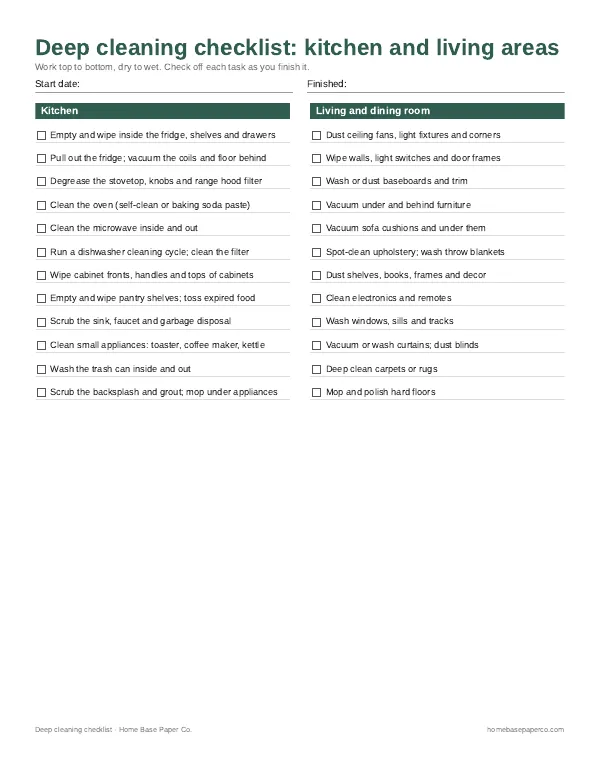
Clean the whole house in order: get the free deep cleaning checklist
A printable room-by-room deep cleaning checklist that tells you what to do first, so nothing gets cleaned twice. You'll also get our weekly HomeBase email with simple cleaning routines and chore ideas the whole family can help with.