

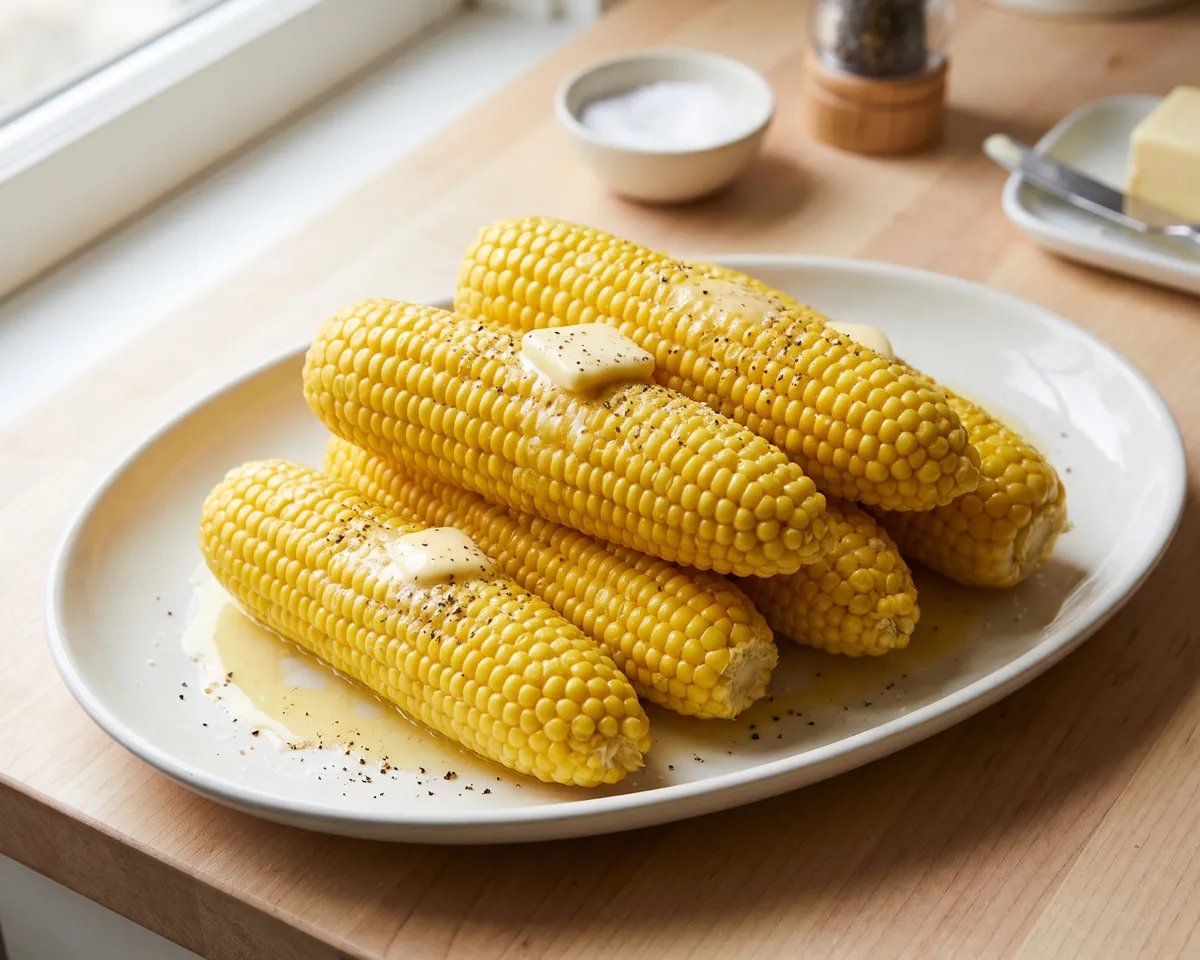
The short answer: boil fresh, shucked corn on the cob for 3 to 5 minutes after the water returns to a boil. Corn still in the husk needs about 10 minutes, and frozen cobs need 5 to 8 minutes.
- Key numbers: large pot · at least 6 cups of water · 3 to 5 minutes for fresh ears · 10 minutes in the husk · 5 to 8 minutes frozen · 3 to 4 days in the fridge
- Done test: bright yellow, plump kernels that burst when pierced
Prep time: 5 minCook time: 15 minTotal time: 20 minServings: 4 servingsFresh-corn recipe: cooking allows about 10 minutes to bring water to a boil plus up to 5 minutes boiling corn. Frozen ears need up to 3 minutes more; stove and pot size change the total..
This boiling guide was rebuilt November 16, 2026. The historical grocery-price example below retains its November 4 check date; it is not a quote for today’s store prices. The sections below cover a boil-time chart for every kind of corn, step-by-step boiling, batch sizes, butter and toppings, cost per ear, nutrition and storage.
Corn on the cob boil time chart
Start the timer when the water comes back to a full boil after the corn goes in.
| Type of corn | Boil time | Notes |
|---|---|---|
| Fresh summer corn, shucked | 3 to 4 minutes | Sweetest and most tender; needs the least time |
| Grocery store corn, shucked | 4 to 5 minutes | Most supermarket ears land here |
| Older or starchy ears, shucked | 5 to 7 minutes | Taste a kernel at 5 minutes |
| Corn in the husk | About 10 minutes | Husk insulates the kernels; peel after cooling slightly |
| Frozen corn on the cob | 5 to 8 minutes | Cook straight from frozen, no thawing |
| Frozen cut kernels | 2 to 3 minutes | Drain well before buttering |
| Mini or halved cobs | 3 to 4 minutes | Snapped halves cook a little faster |
| Cold-water start | 1 to 2 minutes after boiling | Put ears in cold water, bring to a boil, then time |
| Keep-warm hold | Up to 10 minutes off heat | Turn the burner off and cover the pot |
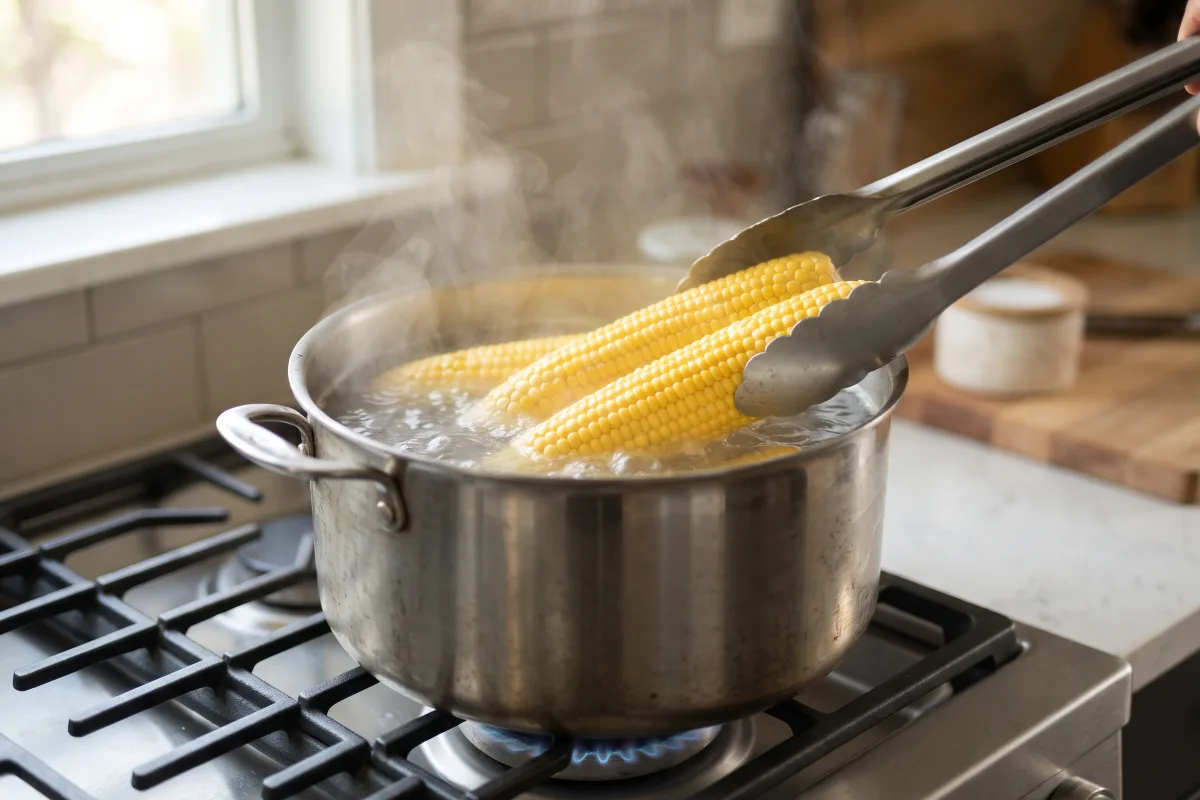
Why boiling times differ
Freshness, ear size, the husk and the starting temperature all affect when corn is ready. This page’s existing chart uses 3 to 5 minutes for fresh shucked ears and 5 to 8 for frozen cobs. Begin checking rather than treating the last minute as a requirement. Frozen kernels are a different product from a dense frozen cob, so do not give them the same time.
Iowa State University Extension’s preparation guide uses 5 to 6 minutes for shucked fresh corn. That is a useful reminder that recipes give ranges, not a universal finish time. Use a tender kernel and a hot center as your final check. “Husked” and “shucked” both mean the leaves have been removed; “in the husk” means they remain on the ear.
For packaged frozen corn, the manufacturer’s instructions take priority over this general chart, especially if the bag specifies a cold-water start. Start methods have different clocks: a recipe timed after boiling cannot be compared directly with a total that includes heating cold water.
How to pick, shuck and de-silk corn
- Pick: Iowa State University Extension’s guide above says to choose ears with a bright green husk and, after peeling the husk back, kernels that are evenly spaced and plump. Look for damp, tight husks and avoid dry, yellow or brown ones.
- Store: with the husk on, keep ears uncovered in the refrigerator for 1 to 2 days; husked ears go in tightly wrapped plastic for 1 to 2 days, per the same extension page.
- Shuck: remove the outer husk and the silky strings, break off the stalk at the base and rinse under cool running water.
- Silk that will not come off: rub the ear with a damp paper towel, or boil it in the husk and pull the husk and silk off together once it has cooled enough to handle.
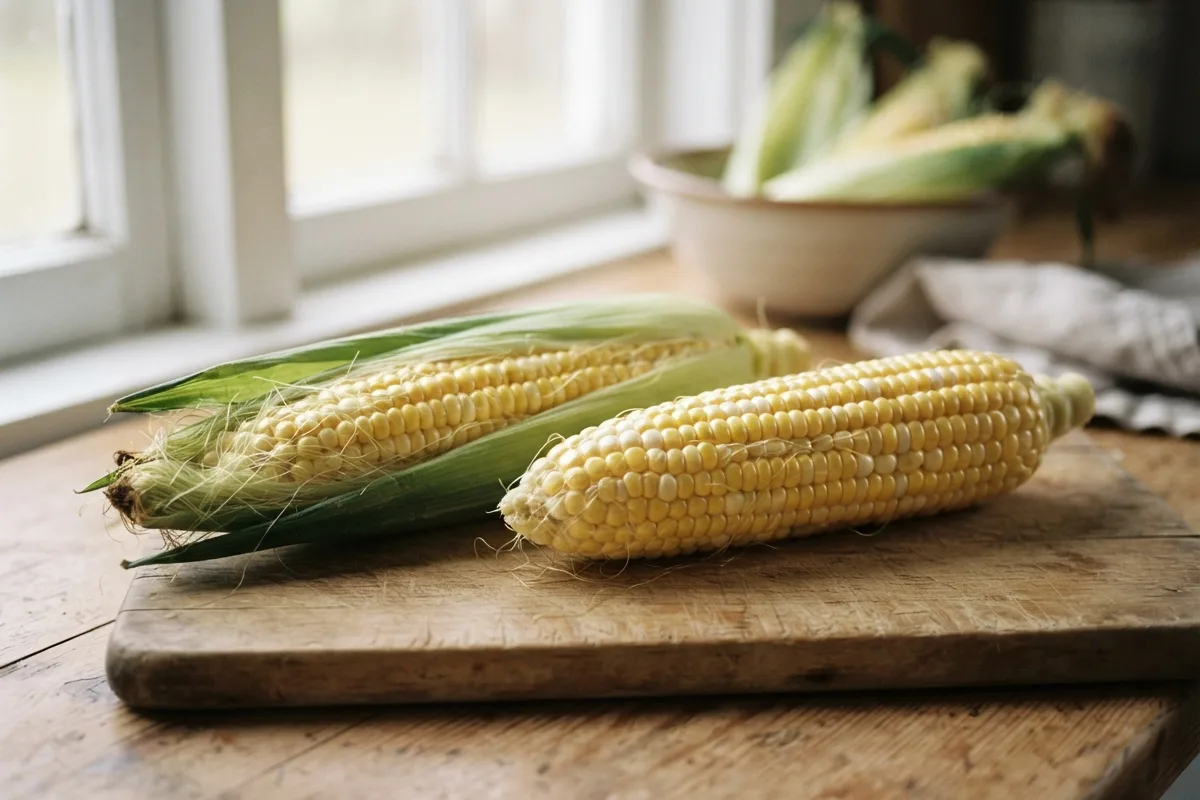
Corn on the cob ingredients: 4 servings
The measured base recipe uses the fresh-corn method below. One serving is one ear; use the frozen timing section for frozen ears. Water is the cooking medium and is drained away.
| Ingredient | Amount | Notes |
|---|---|---|
| Fresh corn on the cob | 4 ears | Remove husks and silk; halve only if needed to fit |
| Water | 8 cups | Use a pot that holds the ears below the water, with room to prevent overflow |
| Butter | 2 tablespoons | The existing cost example uses 1/2 tablespoon per ear |
| Salt and black pepper | To taste | Add at the table; use olive oil or dairy-free butter if needed |
Equipment: a large pot, lid, tongs and a serving plate. Dry the outside of the pot before it goes on the burner. Keep the handles turned away from the edge and lower ears gently so the water does not splash.
How to boil corn on the cob, step by step
- Shuck the corn. Pull the husks down and snap them off at the stem, then rub away the silk with your hands or a damp paper towel.
- Fill a large pot. For the base recipe use 8 cups of water for 4 ears, adjusting the water or cooking in batches so the ears can be submerged without filling the pot to the rim.
- Bring the water to a rolling boil. Allow about 10 minutes for the water to heat as a planning estimate; the actual time depends on your stove, pot and water temperature. Leave the water plain.
- Add the corn. Lower the ears in with tongs. Snap long ears in half if they do not fit.
- Start timing when the boil returns. Cook 3 to 5 minutes for fresh shucked corn, using the chart above for husked or frozen ears.
- Check a kernel. Pierce one with a knife tip. It should burst with juice and look glossy and bright.
- Lift out and butter right away. Let excess water drain, then spread the 2 tablespoons of butter across the 4 ears and season to taste while hot.
Rate this recipe
How long to boil frozen corn on the cob: 5-8 minutes
Frozen cobs go straight into the pot, with no thawing needed.
- Bring a large pot of water to a rolling boil, enough to cover the ears completely.
- Add the frozen cobs and wait for the water to return to a boil. This is when the timer starts.
- Cook 5 to 8 minutes. Smaller, thinner cobs sit near 5 minutes and thick, fully frozen ears near 8.
- Test a kernel. It should be hot all the way through, plump and bright yellow.
- Drain, butter and serve right away.
If the cobs have partly thawed in the fridge, start checking at 4 minutes. Frozen cut kernels are different: they need only 2 to 3 minutes, so don't use the cob time for a bag of kernels.
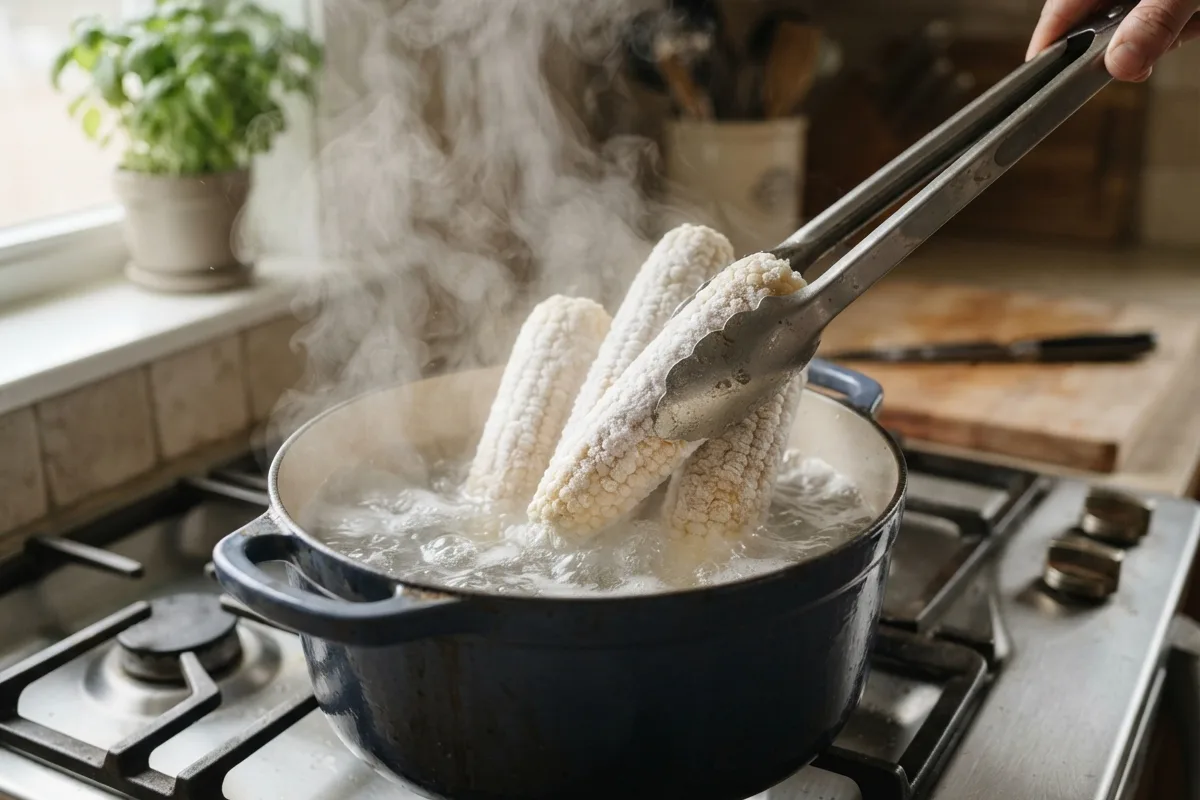
If you would rather use the air fryer
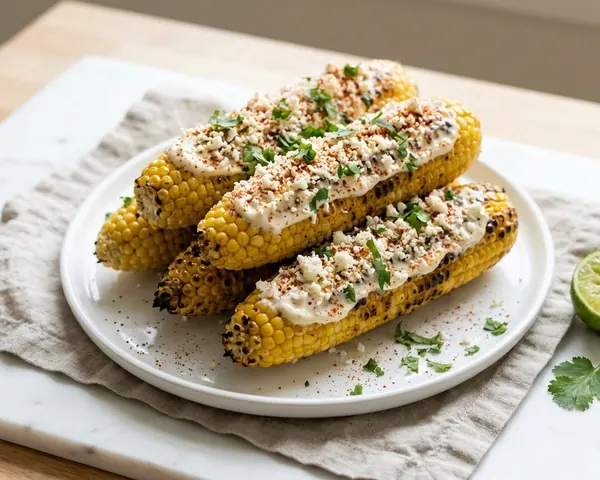
An air fryer gives corn browned patches instead of the evenly moist surface of boiled corn. Use an appliance-specific recipe or your frozen-corn package instructions, arrange the ears in a single layer and turn them as directed. An air-fryer time is not interchangeable with the boiling time above. For a charred topping-style dish, use our Mexican street corn recipe instead of changing this pot method midway through cooking.
Other ways to cook it: off the heat and in the microwave
- Off-heat method (hands-off): bring the pot to a boil, add the ears, cover, turn the burner off and let it sit for about 10 minutes. This is an alternative to continuous boiling, not extra cooking after a full boil-time cycle. Test tenderness before serving and avoid an indefinite warm-water hold.
- Microwave: Iowa State University Extension’s guide above says to put 2 to 4 husked ears in a microwave-safe baking dish with 1/3 cup of water, cover with plastic wrap leaving one corner open, and cook on high for 3 minutes per ear (12 minutes for 4 ears).
- Air fryer: see the times above.
How to tell corn on the cob is done
- Color: kernels turn a brighter yellow (or white, for white corn) and look plump and glossy.
- Pierce test: a kernel pierced with a knife tip or fork bursts with juice and is tender, not doughy.
- Bite test: the first bite should snap and be sweet. Kernels that look dented or wrinkled have cooked too long.
Overcooking is the main failure. If the kernels are already tender, take the ears out rather than leaving them boiling while the rest of dinner finishes. Color alone is unreliable for white or mixed-color varieties, so use tenderness and heat as well.
How many ears to cook at once
Crowding the pot drops the water temperature, so the corn sits in warm water instead of boiling. These batch sizes keep the boil steady:
| Pot check | What to do | Why it helps |
|---|---|---|
| Ears stick above the water | Halve them or use fewer ears | Every ear needs contact with hot water |
| Water would overflow when corn is added | Take water out before adding the corn | Leaves space for displacement and bubbling |
| Boil takes a long time to recover | Make a smaller batch | Keeps the timing easier to judge |
| Dinner needs more than one batch | Arrange a safe holding plan before starting | Avoids a pile of cooling ears on the counter |
For a crowd, keep the recipe’s doneness test for every batch rather than multiplying the boiling time by the number of ears. Do not assume an insulated cooler keeps food safely hot: check the holding temperature or serve the finished batch promptly.
Newsletter
3 easy dinners a week
Get three emails a week, Mon/Wed/Fri, with easy dinner ideas from HomeBase.
Salt, sugar or milk in the water?
You do not need any of them. Many cooks skip salt in the water and salt at the table instead, where you can taste it. A spoonful of sugar can help older ears taste sweeter. Some cooks add a splash of milk and a pat of butter to the pot for richer, creamier corn, which is a nice touch for a holiday table but not required.
Butter and topping ideas
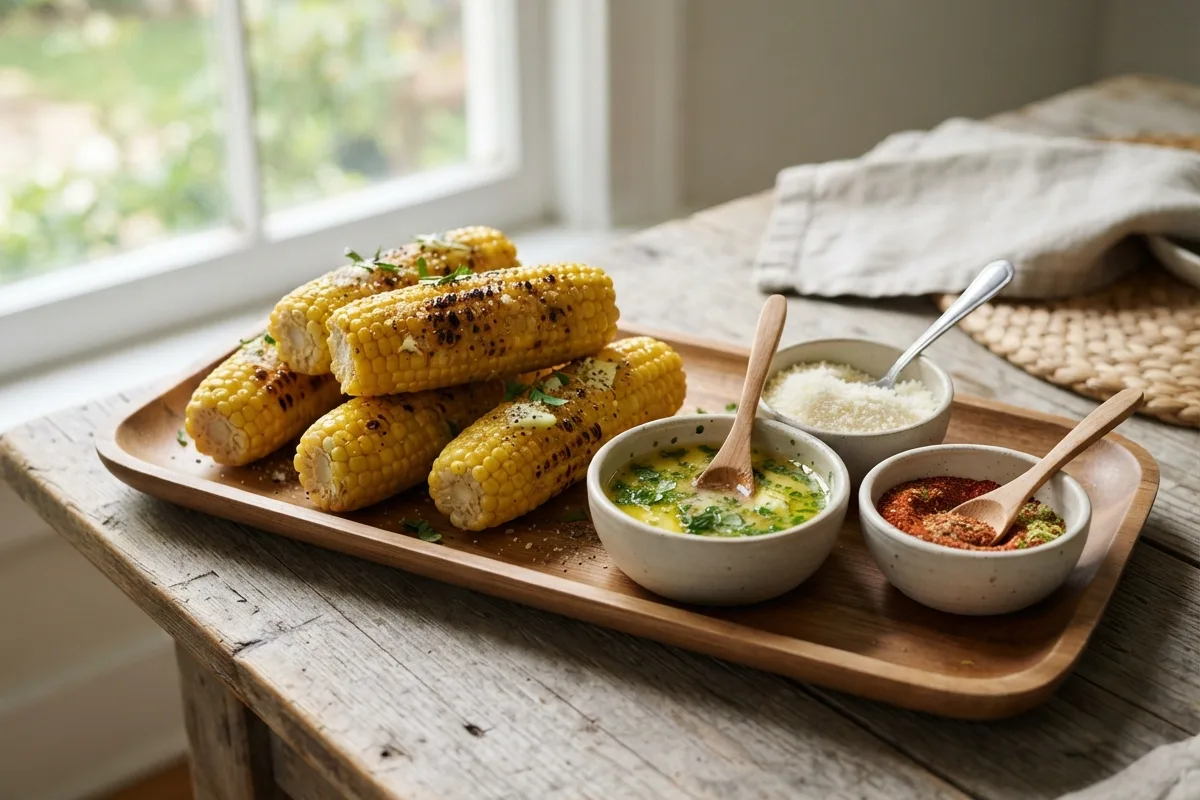
Plain butter and salt is the classic, but corn takes almost any flavor. Roll a hot ear in one of these:
| Topping | What to mix |
|---|---|
| Garlic herb butter | 2 tbsp soft butter, 1 minced garlic clove, chopped parsley |
| Chili lime | Butter, lime zest and juice, chili powder, salt |
| Street corn style | Mayo, cotija, chili powder, lime; see our Mexican street corn recipe |
| Parmesan | Butter, finely grated Parmesan, black pepper |
| Honey butter | 2 tbsp butter, 1 tsp honey, pinch of salt |
| Cajun | Butter, Cajun seasoning, a squeeze of lemon |
| Everything bagel | Butter, everything bagel seasoning |
| Brown butter and sage | Butter cooked until nutty, with crisp sage leaves |
| Pesto | A thin swipe of basil pesto |
| Smoked paprika | Butter, smoked paprika, flaky salt |
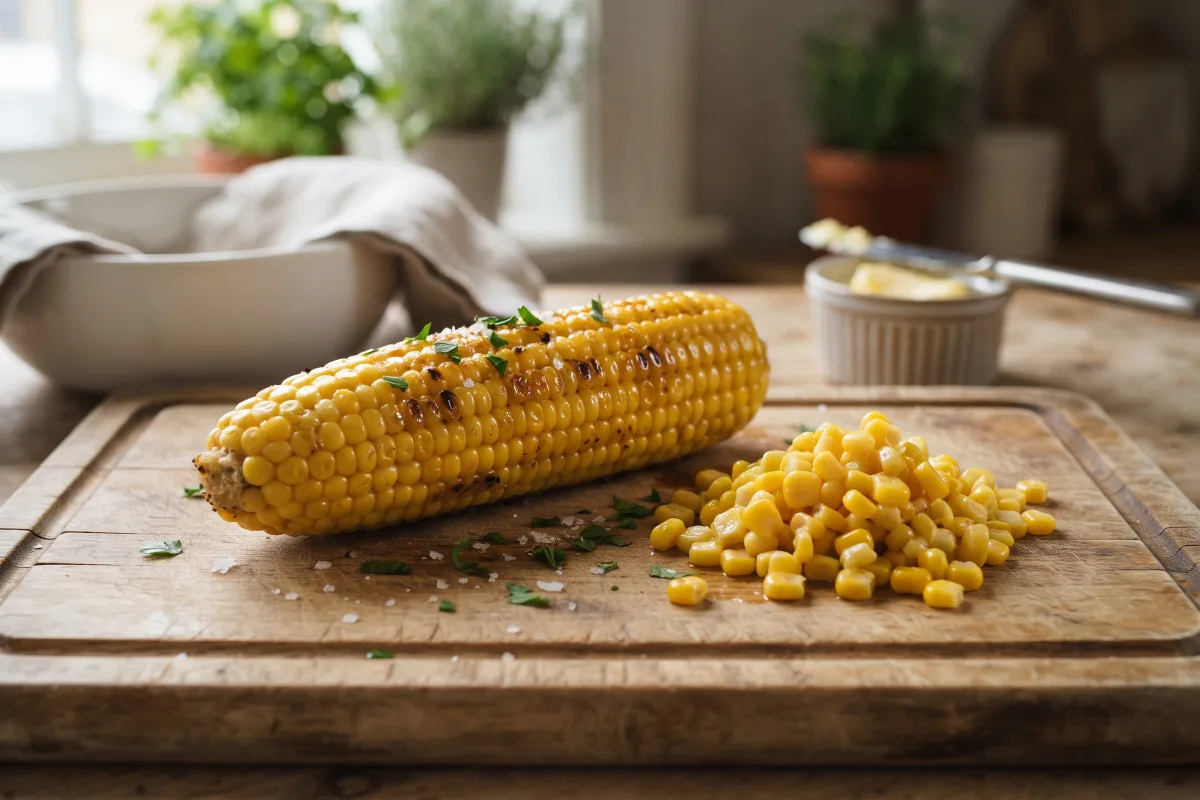
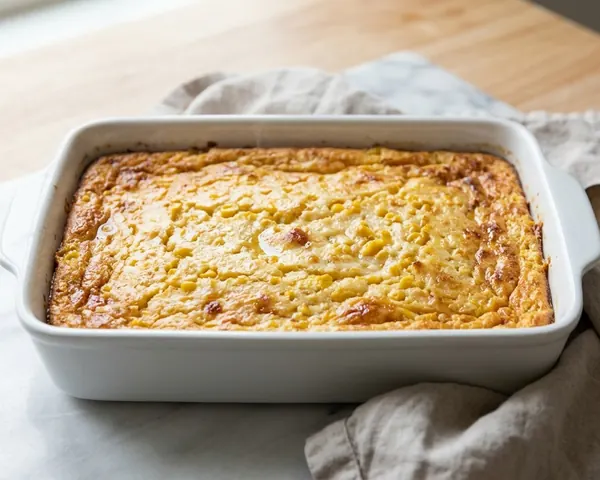
Leftover kernels are great in a corn casserole, stirred into cornbread batter or folded into a potato salad.
7 corn on the cob boiling mistakes to avoid
- Over-seasoning the water. Plain water keeps this method consistent; salt the finished ear where you can taste it. Cooks disagree about salting the pot, so it is not a required step.
- Starting the timer too early. Time from when the water returns to a boil, not from when the corn goes in.
- Overcrowding the pot. Too many ears drop the water temperature and lengthen the cook time; use the batch table above.
- Boiling for 15 minutes "to be safe." Corn is cooked in minutes, and long boiling makes it mushy.
- Thawing frozen cobs first. Drop them in frozen and give them 5 to 8 minutes.
- Using the cob time for frozen kernels. Frozen cut kernels need only 2 to 3 minutes.
- Letting cooked corn sit in the water for hours. Hold it off the heat for at most 10 minutes, then lift it out and refrigerate leftovers within 2 hours.
Troubleshooting: tender kernels without a soggy cob
| What you notice | Likely issue | What to change |
|---|---|---|
| Corn is hot outside but cold toward the center | Frozen ears have not heated through | Continue cooking, check a kernel near the middle and follow package instructions |
| Kernels are hard after the first check | Ear is older, larger or less tender than expected | Check again after a little more cooking rather than draining the whole pot early |
| Kernels are soft and waterlogged | Corn stayed boiling after it was done | Drain now; start checking earlier next time |
| Some ears are done and others are not | Mixed sizes or uneven submersion | Remove finished ears and give the others more time |
| Butter slides into a puddle | Too much water clings to the surface | Drain before adding the topping |
| A white ear never becomes bright yellow | Natural variety color | Judge plumpness, tenderness and heat instead of waiting for yellow |
Older corn cannot be made just-picked by adding sugar. If an ear smells spoiled, has mold or looks badly deteriorated, discard it rather than trying a longer boil. For a mixed pot of fresh and frozen corn, cook separately so the frozen centers can heat without overcooking the fresh batch.
Serve corn with a meal, or cut kernels off for later
Serve plain boiled corn beside burgers, roast chicken, beans or a salad. Keep the topping separate when guests have different dietary needs. For dairy-free corn, use a drizzle of olive oil and herbs instead of butter; check seasoning labels when someone has an allergy.
When cutting cooked kernels off, let the ear cool enough to handle, place it securely on a board and keep fingers clear of the knife. Cut down the side in controlled passes instead of scraping toward your hand. Catch the kernels in a wide bowl or on a rimmed tray and refrigerate them promptly.
Use the kernels in a cold salad only after they have been cooled safely, or add them to a hot soup, rice bowl or casserole that you will heat through. Our side-dish collection helps pair corn with the rest of dinner; the Mexican street corn guide covers the separate mayo, lime and cheese version.
Make-ahead, hot holding and freezing are different jobs
For best texture, boil corn close to serving. If you cook early, decide whether you are holding it hot or refrigerating it; a covered pot on an unlit burner eventually becomes a cooling pot. USDA FSIS says hot food should stay at 140°F or above and cold food at 40°F or below. Refrigerate perishables within 2 hours, or 1 hour above 90°F, instead of resetting the clock when guests arrive.
For a short pause, take the pot off the heat and check texture before service. For a longer delay, refrigerate the corn in a shallow container and reheat it to 165°F as a leftover. Use the thermometer rather than relying on a fixed microwave time. A towel-lined cooler is an insulated container, not proof that the food remains at a safe temperature.
Freezing fresh corn for storage also differs from cooking frozen corn for dinner. Follow a tested preservation method for blanching and cooling fresh ears before freezing; the dinner chart is not a preservation schedule. For already cooked leftovers, pack cooled ears or kernels in freezer containers, remove excess air and label the date. Use USDA’s 3 to 4 month quality window for leftovers rather than treating freezing as a way to fix food that sat out too long.
Serving equipment to check before the party
Affiliate links: we may earn a small commission. As an Amazon Associate we earn from qualifying purchases. Details.
Check what you already own before buying anything. A food thermometer such as the Alpha Grillers instant-read thermometer helps check hot holding and reheated food. Rubbermaid Brilliance food storage containers can hold refrigerated leftovers. Choose containers that fit the amount of food and your refrigerator space, and follow their care instructions.
What corn on the cob costs per ear
The following is the historical cost example retained from this page, not a current nationwide price claim. The original November 4 check recorded USDA AMS National Retail Report grocery ads running October 24 to November 5, 2026 at sweet corn at an average $0.55 per ear sold loose and $3.06 for a 4- to 5-ear tray. The existing calculation uses $3.96 per pound for butter. The report link updates over time, so use your own store price for a new shopping trip.
| Item | Price checked Nov. 4, 2026 | Per ear |
|---|---|---|
| Sweet corn, loose | $0.55 each | $0.55 |
| Sweet corn, 4 to 5 ear tray | $3.06 per tray | $0.61 to $0.77 |
| Butter, 1/2 tbsp per ear | $3.96 per lb (32 tbsp) | about $0.06 |
| Loose ear with butter | about $0.61 |
That makes 8 buttered ears for a family cookout about $4.90 total. Tracking prices like this in a grocery price book shows when corn is at its cheapest, and it fits easily into meal planning on a budget. For more ways to cut the bill, see how to grocery shop on a budget.
Corn on the cob nutrition
One medium ear (6 3/4 to 7 1/2 inches) yields about 102 grams of kernels. Based on USDA FoodData Central values for yellow sweet corn, that is roughly:
| Per medium ear | Amount |
|---|---|
| Calories | 88 |
| Carbohydrate | 19 g |
| Protein | 3.3 g |
| Fiber | 2 g |
| Fat | 1.4 g |
Butter adds about 50 calories per half tablespoon.
Storing and reheating boiled corn
- Fridge: refrigerate cooked corn within 2 hours and use it within 3 to 4 days, the window USDA FSIS gives for leftovers. Wrap ears in foil or cut the kernels into a sealed container.
- Freezer: cut the kernels off, spread them on a sheet pan to freeze, then bag them. Use within a few months for the best texture, following the USDA leftovers guidance linked above; frozen leftovers lose quality during long storage.
- Reheat: heat refrigerated ears in simmering water or a covered microwave-safe dish until they reach 165°F, per USDA leftover guidance. Check more than one spot and use microwave-safe covers rather than foil in the microwave.
- Raw corn: keep unshucked ears in the fridge and cook them within a day or two. The sugars turn to starch the longer corn sits.
More side dishes you'll love
Frequently asked questions
How long do you boil corn on the cob? Boil fresh, shucked corn on the cob for 3 to 5 minutes once the water returns to a boil. Very fresh summer corn is ready closer to 3 minutes, and older or starchier ears take closer to 5 to 7 minutes.
How long do you boil corn on the cob in the husk? Boil corn in the husk for about 10 minutes. The husk slows the heat, so it needs roughly twice as long as shucked corn. Let it cool for a few minutes, then pull the husk and silk off together.
How long do you boil frozen corn on the cob? Boil frozen corn on the cob for 5 to 8 minutes, straight from the freezer with no thawing. Frozen cut kernels need only 2 to 3 minutes.
Should you salt the water for corn on the cob? Salting the water is optional, and many cooks skip it. Corn is sweet on its own, so salt it at the table with butter instead, where you can taste how much it needs.
How do you know when corn on the cob is done? Corn on the cob is done when a kernel is hot and tender and gives with gentle pressure from a fork or knife tip. Kernels should look plump, but naturally white corn will not turn yellow, so color alone is not a reliable finish test.
Can you overcook corn on the cob? Yes, corn left boiling too long turns chewy and starchy and loses its sweetness. Pull it at 3 to 5 minutes, or turn the heat off and let it sit in the hot water for up to 10 minutes to keep it warm.
How many ears of corn fit in one pot? Cook only as many ears of corn as your pot can submerge with room for the water to bubble without overflowing. If whole ears do not fit, halve them or use another batch. The measured recipe on this page uses four ears; a pot’s quart label alone does not guarantee a particular number fits.
How long does cooked corn on the cob last in the fridge? Cooked corn on the cob keeps 3 to 4 days in the refrigerator. Refrigerate it within 2 hours of cooking, wrapped or in a sealed container, or cut the kernels off and freeze them for later.
How do you work out the cost per ear of corn on the cob? Work out the cost per ear by dividing the pack price by the number of ears, then adding the topping cost. The historical November 4 example on this page uses $0.55 per loose ear and about $0.06 for butter. Those are recorded example prices, not a promise about your store today.
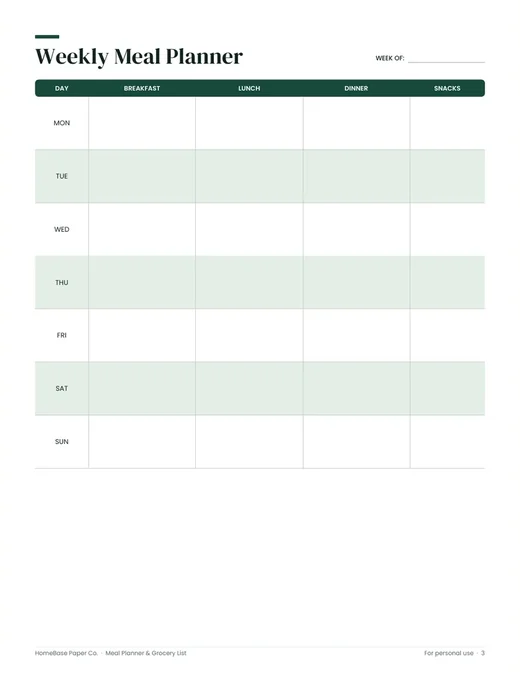
What printable helps plan a corn on the cob cookout? The Meal Planner & Grocery List is $3.99. It has a weekly menu grid and an aisle-sorted grocery list, so the corn, butter and sides for a cookout land on one list.
Where can I save my corn on the cob recipe and timing notes? The Family Recipe Binder is $6.99. Its fillable recipe pages and cards hold your boil times, butter blends and topping ideas so you are not looking them up every summer.
Is there a bundle with both the meal planner and recipe binder? The Family Life Admin Bundle is $15.99, down from $23.95 bought separately. It includes the Meal Planner & Grocery List and the Family Recipe Binder plus three more family organizers.
Do you have to thaw frozen corn on the cob before boiling it? No, you do not have to thaw frozen corn on the cob before boiling it. Drop the frozen cobs into boiling water, wait for the boil to return, and cook them 5 to 8 minutes. Partly thawed cobs may be done in about 4 minutes, so check a kernel early.
Does frozen corn on the cob take longer to boil than fresh? Yes, frozen corn on the cob takes longer to boil than fresh corn, about 5 to 8 minutes against 3 to 5. The frozen cob first has to thaw in the pot, and it also drops the water temperature, so wait for the boil to return before you start the timer.
What is the best way to remove the silk from corn on the cob? The easiest way to remove corn silk is to shuck the ear, then rub it down with a damp paper towel or your hands. Iowa State University Extension says to remove the outer husk and the silky strings and rinse the ear under cool running water. Boiling the ear in its husk and pulling the husk and silk off together afterward also works.
How do you pick fresh corn on the cob at the store? Pick corn with a bright green husk that is damp and tight against the cob. Iowa State University Extension says that after you peel the husk back, the kernels should be plump and evenly spaced. Heavy ears with golden, shiny silk are fresher than ones with dry, brown husks or black, mushy silk.
How long do you microwave corn on the cob? Microwave husked corn on the cob for about 3 minutes per ear, according to Iowa State University Extension: put 2 to 4 ears in a microwave-safe dish with 1/3 cup of water, cover with plastic wrap with one corner open and cook on high, 12 minutes for 4 ears. Boiling remains faster for a big batch of 6 or more.
Can you turn the heat off and let corn sit in the water? An off-heat corn method starts with boiling water and cooks the ears covered after the heat is turned off. It is an alternative to the continuous-boil method, not an extra stage afterward. Check tenderness before serving and do not leave cooked corn in cooling water for an extended hold.
Why is my boiled corn on the cob tough or mushy? Boiled corn may be tough because it was older or starchier, while overcooking can leave kernels soft and waterlogged. Check a kernel early and remove ears as they become tender. Longer boiling cannot restore the sweetness of newly picked corn.
Can you boil corn on the cob ahead of time? You can boil corn ahead, refrigerate it promptly and reheat it until hot throughout. If holding it for service instead, keep it at 140°F or above. An unheated pot or an insulated cooler does not guarantee a safe holding temperature; use a thermometer and follow the USDA time limits explained above.
How long should you boil corn on the cob for a crowd? Boil corn for a crowd in manageable batches, checking the same tenderness cues on every batch. More ears do not mean multiplying the boiling time. Serve promptly or keep finished corn in a verified hot hold; avoid leaving it cooling on the counter while the remaining batches cook.
How long should corn on the cob be boiled if it came from the farmers market that morning? Corn picked recently can be tender sooner than older supermarket ears. Start checking before the end of the chart’s range, then use tenderness rather than an assumed age to decide when to drain it. Ask the seller when it was picked if freshness is your priority.
Should I follow the corn package or the boiling chart? Follow your frozen-corn package when it provides specific directions. The chart is general guidance, while the bag may specify a cold-water start, a particular cob size or another cooking method. Compare when the timer starts before deciding that two sets of instructions disagree.
Is boiling corn for dinner the same as blanching corn before freezing? Boiling corn for dinner and blanching it for freezing have different purposes. Dinner timing aims for hot, tender kernels ready to eat. Preservation instructions also specify processing and cooling steps, so use a tested freezing method instead of treating this dinner chart as a preservation schedule.
Sources
- USDA FoodData Central (Corn, sweet, yellow, raw, FDC ID 169998) fdc.nal.usda.gov
- USDA AMS: National Retail Report, Specialty Crops ams.usda.gov
- USDA FSIS: Leftovers and food safety fsis.usda.gov
- Corn on the Cob (Iowa State University Extension, Spend Smart Eat Smart) spendsmart.extension.iastate.edu
Made this? Tell us how it went
Your notes help the next cook: what you changed, how long it took, how it turned out.