The short answer: a lease agreement template is a fill-in contract between a landlord and tenant that sets the rent, term, deposit, rules and repairs for a rental. Copy the free 18-clause template below, fill in every blank, attach the lead paint disclosure if the home was built before 1978, and check your state's deposit, late fee and notice rules before anyone signs.
- Must-have clauses: parties, property, term, rent and due date, late fee, deposit, utilities, repairs, entry, pets, subletting, ending the lease, signatures.
- Federal musts: the EPA lead disclosure for pre-1978 homes and Fair Housing Act compliance.
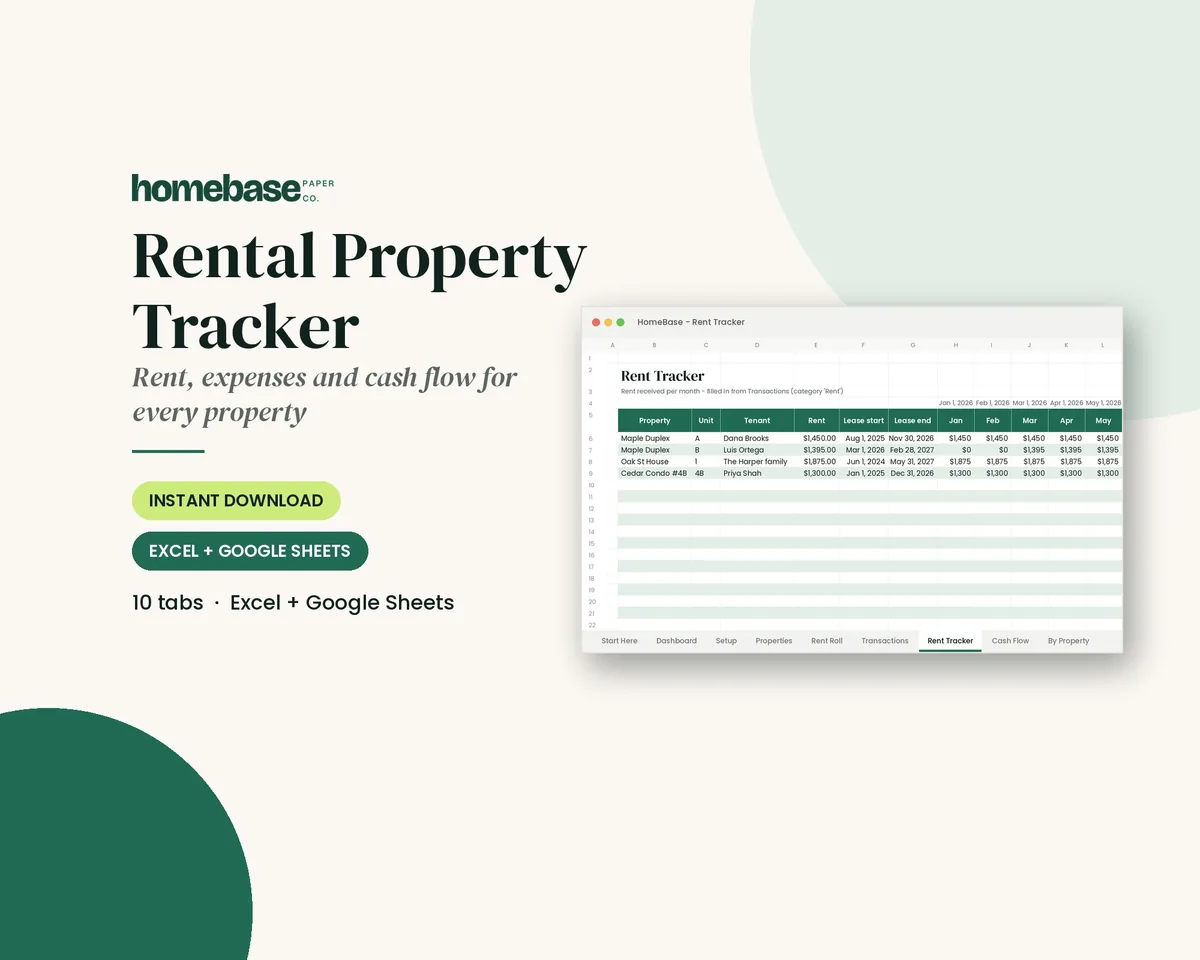
- Track the rent: log every payment in the Rental Property Tracker ($11.99), or sign up for the weekly HomeBase email.
Our picks for lease agreement template
Spreadsheets
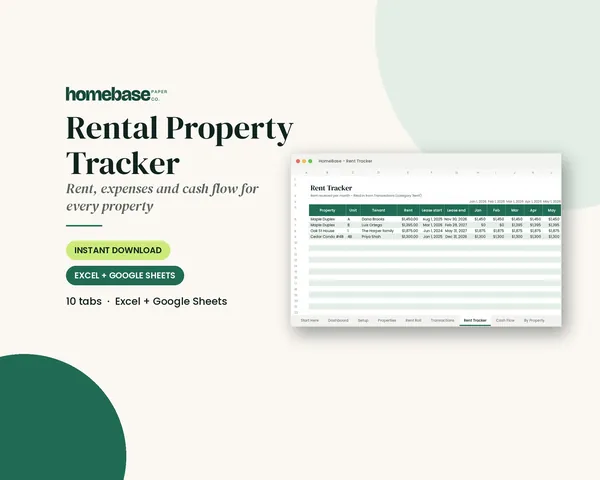
Rental Property Tracker
Log rent and expenses once - see who has paid each month, cash flow per property and category totals for tax time.
This page is general information, not legal advice. Landlord-tenant law is mostly set by states and cities, so have a local attorney or your state's landlord-tenant resources review a lease you're unsure about. Below: the template, the federal rules, state items to check, lease vs rental agreement and a signing checklist.
Free residential lease agreement template
Copy this into a document, replace every bracket and delete clauses that don't apply.
RESIDENTIAL LEASE AGREEMENT
- Parties. This lease is between [Landlord name] ("Landlord") and [Tenant names, every adult who will live there] ("Tenant"), dated [date].
- Property. Landlord rents to Tenant the home at [full address, unit number], including [parking space, storage, appliances listed].
- Term. The lease starts on [start date] and ends on [end date]. [Or: This is a month-to-month agreement that renews each month until either party gives [30] days' written notice.]
- Rent. Rent is $[amount] per month, due on the [1st] day of each month, paid by [method, such as bank transfer or check] to [payee and address or account].
- Late fee. If rent is not received by the [5th] day of the month, Tenant will pay a late fee of $[amount], within the limit set by state law.
- Prorated rent. Rent for a partial first month is $[amount], due on [date].
- Security deposit. Tenant pays a deposit of $[amount] on signing. Landlord will return it, minus itemized charges for unpaid rent or damage beyond normal wear and tear, within [number] days after Tenant moves out, as state law requires.
- Utilities. Tenant pays [electric, gas, internet]. Landlord pays [water, trash, sewer].
- Occupants. Only the Tenants named above and [minor children or other occupants] may live in the home. Guests may stay up to [14] days in any 6-month period without written consent.
- Use. The home is for residential use only. Tenant will follow building rules and local laws and will not disturb neighbors.
- Maintenance and repairs. Landlord keeps the home safe and habitable and makes repairs within a reasonable time after written notice. Tenant keeps the home clean, reports problems promptly and pays for damage Tenant or guests cause.
- Alterations. Tenant will not paint, change locks or make alterations without Landlord's written consent.
- Entry. Landlord may enter for repairs, inspections or showings with at least [24] hours' notice, except in an emergency.
- Pets. [No pets are allowed.] [Or: Tenant may keep [type and number] with a pet deposit or fee of $[amount], where allowed by law.] Assistance animals are not pets under this clause.
- Smoking. Smoking and vaping are [not allowed / allowed only in designated outdoor areas].
- Subletting. Tenant will not sublet or assign this lease without Landlord's written consent.
- Ending the lease. At the end of the term, Tenant returns all keys and leaves the home clean, with normal wear and tear expected. [Describe renewal and the notice either party must give.]
- Disclosures and addenda. Attached and part of this lease: [lead-based paint disclosure, move-in condition checklist, pet addendum, other required local disclosures].
Signatures. Landlord: ______ Date: ______ · Tenant: ______ Date: ______ · Tenant: ______ Date: ______
Federal rules every lease has to follow
- Lead paint (homes built before 1978): the EPA's lead disclosure rule requires landlords to disclose known lead-based paint and hazards, provide available records, give tenants the pamphlet Protect Your Family From Lead in Your Home and include a Lead Warning Statement with the lease. Short-term leases of 100 days or less with no renewal are among the exemptions. 40 CFR 745.113(c) also requires the landlord (and any agent) to keep a copy of the signed disclosure, or the lease that contains it, for at least three years from the commencement of the leasing period.
- Fair housing: HUD explains that the Fair Housing Act prohibits discrimination based on race, color, national origin, religion, sex, familial status and disability. That covers your ads, screening, rules and lease terms. Don't write rules that single out families with children.
State and local rules to check before you fill it in
| Clause | What varies by state or city |
|---|---|
| Security deposit | Maximum amount, separate account or interest, return deadline, itemized list |
| Late fee | Grace period and maximum fee |
| Entry | Minimum notice before entering |
| Ending the lease | Notice periods for month-to-month and renewals |
| Rent increases | Notice required; rent control in some cities |
| Disclosures | Mold, bed bugs, flood zone, smoking policy and more in some states |
| Repairs | Habitability rules and tenant repair remedies |
Search your state attorney general's or housing agency's landlord-tenant guide and fill in the numbers that comply.
Lease vs rental agreement
| Fixed-term lease | Month-to-month rental agreement | |
|---|---|---|
| Length | Usually 6 or 12 months | Renews monthly |
| Rent changes | Locked for the term | With proper notice |
| Ending early | Usually requires breaking the lease | Written notice, often 30 days |
| Best for | Stable tenants, predictable income | Short stays, flexibility |
Renting your first place instead? Our guide to how to rent an apartment covers it from the tenant side, and renters insurance explains what tenants should cover.
Signing checklist
- Fill in every blank; write "none" instead of leaving a line empty.
- Attach the lead disclosure and the EPA pamphlet for pre-1978 homes.
- Walk through the home together and complete a move-in condition checklist with dated photos.
- Have every adult occupant sign and date the lease and each addendum.
- Give each tenant a full signed copy.
- Record the deposit, first rent and due dates in your rent records.
- Keep the lease and disclosures; 40 CFR 745.113(c) requires keeping the signed lead disclosure for at least three years from the date the lease starts.
Keep rent and lease records organized
Log rent, deposits, repairs and expenses for each unit in the Rental Property Tracker ($11.99), and see our guide to tracking rental property income and expenses or the rent roll template for multiple units.
Frequently asked questions
What should a lease agreement include? At minimum: the names of every landlord and adult tenant, the property address, the lease term, rent amount and due date, how rent is paid, late fees, the security deposit and how it's returned, who pays utilities, repair duties, rules on pets, smoking, guests and subletting, entry notice, required disclosures and signatures. The template on this page covers all of them.
Is a lease agreement template legally binding? A signed lease can be a binding contract, but only if its terms follow your state and local law. A template is a starting point. Clauses that break local rules, such as a deposit above a state cap, may not be enforceable. Have a local attorney or your state's landlord-tenant resources review it if you're unsure.
What is the difference between a lease and a rental agreement? A lease usually runs for a fixed term, often 12 months, and locks in rent for that period. A rental agreement is usually month to month and renews each month until either side gives notice. Either can use the same clauses; only the term section changes.
Do landlords have to give a lead paint disclosure? Yes, for most housing built before 1978. The EPA's lead disclosure rule requires the landlord to disclose known lead-based paint and hazards, share available reports, give the tenant the EPA pamphlet Protect Your Family From Lead in Your Home and include a Lead Warning Statement with the lease. Short-term leases of 100 days or less with no renewal, and a few other housing types, are exempt.
How much can a landlord charge for a security deposit? It depends on your state. Some states cap deposits, often at one or two months' rent, and set a deadline for returning them; others set no cap. Check your state's landlord-tenant law or attorney general's office before filling in the deposit amount.
Can I write my own lease agreement? Yes. Many small landlords use a template like this one and fill in the details. Write in plain language, keep every promise specific (amounts, dates, who pays what), check state rules for deposits, late fees and notice periods, and give each tenant a signed copy.
Does a lease agreement need to be notarized? Most residential leases don't need a notary to be valid. A few situations, such as some long-term leases that will be recorded with the county, can have extra requirements. Check your state's rules if your lease runs longer than a year.
Can a landlord refuse to rent to families with children? No. HUD explains that the Fair Housing Act bans housing discrimination based on race, color, national origin, religion, sex, familial status and disability. Familial status generally covers households with children under 18. Your lease, screening and ads must follow it.
What is a lease addendum? An addendum is an extra page signed with the lease that adds rules or disclosures, such as a pet addendum, a parking addendum, the lead paint disclosure or a move-in condition checklist. List every addendum in the lease so it's clearly part of the agreement.
How long should a lease be? Twelve months is the most common term because it gives both sides a predictable year. Six-month leases suit seasonal moves, and month-to-month agreements give the most flexibility with less certainty. State the exact start and end dates either way.
Can I use this template for a room rental? Yes. List the room the tenant has exclusive use of and the shared areas, such as the kitchen and laundry, and spell out how utilities, chores and guests work. Fair housing and local rules can differ for shared housing, so check them before you advertise.
What should I keep after the lease is signed? Keep the signed lease, every addendum, the move-in checklist and photos, rent receipts and any notices. Federal lead rules at 40 CFR 745.113(c) require landlords to keep the signed lead disclosure for at least three years from the commencement of the leasing period. A payment log makes the payment history easy to show.
Newsletter
Get the HomeBase email
Fresh tips three times a week, Mon/Wed/Fri, with our deals and new products, from printables, spreadsheets and bundles to paperback planners and apparel, plus simple home, money and planning tips.