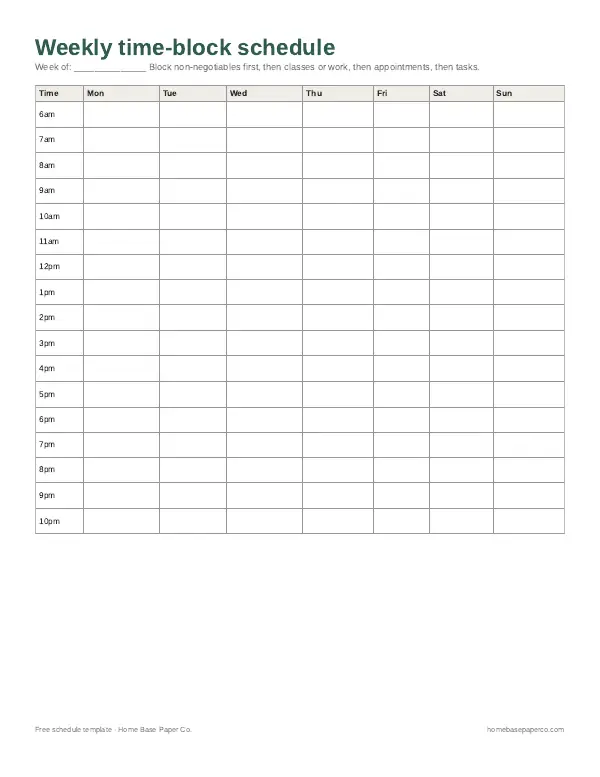
The short answer: this free printable schedule template has five pages, so you can pick the one that fits your week.
- Weekly time-block schedule
- Work and shift and class schedules
- Family schedule and a weekly task list
- Print a fresh copy each Sunday and fill it in with a pencil
- Next step: Get the free schedule template (we email it to you); want more? The Household Binder is $6.99.
Our picks for schedule template

Printables
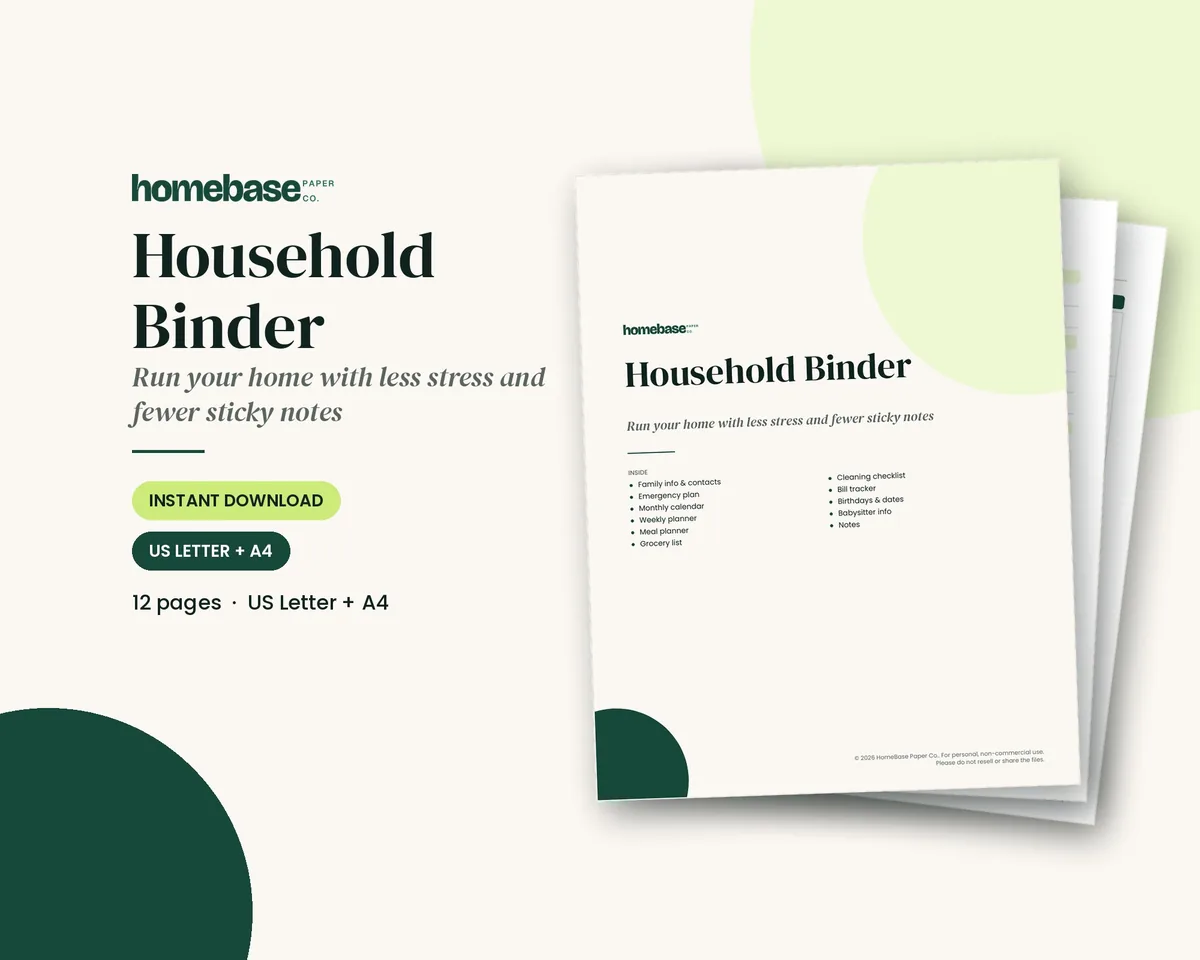
Household Binder
Family info, emergency plan, calendars, meals, groceries, cleaning, bills and sitter notes.
Printables
Cleaning Schedule
Daily, weekly, monthly and seasonal lists - plus a family chore chart.
 Starter pick
Printables
Kids Chore Chart
Weekly chore chart, morning and evening routines, chore ideas by age, a sticker reward chart and an allowance tracker.
 Save 48%
Bundles
Home Management Bundle
Household binder, maintenance log, moving planner, cleaning schedule, home inventory and password log.
A schedule template turns a busy week into a plan you can see. This free printable schedule template has five pages: a weekly time-block schedule, a work and shift schedule, a class schedule, a family schedule and a weekly task list. Pick the page that fits your week, print a fresh copy each Sunday and fill it in with a pencil. For a project or school assignment laid out along a line, try a printable timeline template.
What's in the free download
| Page | Best for |
|---|---|
| Weekly time-block schedule | Students, remote workers, anyone juggling many tasks |
| Work and shift schedule | Small teams, volunteers, shared child care |
| Class schedule | Middle school, high school and college classes |
| Family schedule | Who's where each day: school, work, practice, pickups |
| Weekly task list | Every to-do, with due dates and time needed |
Each page fits US Letter, and A4 with "fit to page."
How to fill in a weekly schedule
Stanford's Center for Teaching and Learning lays out a step-by-step time blocking method. It's built for students, but it works for anyone:
- Schedule your non-negotiables first. Sleep, meals, exercise, family time: what you need for your well-being.
- Add your regular weekly commitments, such as classes, work shifts or standing meetings.
- Add set appointments for this week only.
- List every task on a separate sheet. That's the task list page.
- Block time for each task in the gaps that are left.
Stanford's tips for doing this well:
- Be realistic about how much you can get done in a week.
- Overestimate how long things will take.
- Leave buffer time. It suggests at least 15 hours of entirely blank space each week.
- Match tasks to your energy. Do harder tasks when you have the most energy and easier ones when you tend to be tired.
- Stay flexible. Think of the calendar as a decision-making tool, and move things when life happens.
The time-block schedule
The first page runs from 6am to 10pm in one-hour rows, Monday through Sunday. Shade or color blocks by type: one color for work or school, one for family, one for errands and one for rest. At a glance, you'll see if your week is overloaded. For a day-by-day version with focus and buffer blocks, use our time block schedule template.
If you came looking for a weekly schedule template, this is the page to print first: seven day columns, Monday through Sunday, with one-hour rows from 6am to 10pm, so the whole week fits on one sheet.
Time-block tips:
- Use pencil. Blocks will move.
- Batch small jobs. Put email, calls and errands in one block instead of scattering them.
- Protect one block a day for your most important task.
- Plan travel time. Driving between activities takes real time.
The work and shift schedule
The work schedule page has 14 rows, a column for each day and an hours column. Write each person's shift, like "9–3" or "OFF," and total the hours on the right. It works as a work schedule template for:
- A small shop or family business.
- A volunteer group or church nursery.
- Shared child care or a carpool rotation.
- Caregivers taking turns with an aging parent.
If you're scheduling employees, check your company policy and your state labor rules for minimum breaks and overtime. A printed shift schedule is a planning tool, not a timekeeping record.
The class schedule
The class schedule page has nine periods across Monday through Friday. For each box, write the class, the room and the teacher. College students with classes on different days can write times in the first column instead of period numbers. Make two copies: one for a binder and one for the fridge, so the family knows when tests and labs are.
The family schedule
The family schedule page has one row per person and a column for each day. Fill it in on Sunday with:
- School and work hours.
- Practices, lessons and clubs.
- Appointments.
- Who drives where, with the line at the bottom.
- The dinner plan, so busy nights get easy meals.
Post it on the fridge. Our guide to how to organize a family calendar covers color coding and keeping everyone in the loop.
The weekly task list
Before you block time, write every task on the task list page with its due date and how long you think it will take. Then assign each task a day and time in your schedule. When it's done, check it off. A list on its own can sit for weeks; a scheduled block gets done.
Three types of time plans
A Kansas State University Extension fact sheet on managing time, work and family (it's a historical publication, but the ideas hold up) describes three types of time plans, from simple to detailed:
- A list of projects, done as you have time.
- A list in order of importance, so the most important jobs get done first.
- A detailed time schedule with both the order of projects and the time each one needs.
The fact sheet says the detailed schedule is especially useful for people with little free time and for those just learning to manage their time. The schedule template here is that third kind. If a detailed schedule feels like too much, start with the task list page and work up.
Sample weekly schedule
Here's how a working parent might block one weekday:
| Time | Block |
|---|---|
| 6–7am | Exercise, shower |
| 7–8am | Breakfast, school drop-off |
| 8am–12pm | Work: hardest task first |
| 12–1pm | Lunch, errands |
| 1–4pm | Work: meetings and email |
| 4–5pm | Pickup, practice |
| 5–7pm | Dinner, homework help |
| 7–8pm | Chores, prep for tomorrow |
| 8–10pm | Free time, then bed |
Leave some days lighter than this. Not every hour needs a job. On weekends, try blocking only two or three things, like a family outing, chores and meal prep, and leave the rest open.
Schedule ideas for different weeks
The same pages work for very different lives. A few ways to set them up:
- Shift workers. Write your shifts first, then put sleep right after night shifts as a non-negotiable. Plan errands and appointments on days off, and keep one day each week with nothing scheduled at all.
- College students. Copy your class schedule into the time-block page, then add study blocks right after each lecture while the material is fresh. Put big assignment due dates on the task list as soon as you get the syllabus.
- Homeschool families. Use the class schedule page for subjects and the family schedule page for outside classes, co-ops and field trips. Our homeschool planner has more ideas.
- Caregivers. Use the work and shift page to show who covers which day, and the family schedule for appointments. Share a photo of it with siblings or helpers.
- Remote workers. Block focus time in the morning and meetings in the afternoon, and add a hard stop at the end of the day.
- Busy school years. Fill in the family schedule each Sunday during sports season, when practice times change week to week.
Review your week on Sunday
A schedule works best with a short weekly review. On Sunday, spend 15 minutes:
- Look back. What took longer than planned? What got skipped?
- Move leftovers from last week's task list onto this week's.
- Check the calendar for appointments, birthdays and school events.
- Fill in the non-negotiables, then the commitments, then the tasks.
- Share the plan with anyone it affects.
Over a few weeks, you'll learn how long things really take, and your schedule will get more realistic.
Common schedule mistakes
- Planning every minute. No room for delays means the whole day slides.
- Forgetting transitions. Getting kids in the car, parking and walking in all take time.
- Ignoring energy. Putting your hardest task at 4pm, when you're tired, sets you up to put it off.
- Skipping rest. Free time and sleep belong on the schedule too.
Which schedule page or planner do you need?
- Planning the whole week: this page, or our weekly planner for a planner-style weekly schedule template with goals and notes.
- Planning hour by hour for one day: our daily schedule or hourly planner.
- Seeing the whole month: our monthly calendar or blank calendar template.
- Keeping house: the cleaning schedule template.
Keep the family's schedule with your household plan
The Household Binder ($6.99) has a weekly planner and monthly calendar alongside family info, an emergency plan, a meal planner, a grocery list, cleaning, a bill tracker and sitter info. For kids, the Kids Chore Chart ($3.49) adds a weekly chore chart, morning and evening routines and chore ideas by age. The Cleaning Schedule ($4.49) has daily, weekly, monthly and seasonal cleaning lists plus a family chore chart. The Home Management Bundle ($16.99) bundles our home organizing printables in one download.
Household Binder
Family info, emergency plan, calendars, meals, groceries, cleaning, bills and sitter notes.
$6.99 · Instant download. Print at home or fill it in on screen. Or browse the full Home & Organizing collection.
Frequently asked questions
Is this schedule template free? Yes, this schedule template is free. The schedule template on this page is a free 5-page PDF that we email to you: a time-block week, a work and shift schedule, a class schedule, a family schedule and a weekly task list.
How do I make a weekly schedule? Start with your non-negotiables, like sleep, meals and exercise, then add classes or work, then appointments, then tasks. That is the order in Stanford's time blocking method. Leave blank time for things that run long.
What is a time-block schedule? A time-block schedule gives each task its own block of time on your calendar, instead of a to-do list with no times. The first page of this download is a time-block week from 6am to 10pm, Monday through Sunday.
How much free time should I leave in my schedule? You should leave 15 hours a week or more of free time in your schedule. Stanford's time blocking guide suggests aiming for at least 15 hours of entirely blank space each week, so you can move tasks when something comes up.
Can I use this as a work schedule template? Yes, you can use this as a work schedule template. The work and shift schedule page has rows for 14 people, a column for each day and an hours total. It works for a small team, a volunteer roster or a babysitting co-op. Check your employer's rules and local labor law for anything about hours or breaks.
Is there a class schedule template? Yes, there's a free class schedule template on this page. The free schedule template on this page includes one: page 3 is a Monday–Friday class schedule with nine periods. Write the class, room and teacher in each box, and tape a copy inside a binder or locker.
What should a family schedule include? A family schedule should show each person's school, work, practices, lessons and appointments, plus who drives where. The family schedule page has one row per person and a line for the dinner plan.
Should I estimate how long tasks take? Yes, you should estimate how long tasks take, and overestimate. Stanford's guide says to be realistic about how much you can do each week and to overestimate how long things will take. The task list page has a "time needed" column for that.
Daily or weekly schedule: which is better? A weekly schedule is better for seeing the whole picture: work, school and family plans in one view. A daily schedule is better for detail. Many people plan the week on Sunday, then use our daily schedule or hourly planner each morning.
How do I stick to a schedule? To stick to a schedule, treat it as flexible. Stanford calls a weekly calendar a flexible decision-making tool: if something gets in the way, move blocks around rather than giving up. Do hard tasks when you have the most energy, and review the plan each evening.
Do you sell a planner with a weekly schedule? Yes, HomeBase sells a planner with a weekly schedule: the Household Binder. The Household Binder ($6.99) has a weekly planner and a monthly calendar along with family info, a meal planner, a grocery list, cleaning, bill tracker and sitter info pages.
Can I add chores to a family schedule? Yes, you can add chores to a family schedule. Add a chore column or a row for chores. The Kids Chore Chart ($3.49) has a weekly chore chart, morning and evening routines and chore ideas by age, and the Cleaning Schedule ($4.49) has daily, weekly, monthly and seasonal lists plus a family chore chart.
Is there a free weekly schedule template? Yes, there's a free weekly schedule template on this page. The free PDF on this page starts with a weekly schedule template: a time-block page with Monday through Sunday columns and one-hour rows from 6am to 10pm. The same download adds work and shift, class and family schedules and a weekly task list, that we email to you.
Free printable
Five weekly schedules for work, school and family
Time-block, shift, class, family and task schedules. You'll also get our weekly HomeBase email with simple planning and home organization tips.