

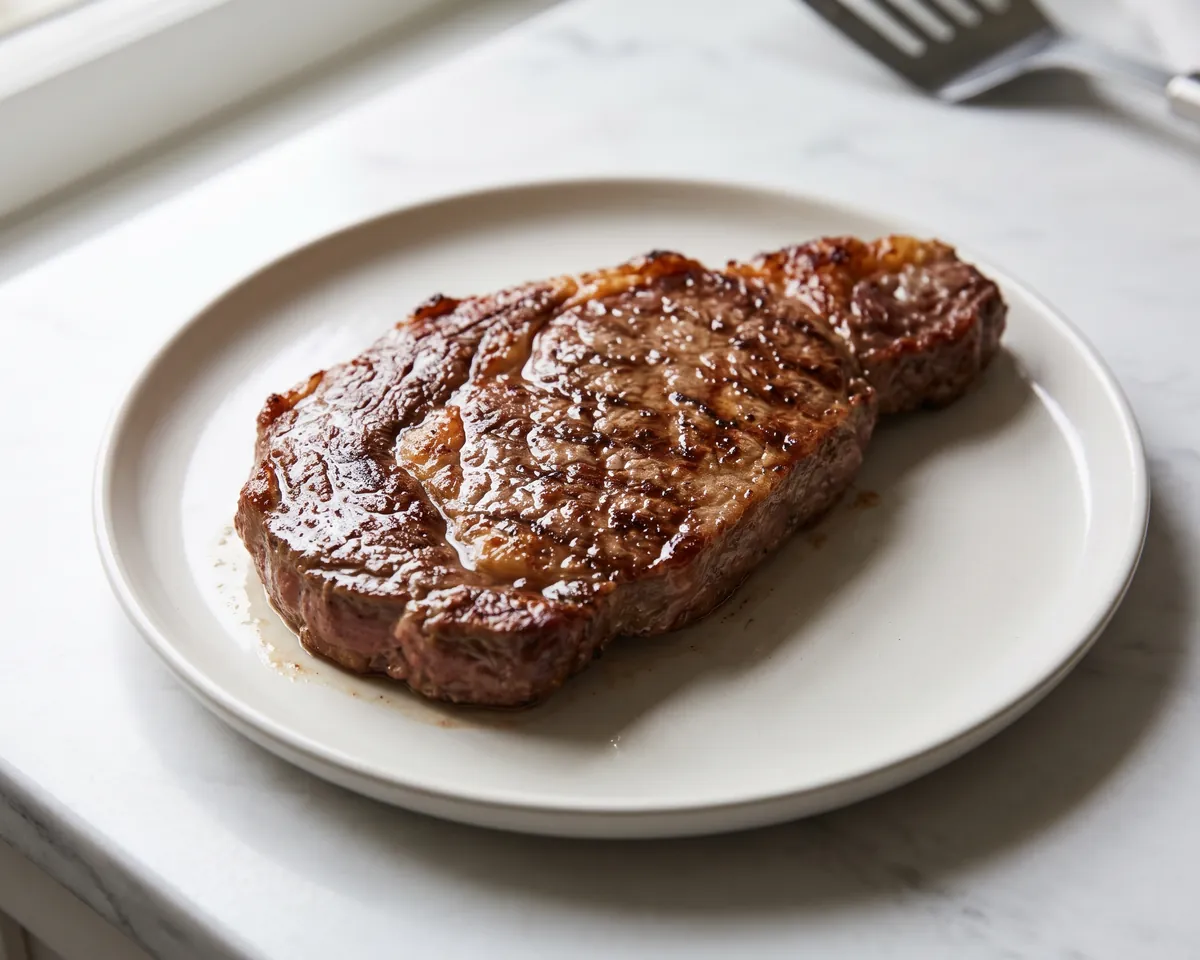
The short answer: to cook steak, pat it dry, salt it well, sear it in a very hot skillet or on a hot grill, and pull it off when a thermometer in the thickest part reads your target. A 1-inch steak takes about 4 to 5 minutes per side. Rest it at least 3 minutes, then slice against the grain.
- Key numbers: the USDA safe minimum is 145°F plus a 3-minute rest. Common cook's targets (not USDA guidance) are 125 to 130°F for medium-rare and 135 to 140°F for medium, before resting.
- Best method by thickness: under 1½ inches, pan-sear or grill. Thicker than 1½ inches, reverse sear (275°F oven, then a hot pan). No grill? Use the broiler.
Prep time: 10 minCook time: 15 minTotal time: 30 minServings: 4 servingsTotal includes the 5-minute rest in step 8.
Checked November 16, 2026 against the USDA Food Safety and Inspection Service temperature chart and beef guide, and the latest Bureau of Labor Statistics average beef prices (October 2026). Below: a steak doneness chart, how to choose a cut, cooking times by thickness, the core pan-seared steak recipe, reverse sear, grilling, broiling, resting and slicing, common mistakes and how to cook steak on a budget.
Steak doneness chart: USDA safe minimum vs common temperatures
Use a food thermometer and push it in from the side into the thickest part. The USDA's safe minimum internal temperature chart lists 145°F, with at least a 3-minute rest, for beef steaks, chops and roasts. That is the food safety line. The other rows are common kitchen targets for texture, and they are lower.
Affiliate links: we may earn a small commission. As an Amazon Associate we earn from qualifying purchases. Details.
A food thermometer such as the Alpha Grillers instant-read thermometer makes that check quick and exact.
| Doneness | Pull it off the heat at | After resting | What it looks like | Label |
|---|---|---|---|---|
| Rare | 120°F | about 125°F | Cool, bright red center. | Common cook's target, below USDA minimum. |
| Medium-rare | 125 to 130°F | about 130 to 135°F | Warm, red-pink center. | Common cook's target, below USDA minimum. |
| Medium | 135 to 140°F | about 140 to 145°F | Pink center. | Common cook's target. |
| USDA safe minimum | 145°F | 145°F or higher, rest at least 3 minutes | Light pink to tan center. | USDA FSIS guideline for whole-cut beef. |
| Medium-well | 145 to 150°F | about 150 to 155°F | Mostly tan, trace of pink. | Common cook's target, meets USDA minimum. |
| Well done | 155 to 160°F | about 160°F or higher | No pink. | Common cook's target, meets USDA minimum. |
Steak keeps climbing a few degrees while it rests, which is why the pull temperature is lower than the final one. If you are cooking for someone pregnant, older, very young or with a weakened immune system, stick with the USDA 145°F rule.
Label check: if the package says "mechanically tenderized," "needle tenderized" or "blade tenderized," the USDA requires cooking instructions on the label. Follow them. A typical example is to cook to 145°F and hold it there for 3 minutes.
How to choose a steak cut
The USDA's Beef From Farm to Table guide explains the basics. Loin and rib cuts are tender and suit dry heat like grilling and broiling. Chuck and round cuts are less tender. More marbling (the white flecks of fat) means a juicier, more flavorful steak, and USDA Prime has the most, then Choice, then Select. Store names vary too: a boneless top loin steak may be sold as strip, New York strip or Kansas City steak.
| Cut | Tenderness | Best way to cook | Cost tier | Tip |
|---|---|---|---|---|
| Ribeye | Very tender, rich | Pan-sear, grill, reverse sear | $$$ | Sear the fat edge too. |
| Strip (New York strip) | Tender, beefy | Pan-sear, grill | $$$ | Easy first steak. |
| Filet mignon (tenderloin) | Most tender, lean | Pan-sear, then oven | $$$$ | Don't go past medium. |
| T-bone or porterhouse | Tender, two muscles | Grill, broil | $$$ | Keep the filet side away from the hottest heat. |
| Top sirloin | Fairly tender, lean | Grill, pan-sear, broil | $$ | Great weeknight steak. |
| Flat iron | Tender, marbled | Pan-sear, grill | $$ | Cook to medium-rare or medium. |
| Chuck-eye | Tender for the price | Pan-sear, grill | $ to $$ | Sometimes called a poor man's ribeye. |
| Flank | Lean, chewy grain | Grill, broil | $$ | Marinate, then slice very thin. |
| Skirt | Loose grain, big flavor | Very hot grill or pan | $$ | Cooks in minutes. |
| Round (top or bottom) | Least tender | Marinate, broil, slice thin | $ | Best for steak salad, fajitas or stir-fry. |
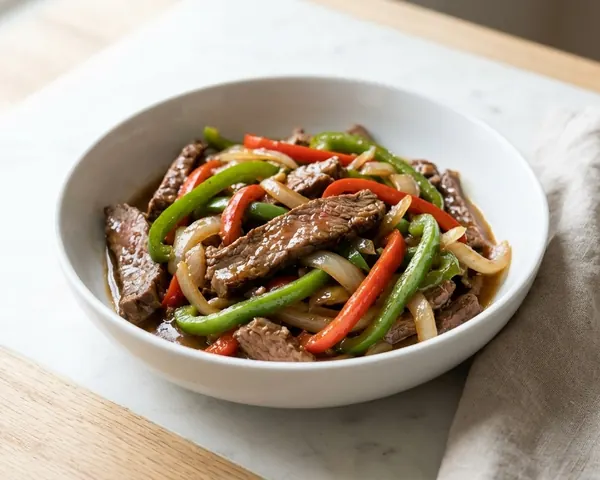
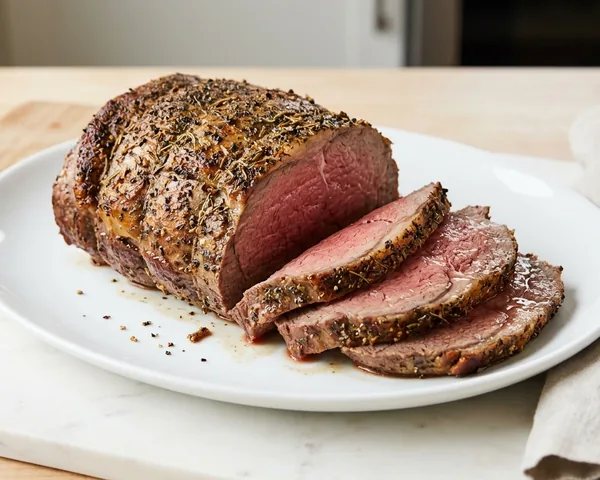
Planning a holiday roast instead? Our guides to prime rib, beef tenderloin and roast beef cover the big cuts. Ham steaks and pepper steak are different dishes, with their own guides at ham steaks and pepper steak.
How long to cook steak by thickness
These are approximate times for high heat, starting from the fridge. Grills, pans and stoves vary, so check the temperature early and often. The USDA's own cooking chart lists 4 to 5 minutes per side for a ¾-inch steak on the grill or broiler.
| Thickness | Pan-sear or grill, per side (medium-rare to medium) | Better method | Oven time if finishing |
|---|---|---|---|
| ½ inch | 2 to 3 minutes | Pan or very hot grill | None. |
| ¾ inch | 3 to 5 minutes | Pan, grill or broiler | None. |
| 1 inch | 4 to 5 minutes | Pan-sear (recipe below) | None. |
| 1½ inches | 6 to 7 minutes | Sear, then 400°F oven, or reverse sear | 4 to 8 minutes at 400°F. |
| 2 inches | Too thick for searing alone | Reverse sear | 45 to 60 minutes at 275°F, then sear. |
Frozen steak: the USDA says you can cook beef straight from frozen in the oven, on the stove or on the grill, but it takes about 50% longer. Thaw in the fridge, in cold water changed every 30 minutes, or in the microwave, and never on the counter.
Pan-seared steak recipe
This is the core method for a 1-inch steak, and it's the one to learn first. A heavy cast iron skillet holds heat best, and a stainless steel pan also works.
Ingredients
- 2 boneless steaks, about 1 inch thick and 12 ounces each (1½ pounds total), such as strip, ribeye or top sirloin
- 1½ teaspoons kosher salt
- 1 teaspoon ground black pepper
- 1 tablespoon high-smoke-point oil, such as canola, vegetable or avocado
- 2 tablespoons butter
- 3 garlic cloves, smashed
- 2 sprigs fresh thyme or rosemary (optional)
Steps
- Dry and season (10 minutes). Pat the steaks very dry with paper towels. Season both sides and the edges with the salt and pepper.
- Heat the pan (about 4 minutes). Set a 12-inch skillet over medium-high to high heat until very hot, then add the oil and swirl until it shimmers.
- Sear the first side (4 minutes). Lay the steaks in the pan, away from you. Don't move them until a deep brown crust forms.
- Sear the second side (3 minutes). Flip with tongs and cook 3 minutes more.
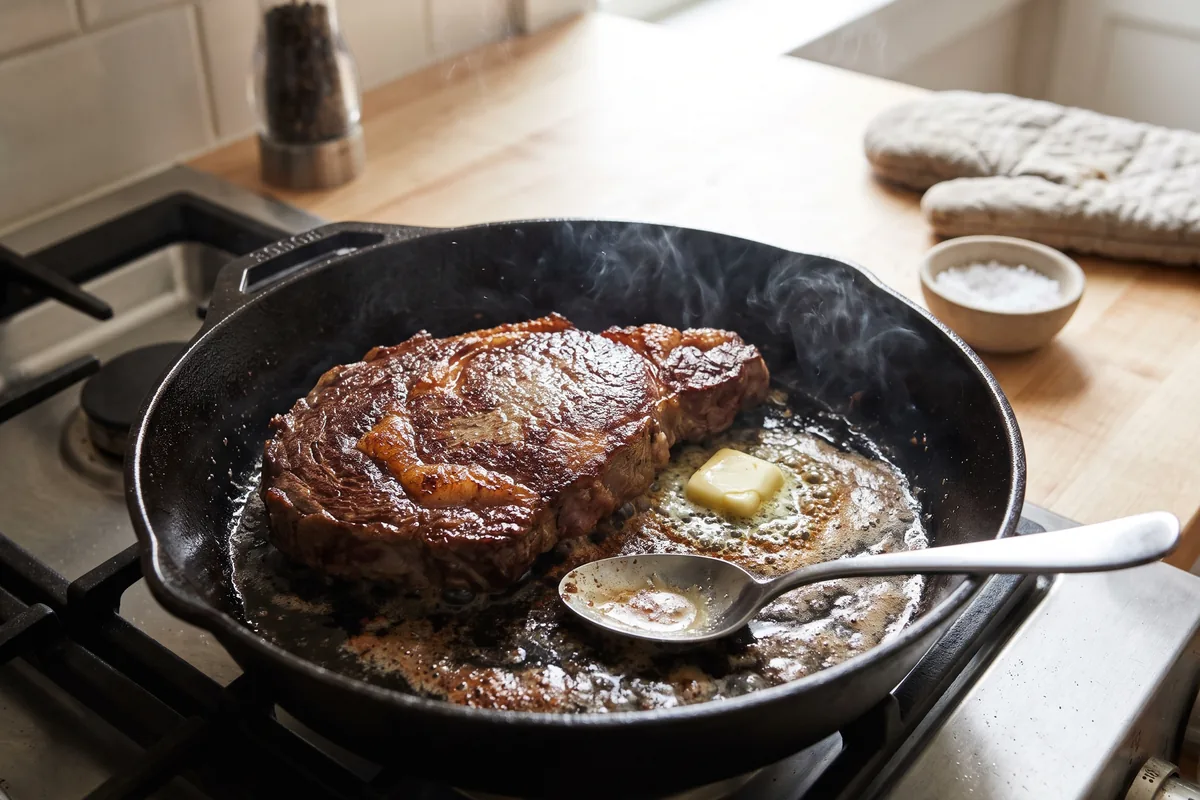
- Baste (2 minutes). Turn the heat to medium. Add the butter, garlic and herbs, tilt the pan and spoon the foaming butter over the steaks.
- Check the temperature. Pull at 125 to 130°F for medium-rare, or cook to 145°F to meet the USDA minimum. If it's not there yet, keep cooking and flip every minute.
- Sear the fat edge. For strip or ribeye, hold the steak on its side with tongs for 30 to 60 seconds.
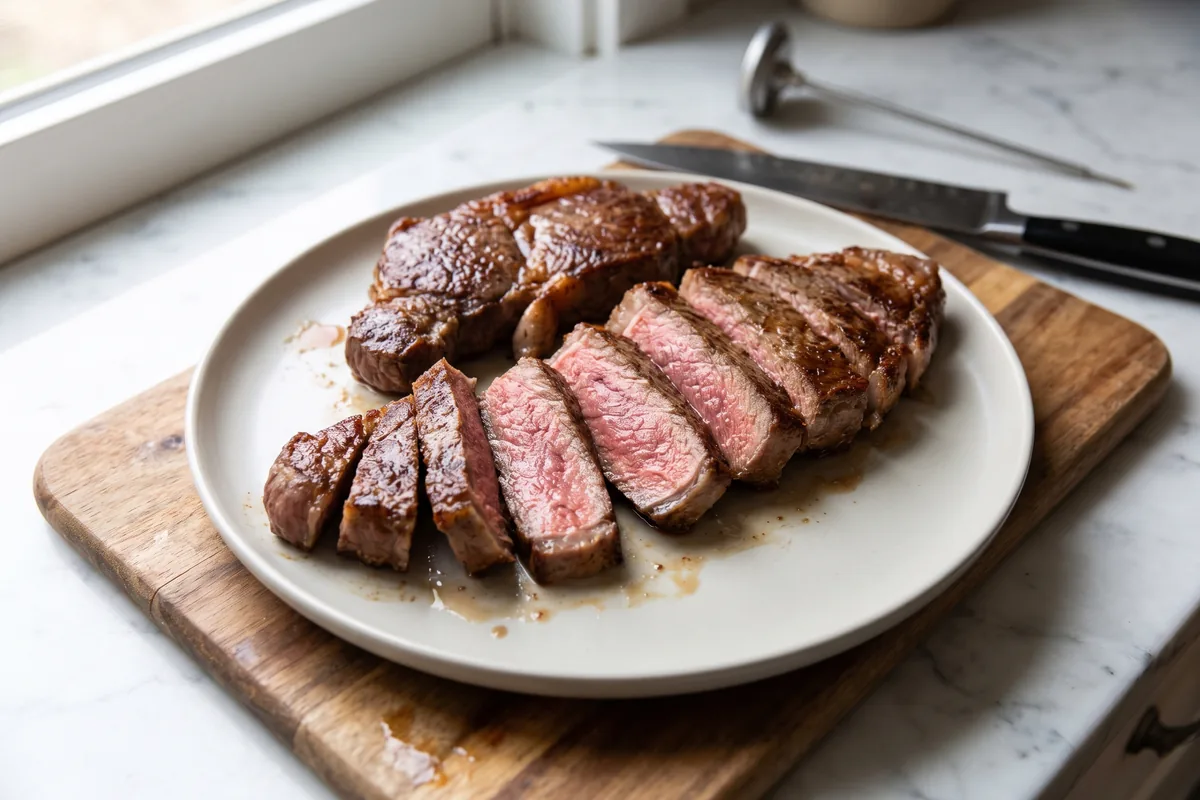
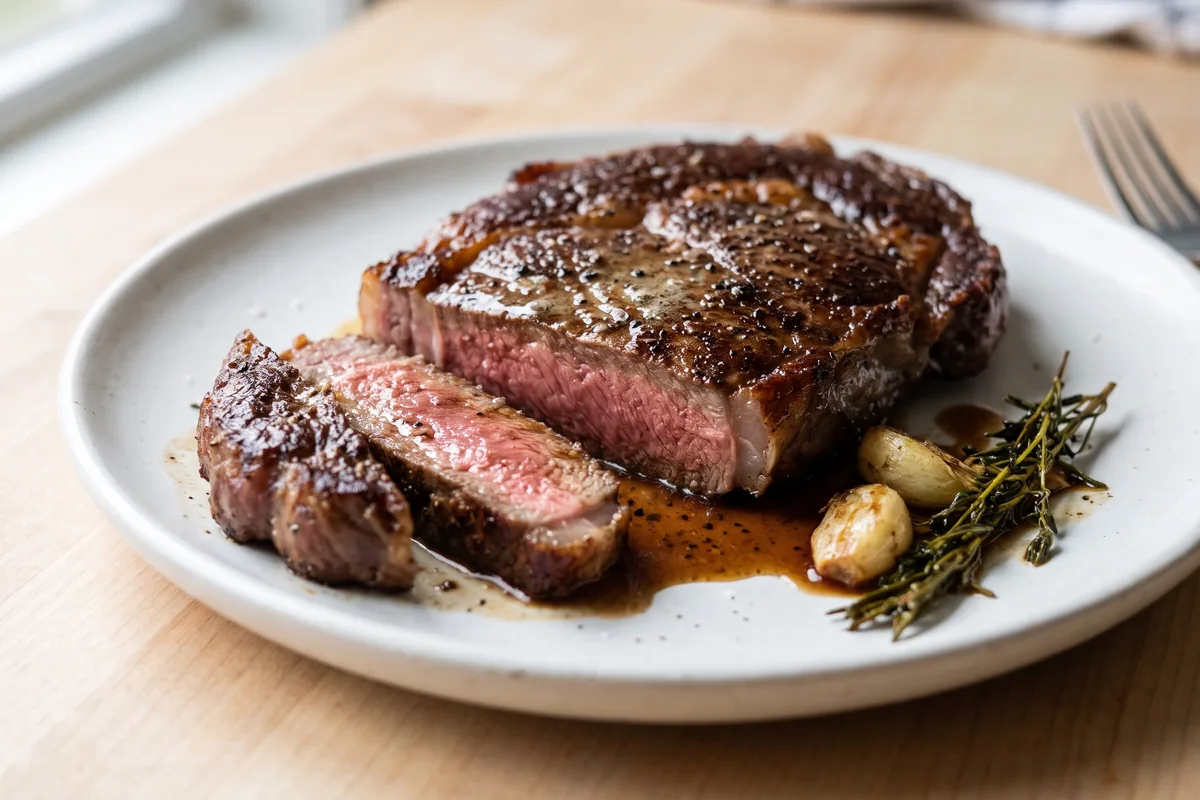
- Rest and slice (5 minutes). Move the steaks to a cutting board and rest 5 minutes. Slice against the grain and spoon the pan butter over the top.
Nutrition (per serving, estimated)
Serving size: 1 serving.
| Calories | 560 |
|---|---|
| Total fat | 47 g |
| Saturated fat | 19 g |
| Cholesterol | 130 mg |
| Sodium | 1020 mg |
| Total carbohydrate | 1 g |
| Dietary fiber | 0 g |
| Total sugars | 0 g |
| Protein | 33 g |
This is an estimate calculated from USDA FoodData Central data for the listed ingredients and amounts. Actual values vary with brands, portions and substitutions.
Serve it with mashed potatoes or a baked potato, garlic green beans or bright chimichurri. For more ideas, see our easy side dishes.
How to cook steak in the oven (reverse sear)
The reverse sear is the most even way to cook a thick steak, from edge to center.
- Heat the oven to 275°F. Season the steak and set it on a wire rack over a sheet pan.
- Bake until the center is 10 to 15 degrees below your target, about 30 to 45 minutes for a 1½-inch steak.
- Heat an oiled skillet until very hot.
- Sear 1 to 2 minutes per side, adding butter in the last minute if you like.
- Check the final temperature, then rest at least 3 minutes and slice.
Sear-then-oven option: sear a 1½-inch steak 2 to 3 minutes per side in an oven-safe skillet, then move the pan to a 400°F oven for 4 to 8 minutes until it hits your temperature.
Rate this recipe
How to grill steak
- Set up two zones: one side very hot (about 450 to 500°F) and one side with low or no heat.
- Oil the grates or brush the steak lightly with oil, then season.
- Grill over the hot side using the thickness chart, flipping once or every minute or two.
- If the outside is browned before the inside is done, move the steak to the cooler side and close the lid.
- Check the temperature, rest and slice.
If you marinated the steak, the USDA says to keep it in the fridge (up to 5 days for beef) and to boil any used marinade before brushing it on cooked meat.
Newsletter
3 easy dinners a week
Get three emails a week, Mon/Wed/Fri, with easy dinner ideas from HomeBase.
How to broil steak
- Set an oven rack so the top of the steak sits about 3 to 4 inches from the broiler, and heat the broiler for 5 minutes.
- Put the seasoned steak on a broiler pan or a rack over a foil-lined sheet pan.
- Broil a ¾-inch steak 4 to 5 minutes per side, or a 1-inch steak about 5 to 6 minutes per side.
- Check the temperature, rest and slice.
How to rest and slice steak against the grain
- Rest: at least 3 minutes, which is the USDA minimum for whole cuts of beef. Five minutes is plenty for a 1-inch steak, and up to 10 minutes for thick ones.
- Find the grain: look for the long lines of muscle fiber running across the steak.
- Slice across them: cut perpendicular to those lines, angled slightly, into ¼- to ½-inch slices. This matters most for flank, skirt and round steak, which can turn chewy if cut with the grain.
15 steak cooking mistakes to avoid
- Guessing doneness instead of using a thermometer.
- Cooking a wet steak, which steams instead of browning.
- Under-seasoning. Thick steaks need more salt than you think.
- Starting in a pan that isn't hot enough.
- Crowding the pan, which drops the heat.
- Flipping too early, before the crust releases.
- Adding butter at the start, where it burns.
- Using a thin, light pan that loses heat.
- Pressing the steak with a spatula and squeezing out juice.
- Pan-searing a 2-inch steak without an oven finish.
- Pulling it at the final temperature and forgetting carryover heat.
- Skipping the rest.
- Slicing with the grain.
- Cooking lean cuts like round or flank past medium without a marinade.
- Thawing steak on the counter instead of in the fridge, cold water or microwave.
How to cook steak on a budget
Steak is one of the pricier dinners on a family grocery budget, so a little planning helps. Bureau of Labor Statistics average prices for October 2026, the latest month published, show boneless USDA Choice sirloin at $13.85 a pound. In the same survey, boneless Choice round steak averaged $10.11 and all uncooked beef steaks averaged $12.85. Your store will differ, so treat these as a benchmark.
| Steak (BLS U.S. city average, Oct. 2026) | Price per pound | Cost for 6 oz raw per person | Cost for 4 oz raw per person |
|---|---|---|---|
| Sirloin, USDA Choice, boneless | $13.85 | $5.19 | $3.46 |
| All uncooked beef steaks (average) | $12.85 | $4.82 | $3.21 |
| Round, USDA Choice, boneless | $10.11 | $3.79 | $2.53 |
Math: price per pound × 6 ÷ 16, or × 4 ÷ 16. The pan-seared recipe above uses 1½ pounds for 4 servings, so it costs about $20.77 in sirloin at the October average, meat only.
Money-saving moves:
- Stretch it: slice 1 pound of steak over salads, rice bowls or fajitas for 4 people, about $3.46 a serving in sirloin. Beef and broccoli works the same way.
- Buy the family pack and freeze steaks you won't cook within 3 to 5 days. The USDA says raw steaks keep their best quality for 6 to 12 months frozen.
- Pick cheaper tender cuts: chuck-eye, flat iron and top sirloin cook like pricier steaks.
- Track prices: a grocery price book shows when your store's steak price is really low.
- Balance the week: plan one steak night next to cheap meal ideas and a few stew meat recipes. Our guides to meal planning on a budget and how to grocery shop on a budget walk through it.
Storing and reheating leftover steak
Refrigerate cooked steak within 2 hours, or 1 hour if it's above 90°F, in shallow covered containers. The USDA says cooked beef keeps 3 to 4 days in the fridge, and leftovers should be reheated to 165°F. For tender leftovers, slice them cold and warm them briefly in a skillet, or use them cold in a salad or sandwich.
Airtight glass containers with lids keep leftovers fresh and can go from the fridge to the microwave.
More beef and pork dinners you'll love
Frequently asked questions
How do you cook a steak? To cook a steak, pat it dry, season it with salt and pepper, and sear it in a very hot, oiled skillet for about 4 minutes on the first side and 3 to 4 minutes on the second for a 1-inch steak. Check the thickest part with a food thermometer, then rest it at least 3 minutes and slice against the grain.
What temperature should steak be cooked to? The USDA safe minimum for beef steaks is 145°F, measured with a food thermometer, followed by at least a 3-minute rest. Many cooks take steaks off the heat sooner for rare or medium-rare, but 145°F is the federal food safety guideline, and it is the target to use for anyone at higher risk of food poisoning.
How long do you cook a steak on each side? A 1-inch steak takes about 4 to 5 minutes per side in a hot pan or on a hot grill for medium-rare to medium. A ¾-inch steak takes 3 to 5 minutes per side, and a 1½-inch steak takes about 6 to 7 minutes per side. Times are only a guide, so always finish by checking the internal temperature.
What is the best way to cook steak? The best way to cook steak depends on its thickness. Steaks 1½ inches thick or less do well pan-seared or grilled over high heat. Thicker steaks cook more evenly with a reverse sear, which means a low oven first and a quick, hot sear at the end. The broiler is a good option when you can't grill.
What is the best cut of steak for pan-searing? The best steaks for pan-searing are tender, well-marbled cuts about 1 inch thick, such as ribeye, strip, top sirloin and flat iron. The USDA notes that loin and rib cuts suit dry heat like grilling and broiling, while chuck and round cuts are less tender and usually need marinating, thin slicing or braising.
How long should steak rest after cooking? Rest steak at least 3 minutes after cooking, which is the USDA minimum rest for whole cuts of beef. Five minutes works well for a 1-inch steak, and thicker steaks can rest up to 10 minutes. Set it on a cutting board or plate, and tent it loosely with foil if your kitchen is cool.
How do you cook steak in the oven? To cook steak in the oven, use the reverse sear. Bake the seasoned steak on a rack over a sheet pan at 275°F until it is about 10 to 15 degrees below your target, then sear it in a hot skillet for 1 to 2 minutes per side. A 1½-inch steak usually needs about 30 to 45 minutes in the oven.
Can you cook steak from frozen? Yes, you can cook steak from frozen in the oven, on the stove or on the grill, but it takes about 50% longer, according to the USDA. Don't cook frozen beef in a slow cooker. To thaw first, use the refrigerator (steaks usually thaw within a day), cold water changed every 30 minutes, or the microwave.
Do you need oil to cook steak in a pan? You need only a thin film of oil to cook steak in a pan, about 1 tablespoon in a 12-inch skillet. Pick an oil with a high smoke point, such as canola, vegetable or avocado oil. Add butter only near the end, over medium heat, because it burns at the high heat you use for searing.
How do you know when steak is done without a thermometer? You can't reliably tell when steak is done without a thermometer. The finger-poke test and color are rough guesses that change with the cut and thickness. The USDA recommends checking the internal temperature with a food thermometer, and an instant-read thermometer takes only a few seconds to use.
How long does cooked steak last in the fridge? Cooked steak lasts 3 to 4 days in the refrigerator at 40°F or below, according to the USDA. Refrigerate it within 2 hours of cooking, or within 1 hour if it's above 90°F, in shallow covered containers. Raw steaks keep 3 to 5 days in the fridge and 6 to 12 months in the freezer.
What is the cheapest steak that is still good? The cheapest steaks that still eat well are round steak, chuck-eye, flat iron and top sirloin. In October 2026, boneless USDA Choice round steak averaged $10.11 a pound in U.S. cities, compared with $13.85 for boneless sirloin, according to the Bureau of Labor Statistics. Round steak is best marinated and sliced thin.
Where can I save my favorite steak recipe and temperatures? The Family Recipe Binder ($6.99) is a printable binder with section dividers, four recipe page layouts, 4x6 and 3x5 recipe cards and a conversion chart, so the steak method, rub and doneness temperatures your family likes live in one place.
Sources
- Safe Minimum Internal Temperature Chart (USDA Food Safety and Inspection Service) fsis.usda.gov
- Beef From Farm to Table (USDA Food Safety and Inspection Service) fsis.usda.gov
- Average Price: Steak, Sirloin, USDA Choice, Boneless, per lb., U.S. City Average (U.S. Bureau of Labor Statistics) data.bls.gov
Made this? Tell us how it went
Your notes help the next cook: what you changed, how long it took, how it turned out.