The short answer: work-life balance means your week has room for the things that keep you well, not a perfect 50/50 split. A full-time US worker averages 8.1 hours on days worked, and adults 18 to 60 need 7 or more hours of sleep, so plan both before anything else.
- Start with the math: a week has 168 hours. Five 8.5-hour workdays plus seven 7-hour nights use 91.5 of them, which leaves 76.5 hours for meals, chores, people and rest.
- Top moves: put sleep on the plan first, set a hard stop for work, batch home tasks into set slots, plan dinners before Monday and protect one personal block a day
- Free kit: get the free schedule template (we email it to you). It has five pages: a weekly time-block grid, a work and shift schedule, a class schedule, a family schedule and a weekly task list. Want the home side organized too? The Household Binder is $6.99.
Facts checked November 14, 2026 against the BLS 2025 American Time Use Survey, the CDC, NIOSH and NIMH. Below: nine planner habits, what balance really means, a sample full-time week, how to build your own week and the warning signs to watch.
How do you get work-life balance when the week already feels full? You plan it on paper the same way you plan a work project. Work hours, sleep, home tasks and personal time each get a real place on the page, so nothing has to fight for leftovers at 9 p.m.
9 planner habits for better work-life balance
These habits work for office jobs, remote jobs and shift work. Pick two or three to start. You don't need all nine in week one.
1. Count your 168 hours before you plan anything
Write down your work hours, commute, sleep and fixed family duties for one normal week. Subtract them from 168. The number left over is your real free time. Most people are surprised by how small, or how big, it is.
2. Put sleep on the planner first
The CDC sleep guidelines say adults 18 to 60 need 7 or more hours a day, adults 61 to 64 need 7 to 9 hours, and adults 65 and older need 7 to 8 hours. Write a lights-out time and a wake time on every day of the week. The CDC also lists going to bed and getting up at the same time every day as a habit that improves sleep.
3. Give work a hard stop time
Write your stop time on the page like an appointment. When it arrives, you finish the current task, write tomorrow's first step and close the laptop. A written stop time is easier to keep than a vague plan to "log off early."
4. Plan the whole week on one page
One page that shows work, home and personal plans side by side makes conflicts obvious. If Tuesday has a late meeting and a school event, you see it on Sunday instead of Tuesday afternoon. Our weekly planner guide compares layouts if you're choosing one.
5. Batch home tasks into set slots
Laundry, dishes and tidying expand to fill every free evening when they have no home. Give them fixed slots, like 30 minutes after dinner on Monday and Thursday, and one longer block on the weekend. A cleaning routine with a written schedule keeps the slots short.
6. Decide dinners before Monday
Nightly "what's for dinner?" decisions eat time and patience after a long workday. Pick five dinners on the weekend, shop once and write each meal on its night. Our guide to meal planning walks through a first week.
7. Protect one personal block a day
Schedule 30 to 60 minutes a day that belongs to you: a walk, a call with a friend, a hobby or a nap. Treat it as fixed. If it moves, it moves to another slot that same week, not to "someday." Our list of self care ideas has free ones that fit in short blocks.
8. End the workday with a shutdown list
Before you stop, write the open loops: unanswered messages, tomorrow's top three tasks and anything you're worried about forgetting. Getting it on paper makes it easier to stop thinking about work at dinner. A quick brain dump works the same way for home worries.
9. Review the week every Friday
Spend 10 minutes asking three questions. Where did work spill into personal time? What did I skip that I wanted? What one change will I try next week? Keep the answers in your planner so you can spot patterns over a month.
What work-life balance actually means
Work-life balance is not an equal split of hours. A nurse on three 12-hour shifts and a teacher in May have very different weeks, and both can feel balanced or burned out.
A more useful test is whether your week covers the basics most of the time:
- Enough sleep most nights, at roughly the same times
- Work that ends at a predictable point on most days
- Home tasks that fit in planned slots instead of every spare minute
- Time for people and rest that doesn't get canceled every week
- Room for surprises, like a sick day or a late shift, without the whole week falling apart
Balance also changes by season. Tax season, a new job, a move or the holidays can tip the week for a while. The goal is to notice the tilt and plan your way back, not to be perfect every week.
Work-life balance by the numbers
These are national averages, not targets. They help you see whether your week is unusual or typical.
| What was measured | Number | Source |
|---|---|---|
| Hours worked on days worked, full-time employed | 8.1 hours | BLS, 2025 |
| Hours worked on an average weekday vs. weekend day, full-time employed | 8.5 vs. 5.5 hours | BLS, 2025 |
| Employed people who worked on an average weekday vs. weekend day | 81% vs. 30% | BLS, 2025 |
| Employed people who did some or all work at home on days worked | 35% | BLS, 2025 |
| Leisure time, employed adults with no children under 18 | 4.5 hours a day | BLS, 2025 |
| Leisure time, employed adults living with a child under 6 | 3.2 hours a day | BLS, 2025 |
| Leisure time, ages 35 to 44 (lowest of any age group) | 3.9 hours a day | BLS, 2025 |
| Recommended sleep, adults 18 to 60 | 7 or more hours a day | CDC |
All BLS figures come from the American Time Use Survey 2025 results, released June 25, 2026. The same survey found that watching TV took 2.6 hours a day, about half of all leisure time. It also found that time spent socializing and communicating fell to 35 minutes a day in 2025, from 41 minutes in 2015.
What this means for your planner: if your free time is mostly screen time, you may have more room than it feels like. Moving even 30 minutes of it to a walk or a call with a friend is a real change.
A sample work-life balance schedule for a full-time week
This example is built for a weekday office or remote job with 8.5-hour days, the BLS weekday average for full-time workers. The times are examples. Change them to fit your shift, commute and family.
| Day | Work | Home slot | Personal block | Lights out |
|---|---|---|---|---|
| Monday | 8:00 a.m. to 4:30 p.m. | 30-minute laundry and tidy after dinner | 7:30 to 8:15 p.m. walk | 10:30 p.m. |
| Tuesday | 8:00 a.m. to 4:30 p.m. | Dinner from the meal plan | 8:00 to 9:00 p.m. hobby | 10:30 p.m. |
| Wednesday | 8:00 a.m. to 4:30 p.m. | Bills and mail, 20 minutes | Call a friend or family member | 10:30 p.m. |
| Thursday | 8:00 a.m. to 4:30 p.m. | 30-minute kitchen and bathroom reset | 7:30 to 8:15 p.m. walk | 10:30 p.m. |
| Friday | 8:00 a.m. to 4:30 p.m. | 10-minute weekly review | Night off: no chores | 11:00 p.m. |
| Saturday | Off | One 90-minute home block in the morning | Afternoon with people or rest | 11:00 p.m. |
| Sunday | Off | Grocery shop and plan five dinners | Quiet evening, set out Monday's things | 10:30 p.m. |
The math behind it: five 8.5-hour workdays add up to 42.5 hours. Seven nights of 7 hours of sleep add up to 49 hours. That's 91.5 of the week's 168 hours, which leaves 76.5 hours for commuting, meals, chores, family and rest.
Shift workers can use the same idea. Plan sleep around the shift first, then put home and personal blocks on days off. If you want an hour-by-hour plan for every day, our time blocking guide covers methods and sample days.
Build your own balanced week in 30 minutes
You need a pen, your work schedule and a blank weekly page. The free schedule template has a time grid from 6 a.m. to 10 p.m. that works well for this.
- Write the fixed items first. Work hours, commute, school runs and standing appointments go on the page before anything else.
- Add sleep. Pick a lights-out time that gives you at least 7 hours before your alarm, and use the same times on most days.
- Mark your work stop time on each workday. Circle it.
- Place two or three home slots for chores, bills and errands. Keep each one short and specific.
- Pick dinners for each weeknight and write them on the page.
- Add one personal block per day, even if it's only 30 minutes.
- Leave one open evening or afternoon as a buffer for whatever goes wrong.
- Review on Friday and change one thing for next week.
If your list of tasks is longer than your time, sort it before you schedule it. The Eisenhower matrix template helps you split tasks into do, schedule, hand off and drop.
Signs your work-life balance is off
Stress is a normal response to a busy week. It becomes a problem when it doesn't let up. The NIMH stress fact sheet lists symptoms such as excessive worry, tension, headaches or body pain, high blood pressure and loss of sleep.
Watch for these patterns in your planner:
- Sleep keeps getting cut to finish work or chores
- Your stop time moves later most days of the week
- Personal blocks get canceled more weeks than not
- Weekends are only catch-up time for tasks that didn't fit
- You feel tired even after a full night's sleep, which the CDC lists as a sign of poor sleep quality
Long or irregular hours matter too. A NIOSH Science Bulletin on working hours and fatigue says scheduling practices such as night shifts or extended hours can interfere with sleep. It also notes that work-related fatigue can spill over into personal lives. Researchers it cites estimate that close to 1 in 8 workplace injuries may relate to fatigue.
What helps: NIMH suggests keeping a journal, exercising, eating healthy, regular meals, sticking to a sleep routine, cutting back on excess caffeine and reaching out to friends or family. Your planner can hold every one of those as a block or a checkbox.
When to get help: if your stress or anxiety won't go away or makes it hard to get through the day, talk to your doctor or a licensed mental health professional. If you're in crisis, call or text 988 to reach the 988 Suicide & Crisis Lifeline. This guide is general information, not medical advice.
Work-life balance for different kinds of weeks
Working from home: the commute is gone, and so is the natural end of the day. Set a start time, a stop time and a closing step, like shutting the laptop and writing tomorrow's list. Keep work supplies in one spot so they don't spread through the house.
Short on room? Our guide to setting up a home office in a small space shows how to make a work corner you can close up at the end of the day.
Shift work or rotating schedules: plan the week around sleep, not the clock. Write each shift, then the sleep window that follows it, then home tasks on days off. A morning routine and a night routine can move with your shift.
Caring for a parent or relative: caregiving is a second job. Put it on the page with real hours so you can see the full load, and plan help where you can. Our guide to caregiver burnout covers warning signs and a recovery plan.
Busy family weeks: one shared calendar stops the "I didn't know about that" moments. See our tips on how to organize a family calendar everyone can read.
Real example: before HomeBase, I worked as an executive assistant, keeping other people's calendars and details in order. A household runs on the same things a busy office does: lists, due dates and one shared calendar. And a plan you can pause and pick back up is worth more than a perfect plan you quit.
Planners that keep home tasks from spilling into your evenings
Work-life balance gets easier when the home side of your week has its own system. These printables put meals, chores and family details on paper so they stop living in your head.
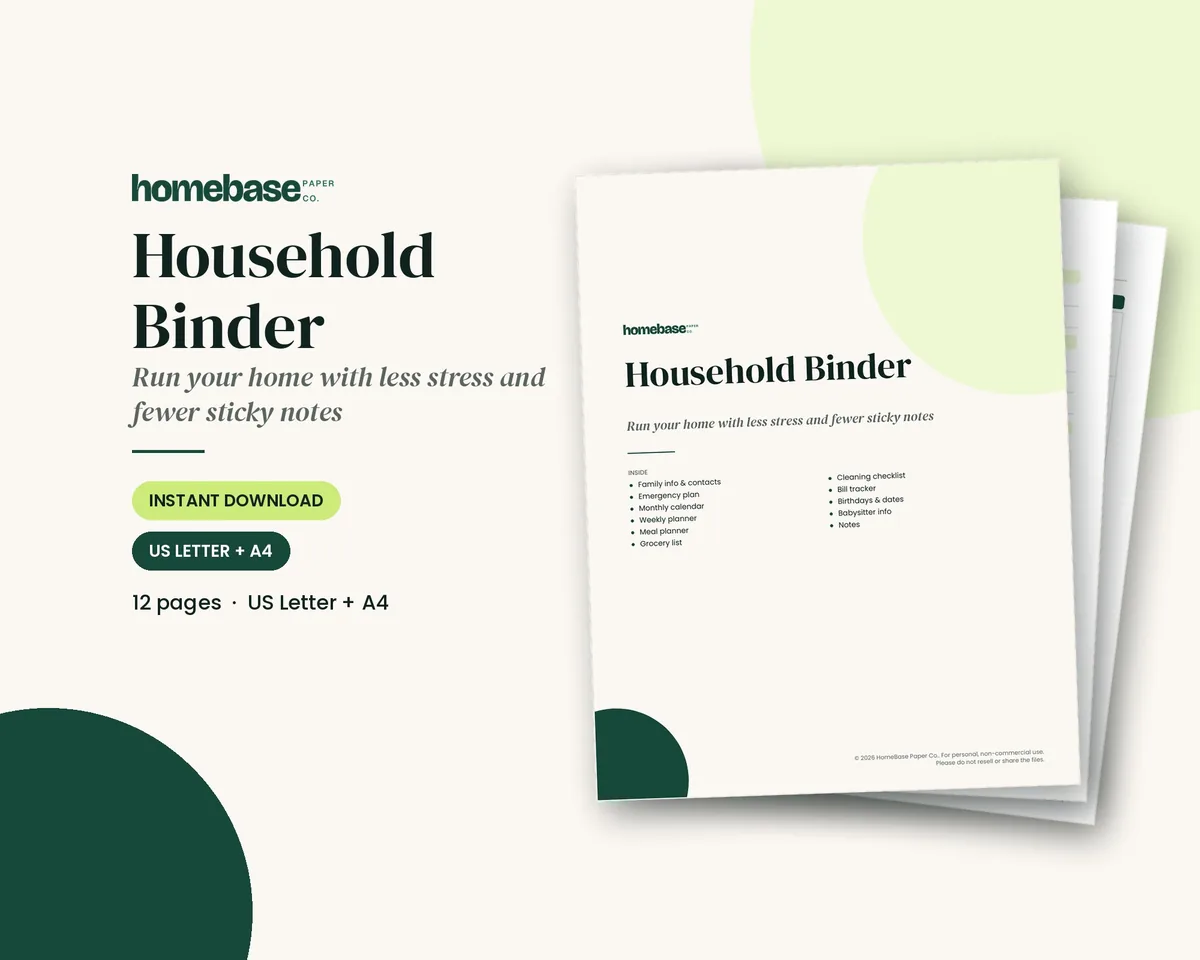
- Household Binder, $6.99: a 12-page printable with a weekly planner, monthly calendar, meal planner, grocery list, weekly cleaning page, bill tracker and family information pages.
Browse every printable planner on the Printables page, or see money-saving sets on the Bundles page. For more ways to get through a busy day, read our guide on how to be more productive.
Frequently asked questions
What is work-life balance? Work-life balance is a week with enough room for work, sleep, home tasks, people and rest, without one constantly crowding out the others. It is not an exact 50/50 split of hours. Most people judge it by whether the basics fit most weeks, not by any single perfect day.
How do you have work life balance? You get work-life balance by planning your week on paper before it fills up. Put sleep and work hours on the page first, set a hard stop time for work, batch chores into set slots, decide dinners before Monday and protect one personal block every day. Then review the week each Friday and change one thing.
What are examples of good work-life balance? Good work-life balance looks like a predictable stop time, 7 or more hours of sleep most nights and personal time that rarely gets canceled. Other examples are chores that fit in short planned slots, dinners decided ahead of time and weekends that are not only catch-up time for unfinished tasks.
Does work-life balance mean splitting time 50/50? No, work-life balance does not mean an equal split of hours. A full-time worker spends far more weekday hours working than relaxing, and that can still feel balanced. The better test is whether sleep, health, family and rest have a real place in your week most of the time.
How many hours of sleep do adults need? Adults ages 18 to 60 need 7 or more hours of sleep a day, according to the CDC. Adults 61 to 64 need 7 to 9 hours, and adults 65 and older need 7 to 8 hours. Writing a lights-out time and a wake time in your planner makes those hours easier to protect.
How many hours does the average full-time worker work? Full-time employed people in the US worked an average of 8.1 hours on the days they worked in 2025, according to the BLS American Time Use Survey. That was 8.5 hours on an average weekday and 5.5 hours on an average weekend day for those who worked.
What are the signs of poor work-life balance? The clearest signs of poor work-life balance are cut sleep, a work stop time that keeps moving later and personal plans that get canceled most weeks. Feeling tired after a full night's sleep, constant worry, tension and headaches can also be signs that stress is building and the week needs a change.
How can I improve work-life balance when I work from home? When you work from home, improve work-life balance by setting a start time, a stop time and a closing step for each day. Shut the laptop, write tomorrow's first task and keep work supplies in one spot. In 2025, 35% of employed people did some or all of their work at home on days they worked, per the BLS.
How do shift workers find work-life balance? Shift workers find work-life balance by planning the week around sleep instead of the clock. Write each shift, then the sleep window that follows it, then put chores and personal time on days off. NIOSH notes that night shifts and extended hours can interfere with sleep, so the sleep window comes first.
How do I stop thinking about work after hours? A shutdown list helps you stop thinking about work after hours. Before you stop for the day, write unanswered messages, tomorrow's top three tasks and anything you might forget. Once it is on paper, you can close the laptop knowing where to start tomorrow.
When should I talk to a professional about stress? Talk to your doctor or a licensed mental health professional if stress or anxiety won't go away or makes it hard to get through the day. NIMH says talk therapy and medication are the two main treatments for anxiety. If you are in crisis, call or text 988 to reach the 988 Suicide & Crisis Lifeline.
Is there a free printable for planning a balanced week? Yes, the free HomeBase schedule template is a five-page printable PDF we email to you. It includes a weekly time-block grid from 6 a.m. to 10 p.m., a work and shift schedule, a class schedule, a family schedule and a weekly task list. Sign up on its free download page to get it.
Which HomeBase planner helps most with work-life balance? The Household Binder ($6.99) is the best single HomeBase planner for work-life balance at home. It is a 12-page printable with a weekly planner, monthly calendar, meal planner, grocery list, weekly cleaning page and bill tracker, so the home side of your week lives on paper instead of in your head.
Newsletter
Get the HomeBase email
Fresh tips three times a week, Mon/Wed/Fri, with our deals and new products, from printables, spreadsheets and bundles to paperback planners and apparel, plus simple home, money and planning tips.